
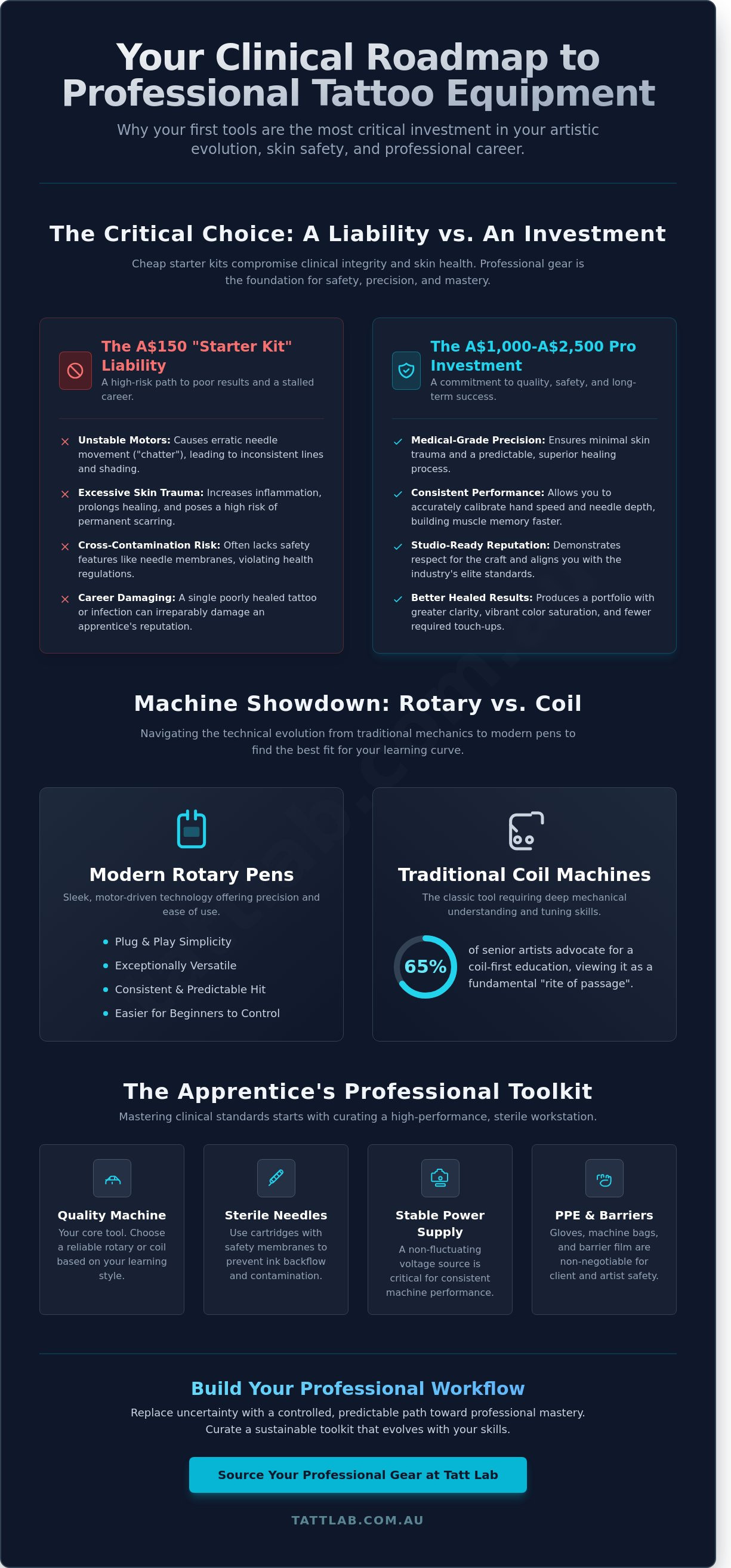
That A$150 all-in-one starter kit isn't a bargain; it's a liability that can compromise a client's skin health before your career even begins. We know the frustration of filtering through conflicting forum threads while trying to justify the high cost of professional gear against a limited apprentice budget. Selecting the right tattoo equipment for apprentices is the most critical decision in your artistic evolution, as it dictates how the skin recovers and how the ink fragments settle within the dermis. This guide serves as your clinical roadmap to the tools that define a professional Lab environment. We'll provide a vetted list of essential gear and explain the science of why quality machines produce superior healed results. By the end of this article, you'll have the technical knowledge to build a sterile, high-performance workstation that prioritises safety and precision. It's time to replace uncertainty with a controlled, predictable path toward professional mastery.
Key Takeaways
- Understand why medical-grade, vetted tools are the baseline for skin safety and why generic "starter kits" compromise your professional clinical integrity.
- Navigate the technical evolution from traditional coil mechanics to modern rotary pens to determine the best machine for your specific learning curve.
- Decode the science of needle groupings and membrane safety systems when selecting professional tattoo equipment for apprentices to ensure consistent artistic results.
- Master the clinical standards of station setup by integrating essential PPE and barrier protection to safeguard both your art and the client's skin health.
- Learn how to curate a sustainable professional workflow that evolves with your skills, supported by Australia’s specialist equipment partners at Tatt Lab.
The Professional Standard: Why Apprentice Equipment Matters
Professional tattoo equipment for apprentices represents more than just a toolkit; it's the clinical foundation of your future career. We define professional gear as medical-grade instruments that have undergone rigorous testing for biocompatibility and mechanical reliability. When you're working on a living canvas, skin integrity is the primary concern. High-quality machines and needles ensure that the dermis is treated with the precision it requires, facilitating a predictable healing process. This technical edge allows you to focus on your art rather than fighting against your tools.
The learning curve in tattooing is steep. Using professional-grade gear accelerates this process by providing consistent feedback. When your equipment behaves predictably, you can accurately calibrate your hand speed and needle depth. This consistency is what builds the muscle memory necessary for long-term success. It's the difference between guessing your results and engineering them.
The Risk of Substandard Gear
Substandard kits from generic online marketplaces present a significant danger to both the client and the apprentice's reputation. These kits often feature machines with unstable motors that cause needle chatter. This erratic movement leads to excessive skin trauma, increased inflammatory responses, and permanent scarring. In the Australian market, safety compliance is a non-negotiable standard. Using supplies that aren't vetted against local health regulations can lead to cross-contamination risks. A single poorly healed tattoo or a localized infection can stall a career before it begins. Understanding Tattoo machine history and types is essential for recognizing why professional rotary and coil machines are engineered for specific safety protocols that cheap clones ignore.
Investing in Your Future Career
Viewing your tattoo equipment for apprentices as a long-term investment changes your perspective on the initial A$1,000 to A$2,500 you might spend on a professional setup. It's a commitment to your craft and your future clients. Professional tools allow you to master technical nuances, such as voltage-to-hand-speed ratios, much faster than a fluctuating "starter kit" ever could. You'll find that your portfolio develops with greater clarity and fewer touch-ups required.
Most reputable studios in Australia consider the use of professional tattoo supplies the benchmark for anyone seeking a serious apprenticeship. It demonstrates a respect for the studio environment where science meets skin health. By choosing vetted tools from the start, you align yourself with the industry's elite, ensuring that your journey from apprentice to professional is built on a foundation of safety and precision. High-quality tattoo equipment for apprentices doesn't just make the work easier; it makes the results better, protecting the skin and your growing reputation simultaneously.
Choosing Your First Machine: Rotary vs. Coil for Apprentices
The transition from traditional coil machines to modern rotary pens represents a significant shift in the tattooing landscape. For decades, the rhythmic buzz of an electromagnetic coil was the only sound heard in a professional studio. Today, the market for tattoo equipment for apprentices is dominated by sleek, motor-driven technology that offers a different set of challenges and advantages. This evolution reflects a broader movement toward clinical precision and ergonomic safety, focusing on the long-term health of the artist as much as the quality of the ink.
As of 2023, approximately 65% of senior artists in traditional Australian studios still advocate for a coil-first education. They argue that learning to tune a machine is a fundamental rite of passage. It requires a deep understanding of voltage, spring tension, and the mechanical throw of the needle. This technical literacy ensures you aren't just an operator, but a specialist who understands the physics of how ink enters the dermis. Mastering a complex tool early on builds a foundation of respect for the craft's history and technical requirements.
Maintaining high standards of clinical integrity is a non-negotiable part of your journey. Familiarising yourself with Public Health Tattoo Regulations provides a necessary framework for these operational requirements. These guidelines ensure that regardless of the machine you choose, your workspace remains a safe, regulated environment that prioritises skin health and patient safety above all else.
The Case for Rotary Machines
Rotary machines like the EZ V-Select or Elite series have gained immense popularity for their "plug and play" simplicity. They don't require the complex tuning or constant spring replacements associated with coils, which allows you to focus entirely on your hand speed and artistic execution. These machines are exceptionally versatile, making them a preferred choice for fine-line work and soft shading. Because they use a consistent motor cycle, they offer a predictable hit that is easier for a beginner to control during long sessions.
Understanding Coil Machine Mechanics
A coil machine offers a level of tactile feedback that a rotary simply cannot replicate. The vibration and resistance tell you exactly how the needle is interacting with different skin types, which is invaluable for developing a natural sense of depth perception. Learning to adjust the contact screw and duty cycle creates a deeper connection to the tattooing process. This knowledge is essential for those who want to master traditional American or Japanese styles. Understanding these mechanics makes the eventual evolution of your craft much smoother as you transition between different tools and techniques.
Hand health is a critical consideration that is often overlooked in the early stages of a career. Traditional coil machines frequently weigh between 200 and 250 grams, which can contribute to repetitive strain injuries over time. In contrast, modern rotary pens average between 120 and 150 grams and produce roughly 30% less vibration. This reduction in physical stress allows for longer, more focused sessions without compromising the integrity of your steady hand. Choosing a machine that balances power with ergonomics is the first step toward a long and successful career in the industry.
The Needle & Cartridge Ecosystem: Understanding Liners and Shaders
The needle serves as the precise point of contact where art meets biology. For those beginning their journey, understanding this interface is vital for protecting skin health and ensuring consistent results. Selecting the right tattoo equipment for apprentices involves more than just picking a popular brand; it requires a clinical understanding of how needle geometry interacts with the dermis. Think of your setup as a portable lab where hygiene and precision are the only priorities. Every configuration you choose dictates the level of trauma the skin endures and the clarity of the final healed result.
Essential Needle Groupings for Beginners
Modern needle groupings are designed to perform specific tasks with mechanical efficiency. Beginners should focus on mastering three primary configurations before experimenting with more complex specialty pins.
- Round Liners (RL): These pins are soldered into a tight, circular point. They are the backbone of your first few months, used for creating crisp, defined outlines. Because the pins are clustered closely, they offer high resistance, requiring a steady hand and a deep understanding of skin tension.
- Round Shaders (RS) and Magnums (MG): Once you've mastered line work, you'll transition to filling. Round Shaders have more space between the needles, making them ideal for small areas of color or thick, bold lines. Magnums use two rows of needles to cover larger surface areas efficiently, reducing the time the skin is open and vulnerable.
- Curved Magnums: These are the secret to smooth, trauma-free gradients. The slight arc of the needle grouping matches the natural elasticity of the skin, allowing for softer edges and more consistent saturation without the risk of "chopping" the tissue.
The taper of the needle also changes how ink is deposited. A long taper enters the skin easily but carries less pigment, making it perfect for soft black and grey work. Short tapers create a larger puncture, allowing for faster solid color saturation. You must also watch for manufacturing defects. Cheaply made needles often have microscopic "hooks" at the tip. These defects act like barbs, tearing the skin as the needle retracts, which complicates the healing process and leads to excessive scarring.
Cartridge Safety and Compatibility
The shift from traditional needles to cartridges has revolutionized safety in the studio. A high-quality cartridge uses an internal membrane system to create a physical seal. This barrier prevents ink, blood, and interstitial fluid from flowing back into the machine's grip or motor. This prevents cross-contamination and protects the longevity of your tattoo equipment for apprentices. Lower-quality cartridges often use simple rubber bands, which lack a true seal and can fail during long sessions.
Most modern systems utilize a universal fit, meaning you can swap between different brands of cartridges without changing your machine. However, the internal tension and stability of the needle bar vary significantly between manufacturers. Choosing a stable, membrane-backed system ensures that your needle tracks true without lateral wobble. The precision of the internal mechanism defines why cartridge quality is the most critical factor in tattoo cartridges selection, as it safeguards the machine from contamination while ensuring the needle tracks true.
Clinical Integrity: Essential Medical Supplies and PPE
Think of your tattoo station not as an art desk, but as a clinical field. Every procedure you perform is a deliberate skin transformation that requires the same level of rigor found in a medical laboratory. In Australia, skin penetration regulations are strict for a reason. Maintaining clinical integrity isn't about ticking boxes; it's about protecting the biological health of your client. When you source tattoo equipment for apprentices, your first priority must be the safety of the environment you create.
Medical-grade isn't a buzzword. It's a legal and ethical requirement that ensures your supplies are free from contaminants and capable of withstanding the demands of a professional session. Cross-contamination is the primary risk in any studio. If you touch a contaminated surface and then touch your machine, the chain of sterility breaks. Keeping your station sterile requires a disciplined routine and a refusal to cut corners on consumables.
The PPE Checklist for Every Tattoo
- Nitrile gloves: Avoid latex due to common allergies. High-quality nitrile gloves provide the puncture resistance and tactile sensitivity needed for precise work. Look for textured fingertips to maintain a steady grip on your machine.
- Barrier protection: You must wrap everything. This includes your power supply, clip cords, and even your workstation furniture. If a surface can't be autoclaved, it must be covered.
- Surface sanitisers: Use hospital-grade disinfectants that are TGA-approved for use in Australia. These are designed to kill bloodborne pathogens in seconds.
The role of medical supplies for tattoo artists is to create a fail-safe between the practitioner and the patient. This prevents the transmission of pathogens like Hepatitis C or staph, ensuring the journey toward new ink remains safe and professional.
Skin Preparation and Aftercare
Prepping the canvas is a scientific process. You start with green soap or medical-grade skin cleansers to remove surface oils and bacteria. This isn't just for hygiene; it ensures your stencil bonds correctly to the skin. If the skin isn't prepped, the transfer gel won't hold, and your precision will suffer as the design fades during the session. A clean, stable surface is the foundation of any successful application.
The process continues long after the needle stops moving. The importance of high-quality tattoo aftercare cannot be overstated. You're responsible for educating your client on how to manage their skin's healing response. Proper aftercare preserves the clarity of your work and prevents the inflammatory complications that lead to ink fallout or scarring. Selecting the right tattoo equipment for apprentices means choosing products that support the skin's natural recovery from start to finish.
Elevate your professional standards by sourcing your clinical studio essentials from specialists who value skin health.
Curating Your Station: Building a Sustainable Kit with Tatt Lab
Moving beyond the initial purchase phase marks a pivotal shift in your career. You aren't just buying gear; you're engineering a professional environment. At Tatt Lab, we view the selection of tattoo equipment for apprentices as a foundational exercise in skin integrity and technical precision. We only stock products that our own resident artists use daily. This ensures every needle, power box, and pigment meets a clinical standard of excellence before it ever reaches your station.
Our philosophy centers on the idea that your kit should evolve alongside your technical skills. A curated workflow reduces the cognitive load during a session, allowing you to focus on the needle depth and saturation rather than struggling with inconsistent tools. By choosing artist-vetted supplies, you bypass the trial-and-error phase that often leads to wasted capital and compromised skin health.
Essential Consumables vs. Long-term Equipment
Managing your overheads requires a dual-track approach to procurement. Your monthly supply runs focus on the "disposable workflow," involving high-quality cartridges and medical-grade barriers. Investing in comprehensive tattoo ink sets allows you to build a versatile palette from day one. This ensures color consistency as your portfolio expands, providing a predictable result for every client.
Beyond the skin, consider your physical longevity. Furniture and lighting are long-term investments in your ergonomics. Poor lighting leads to eye strain, while an unsupportive stool can cause chronic back issues within your first two years. High-CRI lighting and adjustable stools aren't luxuries; they are essential components of a sustainable practice that protects your body during long sessions.
The Tatt Lab Advantage for Apprentices
We understand that the transition from apprentice to professional artist involves navigating complex overheads and high expectations. Tatt Lab serves as a dedicated partner in this evolution. With nationwide express shipping across Australia, we ensure your tattoo equipment for apprentices arrives before your next scheduled skin day. This reliability is vital for maintaining a professional reputation with your studio and your clients.
Our wholesale support structure is designed specifically to help emerging artists manage their initial investment without compromising on safety or quality. This methodical approach to supply management reduces anxiety, replacing uncertainty with a sense of controlled, predictable progress. We treat your station like a laboratory where science meets art. Explore our curated selection of professional tattoo equipment to begin refining your professional setup today.
Setting the Foundation for Your Professional Evolution
The transition from a student to a professional artist begins with the tools you hold. Selecting high-quality tattoo equipment for apprentices isn't merely a purchase; it's a commitment to skin health and technical precision. By prioritizing medical-grade safety standards and understanding the mechanics of your machine, you ensure that every procedure supports the body's natural healing process. This methodical approach to your station mirrors the precision required for long-term skin integrity. Guidelines from the Australian Department of Health emphasize that strict adherence to sterile protocols is the only way to protect both artist and client, making your choice of clinical-grade PPE a fundamental part of your kit.
Tatt Lab provides the foundation for this professional journey. As an artist-owned and operated specialist, we understand the unique demands of the Australian tattoo landscape. We bridge the gap between technical expertise and creative growth, offering supplies that meet rigorous clinical benchmarks. With express nationwide shipping across Australia, your career progression remains uninterrupted and supported by experts who value the art of the craft as much as the science of the skin.
Build your professional apprentice kit at Tatt Lab today
Your path toward becoming a master artist is a deliberate evolution. Trust your technical knowledge, respect the biological process, and let your equipment be the silent partner in your creative success.
Frequently Asked Questions
Is it better for an apprentice to start with a rotary or a coil machine?
Most modern apprentices start with a rotary machine because of its versatility and lower maintenance requirements. While coil machines offer a traditional "hit" that some mentors prefer for lining, roughly 70% of new artists now opt for rotary pens. These machines handle both lining and shading with simple voltage adjustments, which allows you to focus on mastering needle depth and hand speed without the technical distraction of tuning springs.
What are the most essential needle sizes for a beginner tattoo artist?
A beginner's toolkit should prioritize 3RL, 7RL, 9RS, and 11CM (Curved Magnum) needles. These specific sizes cover approximately 90% of the foundational work required during an apprenticeship, from fine detail to solid color packing. Using high-quality tattoo equipment for apprentices ensures these needles are sharp and consistent, which protects the skin's integrity and facilitates a predictable healing process for your client.
Can I use a cheap tattoo kit from Amazon if I change the needles?
No, you shouldn't use cheap kits from mass-market retailers even if you replace the needles with professional ones. These machines often lack consistent voltage regulation, which causes erratic needle movement and unnecessary skin trauma. Research from the Australian Department of Health highlights that non-compliant equipment frequently fails to meet sterilization standards. Investing in professional gear prevents the risk of cross-contamination and ensures your work remains precise.
How much should an apprentice expect to spend on their first professional setup?
An apprentice should expect to invest between A$1,200 and A$2,500 for a complete professional setup in the Australian market. This budget covers a mid-range rotary machine at approximately A$600, a reliable power supply for A$300, and a bulk start-up of medical-grade consumables. While it's a significant upfront cost, high-quality tattoo equipment for apprentices provides the technical reliability needed to build a professional portfolio without the risk of equipment failure.
What medical supplies are legally required for a tattoo studio in Australia?
Australian regulations, specifically the Public Health Act 2010 and local council guidelines, require studios to stock TGA-approved disinfectants and clinical waste containers. You must have a sharps container, hospital-grade surface wipes like Isowipe, and sterile barrier film for all touchpoints. Maintaining these standards is a clinical necessity that ensures every procedure is conducted within a controlled, hygienic environment, prioritizing long-term skin health and safety.
Why is nitrile preferred over latex for tattoo gloves?
Nitrile is the industry standard because it's three times more puncture-resistant than latex and eliminates the risk of allergic reactions for both the artist and the client. In a clinical setting, nitrile gloves provide a superior barrier against bloodborne pathogens and don't degrade when they come into contact with petroleum-based ointments. This material choice reflects a commitment to safety, ensuring your grip remains steady throughout the entire transformation process.
How do I know if a tattoo cartridge is compatible with my machine?
Most modern machines use the "universal twist-lock" system, making them compatible with major brands like Cheyenne, Kwadron, and Bishop. You can verify compatibility by checking if the cartridge has the standard notched back-stem that fits into a rotary pen or specialized grip. Always ensure the cartridge has an internal safety membrane; this prevents backflow of ink and biological fluids into the machine, which is a critical step in preventing cross-contamination.
What is the difference between a liner and a shader needle?
A liner needle features a tight grouping of pins designed to create crisp, defined boundaries, while a shader has a looser or flat configuration for blending and packing color. Liners typically use a "round" configuration (RL), whereas shaders come in "magnum" (M1) or "round shader" (RS) formats. Choosing the correct configuration allows for efficient pigment implantation with minimal passes, which reduces the inflammatory response and promotes faster skin recovery.


Comments (0)
There are no comments for this article. Be the first one to leave a message!