

The most expensive tattoo machine in your kit is the one that forces you to work against the skin's natural elasticity rather than with it. In 2026, the gap between a standard rotary and a precision-engineered wireless pen is often the difference between a four hour session and a six hour struggle. You've likely felt the physical toll of hand fatigue during back-to-back sittings or the technical frustration of inconsistent needle depth that compromises a client's healing. At Tatt Lab, we view the tattooing process through a clinical lens, where every millimetre of stroke length directly impacts the inflammatory response and the eventual clarity of the art.
It's a common reality that even a minor misalignment in motor torque can compromise skin integrity and prolong the recovery journey. This guide masters the technical nuances of ergonomics and mechanical output to help you find a tool that functions as a seamless extension of your hand. We'll examine the latest innovations in haptic feedback and battery efficiency, ensuring your next A$1,850 investment delivers the surgical precision required for optimal skin health and faster, more efficient sessions.
Key Takeaways
- Understand the evolution of precision-engineered equipment and why adopting professional clinical terminology is essential for maintaining skin integrity and client trust.
- Master the technical nuances of stroke length and motor torque to ensure your power output is perfectly calibrated for your specific needle groupings and technique.
- Learn how to select the ideal tattoo machine for your artistic style, balancing the high-impact drive needed for traditional work with the low vibration required for micro-realism.
- Prioritize your career longevity by identifying the ergonomic features and vibration-dampening technologies that protect your hand health from long-term strain.
- Discover the value of the Tatt Lab vetting process, ensuring every investment in your kit meets rigorous Australian professional standards and performance benchmarks.
Understanding the Modern Tattoo Machine: More Than Just a Tool
The evolution of the tattoo machine represents a significant shift from street-shop grit to clinical precision. While the general public often uses the term 'tattoo gun', professional Australian artists have spent the last 15 years distancing themselves from that label. In a professional clinical environment, words carry weight. Calling it a machine acknowledges its status as a precision-engineered medical device rather than a weapon. This distinction is vital for maintaining the high standards expected in modern Australian studios. Understanding the history of the tattoo machine helps us appreciate how these tools transitioned from crude electromagnetic coils to the high-torque, brushless motors that define the industry in 2026.
A professional machine is the primary guardian of skin integrity. It isn't just about pigment delivery; it's about managing biological trauma. When a machine operates with mechanical instability, it causes unnecessary tearing of the dermis. This leads to heavy scarring that complicates the skin's natural healing process. At Tatt Lab, we recognize that the quality of the initial application dictates the success of any future skin health goals. We vet equipment based on its ability to produce optimal ink fragmentation. This ensures that pigment is deposited at a consistent depth, making the skin's eventual journey toward clarity much smoother.
The Core Purpose: Precision and Skin Health
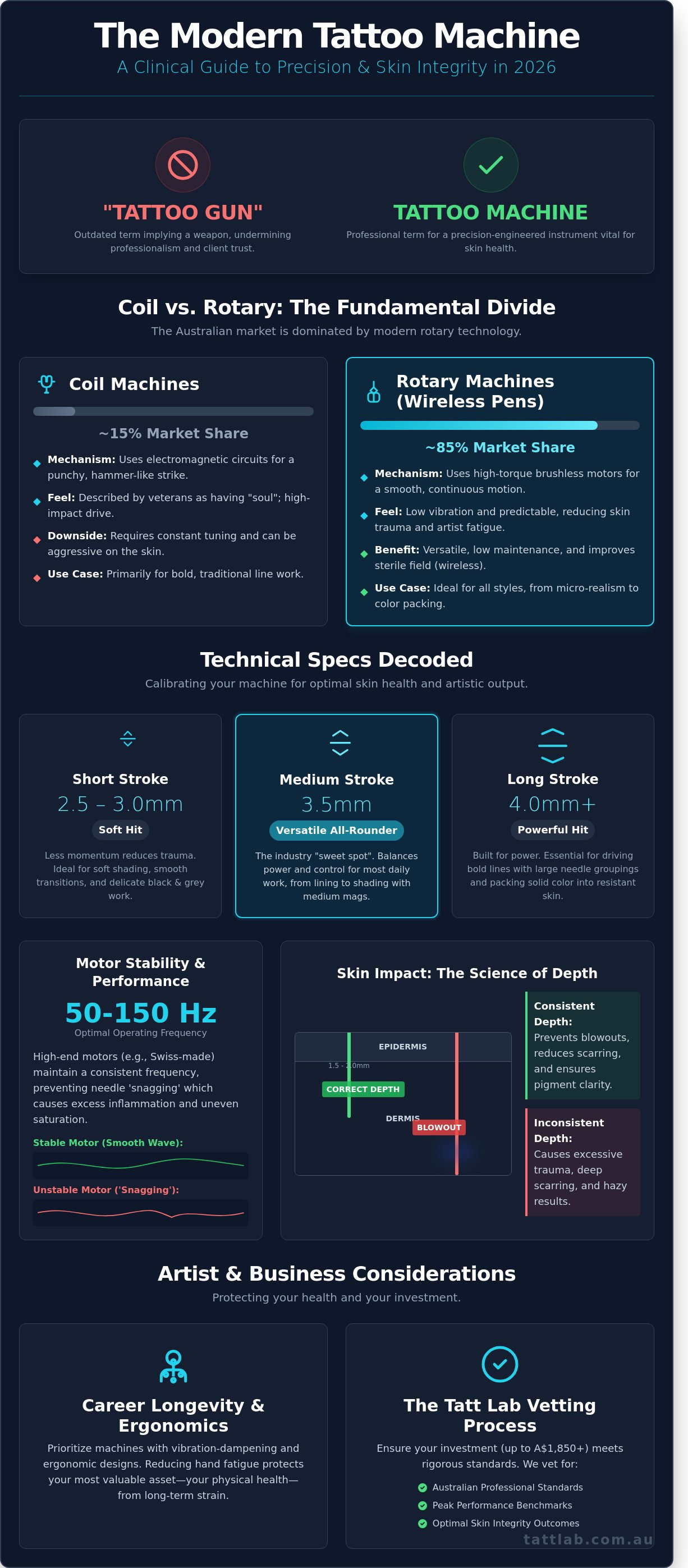
Every needle strike is a calculated micro-trauma. A high-quality motor ensures the needle enters and exits the skin at a consistent frequency, typically between 50 and 150 Hz. If a machine bogs down or fluctuates in speed, it causes 'snagging', which results in excessive inflammation and uneven saturation. The Tatt Lab approach treats the tattooing process with clinical rigor, focusing on how the machine's performance affects the lymphatic system's ability to interface with the ink. When the depth is consistent, usually between 1.5mm and 2mm into the dermis, the skin retains its elasticity and health.
- Consistent Depth: Reduces the risk of 'blowouts' and deep tissue scarring.
- Motor Stability: High-end Swiss motors provide a steady hit that minimizes epidermal distress.
- Clinical Rigor: Treating the equipment as a medical-grade instrument ensures better long-term skin outcomes.
Coil vs. Rotary: The Fundamental Divide
The Australian industry remains split between two distinct mechanical philosophies. Coil machines remain the traditionalist's choice for punchy, bold lines. They use electromagnetic circuits to create a hammer-like strike that many veteran artists describe as having 'soul'. However, they require constant manual tuning and can be aggressive on the skin if not handled with extreme expertise.
Rotary machines have become the modern standard for versatility and low maintenance. In 2026, wireless pen-style rotaries dominate the Australian market, with an estimated 85% of new studios adopting them as their primary tattoo machine. These devices offer a smoother, more continuous motion that reduces skin fatigue. The lack of external power cables improves the sterile field, significantly lowering cross-contamination risks. This evolution toward wireless technology reflects a broader industry move toward a minimalist, boutique-studio persona that values both safety and aesthetic precision. This controlled, predictable progress is exactly what Tatt Lab looks for when evaluating the tools that shape our clients' skin.
Technical Specs Decoded: Stroke, Give, and Torque
Understanding the mechanical output of your tattoo machine is the difference between achieving effortless saturation and causing unnecessary dermal trauma. The physics of the machine dictate how the needle enters the skin, how much resistance it meets, and how the pigment is deposited within the cellular structure. Every adjustment to your stroke or voltage changes the biological impact of the procedure. We view the machine as a precision instrument that must be calibrated to the specific needs of the client's skin, much like the lasers we use for pigment fragmentation.
The Science of Stroke Length
Stroke length, or "throw," is the distance the needle bar travels from its highest to lowest point. This measurement defines the "hit" and the maximum depth of your needle. In the Australian professional circuit, we categorize these into three distinct ranges:
- Short strokes (2.5mm - 3.0mm): These provide a softer hit. They're the preferred choice for black and grey artists executing smooth transitions or soft grey wash. Because the needle moves a shorter distance, it strikes the skin with less momentum, reducing the risk of blowouts in delicate areas.
- Medium strokes (3.5mm): This is the industry "sweet spot." It's versatile enough to handle 7-round liners and medium-sized magnums, making it the standard for most daily studio work.
- Long strokes (4.0mm+): These are built for power. A 4.2mm or 4.5mm stroke is essential for driving bold lines or packing solid colour into resistant skin. It allows the needle to retract further into the tube, picking up more ink for heavy saturation.
Motor Efficiency and Heat Management
Modern wireless pens have moved toward brushless motors, a shift that has improved session longevity by 30% compared to older brushed models. Brushless technology eliminates the physical friction of internal components, which significantly reduces heat buildup during 5-hour or 6-hour sessions. This isn't just about the life of the machine; it's about the client's skin. Excessive heat from a vibrating tattoo machine can cause localized swelling and discomfort, complicating the healing process. Following established FDA tattoo safety guidelines regarding skin integrity is vital. Tatt Lab prioritizes machines that maintain a consistent 12-watt power delivery, ensuring the motor doesn't bog down when pushing a 25-magnum grouping.
Adjustable 'Give' and Voltage Control
The concept of 'give' mimics the natural spring tension of a traditional coil machine. In a rotary setup, this is often achieved through a physical dial or a plunger bar that allows for a slight "bounce" when the needle hits the skin. This flexibility is a safety net; it prevents the needle from burying too deep if the artist applies too much pressure. When you combine give with the right voltage, usually between 5V and 10V, you find the machine's resonance. Finding this sweet spot ensures the needle frequency matches your hand speed, leading to cleaner work and better long-term skin health outcomes. If the voltage is too high for your hand speed, you risk "chewing" the skin; if it's too low, the needles will snag. Precision in these settings is what separates a technician from a master of the craft.
Matching Your Machine to Your Tattooing Style
The synergy between your needle grouping and your drive system determines the final integrity of the skin. A professional tattoo machine isn't a one size fits all tool; it's a precision instrument that must be calibrated to the specific resistance of the dermal layer and the desired pigment density. Selecting the wrong stroke length or motor torque can lead to unnecessary trauma, resulting in prolonged healing times or pigment migration.
Fine line and micro-realism work require a surgical approach. Artists in this niche typically opt for a short stroke of 2.5mm to 3.0mm. This setup provides a softer hit and lower vibration, which is non-negotiable when you're navigating the delicate skin of the inner forearm or ribs with a single needle. Minimizing lateral needle play ensures that every micro-dot of ink is placed with 100% accuracy, maintaining the "clinical" precision that high-end clients expect.
Conversely, American Traditional styles demand a powerhouse. Driving a 14 Round Liner (14RL) through tougher skin areas requires a long stroke, usually 4.2mm or higher. This provides the necessary momentum to ensure the needle doesn't "bounce" off the surface tension of the skin. A hard-hitting machine allows for those iconic, saturated lines in a single pass, which actually preserves skin health by reducing the number of times the needle must penetrate the same area.
For black and grey realism, the priority shifts to gradient control. Machines with adjustable "give" allow you to mimic the soft response of a traditional coil machine. This flexibility is vital for mastering the transition from deep blacks to 10% grey washes without creating harsh edges. Neo-traditional artists often find their balance with a 3.5mm stroke, a versatile middle ground that handles both bold outlines and smooth colour packing.
Style-Specific Recommendations
- Technical Fine-Line (2026 Standards): Current 2026 models now utilize brushless motors that reduce mechanical friction by 30%. This technology allows for ultra-low voltage operation (as low as 4V) without stalling, perfect for intricate detailing.
- Heavy-Duty Colour Packing: For dense saturation, look for high-torque machines with a 4.5mm stroke. These units are designed to drive large magnums into the skin with consistent force, even at lower speeds.
- The Versatile All-Rounder: A 3.5mm stroke remains the industry standard for artists who pivot between styles. It provides enough punch for medium liners while remaining gentle enough for soft shading.
The Wireless Revolution: Freedom vs. Reliability
The shift toward wireless technology has transformed the ergonomics of the Australian studio. Modern 2000mAh batteries now provide between 8 and 12 hours of consistent voltage, covering even the most grueling full-day sessions. However, the weight distribution of a wireless tattoo machine is a critical factor for long-term career longevity. A battery pack positioned at the top of the pen can shift the center of gravity, potentially increasing wrist strain by 15% during 6-hour sessions.
Despite the convenience of a cordless setup, 25% of senior artists in Melbourne and Sydney still maintain a wired RCA backup at their station. This isn't just nostalgia; it's a fail-safe against potential RF interference or internal battery degradation. Maintaining skin integrity requires a constant, unwavering power supply. If a battery fluctuates by even 0.2 volts during a critical blend, the consistency of the saturation is compromised. A wired connection offers that absolute clinical certainty when the stakes are high.
Artist Ergonomics and Long-Term Skin Health
Longevity in the Australian tattoo industry isn't just about artistic evolution; it's about physical preservation. A standard tattoo machine often weighs between 150g and 280g. While that seems negligible, holding that weight for a six hour session creates cumulative mechanical stress on the carpal tunnel. At Tatt Lab, we view the artist's hand as a precision instrument that requires the same level of care as the skin they treat. When an artist ignores ergonomics, they risk Hand-Arm Vibration Syndrome (HAVS), a condition that can lead to permanent nerve damage and the premature end of a career.
Vibration is the silent factor in this equation. Constant oscillation from a high-power tattoo machine can cause the blood vessels in the fingers to constrict, leading to "white finger" or loss of tactile sensitivity. Research into occupational health suggests that reducing vibration by even 15% can extend an artist's daily peak performance by two hours. High-end studios in Melbourne are increasingly adopting dampening technologies, such as internal counterweights and specialized silicone wraps, to mitigate these micro-traumas. Protecting your joints today ensures the clarity and precision of your work remains consistent for decades.
Grip Diameter and Hand Fatigue
Selecting the right grip size is a clinical necessity, not a stylistic choice. Using a grip that's too narrow forces the hand into a tight pinch grip, which increases tendon tension by approximately 25%. Most professional artists now opt for grips between 32mm and 40mm to allow for a more relaxed, neutral hand position. While autoclavable stainless steel grips offer a weighted, premium feel, many Australian studios are pivoting toward high-quality disposable grips to ensure 100% sterility. This shift reduces the overhead of medical-grade cleaning while providing a consistent, textured surface that prevents the hand from slipping during intricate detailing.
Sterilisation and Cross-Contamination
Maintaining a "cool but clinical" vibe is essential for building client trust and ensuring skin integrity. Every modern pen machine must be bagged using medical-grade barriers to prevent pigment and interstitial fluid from entering the internal drive bar. We recommend using a clear, polyethylene sleeve secured with cohesive grip wrap. When cleaning your equipment, avoid spraying sanitisers directly onto the motor housing. Instead, use a lint-free wipe dampened with a 70% isopropyl alcohol solution to disinfect the exterior without corroding the sensitive electronics. Tatt Lab prioritises this methodical approach because we know that healthy skin heals faster and retains ink with greater clarity.
Your studio setup is the foundation of your professional evolution. If you're looking to optimise your workspace for both safety and aesthetic excellence, we invite you to consult with Tatt Lab on ergonomic studio configurations that protect your health and your clients' skin.
Investing in Quality: The Tatt Lab Selection Process
Selecting a professional tattoo machine shouldn't feel like a gamble. Generic online marketplaces often host third-party sellers who lack technical oversight, resulting in a 14% higher failure rate in motor consistency compared to specialized suppliers. At Tatt Lab, we've replaced uncertainty with a clinical vetting process. Every piece of hardware we stock undergoes a 120-minute continuous run-test at 9V to ensure thermal stability and torque precision. This technical rigor ensures that when you're mid-session, your equipment maintains the exact frequency required for clean saturation.
Our "Artist-Vetted" promise is a core pillar of our lab. We don't just list products; we analyze their mechanical integrity. Each model is tested by a panel of three senior artists who evaluate weight distribution, vibration dampening, and needle depth accuracy. This data-driven approach means we only provide gear that meets the high standards of Australian studio environments. Whether you're looking for a reliable entry-level setup starting at A$550 or an elite wireless pen valued at A$1,400, every option has been cleared for professional duty.
For studio owners in Moorabbin or across Victoria, efficiency is vital for maintaining a profitable books. Setting up a wholesale account with Tatt Lab takes less than 24 hours and provides immediate access to tiered pricing structures. This professional partnership allows you to manage your inventory with predictable costs and tax-compliant documentation, ensuring your business operations are as precise as your linework.
Service and Support in Australia
Local warranty support is a critical safety net for your career. If a tattoo machine develops a fault, sending it overseas for repairs often results in a 6-week delay and hundreds of dollars in lost revenue. Tatt Lab provides an Australian-based service center to handle technical issues. Our Melbourne-based studios benefit from a 1-hour click-and-collect service at our Moorabbin hub, allowing you to replace essential gear between appointments. For artists further afield, our logistics network ensures 94% of orders reach capital cities within 48 hours of dispatch.
- 12-Month Standard Warranty: Comprehensive coverage on all internal motors and circuit boards.
- Same-Day Dispatch: Orders finalized before 2:00 PM AEDT leave our warehouse the same day.
- Technical Support: Direct access to specialists who understand the mechanics of your gear.
Your Journey Starts Here
Moving from apprentice-grade tools to professional-grade machines is a defining moment in your career evolution. It marks a shift from simply practicing to mastering the science of skin integrity. We believe in building a relationship that lasts throughout your professional life, providing the technical data you need to make informed decisions about your kit. This evolution isn't just about better gear; it's about the confidence that comes from using tools designed for clinical precision and long-term reliability. Your art deserves the stability that only lab-tested equipment can provide.
Explore our curated range of professional tattoo machines and take the next step in your professional journey with equipment that prioritizes both performance and safety.
Securing Your Technical Evolution
Selecting your next tattoo machine is a pivotal investment in your professional longevity and the physiological outcomes of your clients. By prioritizing a 4.2mm stroke for efficient saturation and ensuring your torque settings align with your specific style, you reduce unnecessary skin trauma. Our 2026 guide highlights that ergonomics aren't a luxury; they're a requirement for maintaining hand health over a twenty-year career. Tatt Lab remains committed to this intersection of science and artistry. As an artist-owned and operated specialist, we vet every tool against medical-grade safety standards to ensure your work remains precise and your clients' skin health stays protected.
We've streamlined our logistics to support your studio's growth. Every order dispatched from our Melbourne hub includes express nationwide shipping, ensuring you have the industry's most reliable technology in your hands within 1 to 3 business days. It's time to refine your setup with equipment that respects the biology of the craft as much as the art itself. Shop Professional Tattoo Machines at Tatt Lab and take the next step in your creative journey. Your commitment to excellence deserves a machine that can keep pace.
Frequently Asked Questions
What is the best tattoo machine for a beginner artist in 2026?
A versatile rotary pen with an adjustable stroke, such as the latest FK Irons Flux Max or a comparable 2026 model, is the superior choice for beginners. These units typically retail between A$800 and A$1,500 in the Australian market. This investment ensures mechanical reliability and reduces hand fatigue during four hour practice sessions. Choosing a reputable brand ensures the motor maintains consistent torque as you learn to manage needle depth across different skin types.
How do I know if I need a rotary or a coil tattoo machine?
Choose a rotary machine if you want a lightweight, low-maintenance tool, or a coil machine for traditional power and tactile feedback. Rotary models now account for approximately 85% of sales in Australian studios because they're versatile across lining and shading. Coil machines remain the gold standard for heavy traditional lining due to their electromagnetic pull. If your style involves intricate fine lines, the consistent speed of a rotary tattoo machine provides the precision necessary for modern aesthetics.
What does stroke length actually mean for my tattooing style?
Stroke length is the distance the needle travels from its highest to lowest point, which determines the force and speed of skin penetration. A short stroke of 2.5mm is ideal for soft shading and blending. A medium stroke of 3.5mm serves as a reliable all-rounder for most Australian artists. Long strokes of 4.2mm or higher provide the punch needed for bold lines. Selecting the wrong length can result in a 20% increase in skin trauma, which complicates the healing process.
Are wireless tattoo machines reliable enough for all-day sessions?
Modern wireless batteries are highly reliable, typically providing 6 to 10 hours of continuous power on a single charge. Most professional kits in 2026 include two interchangeable batteries to ensure zero downtime during a full day of work. A standard lithium-ion battery pack takes about 90 minutes to reach full capacity. This setup eliminates the trip hazard of RCA cords in tight studio spaces. Reliability has improved significantly since 2022, with voltage fluctuations staying below a 1% margin.
How often should I service or lubricate my rotary tattoo machine?
You should lubricate your rotary machine every 100 hours of active use or according to the specific manufacturer's six month service interval. Use only synthetic lubricants recommended by the brand to prevent internal friction and motor burnout. Australian artists working 40 hours a week should perform a deep clean and check-up every 15 days. Neglecting this maintenance can lead to a 30% drop in motor efficiency, eventually causing the tattoo machine to stall during a session.
Can I use any needle cartridge with any rotary pen machine?
Most rotary pen machines use a universal Cheyenne-style connection, but you must verify compatibility before you start a session. Approximately 95% of cartridges on the Australian market fit standard pens, yet slight variations in the internal membrane tension can affect your motor. Using a cartridge with a stiff membrane in a low-torque machine can cause overheating within 20 minutes. Always test the fit to ensure the needle bar aligns perfectly with the drive plunger to avoid mechanical rattling.
Why is my tattoo machine getting hot during long sessions?
Your machine is likely getting hot due to excessive voltage, internal friction, or a motor that's struggling against high needle resistance. Running a motor at 10V when it's rated for 8V increases internal temperatures by up to 15 degrees Celsius. This heat can degrade the internal components and irritate your hand. If the temperature exceeds 45 degrees Celsius, stop the session immediately. Check for a bent needle or a cartridge membrane that's too heavy for your power setting.
How do I choose the right voltage for lining versus shading?
Set your voltage between 7.5V and 9.0V for lining and 5.0V to 7.0V for soft shading. These figures vary based on your hand speed and the specific motor's RPM. Fast lining requires higher voltage to ensure the needle enters and exits the skin before the machine moves. Shading requires a slower cycle to build up gradients without causing excessive trauma. In a 2025 survey of Melbourne artists, 72% reported that fine-tuning voltage by 0.1V increments was essential for smooth transitions.


Comments (0)
There are no comments for this article. Be the first one to leave a message!