

The difference between a muddy transition and a seamless gradient isn't just in your wrist; it's in the physics of the needle's tip. While many artists focus on ink brands or machine voltage, the actual architecture of your long taper tattoo cartridges dictates how the skin receives every single puncture. A long taper acts as a precision scalpel, offering a narrower point of entry that minimizes resistance and preserves the integrity of the dermal layer.
You've likely experienced the frustration of inconsistent ink flow during a long session or the disappointment of seeing excessive trauma hinder a client's healing process. It's a common challenge when trying to master soft pepper shading or delicate fine lines. This guide provides the technical clarity you need to stabilize your workflow. You'll learn how to leverage the specific geometry of long tapers to achieve predictable ink saturation and smoother black and grey transitions across diverse skin types. We will explore the science of skin resistance, the impact of modern safety standards like ISO 13485, and the specific techniques that turn these cartridges into your most reliable studio tools.
Key Takeaways
- Gain a technical understanding of needle geometry to see how an elongated slant minimizes dermal resistance during the procedure.
- Master the use of long taper tattoo cartridges to achieve superior saturation with a significantly reduced inflammatory response.
- Learn to select specific configurations for your goals, whether creating crisp fine lines or seamless black and grey gradients.
- Understand the interplay between needle gauge and taper length to ensure predictable results across different skin textures.
- Identify the professional benchmarks for needle stability and housing precision required for complex, long-form sessions.
Understanding Long Taper Tattoo Cartridges: Why Precision Matters
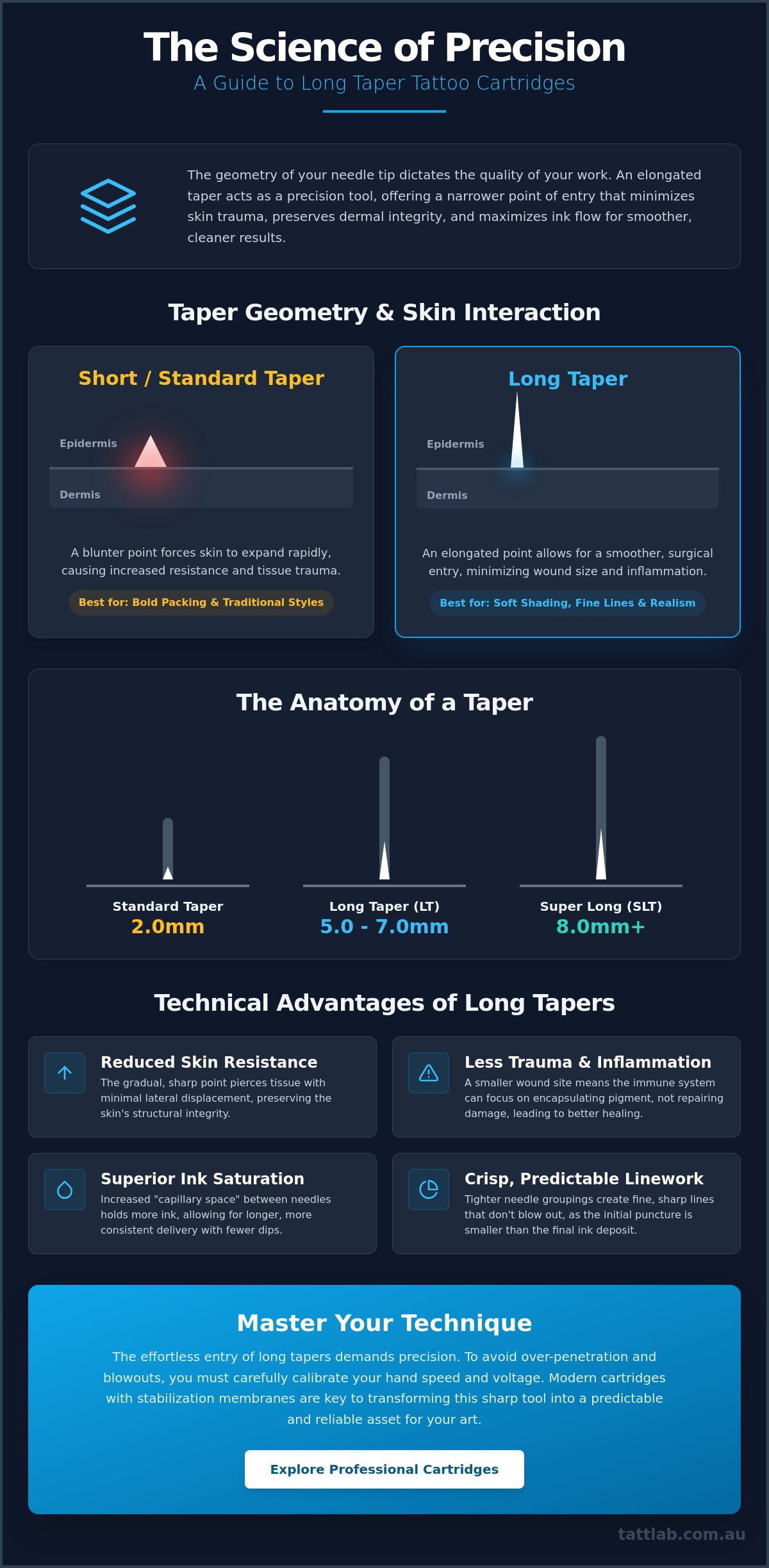
Taper length is the critical variable that determines how a needle interacts with the skin's surface. In the context of long taper tattoo cartridges, this measurement refers to the distance from the needle's sharpest point to the location where it reaches its maximum shaft diameter. While a standard taper typically measures around 2.0mm, a long taper extends this distance to 5.0mm or even 7.0mm. This elongated geometry creates a more gradual slant. It's a deliberate design choice that fundamentally alters the physics of every stroke.
The primary benefit of this design is a significant reduction in skin resistance. When a needle enters the dermis, it must displace tissue to create space for the pigment. A shorter, blunter taper forces the skin to expand rapidly, which can lead to increased trauma and inflammation. In contrast, the elongated point of a long taper allows for a smoother, more surgical entry. This precision is essential when working with modern Tattoo machine technology, as it allows the artist to maintain consistent depth without needing to increase the machine's "hit" or force.
Needle groupings also benefit from this elongated structure. Because the needles in a grouping stay thinner for a longer distance, they can be soldered closer together at the tip. This results in a tighter feel, especially in Round Liners. It enables the creation of incredibly fine, crisp lines that don't blow out as easily because the initial puncture is smaller than the final ink deposit. It's a subtle shift in anatomy that yields a predictable, high-performance result.
The Anatomy of a Long Taper
The distinction between a Long Taper (LT) and a Super Long Taper (SLT) is often a matter of millimeters, yet the biological impact is profound. While an LT typically sits between 5.0mm and 7.0mm, an SLT can reach 8.0mm. This creates an exceptionally narrow cone. A narrower cone means less skin is displaced during the puncture, which directly correlates to a smaller wound site and faster recovery times for the client. Visualizing the needle as a slender cone rather than a wedge helps explain why ink displacement is more controlled, leading to cleaner saturation.
Long Taper vs. Short Taper: The Artist’s Feel
Short tapers provide a punchy sensation; they hit the skin with more immediate resistance, making them ideal for the bold, saturated packing found in Traditional styles. Long tapers offer a softer feedback. They glide into the tissue with minimal snagging, allowing for the delicate, layered approach required for hyper-realism or soft black and grey. If you find your needles catching on the skin during whip-shading, switching to long taper tattoo cartridges often resolves the issue immediately. This softer feel reduces the risk of overworking the skin during long-form sessions.
The Technical Advantage: How Long Tapers Influence Ink Flow and Skin Trauma
The mechanical efficiency of long taper tattoo cartridges lies in their ability to penetrate the skin with minimal resistance. A sharper, more gradual entry point ensures that the needle pierces the tissue with reduced lateral displacement. This preserves the structural integrity of the dermal layers. When the skin isn't subjected to the blunt force of a shorter taper, the inflammatory response is noticeably lower. This clinical benefit is vital for managing tattoo safety risks, as less trauma typically results in reduced swelling and a more stable environment for pigment to settle.
Fluid dynamics also change significantly with an elongated taper. In a needle grouping, the space between the individual pins acts as a reservoir. Because long tapers remain narrow for a greater length of the shaft, the internal volume between the needles is larger compared to standard configurations. This increased "capillary space" allows the grouping to hold more pigment. It results in a more consistent delivery of ink over a longer duration. You'll find yourself dipping for ink less frequently, which helps maintain a steady rhythm during intricate sessions.
Precision requires discipline. The very sharpness that makes long tapers effective also increases the risk of blowouts if hand speed isn't carefully calibrated. Because these needles enter the skin so effortlessly, it's easy to over-penetrate. Modern cartridge technology addresses this through the integration of internal membranes. These membranes stabilize the needle bar, dampening lateral vibrations that could cause "shaky" lines or unnecessary tissue damage. This stabilization is what allows a long, thin needle to perform with the predictability of a much sturdier tool.
Skin Integrity and Healing Outcomes
Healthy skin is the best canvas for long-term pigment retention. When you use a long taper, you're practicing a form of "micro-surgery" that respects the body's biology. Reduced trauma means the immune system can focus on encapsulating the ink particles rather than repairing extensive cellular damage. This approach is a cornerstone of Mastering Tattoo Aftercare; a tattoo that starts with minimal trauma always heals with more vibrant, crisp results. If you want to refine your results, selecting the right high-quality tattoo cartridges is the first step toward better healing.
Ink Saturation and Delivery
Long tapers are the gold standard for techniques that require subtle gradients, such as pepper shading or whip-shading. The gradual point allows for a "softer" saturation, where you can layer tones without reaching a point of skin exhaustion too quickly. This "reservoir" effect ensures that even as the needle wears slightly during a long session, the flow remains predictable. It allows for a level of technical control that shorter tapers simply cannot match in realism or fine-line work.
Choosing Your Configuration: Long Taper Liners vs. Magnums
Selecting the appropriate configuration is a clinical decision that defines the final aesthetic of the piece. While we've detailed the physics of skin entry, the practical application of long taper tattoo cartridges varies significantly between lining and shading tasks. Each needle grouping interacts with the dermis differently based on its arrangement, but the long taper remains the constant that ensures those interactions are gentle and precise. It's about matching the needle's architecture to the specific biological response you want to elicit.
Round Liners (RL) benefit most from the long taper's ability to create a narrow "footprint." Because the needles are soldered closer at the tip, they produce lines that are crisp and remarkably thin. Round Shaders (RS) utilize the same gradual point to allow for soft blending in tighter spaces where a magnum might be too cumbersome. For larger areas, Magnums (MG) and Curved Magnums are transformed by the long taper into tools for "buttery" smooth black and grey transitions. The elongated slant allows the artist to brush the skin with transparent layers of pigment, building depth without the harsh edges typical of shorter tapers.
Fine-Line Work and Tight Liners
For delicate geometry and micro-realism, a 0.25mm (08) Long Taper is often considered the gold standard. This specific diameter, when paired with an elongated taper, prevents the "blobbing" effect that occurs when too much ink is deposited at the start of a line. The needle's narrow profile ensures that the initial puncture is minimal, allowing for controlled ink delivery from the very first contact. Professional artists rely on the stability found in high-quality Australian tattoo supplies to ensure these thin needles don't vibrate or deflect during critical passes.
Shading Mastery: Mags and Curved Mags
Mastering soft-edge realism requires a tool that doesn't leave a "footprint" at the edge of each stroke. Curved Magnums with a long taper are designed for this exact purpose. They allow for a sweeping motion that deposits ink in a graduated fashion, mimicking the way light falls on a three-dimensional object. When choosing between a 10 (0.30mm) and a 12 (0.35mm) diameter for shading, consider the skin's texture and the desired graininess of the "pepper" shading. Adhering to the safety standards found in the Body Art Model Code ensures that regardless of the configuration, the procedure remains a safe, clinical practice focused on long-term skin health.
Professional Selection Criteria: Diameter, Gauge, and Needle Count
The technical logic of long taper tattoo cartridges relies on the specific interplay between the needle’s gauge and its taper length. The gauge system categorizes needle thickness into three primary professional standards: 08 (0.25mm), 10 (0.30mm), and 12 (0.35mm). While the taper defines the angle of entry, the diameter defines the volume of the puncture. A common mistake is assuming that all long tapers behave identically across different gauges. In reality, a 12-gauge long taper feels significantly more "present" in the skin than an 08-gauge long taper. This is because the 12-gauge needle reaches its full 0.35mm diameter much faster than its thinner counterparts, creating a larger footprint despite the sharp point.
Calibration involves matching these needle characteristics to your machine’s stroke length. If you're using a long taper with a short stroke machine, the needle might not fully clear the skin’s surface, increasing the risk of snagging or "spitting" ink. A longer stroke, typically between 3.5mm and 4.2mm, provides the necessary clearance for an elongated taper to cycle correctly. This ensures that every puncture is clean and every ink deposit is deliberate, preventing the needle from dragging through the tissue during the return cycle.
The Gauge and Taper Relationship
Choosing the right gauge is a matter of balancing saturation speed with detail. 10-gauge (0.30mm) long tapers are the most versatile choice for modern artists, offering a middle ground that handles both solid lining and smooth shading with equal composure. When the work demands extreme precision, moving to an 08-gauge is the logical progression. An 08-gauge needle with a 7mm super long taper provides the smallest possible entry point for high-detail facial features in portraits. This combination allows for microscopic adjustments in tone without overworking the delicate tissue of the face.
Needle Count and Grouping Tension
The elongated geometry of long tapers allows for needle groupings to be soldered with higher tension. This creates "tight" clusters that don't choke the ink flow because the capillary space between the shafts remains open for a longer distance. This is the defining characteristic of "Bugpin" configurations, which typically utilize 08 or 10-gauge needles with extended tapers to achieve a compact, high-precision cluster. Maintaining this level of technical performance requires a commitment to medical-grade tattoo supplies that prioritize both needle integrity and housing safety.
To optimize your setup for the highest level of detail, you can shop our professional range of long taper cartridges to find the exact gauge and configuration for your next project.
The Tatt Lab Specialist Collection: High-Performance Long Taper Cartridges
Every artist understands that technical knowledge is only as effective as the equipment used to execute it. At Tatt Lab, we function as a dedicated partner to the professional community, vetting every brand against rigorous Australian professional standards. This selection process ensures that our long taper tattoo cartridges meet the demands of high-traffic studios while prioritizing the physical integrity of the client. Our curation filters for needle sharpness, housing transparency, and medical-grade sterilization compliance, providing a sense of controlled, predictable progress for every session.
The EZ V-Select series has established itself as a benchmark for stability within the industry. Its precision membrane technology prevents ink backflow while providing a consistent tension that balances the machine's drive. This makes it an essential tool for artists who prioritize predictable needle performance across different skin types. For those engaged in long-form sessions, the Elite EVO range offers superior needle soldering and an ergonomic housing design that reduces hand fatigue. If you're currently transitioning from traditional needles to cartridges, the Elite III series provides a reliable, high-performance entry point that maintains the tactile feedback you're accustomed to without the complexity of manual needle bars.
Standout Products for Your Studio
Within our facility, certain configurations have become staples for specific artistic disciplines. EZ V-Select Round Liners are the preferred choice for Australian fine-line specialists who require absolute precision for geometric or micro-realism work. The tightness of the grouping ensures that lines remain crisp even as the skin reacts to the procedure. For realism, Elite EVO Curved Magnums excel in achieving the soft-edge blends discussed in previous sections. These tools are indispensable for portraiture where transparent layering is required. Professional Australian studios can also benefit from bulk purchasing options, ensuring that high-performance tools are always in stock to maintain a steady, uninterrupted workflow.
Ready to Upgrade Your Setup?
Transitioning your technique when switching to long taper cartridges requires a subtle shift in hand speed and depth perception. Because the entry point is sharper and creates less resistance, you may find that you can lower your machine's voltage while maintaining the same level of saturation. It's also vital to pair these precision needles with high-quality tattoo ink. The pigment's viscosity must complement the needle's flow dynamics to prevent clogs and ensure a smooth, transparent application that heals with clarity.
A meticulous approach to your equipment is the first step toward a liberating narrative of personal transformation for your clients. Explore the full range of Long Taper Tattoo Cartridges at Tatt Lab and refine your technical toolkit today.
Elevating Your Technical Standards
Mastering the nuances of needle geometry is a defining step in your professional progression. By prioritizing the physics of a more gradual entry, you ensure that every procedure respects the biological integrity of the skin. You've seen how the right configuration, from tight round liners to curved magnums, allows for a level of layered saturation that standard needles often fail to achieve. Integrating high-performance long taper tattoo cartridges into your workflow transforms the tattooing process from a technical task into a precise, predictable science.
As an artist-owned and operated facility, we understand that reliability is non-negotiable. We've curated a specialist collection featuring premium brands like EZ and Elite to ensure your equipment meets the highest clinical standards. We provide express nationwide shipping across Australia, so you can maintain your studio's momentum without delay. Shop the Professional Collection of Long Taper Tattoo Cartridges at Tatt Lab and continue your journey toward technical mastery. Your commitment to precision is the foundation of your clients' self-assurance and your own artistic legacy.
Frequently Asked Questions
Is a long taper better for lining or shading?
Long tapers excel in both lining and shading, though their primary advantage is the "softness" they bring to the procedure. For lining, they create a tighter, more precise entry point that results in cleaner fine lines. In shading, the gradual taper allows you to build layers of transparent pigment without immediately overworking the dermis, making them ideal for realism and soft black and grey work.
Can long taper needles cause more blowouts?
Long taper needles can increase the risk of blowouts if your hand speed and machine voltage aren't properly calibrated. Because the needle point is exceptionally sharp, it penetrates the tissue with very little resistance. If you're used to the "punchier" feel of a short taper, you might accidentally go too deep or move too slowly, causing ink to spread in the subcutaneous layer.
What is the difference between a long taper and a bugpin needle?
The difference lies in geometry versus diameter. A long taper refers to the length of the needle's point, while "bugpin" refers to the thickness of the individual needle pins, usually 0.30mm (10 gauge) or 0.25mm (08 gauge). Many long taper tattoo cartridges utilize bugpin needles to achieve the tightest possible groupings for high-detail work, but you can also find long tapers in standard 12-gauge pins.
How do I know if my cartridge is a long taper?
Most professional manufacturers label their packaging with "LT" for Long Taper or "SLT" for Super Long Taper. You can also identify them visually by examining the needle tip; a long taper will have a noticeably longer, more gradual slant before reaching the full diameter of the shaft. Standard tapers usually measure around 2.0mm, while long tapers extend to 5.0mm or more.
Do long taper cartridges work with all rotary machines?
Long taper cartridges are compatible with most modern rotary machines that use a universal cartridge docking system. However, the machine's stroke length significantly impacts performance. A longer stroke, such as 3.5mm to 4.2mm, is often preferred for long tapers to ensure the needle fully clears the skin and the cartridge tip between cycles, which maintains consistent ink flow and prevents snagging.
What gauge should I choose for long taper round liners?
For delicate fine-line work, an 08-gauge (0.25mm) is the professional standard as it offers the smallest entry point. If you need slightly more saturation or a more versatile tool for various styles, a 10-gauge (0.30mm) is a reliable middle ground. The choice depends on the level of detail required and the client's skin type, with thinner gauges causing less trauma in sensitive areas.
Why do long tapers help with "pepper shading"?
Long tapers facilitate "pepper shading" because their sharp, narrow points create distinct, clean punctures. When you whip-shade with long taper tattoo cartridges, the needle spends less time in the skin, leaving behind individual "dots" of pigment rather than a solid wash. This allows for the high-contrast, grainier texture that defines the pepper shading technique while keeping the surrounding tissue healthy.
How often should I change my long taper cartridge during a session?
You should change your cartridge if you notice any "hooking" on the skin or a decrease in ink flow, which typically happens after 4 to 6 hours of continuous use. Long tapers are more susceptible to tip dulling because they're so thin. Regularly inspecting your needle under magnification during a long session ensures you aren't causing unnecessary trauma with a compromised point.


Comments (0)
There are no comments for this article. Be the first one to leave a message!