

A needle that loses its edge mid-session is more than a technical inconvenience; it's a direct threat to the integrity of the skin and the longevity of your art. You've likely felt the frustration of inconsistent ink flow or the clinical anxiety that comes when a client's skin reacts poorly to subpar geometry. In an industry where precision dictates biological outcomes, this guide to tattoo needles serves as your technical roadmap to professional excellence.
We understand that the confusing jargon found on most supply boxes often obscures the science of a successful procedure. You deserve a setup that offers predictable performance from the first pass to the final detail. By mastering the nuances of configuration, you'll transition from managing technical hurdles to focusing entirely on your creative narrative. This article explores how the Elite Platinum collection, crafted from 316L medical-grade steel, provides the structural stability required for flawless saturation. We will preview how selecting the right taper can drastically reduce healing times, ensuring your work remains a liberating narrative of personal transformation rather than a difficult recovery process.
Key Takeaways
- Learn why 316L medical-grade stainless steel is essential for maintaining needle sharpness and minimizing tissue trauma throughout high-intensity sessions.
- Understand the mechanical differences between Round Liners and Round Shaders to achieve crisp definition and smooth color packing with surgical precision.
- Use this comprehensive guide to tattoo needles to decode technical specifications like gauge and taper, allowing you to match your tools to specific skin resistance.
- Identify the optimal needle configurations for your specific artistic style, from Curved Magnums for realism to bold liners for traditional work.
- Discover how the Elite Platinum collection provides the clinical consistency required to ensure every needle performs predictably from the first pass to the final detail.
The Anatomy of a Professional Tattoo Needle
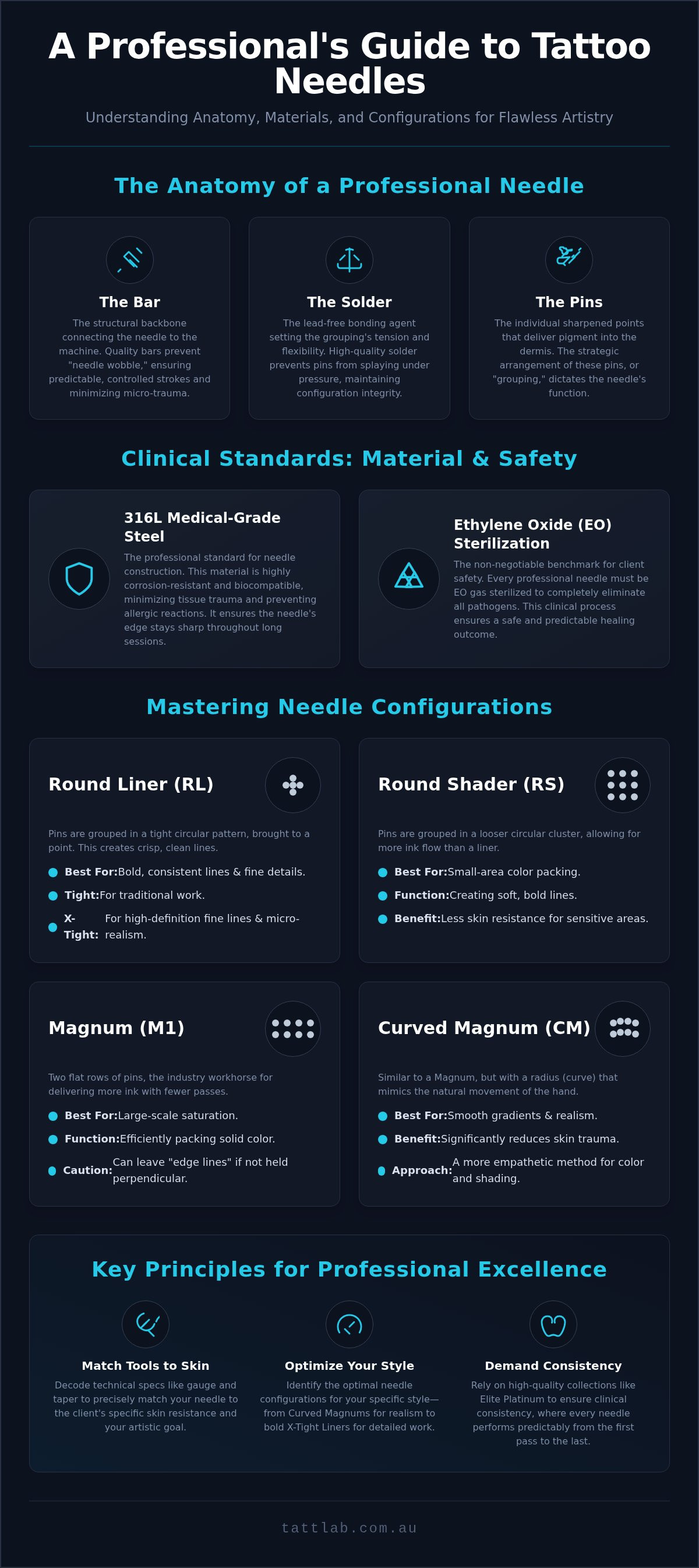
The tattoo needle is the most intimate point of contact between your vision and the client's body. While the history of the tattoo machine shows a rapid evolution from rudimentary tools to high-precision rotary pens, the fundamental physics of the needle remains constant. As you navigate this guide to tattoo needles, you'll see that a professional needle is a three-part assembly:
- The Bar: The structural backbone that connects the needle unit to the machine.
- The Solder: The lead-free bonding agent that sets the grouping tension and flexibility.
- The Pins: The individual sharpened points that deliver the pigment into the dermis.
Quality begins with the bar. It's the structural backbone for the entire unit. If the bar lacks rigidity or is improperly aligned, the resulting "needle wobble" creates micro-trauma in the skin. This instability leads to blurred lines and inconsistent saturation. Elite Platinum needles prioritize this alignment, ensuring every stroke is predictable and controlled. Between the bar and the pins lies the solder. This lead-free joining material dictates the tension of the grouping. High-quality soldering ensures pins don't splay under pressure, maintaining the integrity of the configuration throughout the session.
The Science of Needle Groupings
A grouping is the strategic arrangement of pins to achieve specific skin penetration. These individual pins are clustered together to create different shapes, such as tight circles for lining or flat rows for shading. The height of the solder is a critical technical detail. Higher solder creates a stiffer grouping for bold work, while lower solder allows for more flexibility during delicate transitions. This flexibility influences capillary action, the physical process where ink is drawn into the spaces between the pins and then released into the skin. This guide to tattoo needles emphasizes that without precise clustering, ink retention fails, forcing you to make multiple passes that damage the skin.
Material Standards and Sterility
The biological safety of your client depends entirely on material integrity. Elite Platinum needles use 316L medical-grade stainless steel because it's highly resistant to corrosion and biocompatible. Using inferior metals can lead to allergic reactions or poor healing outcomes. Beyond the metal itself, sterility is the non-negotiable benchmark for professional studios. Every needle must undergo Ethylene Oxide (EO) gas sterilization to eliminate pathogens. For a deeper look at maintaining a sterile environment, you can consult our resource on medical supplies for tattoo artists. This commitment to clinical standards ensures the process of transformation remains safe and predictable for every client.
Mastering Configurations: Round Liners to Magnums
Selecting the correct configuration is a clinical decision that dictates the final aesthetic of the piece. While the previous section detailed the physical build, this portion of our guide to tattoo needles focuses on how pin arrangement influences skin interaction. Each configuration serves a distinct purpose in the narrative of the tattoo, from the first structural line to the final wash of color.
When to Reach for a Round Liner
Round Liners (RL) are grouped in a circular pattern, with the pins brought to a tight point at the tip. Within the Elite Platinum range, you'll encounter variations such as "Tight" and "X-Tight." Standard tight liners provide the structural integrity required for traditional American work, where a bold, consistent path is necessary. Conversely, X-Tight liners are pinched closer to the point, making them the preferred choice for high-definition fine lines and micro-realism. Precision manufacturing ensures these pins remain perfectly centered. This prevents the "rattle" that causes uneven line weights. Adhering to FDA safety guidelines regarding equipment integrity ensures that these tight groupings don't compromise the skin's biological barrier through excessive friction.
Round Shaders (RS) bridge the gap between lining and large-scale shading. Unlike the pinched tips of a liner, these pins are grouped in a loose cluster. This arrangement allows for more ink flow, making them ideal for small-area color packing or creating soft, bold lines that require a less aggressive entry. Because the pins aren't as tightly bound, the skin experiences less resistance, which is a vital consideration for sessions involving sensitive areas.
The Versatility of Magnum Configurations
Magnums (M1) are the industry workhorse for large-scale saturation and smooth gradients. They consist of two rows of pins, allowing for more ink to be delivered with fewer passes. However, the choice between a standard Magnum and a Curved Magnum (CM) is often a matter of skin integrity. Standard Magnums are flat. They excel at packing solid color but can sometimes leave "edge lines" if the artist's hand isn't perfectly perpendicular.
The radius on Curved Magnums mimics the natural movement of the needle into the skin. This curvature prevents the outer pins from digging too deep, which significantly reduces trauma. It's a more empathetic approach to the body, facilitating a faster healing process. If you're performing whip shading, the specific pin spacing in these configurations allows for that sought-after "peppered" look. It provides a controlled, predictable gradient that looks like a natural extension of the skin. As you use this guide to tattoo needles to refine your setup, you'll find that Elite Platinum provides the consistency needed for elite artistry. To ensure your technical performance matches your artistic intent, you might consider evaluating the Elite Platinum collection for your next session.
The Technical Specs: Understanding Diameter and Taper
While configurations define the shape of your work, the technical specifications of individual pins define the texture and resolution of the final piece. This guide to tattoo needles looks at the two most critical variables: gauge and taper. Mastery of these specs allows you to manipulate how the skin receives pigment, turning a technical procedure into a controlled, predictable narrative of progress. In the Elite Platinum collection, these variables are calibrated to ensure that your technical performance never wavers, regardless of the session's complexity.
Gauge refers to the diameter of each individual pin within the grouping. In modern professional studios, this is typically categorized by numbers ranging from #8 to #12. A #12 gauge (0.35mm) is the industry standard for bold color packing and traditional lining. It delivers a higher volume of pigment per strike because the larger surface area creates a larger entry point. Conversely, a #8 gauge (0.25mm), often called a "Bugpin," is designed for intricate detail. Because the pins are thinner, the "pixel" size of the tattoo is reduced, allowing for higher resolution in realistic portraits and delicate transitions.
Gauge Selection for Specific Skin Types
Selecting the right gauge is a matter of clinical empathy. A #10 (0.30mm) pin is widely considered the "all-rounder" for modern artists. It offers a sophisticated balance between efficient ink flow and reduced skin trauma. When you're working on thin or compromised skin, reaching for #08 Bugpins is a strategic choice to maintain skin integrity. Smaller diameters require less force to penetrate the dermis. This approach lowers the client's anxiety during the session and leads to a more stable healing process, as the body has less micro-trauma to repair.
Taper Length and Machine Speed
The taper length is the distance from the point of the needle to its thickest diameter. This geometry dictates the physics of skin resistance. Short tapers (ST) have a more aggressive point that widens quickly. This design allows for increased ink delivery, making them the preferred choice for packing solid color at lower machine speeds. However, for delicate shading and greywash transitions, long tapers (LT) are non-negotiable.
Long tapers provide precision control. Because the point is more gradual, the needle enters the skin with significantly less resistance. This allows you to run your machine at higher speeds for smooth, multi-tonal gradients without tearing the tissue. Elite Platinum long tapers are specifically engineered to maintain their surgical sharpness throughout six-hour sessions. They don't dull or hook mid-session, which ensures that your technical performance remains consistent from the first line to the final highlight. By matching the taper to your machine's speed and the pigment's density, you ensure a flawless saturation that respects the body's physical integrity.
Selection Framework: Matching Needles to Artistic Styles
Every artistic discipline requires a specific set of tools to translate a vision into a permanent reality. While the technical specs of gauge and taper provide the foundation, this guide to tattoo needles focuses on the strategic application of those specs across different genres. Your choice of needle configuration acts as a bridge between the clinical safety of the procedure and the aesthetic outcome of the art. When you align your tools with your style, you minimize skin resistance and maximize saturation efficiency.
The Realism Toolkit
Black and grey realism relies on the ability to create seamless, multi-tonal gradients that mimic the softness of a photograph. Elite Platinum Curved Magnums are the gold standard for this work. The curved profile allows you to roll the needle across the skin, preventing the harsh "edge lines" that flat magnums can leave behind. By combining these with #08 Long Taper Bugpins, you can achieve an atmospheric perspective that feels three-dimensional. These thinner pins create smaller entry points, which is essential for the delicate layering required in portraiture. To ensure your pigment choices match this level of technical precision, you can refer to the professional guide to tattoo ink for insights on pairing needles with specialized greywash sets.
Bold Work and Solid Saturation
Traditional and Neo-Traditional styles demand a different mechanical approach. These genres prioritize bold, unwavering lines and saturated blocks of color. For lining, #12 Round Liners provide the necessary structural weight. When it's time to pack color, Round Shaders are surprisingly versatile. They're excellent for "spit-shading" effects, where you need a soft transition between a bold line and a color fill. Maintaining consistent needle tension is critical here; if the grouping is too loose, you'll struggle to achieve solid blackwork without over-working the skin. Using the wrong configuration often leads to excessive trauma, which compromises the healing process and the final vibrancy of the pigment.
Other specialized styles require a curated selection of the Elite Platinum range:
- Fine Line and Minimalism: The modern urban aesthetic often calls for #06 or #08 Round Liners. These ultra-thin configurations allow for the "single-needle" look while maintaining the stability of a small grouping.
- Japanese Horimono: This style balances large-scale background packing with intricate motifs. You'll need standard Magnums for the heavy black "Gakubori" backgrounds and precision Round Liners for the detailed dragon scales or floral patterns.
Selecting the right tools is the first step toward predictable, elite results. If you're ready to upgrade your studio's performance, you can shop the Elite Platinum collection to find the perfect configuration for your specific artistic narrative.
The Elite Platinum Advantage: Why Professionals Choose Tatt Lab
The transition from technical understanding to practical application requires a toolset that mirrors your commitment to excellence. Throughout this guide to tattoo needles, we've explored the clinical nuances of geometry and configuration. However, the theoretical mastery of these elements only translates to artistry when the physical hardware is beyond reproach. Elite Platinum needles represent this intersection of science and health, providing a benchmark for artists who prioritize skin integrity above all else. By choosing a curated range designed by professionals, you ensure that your technical performance never wavers.
Consistency is the cornerstone of a professional studio environment. There's a specific clinical anxiety that arises when one needle in a box performs differently than the next. Tatt Lab eliminates this uncertainty by subjecting the Elite Platinum range to rigorous clinical standards. Every unit is crafted from 316L medical-grade stainless steel, ensuring that the material integrity remains uncompromised from the initial setup to the final pass. This artist-owned approach means every configuration has been vetted in a high-end laboratory setting before it reaches your station.
Performance Under Pressure
Technical failure during a session isn't just a hurdle; it's a disruption to the client's narrative of transformation. Elite Platinum needles are engineered to reduce "snagging," a common issue with inferior products that causes unnecessary trauma and discomfort. This smoothness is a result of Red Dot-level meticulousness in the Platinum range manufacturing process, where every pin is inspected for surgical sharpness. Even when working on tough skin areas or during extended sessions, these needle points maintain their structural stability. They don't hook or dull, allowing you to maintain a steady, educational rhythm without technical distractions.
Your Partner in Professionalism
Choosing Tatt Lab means more than just purchasing consumables. It's about establishing a dedicated partnership with a specialist Australian provider that understands the urgency of studio logistics. By utilizing the Shopify platform for rapid studio restocking and offering nationwide express shipping across Australia, we ensure your facility never faces a shortage of elite tools. Elevating your studio's reputation starts with the physical integrity of the work you produce. Using high-tier consumables like the Elite Platinum range signals to your clients that you value their safety and their aesthetic outcomes with equal rigor.
The journey toward technical mastery is ongoing. As you refine your skills and expand your artistic repertoire, having a predictable, results-oriented toolset becomes your greatest asset. It's time to replace uncertainty with a sense of controlled, predictable progress. You can Explore the full Elite Platinum Tattoo Needles collection at Tatt Lab to secure the precision your artistry demands.
Elevating Your Artistry with Clinical Precision
Mastering the technical nuances of your tools is the final step in bridging the gap between artistic vision and physical execution. As this guide to tattoo needles has detailed, the success of a procedure depends on the harmony between material integrity, configuration geometry, and biological empathy. By selecting 316L medical-grade steel and matching your taper to the specific needs of the skin, you ensure that every session is a predictable narrative of progress rather than a struggle with inconsistent performance.
Elite Platinum needles are artist-vetted for superior sharpness and durability, providing the reliability required for high-intensity sessions. Every unit undergoes clinical-grade EO gas sterilization to maintain the highest safety standards for your clients. With fast nationwide express shipping across Australia, Tatt Lab ensures your studio remains equipped with the industry's benchmark for precision. It's time to let your technical expertise shine through tools that respect both your art and the body.
Upgrade your studio with Elite Platinum Tattoo Needles and experience the confidence of predictable, elite results today.
Frequently Asked Questions
What is the most versatile needle configuration for a beginner professional?
A 1007 Round Liner and a 1209 Curved Magnum are the most versatile configurations for those entering the industry. These tools provide the structural framework and shading capabilities required for a wide range of styles. This guide to tattoo needles suggests starting with mid-range groupings to build a predictable technical rhythm before moving into specialized bugpins or large-scale magnums. It's a balanced approach that reduces session anxiety.
How do I know if I should use a #10 or a #12 gauge needle?
Choosing between a #10 (0.30mm) and a #12 (0.35mm) gauge depends on your desired saturation speed and skin integrity. The #12 is the industry standard for bold color packing because it creates a larger entry point for pigment. However, the #10 is a sophisticated all-rounder that offers a smoother transition and reduced tissue trauma. It's an ideal choice for clients with sensitive skin or for pieces requiring softer gradients.
What is the difference between a standard Magnum and a Curved Magnum?
The primary difference lies in the needle's profile and how it interacts with the skin's natural curvature. Standard Magnums are flat. They're excellent for packing solid blocks of color but can cause "edge lines" if you don't handle them with perfect precision. Curved Magnums feature a radius that mimics the body's contours. This curvature significantly reduces trauma and ensures a seamless, soft-edged gradient, particularly in realism work.
Why does the taper length matter for my tattooing style?
Taper length dictates the amount of resistance the needle encounters upon entry. Long tapers are the preferred choice for delicate shading and greywash because they penetrate the dermis with minimal force. Short tapers widen much faster, allowing for more ink delivery per strike. Matching the taper to your machine's speed ensures a controlled, predictable saturation that respects the body's physical integrity and long-term health.
Are Elite Platinum needles compatible with all professional tattoo machines?
Elite Platinum needles are engineered to meet universal industry standards for professional rotary and pen-style machines. This standardized fitment ensures that you can integrate our high-tier consumables into your existing workflow without technical friction. Maintaining this level of equipment compatibility is a core part of our commitment to providing a streamlined, clinical experience for modern studios across Australia. It's a reliable choice for any specialist setup.
How often should I change my needle during a long tattoo session?
You should change your needle immediately if you notice any "snagging" or if the points feel less sharp during a long session. High-intensity work on tough skin areas can eventually dull even the best steel. Additionally, switching from black pigment to light colors requires a fresh needle to prevent cross-contamination. This ensures that your technical performance remains pristine and your color transitions stay vibrant from start to finish.
What is a "Bugpin" needle and when is it appropriate to use one?
A "Bugpin" refers to a needle made with thinner individual pins, typically a #08 (0.25mm) gauge. These are appropriate for high-resolution detail work and intricate realism where you want to minimize the "pixel" size of the tattoo. Using bugpins is a strategic clinical decision that allows for more passes with less trauma. It facilitates a smoother healing process for the client while achieving a sophisticated urban aesthetic.
How can I tell if a tattoo needle is properly sterilized and safe to use?
A safe, properly sterilized needle will always arrive in an individual blister pack with a visible Ethylene Oxide (EO) gas indicator. This indicator changes color once the sterilization process is complete. In this guide to tattoo needles, we emphasize that you must also verify the expiration date and ensure the packaging is entirely intact. Maintaining the clinical safety of your studio environment is the first step in protecting your client's physical integrity.


Comments (0)
There are no comments for this article. Be the first one to leave a message!