
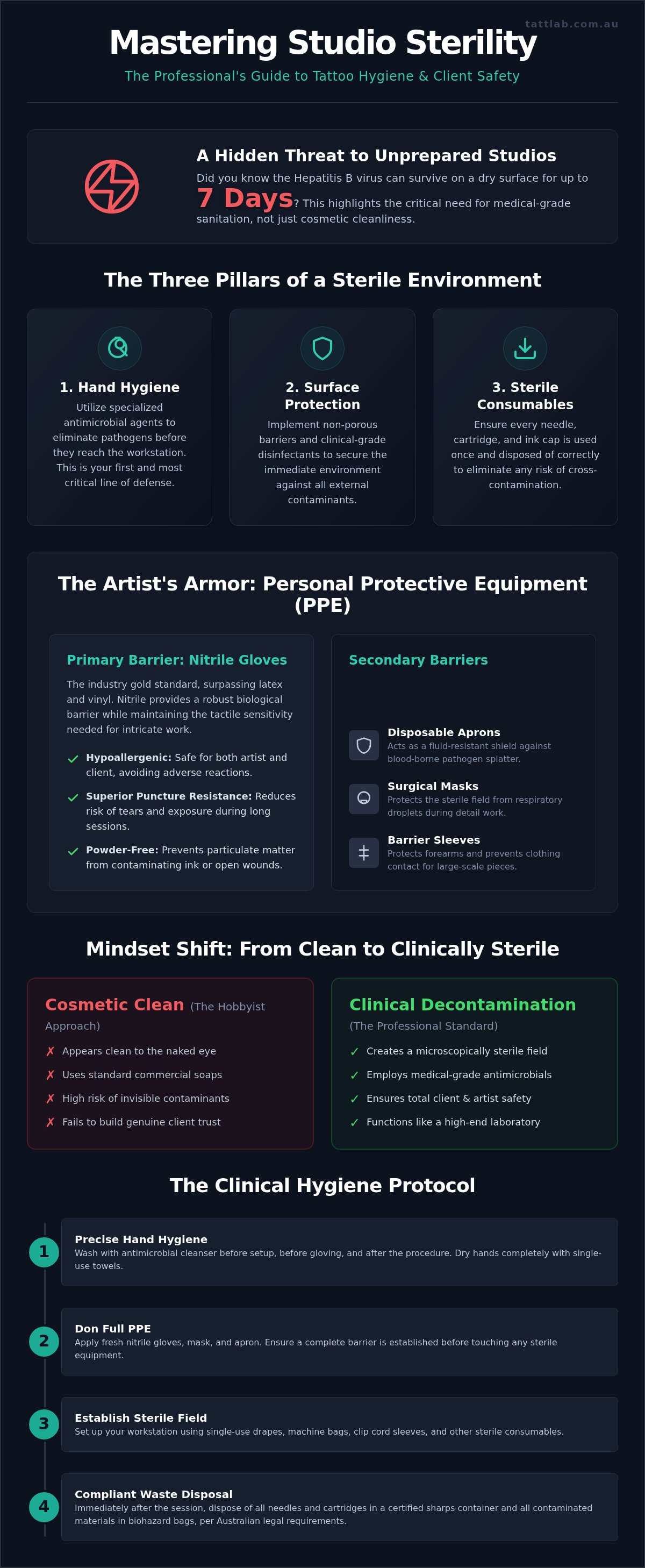
Did you know the Hepatitis B virus can survive on a dry surface for up to seven days? For a professional artist, your studio is more than just a creative space; it's a clinical environment where the margin for error is non-existent. You likely feel the pressure of balancing a seamless artistic workflow with the rigorous demands of medical-grade sanitation. It's natural to feel concerned about the distinction between cosmetic and clinical barriers, particularly when your professional reputation relies on absolute physical integrity.
This guide demystifies the essential tattoo studio hygiene supplies and protocols required to maintain a sterile, professional environment in Australia. By aligning your practice with the latest 2026 standards, you can transform your workspace into a high-end laboratory where science meets art. We will explore everything from compliant waste management to the specific PPE that ensures client safety. You'll gain a clear, methodical roadmap to replace uncertainty with a sense of controlled, predictable progress for every session.
Key Takeaways
- Understand the clinical standards required for skin penetration services in Australia to ensure your studio operates with total integrity.
- Learn to select specialized PPE that provides a robust biological barrier while maintaining the tactile sensitivity needed for intricate work.
- Master the two-step decontamination process and the specific tattoo studio hygiene supplies required to secure a truly sterile field.
- Implement compliant waste management and sharps disposal protocols that meet Australian legal requirements for professional studios.
- Bridge the gap between artistic workflow and medical-grade safety to foster deeper client trust and long-term professional success.
The Professional Standard for Tattoo Studio Hygiene Supplies
In Australia, professional tattooing is legally classified as a skin penetration service. This designation carries a weight of responsibility that transcends basic aesthetics. High-quality tattoo studio hygiene supplies serve as the essential medical-grade barriers between the delicate Process of tattooing and the myriad of external contaminants found in any urban environment. Maintaining these standards isn't just about ticking boxes for a health inspector; it's about honoring the physical integrity of every client who walks through your door. A well-equipped studio uses hygiene as a silent, powerful communicator of expertise, signaling to the client that their safety is as paramount as the art itself.
The foundation of a secure, professional environment rests on three core pillars:
- Hand Hygiene: Utilizing specialized antimicrobial agents to eliminate pathogens before they reach the workstation.
- Surface Protection: Implementing non-porous barriers and clinical-grade disinfectants to secure the immediate environment.
- Single-Use Sterile Consumables: Ensuring that every needle, cartridge, and ink cap is used once and disposed of correctly to prevent cross-contamination.
The Intersection of Art and Infection Control
The elite modern artist views sterility not as a chore, but as a fundamental component of their technical skill. Just as you master linework or color theory, you must master the science of clinical decontamination. There's a profound psychological impact when a client witnesses a meticulous hygiene routine. It builds immediate trust, replacing the natural anxiety of a procedure with a sense of calm assurance. Moving beyond a "clean" appearance to a state of clinical decontamination ensures that your workstation functions like a high-end laboratory. This shift in mindset from cosmetic to medical is what separates a hobbyist from a professional whose practice is built on long-term results and safety.
Hand Hygiene: The First Line of Defense
Your hands are your most valuable tools, yet they're also the primary vectors for cross-contamination. Standard commercial soaps lack the efficacy required for skin penetration procedures. You need medical-grade antimicrobial cleansers that effectively reduce the microbial load without stripping the skin's natural barrier. Hand hygiene must be performed with methodical precision: before you set up your station, immediately before donning gloves, and after every procedure. Proper drying is equally critical. Damp skin under gloves creates a warm, humid environment that can lead to irritation or dermatitis, compromising your comfort during long sessions. Use single-use, lint-free towels and ensure your hands are completely dry before moving to the next stage of your workflow.
Personal Protective Equipment (PPE) for the Modern Artist
Professional artists understand that high-quality PPE is a non-negotiable standard in Australian studios. It creates a critical physical barrier that protects both the artist and the client from cross-contamination and biological hazards. Selecting the right tattoo studio hygiene supplies involves balancing durability and chemical resistance with the need for tactile sensitivity. When you wear PPE, you aren't just following a regulation; you are projecting a sense of meticulousness and calm that reassures your client during a vulnerable process. Understanding Tattoo risks and precautions is the first step in mitigating bloodborne pathogen exposure through robust, daily PPE protocols.
Nitrile Gloves: Tactile Sensitivity Meets Barrier Protection
Nitrile has rightfully become the industry gold standard, surpassing latex and vinyl in every clinical metric. Unlike latex, nitrile is hypoallergenic, ensuring that neither you nor your client suffers an adverse reaction during a session. It offers superior puncture resistance and stands up to the caustic chemicals found in many surface disinfectants. For long sessions, choosing the correct thickness is vital. You need a glove that is robust enough to prevent accidental tears but thin enough to maintain precise needle feedback. Powder-free options are essential in a studio environment to avoid any risk of particulate matter contaminating your ink or the open wound. This careful selection ensures your technical execution remains flawless while maintaining absolute physical integrity.
Secondary Protection: Aprons, Masks, and Sleeves
While gloves are the primary focus, secondary barriers complete the clinical environment of your workstation. Disposable aprons act as a fluid-resistant shield against blood-borne pathogen splatter, protecting your clothing and skin from invisible contaminants. Surgical masks play a dual role; they protect the sterile field from respiratory droplets during close-up detail work and provide a professional layer of separation that respects the client's personal space. For large-scale pieces involving significant movement, barrier sleeves protect your forearms and prevent your clothing from touching the client's skin. This methodical approach to layering protection mirrors the precision of the work itself, turning your studio into a high-end laboratory where science meets health.
Investing in the right equipment is a matter of professional integrity. You can find a curated selection of professional tattoo supplies designed to meet the rigorous demands of the modern Australian artist, ensuring every session is as safe as it is creative.
Sterile Field Management: Surface Cleaners and Barriers
The "sterile field" is the heart of your workspace; it's the immediate environment where the procedure occurs and where the risk of cross-contamination is highest. Effective management of this zone involves a methodical two-step process: clinical decontamination followed by the application of physical barriers. While some view these as redundant, they're actually complementary layers of safety. Decontamination eliminates existing pathogens, while barriers prevent new ones from reaching the surface during the session. This dual approach is a hallmark of professional tattoo studio hygiene supplies, allowing for rapid turnover between clients without compromising the physical integrity of your studio.
Adhering to high standards isn't just about local compliance; it's about following global best practices. For instance, the Washington State tattoo safety and sanitation standards provide a rigorous framework for how workstations should be prepared. By adopting such detailed protocols, you ensure that every surface, from your stainless steel tray to your adjustable lamp, remains a controlled environment.
High-Level Disinfectants for Studio Surfaces
True sterilization requires more than a casual "spray and wipe" routine. You must select TGA-approved disinfectants designed to kill resilient viruses and bacteria effectively. The most critical factor is often overlooked: contact time. Every disinfectant has a specific duration it must remain wet on a surface to reach its full biocidal potential. If you wipe it away too soon, you're merely cleaning, not decontaminating. When handling sensitive equipment like your power units or the tattoo machine itself, use a dampened cloth rather than a direct spray. This protects the internal electronics while ensuring the external housing is clinically safe for the next procedure.
Barrier Films and Equipment Covers
Once the surface is decontaminated, physical barriers act as your second line of defense. Applying barrier film to high-touch areas such as lamps, trays, and armrests makes the post-procedure cleanup significantly more efficient. The "active zone" requires specialized protection; clip cord sleeves and machine bags are essential to prevent blood or ink from entering the crevices of your equipment. Don't forget the peripheral items. Bottle covers and wash bottle bags allow you to maintain aseptic handling of liquids throughout the session. This methodical setup, supported by the right tattoo studio hygiene supplies, ensures that your workflow remains fluid and uninterrupted, reflecting the precision and care you put into every piece of art.
Medical Consumables and Procedural Skin Preparation
Skin preparation is a critical phase where the client’s anatomy is transformed into a sterile surgical site. This process involves a methodical reduction of the microbial load on the skin's surface, ensuring that the introduction of pigment occurs in a controlled environment. Utilizing medical-grade tattoo studio hygiene supplies during this stage does more than prevent infection; it actually supports better ink saturation and minimizes post-procedure inflammation. When the skin is properly prepared, the body's immune response is less reactive to the procedure, allowing the artistry to settle with greater clarity and precision.
A commitment to physical integrity means acknowledging that the skin is a living, breathing barrier. By using specialized disposables, you ensure that no cross-contamination occurs between sessions, protecting the narrative of personal transformation you are helping to create. This clinical approach mirrors the precision of the work itself, using well-constructed protocols to break down complex biological risks into manageable, predictable steps.
Pre-Procedure Antiseptics and Skin Cleansing
The first step in clinical skin preparation is the removal of surface oils and environmental debris. Professional artists often use rubbing alcohol to degrease the area, which ensures that stencils adhere perfectly and subsequent antiseptics can penetrate effectively. Following this, the application of specialized antiseptic cleansers is necessary. These formulations are engineered to kill a broad spectrum of pathogens without causing the excessive dryness that can lead to skin trauma during the session. If hair removal is required, single-use razors are an absolute necessity for every procedure. Even a microscopic nick from a reused blade can introduce bacteria, compromising the safety of the entire session.
Single-Use Precision: Tongue Depressors and Ink Cups
Maintaining a sterile field requires a commitment to single-use precision across every consumable item. For example, using sterile tongue depressors to extract ointments prevents the "double-dipping" that leads to cross-contamination within bulk containers. Similarly, ink cups must be treated as strictly disposable. All unused pigment and the cups themselves must be discarded immediately after the session concludes, regardless of how much remains. Even the process of applying tattoo stencils must be integrated safely within the sterile field, using single-use transfer solutions to maintain an aseptic workflow. This level of meticulousness reflects a deep respect for the client’s health and the longevity of the work.
Adhering to these rigorous standards ensures your studio remains a sanctuary of safety and artistic excellence. You can source your essential medical-grade tattoo consumables from a partner who understands the clinical demands of the modern Australian artist.
Post-Procedure Safety and Studio Waste Protocols
The professional hygiene cycle doesn't end when the artist puts down the machine. It concludes with the methodical disposal of contaminated materials. This phase is a critical legal requirement for skin penetration businesses in Australia, ensuring that the studio environment remains a controlled sanctuary of safety. Proper management of tattoo studio hygiene supplies during the breakdown phase prevents the risk of needle-stick injuries and cross-contamination, protecting both the artist and the public. When you treat the cleanup with the same clinical rigor as the application, you reinforce the studio's reputation for meticulousness and physical integrity.
Sharps Disposal and Biohazardous Waste
Australian standards mandate that all sharps, including traditional needles and cartridges, must be deposited into rigid, puncture-resistant yellow containers. These containers should be placed within easy reach of the workstation to minimize travel with exposed needles. Once full, they require professional collection from licensed clinical waste services to ensure they're incinerated safely. Segregation is equally important for "soft" biohazards. Items such as blood-soaked paper towels, used ink cups, or contaminated barriers must be placed in clearly labeled biohazard bags rather than general studio rubbish. This methodical approach to waste storage prevents hazardous materials from entering the general waste stream, maintaining the studio's clinical edge and professional accountability.
Aftercare Integration: Maintaining the Narrative of Healing
Finalizing the session involves transitioning the client from the procedure to the recovery phase. Applying protective dressings or "second skin" barriers immediately after the work is finished secures the site against environmental pathogens. This is where tattoo aftercare becomes an extension of the studio's hygiene protocol. Providing clients with sterile, professional-grade solutions ensures that the narrative of healing remains consistent from the first needle strike to the final result. You must educate the client on home hygiene, explaining how to protect the artwork during its most vulnerable state. Closing the loop in this way transforms the procedure from a technical task into a comprehensive journey of personal transformation.
A professional breakdown routine is the final hallmark of a specialist. By ensuring every contaminated item is accounted for and every waste protocol is followed, you create a steady, predictable environment. This commitment to safety doesn't just meet regulations; it builds a foundation of trust that allows your clients to feel secure in their choice of artist. Maintaining these high standards is a long-term investment in the health of your community and the longevity of your professional practice.
Elevating Your Practice to Clinical Excellence
Maintaining a professional studio in 2026 requires a seamless integration of artistic vision and clinical rigor. By mastering the two-step decontamination process and strictly adhering to Australian waste management standards, you protect the physical integrity of your work and the safety of your community. Every barrier film applied and every single-use consumable discarded reinforces a narrative of trust and long-term results. The transition from a creative space to a high-end laboratory is a deliberate choice that positions you as a trusted specialist in a modern urban landscape, mirroring the clinical rigor found at specialized medical facilities like Bright Sight Eye Specialists.
Securing the right tattoo studio hygiene supplies is a fundamental step in this professional progression. Tatt Lab provides an artist-vetted selection of TGA-compliant medical supplies designed specifically for the Australian industry. With express national shipping, it's easier than ever to ensure your facility remains stocked with the precision tools required for absolute safety. Shop Professional Tattoo Hygiene & Medical Supplies at Tatt Lab and continue your journey toward mastery. Your commitment to these standards doesn't just meet regulations; it honors the transformative experience of every client you serve.
Frequently Asked Questions
What are the essential hygiene supplies for a new tattoo studio?
Essential tattoo studio hygiene supplies for a new facility include TGA-approved surface disinfectants, powder-free nitrile gloves, and rigid sharps containers. You'll also need a consistent stock of barrier films, clip cord sleeves, and single-use consumables like ink cups and tongue depressors. These items form the baseline of a clinical environment, ensuring you're prepared for both daily procedures and mandatory health inspections from the first day of operation.
Why is it important to use nitrile gloves instead of latex in tattooing?
Nitrile gloves are the industry standard because they are hypoallergenic and offer superior resistance to punctures and chemicals. Unlike latex, nitrile doesn't trigger allergic reactions in clients or artists, which is vital for long-term safety. They also maintain their physical integrity when exposed to petroleum-based ointments or harsh disinfectants, providing a more reliable biological barrier during long or complex sessions.
How do I properly dispose of tattoo needles and sharps in Australia?
In Australia, you must dispose of needles and cartridges in rigid, yellow sharps containers that meet AS 4031 standards. Once these containers reach the designated fill line, they should be collected by a licensed clinical waste management service for safe incineration. Never place sharps in general waste or recycling bins. This follows strict state-based health regulations designed to prevent needle-stick injuries and environmental contamination.
What is the difference between cleaning, disinfecting, and sterilizing?
Cleaning involves the physical removal of dirt and organic matter, while disinfecting uses chemicals to kill most pathogenic microorganisms on surfaces. Sterilizing is the highest level of decontamination, involving the total destruction of all microbial life, including resilient spores. Most modern studios achieve sterility by using single-use, pre-sterilized equipment rather than relying on on-site autoclaves for reusable tools, ensuring a higher margin of safety.
How often should I clean my tattoo workstation?
You should clean and decontaminate your workstation before every setup and immediately after every breakdown. If any surface is accidentally touched or splashed during a procedure, you must stop and re-sanitize that specific area. Maintaining this steady rhythm ensures that pathogens don't have the opportunity to accumulate or spread between different stages of your workflow, keeping the environment controlled and predictable.
Can I use standard household cleaners in a professional tattoo studio?
Standard household cleaners are insufficient because they aren't formulated to eliminate resilient bloodborne pathogens like Hepatitis B. Professional studios require medical-grade, TGA-approved disinfectants with proven virucidal and bactericidal properties. Using non-clinical products compromises the physical integrity of your studio and can lead to significant legal penalties and studio shutdowns during health department audits.
What are the risks of poor hygiene in a tattoo studio?
Poor hygiene carries severe risks, ranging from localized skin infections to the transmission of life-threatening bloodborne viruses. Beyond the biological dangers, a lack of clinical rigor can result in permanent damage to your professional reputation and legal fines reaching tens of thousands of dollars. It's a risk that compromises both the client's health and the long-term viability of your artistic career.
How do I set up a sterile field for a tattoo session?
Setting up a sterile field begins with decontaminating all hard surfaces with a high-level disinfectant. Once dry, apply physical barriers like film and sleeves to all high-touch equipment such as lamps and power units. Finally, arrange your sterile, single-use tattoo studio hygiene supplies on a protected tray, ensuring you only handle them with fresh gloves to maintain an aseptic environment throughout the entire setup process.


Comments (0)
There are no comments for this article. Be the first one to leave a message!