

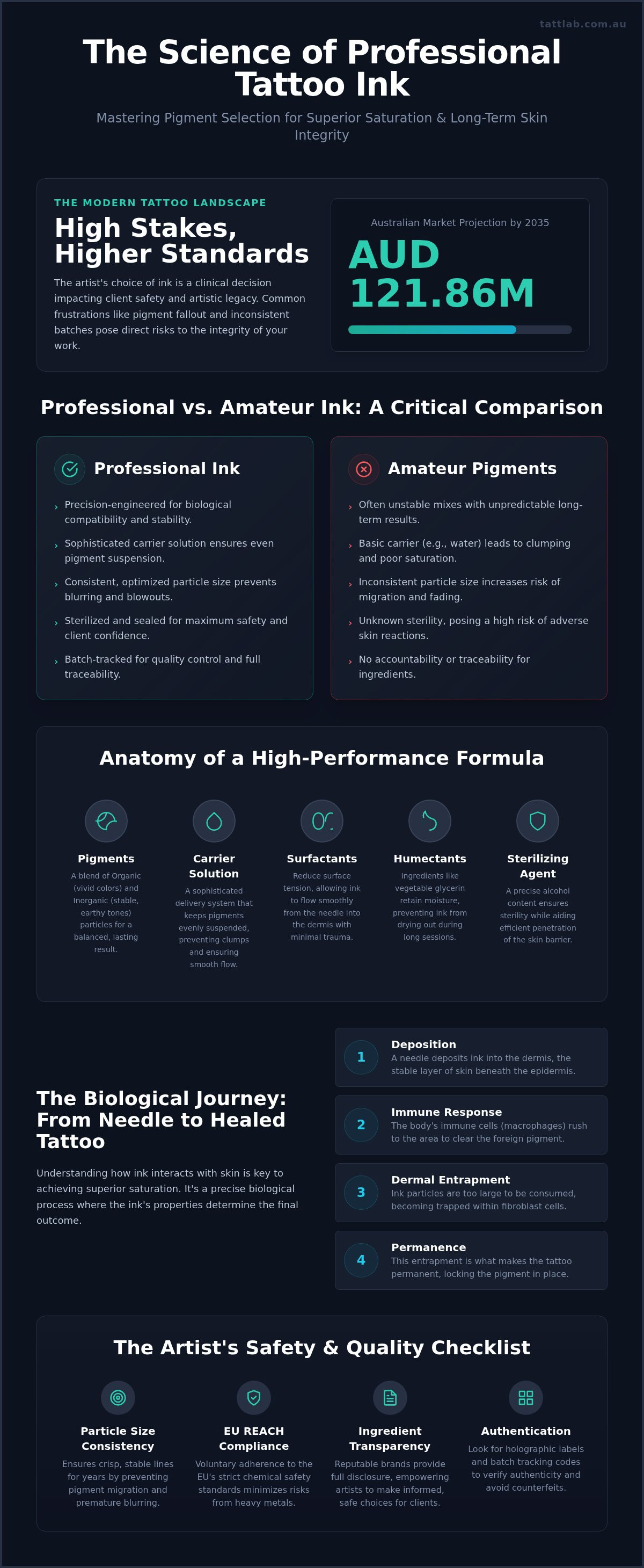
Your choice of professional tattoo ink is more than an aesthetic preference; it is a clinical decision that dictates the biological future of your client's skin. With the Australian tattoo market projected to reach a value of AUD 121.86 million by 2035, the demand for high-stakes precision has never been higher. You have likely experienced the frustration of pigment fallout during healing or the uncertainty of inconsistent batches that disrupt your creative flow. These challenges aren't just technical hurdles; they are direct risks to the physical integrity of your work and the long-term trust of your clients.
We believe that artistic excellence must be supported by medical-grade rigor. This guide will help you master the science of pigment selection and safety standards to ensure superior saturation and long-term skin integrity. We will explore how voluntary adherence to EU REACH standards provides a safety edge in the Australian market, ensuring your results for realism and linework remain predictable. By understanding the chemical stability of your tools, you can move away from regulatory doubt and toward a narrative of consistent, liberating transformation for every person who enters your studio.
Key Takeaways
- Understand the biological mechanics of dermal pigment entrapment and how particle size directly influences the long-term clarity and "blur" of your work.
- Distinguish between amateur pigments and professional tattoo ink by evaluating the carrier solutions that ensure stable skin delivery and consistent saturation.
- Learn to match specific pigment densities to your signature style, ensuring predictable heals for both high-contrast realism and delicate linework.
- Identify non-negotiable safety markers, including ingredient transparency and the clinical protocols used by top-tier manufacturers to mitigate heavy metal risks.
- Discover the advantage of sourcing artist-vetted, world-renowned brands that bridge the gap between creative vision and medical-grade safety.
Defining Professional Tattoo Ink: Beyond the Pigment
The carrier solution plays a vital role that many overlook. It isn't merely a liquid to move the pigment; it is a sophisticated delivery system. A high-quality carrier ensures that pigments remain evenly suspended, preventing the "clumping" that leads to inconsistent saturation or needle clogs. By choosing a professional formula, you are investing in a predictable outcome where the science of the ink supports the artistry of the hand. This methodical approach to selection lowers the risk of adverse reactions, replacing technical uncertainty with a sense of controlled, predictable progress.
The Components of a Professional Formula
The complexity of Tattoo ink composition involves a delicate balance between organic and inorganic pigments. Organic pigments usually provide the vivid, high-saturation colors favored in illustrative work, while inorganic pigments, often derived from mineral oxides, offer the stability and earthy tones essential for realism. Professional brands use surfactants to reduce the surface tension of the liquid, allowing the ink to flow smoothly from the cartridge into the dermis. Humectants like vegetable glycerin are added to retain moisture, preventing the ink from drying too quickly during long sessions. Additionally, a precise alcohol content is maintained to ensure the solution remains sterile while helping the ink penetrate the skin barrier efficiently without causing excessive dehydration.
Regulatory Standards in 2026
As of 2026, the industry has seen a significant shift toward transparency. While Australia's regulatory landscape is still evolving, many top-tier studios voluntarily adhere to the strict EU REACH standards. These benchmarks limit the use of specific chemicals and heavy metals, prioritizing the holistic wellness of the client. Identifying authentic, non-counterfeit ink is a critical protocol for any studio. Reputable manufacturers now use advanced holographic labeling and batch tracking codes. This level of accountability allows artists to trace every bottle back to its production date, ensuring that the professional tattoo ink they use meets the highest clinical-grade safety requirements. This transparency builds immediate trust, framing the tattooing process as a safe, high-end procedure that respects the body's long-term health.
The Science of Saturation: How Ink Interacts with Skin
When a needle penetrates the skin, it bypasses the epidermis to deposit pigment into the upper dermis. This starts a complex biological narrative. The body's immune system immediately responds by sending macrophages to clear the foreign substance. Because the particles in professional tattoo ink are engineered to be larger than what these white blood cells can consume, the pigment becomes trapped within fibroblast cells. This permanent residency is what creates a healed tattoo. Achieving superior saturation requires a deep understanding of this dermal entrapment. If the pigment isn't seated at the correct depth or if the concentration is too low, the result is a faded, inconsistent heal that lacks the vibrancy your client expects.
Precision in tattooing is often a matter of microns. Particle size directly dictates how the ink ages within the tissue. If particles are too small, they can migrate through the interstitial fluid, leading to premature blurring or the dreaded "blowout." High-quality professional formulas maintain a consistent particle size that resists this migration while remaining fine enough to flow through the needle without causing excessive trauma. Ink "dropout" often occurs when the machine speed isn't calibrated to the ink's viscosity. A thicker ink requires more torque and a slower hand to ensure the pigment stays in the skin rather than being wiped away during the session.
Pigment Dispersion and Flow Rates
Modern artists typically favor pre-dispersed professional tattoo ink over traditional pigment powders. These formulas are blended in high-speed laboratory environments to ensure every pigment particle is fully "wetted" by the carrier solution. This prevents clumping, which is a common cause of needle clogs and uneven shading. To manage drying during long sessions, many specialists use a drop of vegetable glycerin or a dedicated mixing solution. This maintains the flow rate and ensures the ink remains fluid enough to enter the skin easily. For artists seeking pigments that balance immediate saturation with long-term stability, exploring a curated range of professional tattoo ink is the first step toward predictable results.
Lightfastness and Long-Term Stability
The longevity of a tattoo depends heavily on the ink's resistance to photo-degradation. UV rays are high-energy waves that can break the chemical bonds of pigment molecules over time. This is why certain black inks can shift toward blue or green as they age. Choosing inks with high lightfastness ratings is essential, especially for exposed areas like hands or forearms. While the FDA tattoo ink safety guidelines focus on immediate health risks and sterility, the artist's responsibility extends to how the work will look a decade later. Selecting pigments with stable chemical structures ensures that the personal transformation you provide remains as sharp and vivid as the day it was finished.
Comparing Industry Standards: Matching Ink to Your Style
Selecting the right professional tattoo ink is a nuanced extension of your artistic voice. In 2026, the Australian market offers unprecedented access to global brands, but this variety brings a new layer of professional responsibility. Recent Binghamton University research on tattoo ink highlighted that many commercial pigments don't align perfectly with their labels, emphasizing the need for artist-vetted sourcing. Whether you are building a starter palette or refining a specialized kit, your choice must align with the specific density and flow requirements of your signature style. Modern formulations have also pivoted toward vegan-friendly and hypoallergenic ingredients, ensuring that aesthetic results don't compromise the holistic wellness of the client.
A versatile studio palette should prioritize stability and predictability. For many artists, this means moving away from "all-purpose" solutions in favor of pigments designed for specific tissue interactions. By selecting world-renowned brands that have been rigorously tested for performance, you minimize the risk of inconsistent heals. This methodical approach to stock management ensures that every session begins with the same high-level clinical authority, allowing you to focus entirely on the creative narrative of the procedure.
The Best Inks for Realism and Smooth Gradients
Realism demands a level of subtlety that manual dilution often fails to provide. While many traditional artists prefer to mix their own washes, professional greywash sets are superior for maintaining consistency across multiple sessions. These sets are laboratory-calibrated to provide a perfect spectrum of tones, from deep, high-saturation blacks for portrait shadows to delicate "ghost" tones for subtle skin textures. Using specialized white inks for highlights is equally critical. These formulas have a higher opacity and a heavier particle weight, ensuring they don't simply "disappear" into the skin during the healing process but instead provide the sharp, reflective contrast necessary for hyper-realistic work.
Bold Inks for Traditional and Neo-Traditional Work
Traditional and neo-traditional styles require a significantly higher pigment load to achieve the vibrant, solid fills that characterize the genre. These inks are engineered to be "packed" into the dermis, requiring a viscosity that stays on the needle and enters the skin with minimal resistance. Consistency in color batches is vital here; a large-scale backpiece or sleeve requires a uniform black that doesn't shift in tone between bottles. Reliable "all-rounder" blacks are the backbone of these styles, offering the versatility to pull crisp, saturated lines while also being capable of smooth, solid shading. By sourcing artist-vetted supplies, you ensure that your boldest designs remain vibrant for decades, resisting the gradual fading that often plagues lower-grade alternatives.
Safety Protocols: Ingredient Transparency and Sterility
For the modern artist, ingredient transparency isn't just a preference; it's a non-negotiable standard of care. When you choose professional tattoo ink, you aren't just buying color; you're investing in a documented chemical profile. High-end manufacturers provide Safety Data Sheets (SDS) that detail every component, from the base pigment to the specific surfactants used. This clarity allows you to advocate for your client's health, ensuring that no hidden allergens or prohibited substances are introduced into their dermal layer. It transforms the procedure from a technical task into a transparent, results-oriented partnership between you and the person in your chair.
The risk of heavy metal contamination is a significant concern in lower-grade pigments. Lead, mercury, and cadmium were once common in the industry, but professional brands now use rigorous testing to mitigate these risks. By adhering to international benchmarks, these manufacturers ensure that metal concentrations remain well below hazardous levels. This scientific rigor protects the client's physical integrity and shields the artist from the legal and reputational fallout of an adverse reaction. While the initial investment in premium pigments may be higher, the cost of safety is minimal compared to the risk of poor heals or medical complications that arise from low-grade alternatives.
Maintaining a sterile field extends to how you handle the ink bottle itself. Always use single-use ink caps and dispose of them immediately after the session. When pouring ink, ensure the bottle tip never touches the cap or any surface in the workstation. This simple protocol prevents cross-contamination and maintains the sterility of the remaining stock. To ensure your studio is equipped with the highest standard of pigments, you can buy professional tattoo ink from our artist-vetted collection.
Understanding Ink Allergies and Sensitivities
Certain pigments, particularly reds, have historically been associated with higher rates of sensitivity due to the presence of cinnabar or other mineral-based irritants. Modern professional formulas have largely replaced these with safer organic alternatives. For clients with a history of skin sensitivity, performing a patch test is a professional best practice. This involves placing a small dot of pigment in an inconspicuous area and monitoring it for several days. Managing client expectations is vital; explain that while reactions are rare with high-quality pigments, the body's immune response is unique to every individual.
Storage and Shelf Life of Professional Inks
Sourcing Professional Ink in Australia: The Tatt Lab Advantage
Tatt Lab isn't just a supplier; it's a dedicated partner in your studio's evolution. As an artist-owned and operated facility based in Victoria, we understand that every bottle of professional tattoo ink you order represents a commitment to your client's safety and your own reputation. Our selection process is rigorous. We only stock world-renowned brands that have been vetted for saturation, consistency, and clinical-grade purity. This artist-first approach ensures that the tools you use are capable of translating your vision into a permanent, vibrant reality without the guesswork often associated with unvetted sources.
Studio performance relies on more than just high-quality pigments. It requires a reliable supply chain that understands the urgency of a busy schedule. Our express nationwide shipping is designed to reduce downtime, ensuring your essential stock arrives when you need it. By minimizing the gap between order and delivery, we help you maintain a steady, educational, and low-pressure environment for your clients. This logistical precision mirrors the technical precision required in the work itself, allowing you to focus on the liberating narrative of personal transformation that happens in your studio.
Superior results also depend on what happens after the needle leaves the skin. Integrating your choice of professional tattoo ink with mastering tattoo aftercare is the most effective way to protect the skin's integrity. When high-stakes consumables are paired with a professional recovery protocol, the outcome is a predictable, high-quality heal that reflects the scientific focus of your practice. This holistic approach ensures that the physical integrity of the body is prioritized from the first drop of ink to the final stage of healing.
The One-Stop Shop for Studio Success
We bridge the gap between medical safety and artistic tools by offering a curated range of supplies that meet the highest industry benchmarks. Whether you are looking for specific cartridge configurations or world-class pigments, our local support team provides expert industry knowledge to help you make informed decisions. For a deeper look into optimizing your workstation and selecting artist-vetted equipment, explore our guide on tattoo supplies. This comprehensive resource helps you align your equipment with the latest safety and performance standards.
Wholesale and Bulk Solutions for Studios
Streamlining your supply chain is essential for multi-artist studios where consistency is a non-negotiable requirement. High-volume orders of professional tattoo ink ensure that every artist in your space has access to the same calibrated pigments, reducing variables in healing outcomes across your entire portfolio. We offer wholesale solutions that prioritize a steady flow of world-renowned brands, allowing your studio to operate as a high-end laboratory where science meets health. You can shop the professional ink collection at Tatt Lab to secure the performance-driven tools your business deserves.
Elevating Your Artistic Standard for 2026
The evolution of the Australian tattoo industry requires a shift from viewing pigments as simple tools to recognizing them as sophisticated medical consumables. By mastering the science behind dermal entrapment and prioritizing ingredient transparency, you ensure that every procedure is a safe, predictable step in a client's narrative of self-assurance. Your choice of professional tattoo ink is the foundation of this progress, bridging the gap between clinical safety and aesthetic longevity. When you align your technical skills with high-performance chemistry, you move away from the uncertainty of poor heals and toward a consistent standard of excellence.
At Tatt Lab, we are dedicated to supporting this high-stakes precision. Our collection is artist-vetted for superior saturation and adheres to clinically focused safety standards that respect the body's long-term health. We understand that your studio's success depends on reliable tools, which is why we offer express nationwide shipping from Victoria to minimize downtime. By choosing supplies that mirror the meticulousness of your craft, you protect the physical integrity of your work and the trust of your clients. We invite you to Explore the Specialist Selection of Professional Tattoo Inks and begin a partnership focused on predictable, world-class results.
Frequently Asked Questions
What is the best professional black tattoo ink for lining?
The ideal lining black must have a high pigment concentration and a viscosity that allows for consistent flow without bleeding into the surrounding tissue. Many specialists prefer "triple black" formulations for their extreme opacity. These inks are designed to stay crisp and dark throughout the healing process, ensuring your linework remains sharp. Choosing a reputable brand ensures the pigment particles are uniform, which prevents the needle from clogging during long sessions.
How can I tell if a tattoo ink is high-quality or professional grade?
High-quality professional tattoo ink is distinguished by its transparency and documentation. Always look for a Safety Data Sheet (SDS) and a clear batch number on the bottle, which allows for full traceability. Reputable manufacturers also use tamper-evident seals and holographic labels to prevent counterfeiting. Sourcing your pigments from an artist-vetted supplier ensures the product has been tested for both performance and safety in a real studio environment.
Is vegan tattoo ink as good as traditional ink?
Modern vegan inks are often superior to traditional formulas because they utilize refined organic pigments that provide exceptional vibrancy and lightfastness. These formulations replace animal-derived glycerin and bone char with high-quality vegetable alternatives that are less likely to cause irritation. Most world-renowned brands have transitioned to vegan-friendly ingredients to ensure their products are accessible and safe for the growing demographic of health-conscious clients without sacrificing saturation.
What are the main ingredients in professional tattoo ink?
The formula for professional tattoo ink typically includes a blend of organic or inorganic pigments suspended in a liquid carrier. This carrier is usually a mix of distilled water, isopropyl alcohol for sterility, and humectants like vegetable glycerin to keep the ink fluid. Surfactants are often added to reduce surface tension, allowing the ink to enter the skin more easily. This precise chemical balance ensures the pigment remains stable within the dermal layer.
How long does a bottle of tattoo ink last after being opened?
A bottle of professional tattoo ink generally has a shelf life of 12 months once the seal is broken. You should always look for the Period After Opening (PAO) symbol on the label, which indicates the recommended usage window. Even if the ink appears fluid, the preservative system can degrade over time, increasing the risk of bacterial contamination. Proper storage in a cool, dark environment is essential to maintain the formula's integrity until its expiration.
Why does my tattoo ink keep drying out in the cap during a session?
Ink often dries in the cap due to the evaporation of the alcohol-based carrier, especially in studios with low humidity or high airflow. To prevent this, you can add a single drop of a dedicated mixing solution or vegetable glycerin to the cap. This slows the evaporation process and maintains the ink's viscosity throughout the session. Keeping your caps covered when not in use also helps preserve the fluid's consistency and prevents needle clogs.
Can I mix different brands of tattoo ink together?
Mixing different brands is generally discouraged because each manufacturer uses a unique chemical carrier. When you combine two different formulas, the surfactants and humectants may not be compatible, leading to pigment clumping or "settling" in the skin. For the most predictable results and consistent healing, it's best to stick to a single brand's ecosystem or use a dedicated mixing solution from the same manufacturer to dilute your pigments.
What should I do if a client has an allergic reaction to a specific ink?
If a client experiences a reaction, your first priority is their safety and comfort. Advise them to consult a medical professional immediately to determine the cause, as it could be a sensitivity to a specific pigment or an aftercare issue. Document the batch number and the specific color used during the session. Providing this information to the client's doctor helps them provide accurate treatment and ensures you can avoid that specific formula in future procedures.


Comments (0)
There are no comments for this article. Be the first one to leave a message!