

Did you know that 73% of professional tattoo artists have now transitioned from traditional needles to single-use cartridges? This shift reflects a broader industry movement toward clinical-grade precision and enhanced safety protocols. However, as you look at your workstation, the sheer variety of options can feel overwhelming. This tattoo cartridges guide is designed to demystify the technical landscape that often feels clouded by inconsistent brand coding and complex configurations.
It's natural to feel a sense of hesitation when switching between brands or selecting a new gauge. You want to ensure consistent ink saturation without causing unnecessary skin trauma or risking the integrity of your client's health through backflow. By mastering the mechanical science behind your equipment, you'll transform your setup time and achieve the predictable, vibrant healing results your artistry deserves. We'll explore the critical differences between configurations like round liners and magnums, decode needle gauges such as the common #10 and #12, and align your practice with the latest AS 5369:2023 hygiene standards for a safer, more professional studio environment.
Key Takeaways
- Understand the modular engineering of modern cartridges to ensure mechanical stability and a consistent needle stroke during every procedure.
- Use this tattoo cartridges guide to accurately decode technical labels, ensuring you select the precise needle gauge and count for optimal ink saturation.
- Learn how to match specific configurations like Curved Magnums to your artistic style to minimize skin trauma and achieve more predictable healing results.
- Identify the biological and mechanical importance of safety membranes in preventing backflow and maintaining a sterile studio environment.
- Elevate your practice by choosing artist-vetted hardware that balances clinical-grade safety with the high-performance needs of modern tattooing.
Decoding the Anatomy: What is a Professional Tattoo Cartridge?
The transition from traditional bar needles to modular systems represents the most significant technological shift in modern tattooing. For decades, artists relied on needles soldered to steel bars, a process that demanded meticulous manual cleaning and sterilization. Today, this professional tattoo cartridges guide focuses on the modular cartridge, a self-contained unit that integrates the needle grouping, housing, and tension mechanism into a single, sterile component. This evolution hasn't just simplified the setup; it has elevated the standard of biological safety across the industry by eliminating the variables associated with manual needle prep.
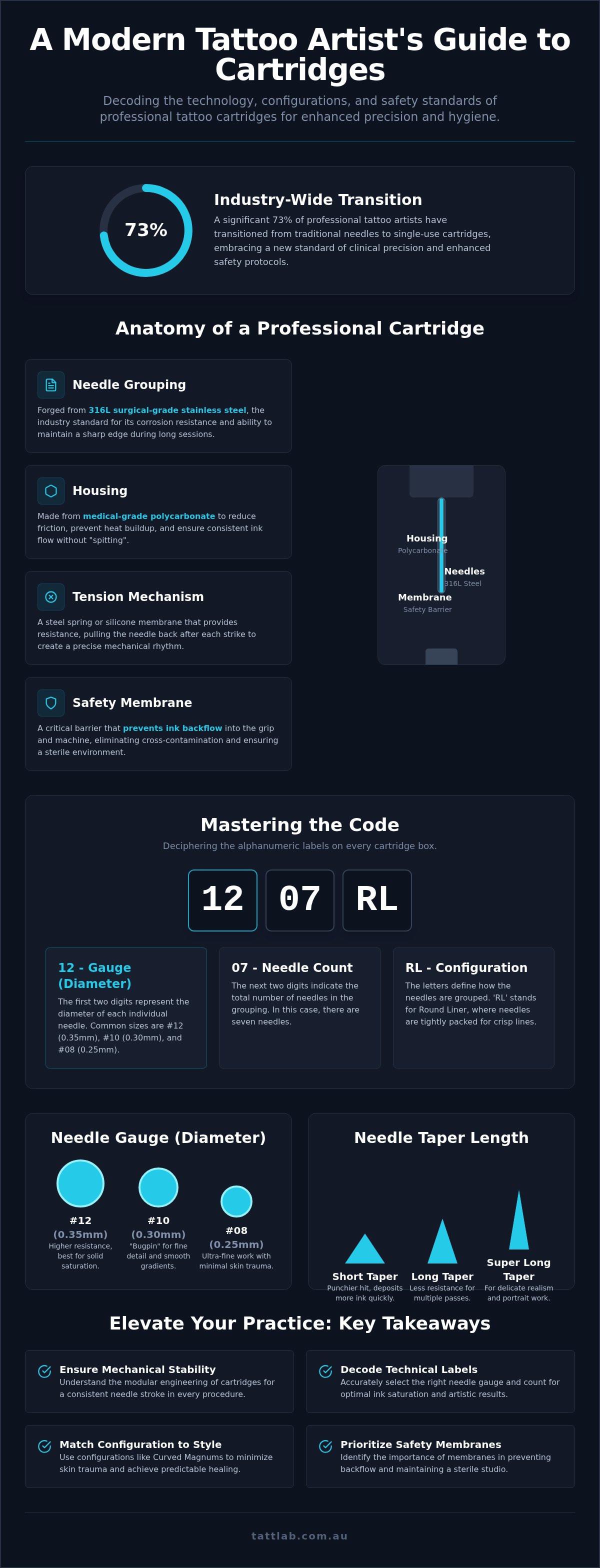
At the heart of every high-performance cartridge is the needle grouping, typically forged from 316L surgical-grade stainless steel. This material is the non-negotiable industry standard because it offers exceptional resistance to corrosion and maintains a sharp edge throughout long sessions. These needles are encased in medical-grade plastic housing, often made from high-clarity polycarbonate. This choice of material is deliberate. It reduces friction between the moving needle and the tip, preventing heat buildup that could otherwise lead to localized skin trauma or the inconsistent "spitting" of ink. The internal tension mechanism, whether a steel spring or a silicone membrane, provides the necessary resistance to pull the needle back into the housing after every strike, creating the mechanical rhythm required for precision work.
The Advantage of Modular Systems
Switching between a lining and shading setup used to require multiple machine configurations or a time-consuming breakdown of your gear. Modular cartridges allow you to swap configurations in seconds, maintaining your creative momentum without interrupting the client's experience. Because these units are designed with standardized back-stems, they ensure a consistent needle depth and throw regardless of the specific Tattoo machine you're using. This uniformity results in a cleaner, more organized workstation where your focus remains on the skin rather than mechanical troubleshooting. The ability to switch tools mid-session with a simple click ensures that your workflow remains as fluid as your artistic vision.
Material Integrity and Skin Safety
The biological impact of your tools is as important as the visual result. Every component must be bio-compatible to ensure the body's healing response isn't compromised by chemical leaching or microscopic debris. High-quality needles undergo a rigorous polishing process that removes microscopic burrs. When needles are inadequately polished, they can act like microscopic saws, creating jagged punctures that lead to excessive inflammation and slower healing times. A smooth finish allows the needle to glide into the dermis with minimal resistance, facilitating better ink flow. A needle's taper refers to the specific length and angle of the needle point, which directly dictates the puncture force required for skin entry and the precision of the ink deposit. This tattoo cartridges guide emphasizes that these technical details are the foundation of skin integrity and artistic longevity. Understanding these components is the first step in a professional progression toward more refined, consistent work.
Mastering the Code: Diameter, Count, and Configuration
Deciphering the alphanumeric code on a cartridge box is like reading a clinical prescription. In this tattoo cartridges guide, we simplify the universal system used by professional manufacturers. Take "1207RL" as an example. The first two digits (12) represent the gauge or diameter of individual needles. The next two (07) indicate the needle count. The letters (RL) define the configuration, in this case, a Round Liner. This systematic approach allows for a predictable mechanical response when the needle interacts with the dermis, ensuring your artistic intent translates perfectly to the skin.
Understanding Gauge and Diameter
The diameter of the needle directly impacts the puncture's surface area and the volume of ink deposited. In Australian studios, the most common needle gauges used are #10 (0.30mm) and #12 (0.35mm). Thicker needles, like the #12, face higher skin resistance, which requires a more deliberate machine stroke to achieve solid saturation. Conversely, #10 "Bugpins" or even #08 (0.25mm) needles allow for ultra-fine detail and smoother gradients with significantly less trauma to the tissue. Choosing the correct diameter is a balance between the desired saturation and the physical integrity of the skin. It's helpful to review FDA tattoo safety guidelines to understand how needle precision and ink delivery contribute to overall client health.
The "Taper" length also plays a critical role in this equation. It describes how gradually the needle point narrows to its tip. We can categorize them as follows:
- Short Taper: Provides a punchier hit, depositing more ink quickly.
- Long Taper: Offers less resistance, allowing for multiple passes with reduced trauma.
- Super Long Taper: Specifically designed for the most delicate realism and portrait work.
Configuration Acronyms Explained
The configuration determines how the needles are grouped and spaced within the housing. Round Liners (RL) are grouped tightly at the tip for crisp, defined lines. In contrast, Round Shaders (RS) feature more internal spacing, making them ideal for small-scale filling or bold shading. For larger areas, Magnums (M1) and Curved Magnums (RM) are the preferred tools. Curved Magnums are often considered the secret to seamless soft shading because their slightly arched profile matches the natural topography of the body, preventing the "edge marks" sometimes left by traditional flat magnums. If your work involves complex geometric patterns, Flat (F) configurations provide the sharp, straight edges required for architectural precision. To ensure you have the right tool for every style, you can browse our range of specialized configurations to find your perfect match.
The Artist’s Selection Guide: Matching Cartridges to Style
Selecting the appropriate hardware is where technical knowledge meets artistic intuition. While the previous sections of this tattoo cartridges guide decoded the numerical labels, the real mastery lies in understanding how these configurations interact with different skin types and artistic styles. Choosing a tool that matches your specific outcome isn't just about convenience; it's a fundamental step in minimizing skin trauma. When you select a configuration that deposits ink efficiently, you reduce the need for multiple passes, which directly leads to faster healing times and more vibrant pigment retention.
Reducing the number of passes over a single area of skin is one of the most effective ways to preserve skin integrity. Every additional pass increases the inflammatory response and the likelihood of scabbing. By selecting a high-performance Magnum for packing or a precision Round Liner for detail, you achieve the desired saturation in fewer strokes. This methodical approach reflects a commitment to holistic wellness, prioritizing the body's natural healing process while delivering an uncompromising aesthetic result.
Configurations for Line Work and Detail
For artists specializing in fine line work, micro-realism, or delicate dotwork, the 'tightness' of a Round Liner is critical. A tight RL grouping ensures the needles don't splay upon impact, allowing for the razor-sharp script and microscopic detail required in modern urban aesthetics. Using Long Tapers in these scenarios is particularly effective. The extended point allows for a more gradual entry into the dermis, requiring less puncture force and significantly reducing the risk of blowouts. For those looking to optimize their saturation further, The Professional Guide to Tattoo Ink provides essential insights into the chemical properties of pigments and how they interact with different needle tapers.
Configurations for Shading and Colour Packing
When shifting focus to shading and colour packing, the physics of needle surface area becomes the primary consideration. Magnums are engineered for large area coverage because they distribute the machine's force across a wider grouping, preventing the concentrated trauma that a single needle might cause. Curved Magnums (RM) have become the secret weapon for realism artists. Their arched profile mimics the natural topography of the body, allowing for seamless 'blush' effects and soft gradients without the harsh edge marks often associated with traditional flats.
In contrast, Round Shaders (RS) are indispensable for bold traditional work. Because the needles are grouped more loosely than in a liner, they excel at packing solid colour and creating the thick, consistent lines found in Neo-Traditional styles. Throughout every session, maintaining a sterile field is paramount to mitigating the health risks of tattoo ink and potential cross-contamination. By matching the configuration to the task, you ensure a smoother narrative of progression for your client, from the first interaction to the final result.
The Science of Safety: Membranes and Cross-Contamination
While artistic selection is vital for the visual outcome, the mechanical safety of your hardware is the bedrock of a professional studio. This tattoo cartridges guide must address the invisible risks that occur behind the needle housing. The most significant advancement in cartridge engineering isn't the needle itself, but the internal barrier that protects both the client and your equipment. Understanding the distinction between a simple tension mechanism and a true safety membrane is essential for maintaining a sterile environment and ensuring the longevity of your tools.
Many entry-level cartridges utilize simple rubber bands to provide needle tension. While these offer the necessary mechanical resistance for the needle to retract, they provide zero protection against fluid migration. True safety cartridges utilize a high-tension silicone or rubber membrane that creates a physical, fluid-tight seal. This barrier is designed to prevent ink, blood, and interstitial fluid from traveling up the needle bar and into your machine's motor housing. Once biological matter enters the internal components of your machine, it creates a permanent reservoir for cross-contamination that is nearly impossible to reach with standard surface disinfectants.
Verifying the integrity of the cartridge housing is just as critical as the internal membrane. High-quality housings are typically constructed from medical-grade polycarbonate and are ultrasonically welded to ensure there are no gaps where fluids can leak. This level of precision engineering reflects a methodical approach to safety, ensuring that the "hit" of the machine remains consistent while the internal motor remains shielded from corrosive fluids. When you choose artist-vetted hardware, you're investing in a predictable, safe progression for every project you undertake.
Preventing Machine Contamination
Ink and biological matter can enter the motor housing through capillary action or the vacuum created by the high-speed movement of the needle bar. Without a membrane, your machine effectively acts as a pump, drawing contaminants upward with every stroke. This doesn't just threaten the health of your next client; it eventually corrodes the delicate internal motor and voids your equipment warranties. For a comprehensive look at maintaining a clinical field, including detailed studio setup checklists, refer to our guide on Medical Supplies for Tattoo Artists.
Professional Hygiene Protocols
Safety protocols must extend from the initial setup to the final disposal. All professional-grade cartridges undergo Ethylene Oxide (EO) Gas processing and are sealed in individual medical-grade blister packs to ensure absolute sterility until the moment of use. The EO Gas sterilization indicator on the packaging changes color to provide visual confirmation that the contents have successfully undergone the sterilization process. Once a session is complete, used cartridges must be disposed of immediately in puncture-resistant yellow sharps containers to comply with Australian safety standards. To protect your clients and your equipment from the risks of backflow, shop our range of membrane-sealed safety cartridges and elevate your studio's hygiene standards.
Why Australian Studios Trust Tatt Lab for Cartridge Supplies
Our commitment to your practice goes beyond simple retail. As an artist-owned and operated business, we recognize that the fluid-tight seal of a safety membrane isn't just a technical feature; it's a non-negotiable requirement for protecting your machine and your client's health. By integrating the technical principles found in this tattoo cartridges guide with our curated inventory, we ensure that your studio operates at the peak of mechanical and biological safety. We specialize in a streamlined procurement process, allowing you to combine your medical-grade PPE and high-performance tattoo consumables in a single, efficient order. This methodical approach reduces administrative friction, giving you more time to focus on the artistic results that define your career.
The Specialist’s Selection
We believe in quality over quantity. That's why we exclusively stock industry-leading brands like Elite and EZ, including the highly regarded Elite III and EZ V-Select series. These manufacturers align with our high standards for 316L surgical stainless steel and medical-grade polycarbonate housings. Buying from an artist-owned Australian business means you have access to local expertise for any technical equipment queries, ensuring you never have to guess which configuration is right for a complex project. For a deeper look at how we select our inventory, explore our article on Professional Tattoo Supplies in Australia.
Supporting the Australian Artist Community
Managing the overheads of a busy studio requires a partner who understands the rhythm of the industry. We offer wholesale accounts designed to support the growth of local studios, providing a steady supply of essential hardware without the stress of international lead times. With nationwide express shipping across Australia and free shipping on orders over $100, we ensure your studio remains stocked and ready for every transformation. Our role is to be your dedicated partner from the initial setup to the final result, replacing uncertainty with controlled, predictable progress. We invite you to explore our full range of Tattoo Cartridges and experience the difference that professional-grade hardware makes in your daily practice.
Refining Your Technical Precision
Mastering the mechanical nuances of your hardware is more than a technical requirement; it's a commitment to the physical integrity of your clients and the longevity of your artistic results. This tattoo cartridges guide has detailed the critical importance of safety membranes in preventing backflow and the clinical logic behind selecting specific needle gauges. By choosing configurations like Curved Magnums for seamless shading or tight Round Liners for script work, you reduce skin trauma and foster a more predictable healing narrative. This methodical approach replaces uncertainty with a sense of controlled progress, allowing you to focus entirely on the creative transformation.
As an artist-owned and operated facility, we focus on providing hardware that meets the highest medical-grade standards. We invite you to shop our curated range of professional tattoo cartridges at Tatt Lab, where every component is vetted for performance and safety. With our comprehensive selection of medical-grade PPE and nationwide express shipping across Australia, your studio will remain equipped for excellence without the stress of supply delays. Your progression as an artist is a journey of constant improvement, and we're here to support your creative progression.
Frequently Asked Questions
What is the difference between a Round Liner and a Round Shader cartridge?
The primary difference lies in the proximity of the needle points to one another at the tip. Round Liners are grouped tightly to create a singular, sharp point for crisp, defined lines; conversely, Round Shaders feature needles that are grouped more loosely. This increased internal spacing allows the Shader to deposit ink over a broader area, making it ideal for small-scale filling, soft transitions, or creating the bold textures found in traditional styles.
Are all tattoo cartridges compatible with all rotary machines?
Most modern rotary machines utilize a standardized universal back-stem, which ensures compatibility with the vast majority of professional cartridge brands. While most hardware follows this Cheyenne-style standard, some proprietary machines require specific cartridges designed by the manufacturer. It's essential to verify your machine’s grip connection before purchasing, though this tattoo cartridges guide focuses on the universal modular system used by industry leaders like Elite and EZ.
How do I know if my tattoo cartridge has a safety membrane?
You can identify a safety membrane by performing a visual and tactile inspection of the cartridge housing. Look for a translucent or colored silicone barrier near the back-stem that creates a physical seal between the needle bar and the machine. If you press the needle bar and feel a soft, elastic resistance rather than the rigid snap of a metal spring, the unit contains a membrane designed to prevent fluid backflow.
What does 'Bugpin' mean in tattoo cartridge terminology?
The term 'Bugpin' refers to a cartridge that utilizes thinner needle diameters, typically #10 (0.30mm) or #08 (0.25mm), grouped into a housing designed for a larger gauge. This configuration allows for more needles to be packed into a smaller surface area. Artists favor Bugpins for ultra-fine detail and seamless realism because the smaller punctures create smoother gradients and minimize visible "dot" textures in the skin.
How often should I change my cartridge during a long tattoo session?
You should change your cartridge if you notice a decrease in needle sharpness or if pigment begins to dry and clog the tip's reservoir. For sessions lasting longer than four hours, swapping to a fresh unit ensures you maintain the mechanical precision required for consistent saturation. Even high-grade 316L stainless steel can lose its microscopic edge after several hours of continuous interaction with the dermis.
Can I reuse a tattoo cartridge if it was only used for a few minutes?
No, you must never reuse a tattoo cartridge under any circumstances once the sterile seal has been broken. Even a few minutes of use exposes the hardware to the studio environment and potential biological matter. Professional hygiene standards mandate that all cartridges are single-use only; they must be disposed of in a sharps container immediately after the session to prevent any risk of cross-contamination.
What is the most common needle gauge used for lining?
The #12 (0.35mm) and #10 (0.30mm) gauges are the most common choices for lining in professional studios. The #12 gauge is the industry standard for bold, traditional lines due to its punchy delivery and slightly larger surface area. The #10 gauge is frequently selected for illustrative or fine-line work where a more delicate entry and refined detail are necessary for the artistic outcome.
Why is my tattoo cartridge spitting ink instead of flowing smoothly?
Ink spitting is typically caused by an incorrect needle depth or an imbalance in your machine's voltage. If the needle is retracted too far into the housing, it can create an air pocket that disrupts the natural capillary action of the ink flow. Adjusting your needle hang or ensuring the cartridge is securely seated in the grip will usually stabilize the pressure and allow the ink to flow consistently.


Comments (0)
There are no comments for this article. Be the first one to leave a message!