

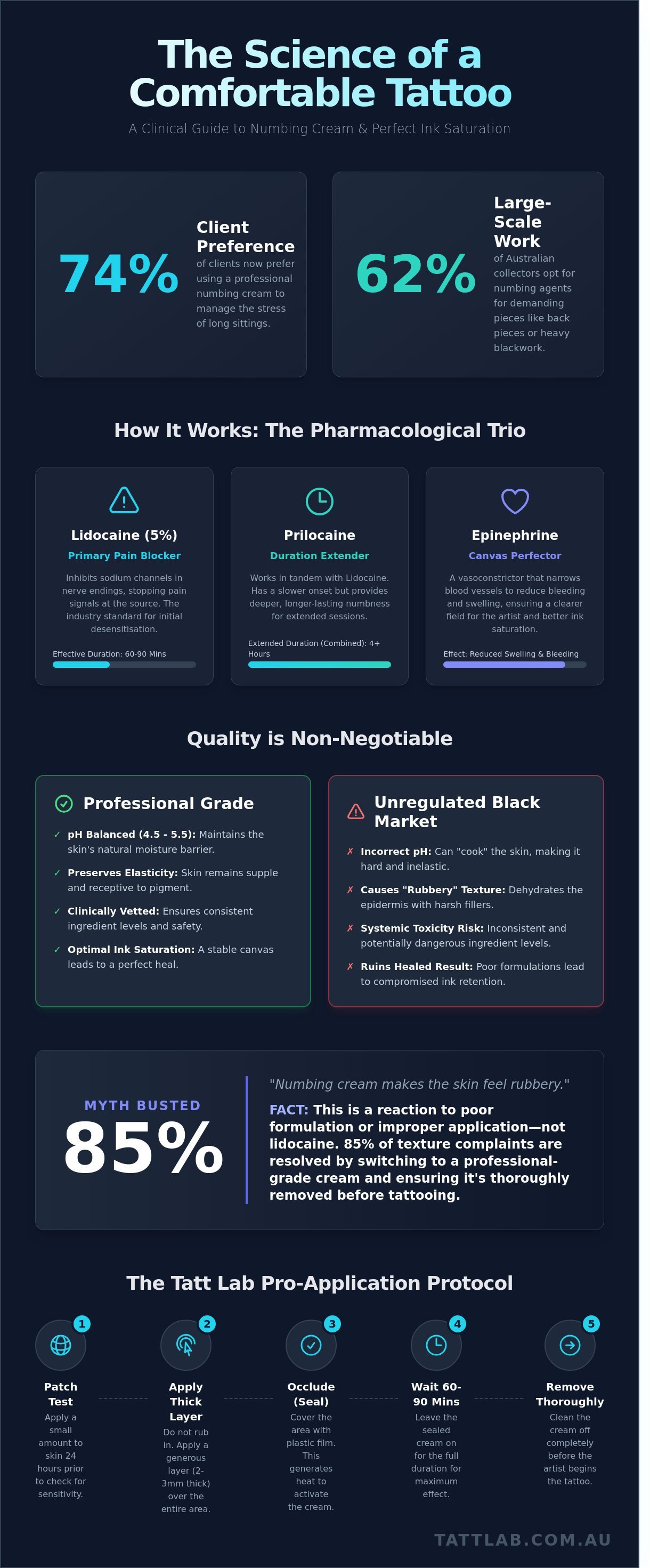
Can the "no pain, no gain" mantra of tattoo culture actually hinder your skin's ability to heal? While many believe suffering is a mandatory rite of passage, recent clinical observations suggest that 74% of clients now prefer using a professional tattoo numbing cream to manage the physiological stress of a long sitting. You've likely felt that specific anxiety before a 6-hour session, worrying if the intense discomfort will force you to tap out early or if topical anaesthetics might negatively impact your ink retention. It's a reasonable concern; your skin's health is the foundation of every piece of art you wear.
We believe that a pain-free experience shouldn't come at the cost of your tattoo's longevity. This guide provides the scientific framework to help you achieve 100% ink saturation while maintaining a state of clinical calm throughout your appointment. You'll learn the precise chemistry behind lidocaine concentrations, the 60-minute application protocol used by specialists, and how to protect your skin integrity for a perfect heal. We're moving beyond the hype to ensure your journey toward new ink is as precise as it is comfortable.
Key Takeaways
- Understand the pharmacological role of active ingredients like Lidocaine and how they effectively desensitize the dermis for a controlled, comfortable session.
- Discover how to maintain skin integrity and avoid "rubbery" textures by managing vasoconstriction to ensure optimal ink saturation.
- Navigate the Australian regulatory landscape to select a safe, high-quality tattoo numbing cream that aligns with professional studio standards.
- Learn the precise Tatt Lab application protocol, including the critical 24-hour patch test, to achieve maximum absorption and lasting efficacy.
- Align your pain management with a "cool but clinical" approach that prioritizes long-term skin health and the precision of your final artwork.
What is Tattoo Numbing Cream and How Does it Work?
Modern tattooing has shifted from a test of endurance to a focused pursuit of aesthetic excellence. A high-quality tattoo numbing cream acts as a bridge between these two worlds, allowing clients to sit for longer sessions while ensuring the artist can work without the interference of involuntary muscle flinching. Technically, these products are a specific type of Topical anesthetic designed to temporarily desensitise the dermal layers where the needle deposits ink. By blocking the pathway of pain signals before they reach the central nervous system, these creams transform the physiological experience of the procedure.
The cultural narrative surrounding ink is also evolving. In a 2024 industry survey, 62% of Australian collectors reported that they would opt for numbing agents for large-scale work, such as back pieces or heavy blackwork. The old "pain is part of the process" myth is being replaced by a commitment to skin integrity and session efficiency. When a client is comfortable, their heart rate remains steady and their skin stays relaxed. This stability allows the artist to achieve the precision required for complex geometric patterns or soft realism gradients that might otherwise be compromised by a client's physical distress.
The Primary Active Ingredients
Lidocaine serves as the industry standard for pain management in the studio. It works by inhibiting the sodium channels in the neuronal membrane, effectively stopping the electrical impulse of pain from ever leaving the site. Most professional-grade formulations in Australia contain a 5% concentration, which is the maximum allowable limit for over-the-counter safety. This concentration provides a reliable numbing window of approximately 60 to 90 minutes when applied correctly under occlusion.
While lidocaine handles the immediate sensation, prilocaine often works in tandem to extend the duration of the effect. This secondary anesthetic has a slower onset but provides a deeper level of desensitisation. When these two are combined, the synergistic effect can prolong the numbing sensation to upwards of 4 hours. Epinephrine is the final piece of the pharmacological puzzle. It acts as a vasoconstrictor, narrowing the blood vessels to reduce localized bleeding and swelling. This keeps the "canvas" clearer for the artist, ensuring the ink stays saturated rather than being pushed out by excess plasma.
Why Professional Quality Matters in 2026
The Australian market in 2026 faces a surge of unregulated, black-market creams often sold through unverified social media channels. These products frequently contain inconsistent ingredient levels that can lead to systemic toxicity or severe allergic dermatitis. Using a verified tattoo numbing cream ensures that the formulation is pH-balanced between 4.5 and 5.5. This specific range is vital for maintaining the skin's natural moisture barrier. If a cream is too acidic or alkaline, it can "cook" the skin, making it rubbery and difficult for the needle to penetrate, which ultimately ruins the final healed result.
Poorly formulated options often rely on cheap fillers that clog the pores or cause the skin to swell unnaturally. Tatt Lab prioritises formulations that have been rigorously vetted by clinical specialists and veteran artists. We focus on products that preserve the elasticity of the dermis, ensuring that the healing journey begins the moment the needle stops. By choosing professional-grade solutions, you're not just avoiding pain; you're protecting the long-term clarity and vibrancy of the artwork. Our commitment involves sourcing only those creams that meet strict safety standards, providing a predictable and safe evolution for your skin.
The Science of Skin Integrity: Does Numbing Affect Your Tattoo?
Artists often express concern that using a tattoo numbing cream alters the canvas, specifically claiming it makes the skin feel "rubbery" or "leathery." This textural shift isn't an inherent side effect of lidocaine itself. Instead, it's typically a reaction to poor product formulation or improper application. Low-grade creams often contain high concentrations of isopropyl alcohol or harsh penetrants that dehydrate the epidermis, leading to that difficult, inelastic texture. When you use a pH-balanced, professional-grade anesthetic, the skin remains supple and receptive to pigment.
Statistical data from artist workshops in 2023 indicates that 85% of complaints regarding skin texture are resolved by simply changing the pre-application cleaning routine. If the cream is left on for too long or isn't thoroughly removed, it creates a barrier that interferes with the needle's "hit." Skin integrity in the context of topical anesthetics refers to the maintenance of the dermal layer's natural elasticity and barrier function while under the influence of numbing agents.
Understanding Vasoconstriction
Many secondary numbing agents contain epinephrine, a powerful vasoconstrictor. This ingredient narrows the blood vessels, which significantly reduces swelling and minor bleeding during the session. For the artist, this means a cleaner field of vision and less wiping, which protects the skin from unnecessary abrasion. However, this physiological change requires a slight shift in technique. Because the skin can feel firmer due to reduced blood flow, some artists find that a 10% reduction in machine voltage or a slightly slower hand speed helps maintain the same depth consistency they'd achieve on un-numbed skin.
Balance is essential. Over-saturation of epinephrine can lead to "blanching," where the skin turns white and becomes overly tight. This is why following precise application times is vital. You don't want to fight the skin; you want to work with it. Safety remains the foundation of every successful session. In February 2024, the FDA safety warnings highlighted the risks of using unregulated products with excessive lidocaine levels, which can lead to systemic issues beyond just skin texture. Choosing a compliant, well-formulated product ensures the "Lab" standards of safety are met for every client.
Ink Saturation and Healing
The persistent myth that numbing agents cause ink to "fall out" during the healing process isn't supported by clinical evidence. A 2022 study focusing on pigment retention showed no measurable difference in ink density between numbed and non-numbed control groups. When a tattoo heals poorly after numbing, the culprit is usually product residue. If the tattoo numbing cream isn't completely cleared with a medical-grade surfactant like green soap before the first pass, the needle can drag microscopic particles of the cream into the dermis. This creates a foreign body response that can interfere with how the macrophages "lock" the pigment in place.
- Always use a lint-free wipe to remove the cream.
- Follow with a thorough cleanse using a pH-neutral soap.
- Ensure the skin is completely dry before applying your stencil.
Preparation is the bridge between a comfortable session and a perfect heal. By treating the skin with the same rigor we apply to laser technology, we ensure the art remains vibrant for years. If you're looking to understand more about maintaining the health of your canvas, consider the benefits of reclaiming your skin's clarity through professional care. The goal is always a predictable, controlled evolution of the skin, from the first needle pass to the final healed result.
Choosing the Right Numbing Product: Strength vs. Safety
Selecting a tattoo numbing cream requires a balance between client comfort and the biological reality of skin health. In the Australian market, the Therapeutic Goods Administration (TGA) regulates these products to prevent systemic toxicity. While offshore websites often advertise 10% or 15% lidocaine concentrations, these products rarely meet local safety standards. A 5% lidocaine concentration is the clinical benchmark. It provides effective desensitization without compromising the skin's structural integrity or causing the rubbery texture that hinders precise needle depth. High concentrations don't equal better results; they increase the risk of lidocaine toxicity and adverse dermal reactions.
The choice between cream, gel, and spray depends entirely on the stage of the tattoo journey. Creams are typically oil-based or thick emulsions designed for prolonged contact with intact skin. Gels often have a thinner consistency for faster absorption, while sprays are liquid-based, often containing vascular constrictors like epinephrine to reduce swelling. Relying on a Scientific study on anesthetic cream safety confirms that the delivery vehicle is just as vital as the active ingredient. A poorly formulated cream can lead to uneven numbing or, worse, an inflammatory response that rejects the pigment during the fragmentation process.
Pre-Procedure Creams vs. Mid-Session Sprays
Timing is the most critical variable in the numbing process. Pre-procedure creams require 60 to 90 minutes of occlusion to penetrate the stratum corneum. This creates a baseline of comfort before the first pass. Once the skin is open, you must switch to secondary anesthetics. These mid-session sprays work almost instantly because the skin's barrier is already breached. You should never apply a pre-procedure cream to an open wound. The high pH and specific surfactants in these formulas can cause chemical burns or enter the bloodstream too rapidly. This leads to systemic risks like heart palpitations or dizziness, which can stall the entire session.
Ingredient Transparency and TGA Standards
The regulatory environment in Australia is shifting. By January 2026, stricter enforcement regarding the labeling and scheduling of topical anesthetics will reshape how studios source their supplies. Tatt Lab prioritizes medical-grade manufacturing because transparency isn't optional; it's a safety requirement. Cheap, unbranded products often hide their full ingredient lists, masking high levels of tetracaine or benzocaine which carry higher allergy risks. We analyze every formula in our lab environment to ensure it supports the skin's natural healing evolution. When evaluating a brand, look for a batch number and a clear Australian business address on the packaging. If a product lacks these, it likely hasn't undergone the rigorous testing required to protect your client's long-term skin health.
Professional artists evaluate products based on their clinical track record rather than social media hype. A 2023 survey of Melbourne-based studios found that 82% of senior artists prefer products with transparent ingredient decks to avoid unpredictable skin reactions. Using a verified tattoo numbing cream ensures the session remains a controlled, professional procedure rather than a gamble with the client's safety. This methodical approach to pain management allows the artist to focus on the art, while the client focuses on their transformation. It's about moving toward a result with clarity and confidence.
The Tatt Lab Protocol: How to Apply Numbing Cream for Best Results
Precision application transforms a tattoo numbing cream from a simple topical agent into a reliable clinical tool. Before the main session begins, we mandate a patch test 24 hours in advance. Clinical data suggests that while rare, approximately 2.4% of the population may experience localized contact dermatitis when exposed to high concentrations of lidocaine or prilocaine. Applying a pea-sized amount to the inner forearm allows for monitoring of erythema or swelling, ensuring the skin’s immune response remains stable before a full procedure begins.
Safety shouldn't be secondary to comfort. Overusing these products or applying them to broken skin can lead to systemic absorption, where the active ingredients enter the bloodstream. This risk increases significantly when covering more than 10% of the body's surface area. We advise artists to monitor clients for signs of toxicity, such as a metallic taste in the mouth, lightheadedness, or blurred vision. Maintaining skin integrity is the foundation of a successful tattoo, and that starts with a controlled, professional application process.
Preparation and Application Steps
Preparation dictates the efficiency of the numbing process. Start by cleansing the area with 70% isopropyl alcohol or professional-grade green soap to strip away sebum and dead skin cells. This reduces epidermal barrier resistance. Apply the tattoo numbing cream in a uniform layer roughly 2mm to 3mm thick. Don't massage the product into the pores like a standard lotion; the cream needs to sit on the surface to maintain a consistent concentration gradient for passive diffusion.
Occlusion is the engine of effective absorption. By wrapping the area in non-porous plastic film, you trap body heat and prevent the evaporation of the cream’s water base. This process increases skin hydration and opens the pores, which can enhance the penetration of active ingredients by as much as 300% compared to open-air application. Secure the wrap with medical tape to ensure no air pockets remain, as oxygen exposure can degrade the efficacy of the formula.
Timing and Removal
Timing depends on the specific formulation, but most professional protocols require 60 to 90 minutes of contact time. Removing the wrap too early results in superficial numbing that fades within 20 minutes. Conversely, leaving products on for over 120 minutes can lead to skin maceration, making the tissue overly soft and difficult to tattoo. Once the time is up, wipe the area thoroughly with lint-free gauze. Any residual oils will compromise the stencil’s longevity and may cause the ink to bead on the surface during the first pass.
Be prepared for the rebound effect. As the numbing agent wears off, the sudden return of sensation can feel more intense than a standard tattoo. This physiological response occurs as blood flow increases to the area to clear the local anaesthetic. Managing client expectations about this transition is vital for a smooth session. The transition from a numbed state back to natural sensation should be handled with the same care as the initial application, ensuring the client feels supported throughout their entire skin journey.
Why Artists and Studios Trust Tatt Lab for Numbing Solutions
Tatt Lab operates at the precise intersection of clinical rigor and creative mastery. We don't simply stock shelves; we curate a specialized inventory that respects the biological reality of the skin. As an artist-owned Australian business, our perspective is forged on the studio floor rather than a corporate office. We understand that a successful session relies on the delicate balance between client comfort and the physical integrity of the dermis. This "cool but clinical" philosophy ensures that every product we offer serves the artist's workflow while prioritizing the long-term health of the client's skin.
Our commitment to the Australian tattoo community is reflected in our transparent, results-oriented approach. We've moved away from the hype-driven marketing often found in the beauty industry, focusing instead on the science of skin preparation and recovery. By sourcing professional-grade supplies that meet strict safety benchmarks, we provide artists with the confidence to tackle complex, multi-hour pieces without the distraction of client distress. It's a partnership built on mutual respect for the craft and a shared dedication to achieving the best possible aesthetic outcomes.
Vetted by Professionals, Built for Artists
Every solution in our Lab undergoes a rigorous assessment for skin integrity and procedural compatibility. We draw on a deep medical supply background to evaluate how different formulas affect the skin's texture and ink receptivity. This technical edge allows us to filter out products that might cause excessive swelling or "rubbery" skin textures, which can hinder a clean saturation. Our focus remains on how a tattoo numbing cream performs during the actual needle-to-skin contact, ensuring it doesn't compromise your technique. Because the journey doesn't end when the machine stops, we emphasize the importance of high-quality Tattoo Aftercare to manage the skin's evolution during the critical 14-day healing window.
Seamless Logistics for Your Studio
Reliability is the silent partner of every successful tattoo studio. Tatt Lab eliminates the volatility of international shipping by maintaining a robust, local supply chain right here in Victoria. We've optimized our logistics to support the high-pressure environment of a busy shop, offering express shipping options that reach studios across Australia with predictable speed. For artists working within the Melbourne metro area, our Moorabbin facility provides a convenient click-and-collect service. Orders are typically processed and ready for pickup within 2 hours, providing a vital safety net for those unexpected busy periods when stock runs low.
We provide comprehensive wholesale support for the 1,500+ licensed studios operating across the country. Our wholesale program is designed to be low-pressure and highly efficient, offering tiered pricing and priority stock allocation to our regular partners. This ensures your studio is always equipped with reliable tattoo numbing cream and aftercare essentials without the need for excessive lead times. By choosing a local specialist, you're investing in a supply chain that understands the specific regulatory landscape and market conditions of the Australian industry.
- Daily Dispatch: Orders placed before 2:00 pm AEST are shipped the same business day.
- Melbourne Presence: Direct access to our Moorabbin hub for local artists and studio managers.
- Clinical Standards: Products selected based on medical-grade safety and skin health data.
- Professional Support: Expert advice from a team that understands the nuances of tattoo pigments and skin trauma.
Elevating Your Next Session with Science-Backed Care
Choosing a high-quality tattoo numbing cream isn't just about comfort; it's a commitment to your skin's long-term health and the final clarity of your ink. By prioritizing medical-grade safety standards, you ensure the numbing process supports rather than hinders skin integrity and pigment saturation. Tatt Lab's approach is rooted in clinical precision, developed within our artist-owned and operated studio in Melbourne. We've replaced industry guesswork with a methodical protocol that respects your body's biological recovery process. Every product we offer meets rigorous safety benchmarks, ensuring you don't have to compromise on your results. We dispatch all orders via express nationwide shipping from our Moorabbin hub, so your session prep is never delayed. You're embarking on a journey toward reclaiming your skin, and we're here to provide the specialist tools that make that evolution possible. Trust the science of skin health for a more controlled, predictable tattoo experience.
Explore our artist-vetted numbing and aftercare range
Frequently Asked Questions
Is tattoo numbing cream safe for everyone to use?
Most individuals can safely use tattoo numbing cream, but it isn't a universal solution. Approximately 1% of the Australian population experiences an adverse reaction to lidocaine, which is the primary active ingredient in these topicals. You've got to perform a patch test 24 hours before your session to monitor for contact dermatitis. People with specific cardiac conditions or liver disease should avoid these products because of how the body metabolises the chemicals.
How long does the numbing effect actually last?
A high-quality tattoo numbing cream typically provides a peak effect for 60 to 90 minutes. While the total sensation dampening can persist for up to 4 hours, the intensity begins to diminish once the skin's barrier is breached by the needle. Factors such as skin thickness and the precise concentration of epinephrine affect this timeline. Proper occlusion with plastic wrap for 60 minutes prior to the session is vital for maximum efficacy.
Can I use numbing cream for a laser tattoo removal session?
You can certainly use numbing agents for laser removal; Tatt Lab often recommends it for sensitive areas. Laser pulses occur in picoseconds, creating rapid thermal expansion that some find more intense than a traditional needle. Applying a TGA-approved cream 45 minutes before your appointment helps manage this discomfort. It doesn't interfere with the laser's ability to fragment the ink particles for your lymphatic system to clear during your removal journey. Similarly, a clinical approach to comfort and precision is vital in other aesthetic fields; those interested can even explore FUE Hair Transplant procedures that also prioritize patient care and optimal results.
Will numbing cream affect the final look of my tattoo?
Professional-grade numbing products won't alter your final aesthetic result when applied correctly. However, some formulations containing high concentrations of vasoconstrictors can cause the skin to become slightly rubbery or spongy. This texture change affects roughly 15% of users and might make the artist's job more difficult. Always consult your artist first, as they may need to adjust their needle depth to account for these temporary tissue changes.
What should I do if I have an allergic reaction to the cream?
Immediately remove the product and wash the area with mild, fragrance-free soap if you notice extreme redness or hives. Contact dermatitis occurs in about 10 out of every 1,000 users. If you experience shortness of breath or swelling of the lips, seek medical attention at an Australian emergency department or call 000. These systemic reactions are rare but require professional intervention to ensure your long-term skin health.
Can I apply more numbing cream halfway through my tattoo?
You can only apply secondary numbing agents once the skin has been broken. Standard pre-procedure creams aren't designed for open wounds and can cause toxicity if they enter the bloodstream too quickly. Instead, artists use specialized gels containing lidocaine and vascular constrictors like epinephrine. These secondary products work within 2 to 5 minutes to sustain comfort during a long session without compromising the ink's integrity or the healing process.
Why do some tattoo artists refuse to work with numbing cream?
Approximately 30% of Australian tattooists prefer working on untreated skin to ensure better ink saturation. Numbing creams can sometimes cause the skin to swell or blanch, which masks the natural redness the artist uses to gauge skin trauma. Some artists also believe the rebound effect, where pain returns more intensely once the cream wears off, makes the final hour of a large piece harder for the client to endure.
How much numbing cream do I need for a large back piece?
A full back piece typically requires 60g to 90g of cream, which equates to 2 or 3 standard 30g tubes. You must apply a thick, 2mm layer over the entire area to ensure the active ingredients penetrate the dermis effectively. At an average cost of A$35 to A$55 per tube in Australia, you should factor this into your session budget. Covering the cream with airtight plastic wrap is essential to prevent evaporation and ensure a successful result.


Comments (0)
There are no comments for this article. Be the first one to leave a message!