

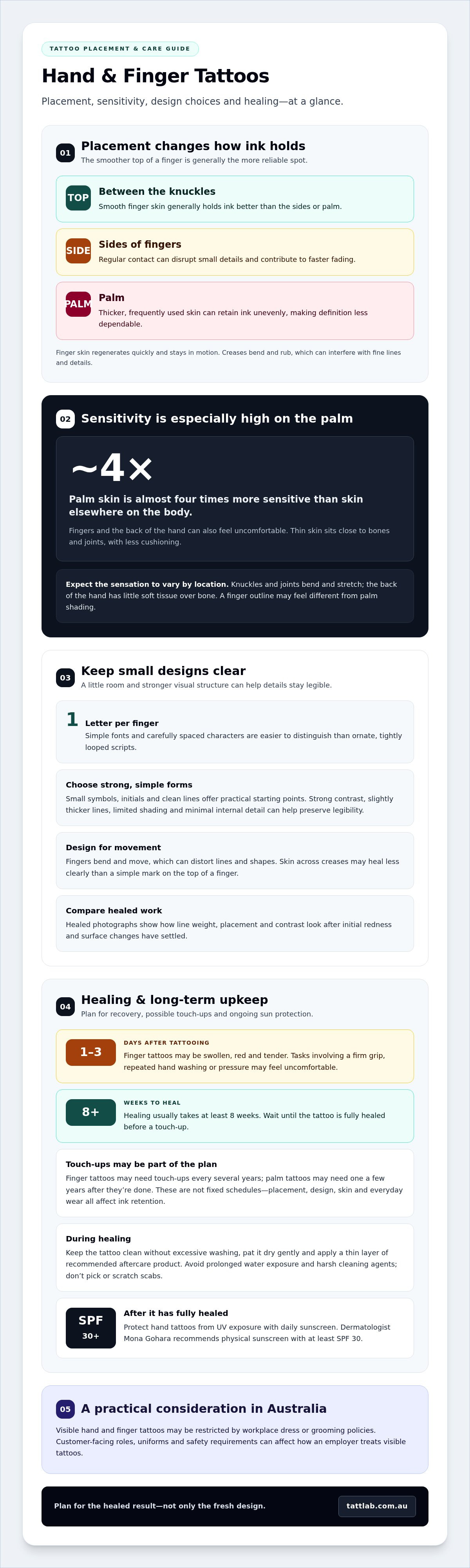
The best tips for tattooing hands and fingers start with choosing placement carefully. The smooth top of a finger, between the knuckles, generally holds ink better than the sides or palm, where tattoos can fade faster. Fingers and the back of the hand can be uncomfortable to tattoo, while palm skin is almost four times more sensitive than skin elsewhere on the body.
That sensitivity, along with frequent movement and skin that may fade or distort fine details, makes hand tattoos a considered choice. Weigh the discomfort against the design’s visibility and how it may look as it heals.
This guide explains why these placements can hurt, why finger tattoos may need touch-ups, and how design, line weight and placement affect the result. It also covers skin movement and healing, helping you make informed decisions about a tattoo that works with the hand rather than against it.
Key Takeaways
- Use strong contrast, slightly thicker lines and limited detail to help small designs stay legible as they heal and age.
- Plan for possible touch-ups, and wait until the tattoo is fully healed, usually at least 8 weeks after the appointment, before having one.
- Account for how fingers bend and move when choosing a motif, since movement can distort lines and shapes.
- During healing, keep the tattoo clean, pat it dry gently and avoid prolonged water exposure and harsh cleaning agents.
- After the tattoo has fully healed, protect hand tattoos from UV exposure with daily sunscreen; dermatologist Mona Gohara recommends physical sunscreen with at least SPF 30.
1. Do Finger Tattoos Fade Faster?
Yes. Finger tattoos often fade faster than tattoos on less exposed, less mobile areas because finger skin regenerates quickly and is constantly in motion. The smooth top of a finger, between the knuckles, generally offers a more reliable placement than the sides or palm. Those areas can lose ink sooner, leaving gaps or patchy sections as the tattoo heals and ages.
Palms pose particular challenges. Their thicker, frequently used skin can make ink retention uneven, so a design may lose definition and look blurred or muddy. The sides of fingers also experience regular contact, while the spaces between fingers bend, crease and rub together. These conditions can disrupt small details. For example, a fine line across a crease may heal less clearly than a simple mark on the top of a finger.
Contrast affects how fading appears. Designs with very fine lines, pale tones or closely packed details can lose legibility as their edges soften. Simple shapes and clear spacing give the eye more structure to follow. Before committing, compare healed photographs with fresh tattoo images. Healed examples show how the artist’s line weight, placement and contrast look after the initial redness and surface changes have settled.
Hand tattoos can need touch-ups, and finger tattoos may require them every several years. Palm tattoos may need a touch-up a few years after they’re done. These are not fixed schedules: the placement, design, skin and everyday wear all influence how the ink holds. Book a finger-tattoo touch-up appointment after 4 weeks, but wait until the tattoo is fully healed before the procedure. Healing usually takes at least 8 weeks after the appointment.
Aftercare helps protect the healing tattoo, though it can’t remove the placement’s natural challenges. Keep the area clean without excessive washing, pat it dry gently and apply a thin layer of recommended aftercare product. Don’t pick or scratch scabs, since removing them can pull out colour. After the tattoo has fully healed, apply sunscreen to your hands daily; dermatologist Mona Gohara recommends physical sunscreen with at least SPF 30.
Visible hand and finger tattoos may be restricted by individual workplace dress or grooming policies in Australia. Customer-facing roles, uniforms and safety requirements can affect how an employer treats visible tattoos, so review the relevant workplace policy before choosing a placement.
For practical tips for tattooing hands and fingers, plan for the healed result, not just the fresh design. Choose a placement with better ink retention, prioritise contrast and consider touch-ups when assessing long-term upkeep. The sides and palms can suit personal expression, but their tendency to fade makes them less dependable for crisp, lasting detail.
2. Why Are Hand Tattoos Painful?
Fingers and the back of the hand are commonly considered uncomfortable tattoo locations. Thin skin sits close to bones and joints, leaving less cushioning between the needle and sensitive structures. The palm can feel especially intense: its skin is almost four times more sensitive than skin elsewhere on the body. Pain varies by placement, so a small finger design may feel different from shading across the palm.
The sensation changes with location. Tattooing over a knuckle or near a finger joint involves skin that bends and stretches during ordinary movement. The back of the hand has little soft tissue over its bones, which can make vibration feel sharp. Palm skin has a distinct texture and high sensitivity. These differences help explain why one person may tolerate a finger outline but find palm work more painful.
Set expectations before the session. Hand tattoos can feel more intense than tattoos on fleshier areas, and the sensation may change as the artist moves between locations. A client expecting a steady level of discomfort may be surprised by sharper moments around joints or the palm. Agreeing on a clear pause signal and discussing the design beforehand helps the client communicate without disrupting precise work.
Two methods are used for finger tattoos: a tattoo machine and Stick and Poke, also called Hand Poke. Stick and Poke is less invasive and tends to hurt less than machine tattooing, but it takes longer. A longer session can mean more time managing discomfort, even when each needle insertion feels gentler. The method affects the rhythm of the session, not just the initial sensation.
Design size and technique also shape the experience. A simple outline may involve less work than a filled motif, while repeated passes over a small area can increase tenderness. Skin tension matters on fingers and palms because stable skin supports controlled needle movement. For artists, a calm pace and clear communication let the client report rising discomfort before it affects positioning.
After the appointment, tenderness is part of the early healing process. Finger tattoos may be swollen, red and tender during days 1–3 after tattooing. Plan around that response: tasks requiring a firm grip, repeated hand washing or pressure on the tattoo may feel uncomfortable. Keep the first days manageable, and follow the aftercare instructions provided for the tattoo.
For artists preparing their setup, professional tattoo supplies can support deliberate, controlled work on sensitive placements.
3. Suitable design detail and fonts for small spaces
Finger skin offers little room for complex artwork, so choose a motif that remains readable at a glance. Small symbols, initials and clean lines are practical starting points. A single star, simple heart or initial can be clearer than a detailed portrait compressed onto one finger. For lettering, keep it to one letter per finger and choose a simple font. Carefully spaced characters are easier to distinguish than ornate scripts with tight loops.
Line weight matters as the tattoo heals and ages. Slightly thicker lines give an outline more visual strength than delicate hairlines, while simple shapes preserve clear edges. Keep shading limited and internal detail minimal. For example, a small crescent can retain its outline without texture, while tiny stars crowded inside it may blur together. Strong contrast also helps the design remain legible if the skin’s appearance changes over time.
Let the placement shape the artwork rather than forcing the design to fit. The smooth top of a finger can suit a small symbol or short line, while a centred, symmetrical motif can sit naturally on the back of the hand. Palms need particular restraint: detailed designs may bleed and fade, leaving the image muddy. A bold, uncomplicated shape is easier to read there than fine lettering or intricate shading.
For a coordinated hand, repeat one visual element rather than copying a full design across every finger. Matching line weight, related symbols or a consistent lettering style can create unity without crowding the skin. If each finger carries a letter, keep the font and scale consistent. Leave space between motifs: cramped symbols can merge into a single dark mark as lines soften.
A hand tattoo that connects to a sleeve needs a deliberate transition. Plan how the composition moves from the wrist onto the hand, using a repeated shape, line direction or shading approach to link the areas. For example, a botanical sleeve could continue with one simplified leaf near the wrist rather than tiny leaves across every finger. Hand movement also changes how the design looks, so assess the layout with the fingers relaxed and spread.
Before tattooing, review the stencil at actual size and check its smallest gaps. If two lines nearly touch, remove an element or simplify the shape. Compare the proposed font with healed examples, not just fresh photographs. This careful edit protects legibility: a compact design with clear spacing is generally better suited to a finger than miniature artwork packed with fine details.
4. Hand and finger skin anatomy and movement
Finger skin is highly mobile and can become dry or cracked, while the back of the hand is thin, with bones close to the surface. Bending and stretching can distort a tattoo’s motif, so a design that looks straight with the hand relaxed may shift when the fingers curl. The artist needs to account for these changing positions during placement and application.
Before choosing a hand or finger tattoo, consider its visibility, movement and healing needs. These placements are often best suited to people with previous tattoo experience who understand how visible hand tattoos are. Discuss how the design will look with your hand relaxed, spread and flexed, then review its position with the tattoo artist before work begins.
For the artist, preparation means creating stable conditions on a moving surface. Even lighting without shadows helps reveal the stencil and skin clearly. Skin tension is especially important on fingers and palms: too little tension can make lines blurry. Thin skin also calls for extra care with needle depth. A softer machine hit is advised for the back of the hand, where the skin is delicate.
Healing happens in stages. During days 1–3 after tattooing, a finger tattoo may be swollen, red and tender. Surface peeling and flaking may occur during days 4–10. The surface can appear healed within 2–4 weeks, but deeper layers may take up to 6 weeks to stabilise. Don’t judge the settled appearance by the first few days, and never scratch scabs, as this can remove colour.
Keep the tattoo clean without excessive washing, gently pat it dry and apply a thin layer of recommended aftercare product. Avoid swimming, hot tubs, long baths and harsh cleaning agents during early healing. Protect a fresh hand tattoo from the sun while it heals. A flexible, breathable covering can protect the back of the hand; use breathable gloves only when necessary.
What should you know before getting a hand or finger tattoo? The skin moves constantly, visible placement can affect work and daily life, and deeper healing takes up to 6 weeks. Plan for careful aftercare and avoid scheduling work that puts repeated pressure or friction on the fresh tattoo.
What are the risks of hand and finger tattoos, including infection and poor healing? Infection and poor healing can affect a fresh tattoo, while movement, thin skin and dryness can complicate healing on the hand. Keep the area clean, avoid picking at scabs and follow the tattoo artist’s aftercare instructions.
5. Recommended and discouraged tattoo placements on fingers and hands
For a design that needs to stay clearer, consider the smooth top of a finger between the knuckles or the back of the hand. These placements offer a more suitable surface than the sides or palm, where ink can fade faster. The best choice also depends on visibility, movement and how much detail the design needs.
The top of a finger suits a small, simple motif placed away from the knuckles. Common finger placements include the top, side, inside and base, but each has different trade-offs. The top is generally more reliable for ink retention. A motif near a joint also moves with the finger, so review its position with the hand both relaxed and bent.
Side and palm placements are less dependable for crisp detail. Repeated contact and skin movement can contribute to faster ink loss, while detailed palm designs may bleed and fade until the image looks muddy. Choose these areas only for designs that can tolerate changes in definition. Fine lettering or tightly packed shading is a poor match for a surface prone to patchiness.
For the back of the hand, a symmetrical, centred motif can follow the hand’s shape and keep the composition balanced. Assess the design with the fingers together and spread, since movement can change its appearance. If the tattoo connects to artwork on the wrist, align the visual flow across the transition so the motif does not look disconnected.
Placement is also a decision about visibility. Hand tattoos are best considered by people with previous tattoo experience who understand how exposed they are in daily life. Before committing, compare the proposed location with work clothing, gloves and usual activities. In Australia, workplace policies may also affect whether visible tattoos are acceptable in particular roles.
Sun exposure adds another practical consideration. After a hand tattoo has fully healed, apply sunscreen to the area daily. Dermatologist Mona Gohara recommends physical sunscreen with at least SPF 30. While the tattoo is healing, protect it from the sun with a fingerless glove or mittens, rather than applying sunscreen to fresh skin.
To prepare for healing after choosing a placement, shop tattoo aftercare supplies and follow the product directions alongside your tattoo artist’s instructions.
The smooth top of a finger between the knuckles is generally preferred, while the sides and palms are less reliable because ink fades faster there. Small symbols, initials and lines are practical finger motifs, though they may fade quickly. Use liners for outlines and magnums for shading; a softer machine hit is advised for the back of the hand, while elbows call for a stronger hit.
Even lighting without shadows is recommended when tattooing hands and arms. Mona Gohara recommends fragrance-free products to help avoid irritation to a healing tattoo.
Tatt Lab: Tattoo Aftercare
Tatt Lab offers Tattoo Aftercare to support the care routine for a fresh hand or finger tattoo. Use aftercare products as part of your healing routine, following your tattoo artist’s instructions for keeping the area clean and protected. For artists working on compact designs, Tatt Lab also offers Traditional Needles, Tattoo Cartridges and Tattoo Inks. These supplies support careful tattooing, from outlining a small motif to applying ink with precision. Choose products that suit your setup and the tattoo’s requirements rather than treating every hand placement the same. Thoughtful preparation and consistent aftercare help you move from appointment to healing with a clear routine. Explore Tatt Lab’s range at tattlab.com.au or contact the team.
Make Your Next Move With Confidence
A hand tattoo is a visible choice, so give the decision time before committing. Consider how you want the design to fit your everyday life, not only how it looks in a stencil. As you compare placement, style and upkeep, a clear plan helps keep your choices aligned.
For artists, the next step is to prepare deliberately for the specific design and skin area. The right setup supports controlled work, while a thoughtful aftercare routine helps guide healing. These practical decisions turn tips for tattooing hands and fingers into a considered approach, rather than a checklist applied without context. Meanwhile, tattoo artists and studio owners looking to streamline the operational side of their practice can turn to bizinfograph.com for professional spreadsheet dashboards and presentation templates to track bookings, supplies, and business performance.
Tatt Lab supports that preparation with professional tattooing and aftercare essentials. Explore the range and choose what fits your work and care routine.
Explore Tatt Lab’s tattoo supplies, and take your next step with care.
Frequently Asked Questions
Why Are Hand Tattoos Painful?
Hand tattoos can feel painful because thin skin leaves little cushioning over bones and joints. Palm skin is almost four times more sensitive than skin elsewhere on the body. If you’re concerned about managing discomfort, agree on a pause signal with your tattoo artist before starting. Machine and hand-poked techniques also create different session rhythms, so discuss the method and process before choosing.
Do Finger Tattoos Fade Faster?
Yes, finger tattoos tend to fade faster because finger skin regenerates quickly and experiences frequent friction and movement. UV exposure can also start fading tattoo ink immediately, according to dermatologist Mona Gohara. Once the tattoo is fully healed, daily sunscreen helps limit that exposure. To see how a design holds up, compare healed photographs rather than judging only by fresh work.
How do hand and finger tattoos heal, and what aftercare is needed?
Hand and finger tattoos heal through surface changes while deeper skin stabilises. During healing, tattoo artist Ron Mor recommends washing a newly tattooed hand with liquid pump soap rather than exposed bar soap. Use fragrance-free products, as dermatologist Mona Gohara advises, and pat the skin dry. Wear gloves for cooking or cleaning when needed to protect the tattoo from dirt and cleaning agents.
How long do hand and finger tattoos last before fading or needing touch-ups?
There isn’t one fixed lifespan: placement and daily wear affect how quickly a hand tattoo loses clarity. Finger tattoos may need touch-ups every several years, while palm tattoos may need one a few years after tattooing. Book a finger-tattoo touch-up appointment after 4 weeks, but wait until full healing, usually at least 8 weeks after the original appointment, before having the tattoo touched up.
How painful are hand and finger tattoos compared with other tattoo placements?
They’re often considered more uncomfortable than tattoos on fleshier areas, but pain varies between people and placements. The palm is particularly sensitive, with skin almost four times more sensitive than elsewhere on the body. A small design on the top of a finger may feel different from work across the palm or knuckles. Consider the location, session method and your comfort when discussing the experience with your tattoo artist.


Comments (0)
There are no comments for this article. Be the first one to leave a message!