

A single millimetre of difference in needle geometry can be the deciding factor between a crisp fine line and a permanent blowout that requires clinical intervention. While many artists focus strictly on brand or gauge, the actual physics of skin integrity depends almost entirely on the taper length. Understanding tattoo needle taper is no longer just a technical preference; it's a fundamental requirement for any professional aiming to reduce skin trauma by the 30% margin seen in modern, high-end studio results.
You likely already know that overworking the skin is the primary cause of inconsistent healed lines and client discomfort. This guide will help you master the technical nuances of needle taper to optimize ink flow and elevate your precision to a laboratory standard. We'll explore the specific mechanics of short, long, and super long tapers, providing you with a clear roadmap to achieve smoother gradients and faster healing times for your clients across Australia. It's time to transition from guesswork to a methodical, results-oriented approach that respects the biological journey of the skin.
Key Takeaways
- Learn the precise geometry behind needle taper and why distinguishing this variable from needle gauge is fundamental to your technical evolution.
- Discover how to strategically match taper lengths to your signature style, whether you require the punch of a short taper or the surgical precision of a long taper.
- Gain a clinical advantage by understanding tattoo needle taper and its complex relationship with ink displacement and fluid dynamics.
- Demystify the science of skin trauma to select configurations that prioritize long-term skin health and minimize inflammatory responses during the session.
- Identify the professional standards for needle stabilization in high-end cartridges to ensure consistent results and a smoother journey for your clients.
Defining the Taper: The Geometry of a Tattoo Needle
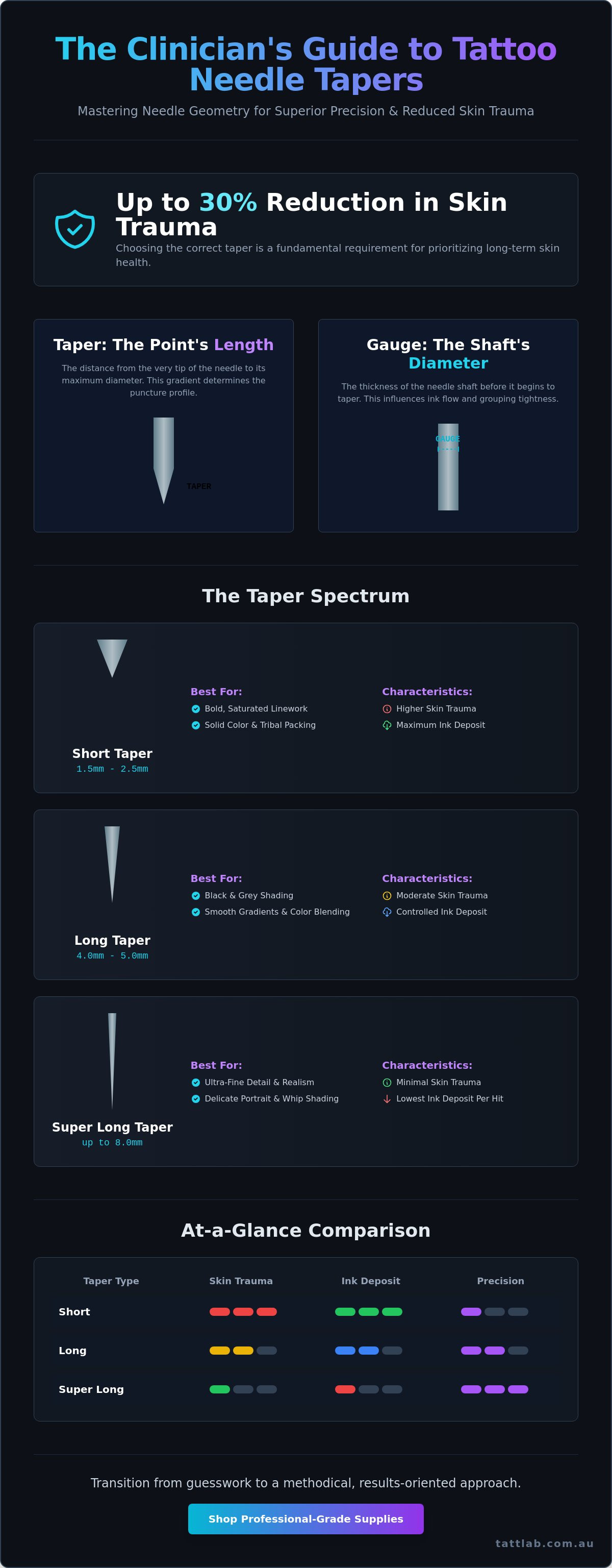
The taper of a tattoo needle is its most critical geometric variable, yet it's often confused with needle gauge. While gauge refers to the diameter of the needle shaft, the taper defines the distance from the very tip of the needle to its maximum diameter. Understanding tattoo needle taper requires looking at the needle as a three-dimensional cone. This gradient determines how the needle enters the skin and how much resistance it encounters during the process.
In a clinical setting, we view the needle taper as a tool for managing skin trauma. A short taper creates a wider puncture wound almost instantly. This is effective for packing solid colour but increases the friction or drag against the tissue. Conversely, a long taper enters the skin with surgical precision, creating a smaller initial opening that expands gradually. This reduced surface area during the initial hit results in less skin displacement and a faster healing journey for the client. The history and types of tattoo machines have evolved alongside these needle geometries, moving from rudimentary tools to high-precision instruments that require specific taper profiles to function optimally.
The Anatomy of the Needle Point
Visualise the needle tip as a conical gradient. The angle of this cone dictates the surface area of the entry point at the moment of impact. A sharper, more acute angle allows the needle to penetrate the epidermis with minimal force, while a blunt angle requires more pressure from the machine. Taper is the gradient of the needle's tip. By controlling this variable, artists can manage the amount of ink delivered per hit and the level of cellular disruption. This precision is vital for maintaining skin health and ensuring the lymphatic system can process the pigment effectively during the healing phase.
Standard vs. Specialist Tapers
Historically, the industry relied on a standard 2.5mm taper for most applications. This provided a balanced hit suitable for traditional bold lines and shading. However, the evolution of modern realism and fine-line styles has pushed manufacturers to develop specialist options. Professional tattoo supplies in Australia now offer long (4mm to 5mm) and super-long (up to 8mm) tapers. These extended gradients allow for softer transitions and multiple passes without compromising skin integrity. In a professional studio environment, understanding tattoo needle taper is no longer a preference; it's a technical requirement for achieving high-clarity results and predictable fading patterns.
- Short Taper: Typically 1.5mm to 2mm. Best for bold lines and heavy saturation.
- Long Taper: Usually 4mm to 5mm. Ideal for smooth black and grey shading.
- Super Long Taper: Reaching up to 8mm. Designed for ultra-fine detail and minimal trauma.
Choosing the correct taper is a decision that balances efficiency with care. When the needle geometry matches the intended technique, the result is a cleaner application that respects the biological limits of the skin. This methodical approach to tool selection mirrors the precision required in laser removal, where every millimetre of interaction counts toward the final transformation.
The Taper Spectrum: From Short to Extra Super Long
Understanding tattoo needle taper requires a clinical look at the geometry of the needle point. The taper is the specific distance from where the needle begins to narrow down to the very tip. This measurement dictates the puncture diameter and the volume of pigment deposited into the dermis. In a professional setting, selecting the right taper isn't just about preference; it's about managing dermal integrity and ensuring predictable ink fragmentation for future clarity.
A longer taper creates a narrower, more surgical entry point. It's precise. However, there's a physical trade-off that artists must acknowledge. Sharper, longer needles don't always result in more efficient ink delivery. Because the tip is thinner for a longer distance, the "well" created by the needle is smaller. This means it carries less pigment per individual strike compared to a blunt, short taper. Professionals must balance these technical choices with safety protocols like OSHA's Bloodborne Pathogens Standard to ensure skin health remains the priority during the procedure.
The physical "flex" of the needle also changes across the spectrum. Longer tapers have more length to bend, providing the artist with softer tactile feedback. This allows for a more delicate touch, which is essential when working on sensitive areas or building soft gradients.
Short (ST) and Medium Tapers (MT)
Short Tapers (1.5mm to 2.5mm) are the heavy hitters for solid saturation. They create a larger puncture hole, allowing a higher volume of ink to flow into the skin quickly. This makes them the "bold" choice for traditional work or tribal styles where deep, opaque blacks are required. Medium Tapers (3.0mm to 4.0mm) serve as the versatile all-rounders in most Melbourne studios. They offer a controlled balance between pigment load and skin trauma, making them suitable for daily use across various styles.
Long (LT) and Extra Super Long Tapers (ESLT)
Long Tapers (5.0mm to 6.0mm) are the industry favorite for fine-line work and smooth black and grey realism. The increased length adds flexibility, which reduces the "punch" of the needle and allows for seamless layering. Extra Super Long Tapers (7.0mm+) provide maximum precision with minimal skin resistance. These require a higher hand speed and a steady technique because the steeper angle means the needle enters and exits the skin with very little drag. If your goal is preserving long-term skin health, choosing these longer tapers can help minimize the risk of scarring by reducing the impact force on the tissue.
Strategic Selection: Matching Taper to Tattooing Style
Mastering your craft requires more than just artistic vision; it demands a technical understanding tattoo needle taper and how it interacts with diverse skin types. For American Traditional artists, the short taper is often the gold standard. Its blunter profile provides a distinct punch that deposits a high volume of ink quickly, creating those iconic, bold lines that define the genre. In contrast, photorealism and smooth whip-shading rely on long tapers. These needles have a more gradual slope, allowing for microscopic entry points that facilitate seamless gradients and soft transitions without causing excessive trauma.
The taper you choose also dictates how you calibrate your equipment. Long tapers offer more resistance because of their increased surface area along the tip. You'll likely need to adjust your machine's voltage, perhaps increasing it by 0.3 or 0.5 volts, to ensure the needle penetrates effectively. Similarly, a longer stroke of 4.0mm or higher helps the needle fully retract and clear the tube when using long tapers, preventing ink flow issues during high-speed sessions.
Texture is another critical factor. If you're aiming for a pepper shading effect or delicate dot-work, understanding tattoo needle taper becomes even more vital. A long taper creates a smaller, more defined dot, while a medium taper provides a slightly softer, more blurred edge. This choice determines whether your shading looks like fine grain or a smooth wash.
Precision Linework and Fine Details
Long tapers are essential for tight 3RL and 5RL configurations. Because the tip is so sharp, it requires significantly less pressure to penetrate the epidermis. This is a key safety measure; it reduces the risk of blowouts, which occur when ink is pushed too deep into the hypodermis. When executing intricate geometric work, maintaining skin integrity is the priority. Long tapers allow you to build detail slowly, ensuring that every line remains crisp and that the healing process is predictable and stable.
Color Packing and Large Scale Shading
When you're saturating large areas, short taper magnums are your most efficient tool. They act like a firm brush that pushes heavy tattoo ink pigments into the dermis with maximum force. However, this efficiency comes with a responsibility to the skin's health. Because short tapers are more aggressive, multiple passes can easily chew the skin if your hand speed isn't perfectly synced with your voltage. Professionals avoid this by using a slower, more deliberate motion, ensuring the pigment is packed solidly in fewer passes to minimize the inflammatory response.
The Science of Flow: Taper, Ink Displacement, and Skin Health
Understanding tattoo needle taper requires looking past the tip and into the fluid dynamics of the cartridge itself. A long taper, while offering surgical precision, creates a tighter seal within the cartridge nozzle. This physical arrangement often generates a vacuum effect that restricts the gravity-fed flow of pigment. While many artists assume a sharper needle is inherently safer for the skin, the reality is more nuanced. A needle that is excessively sharp can slice through tissue with negligible resistance, potentially leading to deep-seated trauma if the artist's hand speed and machine voltage aren't perfectly calibrated. We focus on the biological response, where the puncture size directly dictates the intensity of the inflammatory phase.
Mechanics of Ink Displacement
The well of a cartridge acts as a critical reservoir, but the needle taper dictates how much of that pigment actually reaches the dermis. Long tapers occupy more physical volume within the tip, leaving less space for ink to sit. This explains why specialists using 7mm or 8mm tapers often find themselves making more frequent trips to the ink cap. Taper length acts as a mechanical regulator for ink volume, preventing the "flooding" of the skin that can lead to blowouts or blurred edges. This controlled displacement is essential for maintaining the clarity of the work as the skin begins its natural evolution.
- Vacuum Effect: Tighter tolerances in long taper cartridges can slow down the ink's release.
- Frequency of Dips: Expect to reload pigment more often with long tapers compared to short, blunt alternatives.
- Volume Control: The taper profile ensures that only a precise amount of ink enters the puncture site at any given millisecond.
Prioritising Skin Integrity
At the Lab, we treat the skin as a delicate biological canvas rather than a static surface. Minimizing trauma involves a calculated balance between needle depth and taper profile. When you select a taper that matches the skin's specific resistance, you reduce the inflammatory "blowback" from the body's immune system. Proper taper selection significantly reduces the need for heavy tattoo aftercare intervention, as the skin's primary barrier remains more intact. This methodical approach ensures that the healing journey is steady and predictable, prioritising long-term skin health over immediate speed. By choosing the right tool, you're not just tattooing; you're managing a biological transformation with clinical precision.
Refine your technical approach and prioritise skin health by consulting the specialists at Tatt Lab today.
Selecting Professional Cartridges: The Tatt Lab Standard
At Tatt Lab, we don't just stock equipment; we curate it. Our selection process involves rigorous testing by seasoned artists to ensure every configuration meets a clinical standard. Understanding tattoo needle taper is the foundation of this selection. We prioritize artist-vetted needles because a fraction of a millimetre in taper length can be the difference between a clean heal and unnecessary skin trauma. When a needle is vetted by a professional, it means the taper consistency has been verified under magnification to ensure it doesn't hook or burr during long sessions.
Identifying taper specs on professional packaging is a skill that separates the technician from the hobbyist. Most elite brands use a standardized shorthand that you should look for before opening a blister pack:
- LT (Long Taper): Usually 5.0mm to 7.0mm. These are the go-to for fine line work and smooth grey wash gradients.
- MT (Medium Taper): Approximately 3.5mm. This is the versatile middle ground, often used for traditional work and colour packing.
- ST (Short Taper): Typically 1.5mm to 2.0mm. These allow for maximum ink flow, making them ideal for bold traditional lining and heavy pigment saturation.
The journey from apprentice to master involves a deepening relationship with these specifications. Apprentices often start with medium tapers because they're more forgiving. As your hand speed and depth control evolve, your needle selection becomes more specialized. You'll eventually find yourself reaching for specific long tapers to achieve the softest transitions in realism, or extreme short tapers for "one-pass" solid blacks. It's a technical evolution that respects the skin's biological limits.
Elite and EZ V-Select Systems
These systems represent the technical edge of the modern Australian studio. We focus on internal membranes that prevent backflow while maintaining perfect needle alignment. When sourcing medical supplies for tattoo artists, precision-engineered needles are non-negotiable. Elite and EZ V-Select cartridges offer a unique stabilization system that minimizes lateral vibration. This is vital for long-taper needles; their slender profile makes them prone to "wobble" if the cartridge housing isn't perfectly centered. Comparing taper consistency across these brands shows a deviation of less than 0.01mm, ensuring your 1203RL LT performs identically every time you work.
The Tatt Lab Assurance
Our commitment to the Australian industry is built on surgical-grade tools and transparent data. We provide Melbourne studios and artists nationwide with equipment that respects the biological reality of the skin. We're here to help you reclaim your craft by removing the guesswork from your gear. Better equipment leads to predictable healing and superior aesthetic outcomes. By understanding tattoo needle taper and choosing vetted cartridges, you're prioritizing long-term skin health over quick fixes.
Explore our professional needle and cartridge range and refine your setup with surgical precision.
Mastering the Geometry of Impact
Mastering the technical nuances of your tools transforms a standard tattoo into a clinical masterpiece. Choosing the right taper isn't just about preference; it's a calculated decision that dictates ink displacement and cellular healing. Long tapers minimize skin trauma by creating smaller puncture sites, while short tapers provide the necessary force for 100% saturation in traditional work. A refined understanding tattoo needle taper allows you to manipulate these variables with the same precision you apply to your artistic vision.
At Tatt Lab, we bridge the gap between medical science and creative expression. Our artist-owned and operated facility ensures every needle undergoes surgical-grade quality control to maintain 0.35mm consistency across every batch. We provide the tools that respect the skin's integrity, ensuring your work ages with clarity. With nationwide express shipping across Australia, the high-performance gear you need is never more than 48 hours from your studio door.
Upgrade your precision with Tatt Lab’s professional cartridge range
Elevate your craft and let your technical expertise lead the way toward better skin health and superior results.
Frequently Asked Questions
What is the difference between a long taper and a short taper tattoo needle?
A long taper needle features a point that extends between 6mm and 8mm, while a short taper measures closer to 1.5mm or 2mm. This physical geometry dictates how the needle enters the dermis. Long tapers offer a sharper, more gradual entry that minimizes tissue displacement. Short tapers are blunter; they create a larger hole which allows for more pigment delivery in a single pass.
Does a longer taper make a tattoo hurt less for the client?
Long taper needles generally reduce client discomfort because they cause less mechanical trauma to the skin. By utilizing a point that is 7mm long, the needle creates a smaller puncture diameter compared to a 2mm short taper. This precision preserves the skin's integrity. It aligns with our focus on skin health, as less inflammation typically leads to a more predictable healing journey for the Australian client.
Which taper is best for fine line tattooing?
Long tapers or extra-long tapers reaching up to 8mm are the industry standard for fine line work. When you're understanding tattoo needle taper, you'll see that a longer point allows for tighter groupings. This configuration lets artists execute intricate details without the ink spreading too wide. Professional artists in Melbourne studios often prefer these for single-needle scripts to maintain crisp, 1mm-wide lines.
Can I use long taper needles for color packing?
You can use long taper needles for color packing, but it's inefficient and increases the risk of overworking the skin. Short tapers, typically 2mm in length, are designed to deposit more ink per hit. Using a long taper for heavy saturation often requires 30% more passes to achieve the same opacity. This extra friction can lead to unnecessary scarring or delayed lymphatic clearance of the pigment.
How do I know what taper is in my needle cartridge box?
Taper length is identified by specific letter codes printed on the side of the cartridge box or the individual blister pack. You'll see "LT" for Long Taper, usually 5mm to 6mm, "MT" for Medium Taper at 3.5mm, and "ST" for Short Taper at 2mm. Most Australian suppliers follow these standardized labeling conventions established by major manufacturers to ensure artist precision during the setup process.
Why does ink seem to flow slower with long taper needles?
Ink flows slower with long taper needles because the needle remains in the skin for a shorter duration at its maximum width. The 7mm gradual slope creates a tight puncture that doesn't hold as much pigment as the 2mm blunt entry of a short taper. While this requires the artist to work with more deliberate speed, it results in the high-definition clarity that modern clinical tattooing demands.
Is a 0.35mm needle always a short taper?
A 0.35mm needle is not always a short taper; diameter and taper length are two distinct measurements. The 0.35mm figure refers to the thickness of the needle wire itself, often called a #12 needle. This wire can be ground into a 2mm short taper for traditional shading or an 8mm extra-long taper for delicate lining. Distinguishing between these two metrics is vital for maintaining skin health during complex procedures.
What happens if I use the wrong taper for my tattooing style?
Using the wrong taper can result in either excessive skin trauma or poor pigment retention. If you use a short taper for fine detail, you risk blowouts because the blunter 2mm point displaces too much tissue. Conversely, using a long taper for solid black fills often leads to patchy results. Following the 2024 guidelines from the Professional Tattooing Association of Australia ensures you select tools that respect the biological limits of the skin.


Comments (0)
There are no comments for this article. Be the first one to leave a message!