
Your choice of equipment is the only thing standing between a successful skin transformation and a serious medical complication. When you're first asking what tattoo supplies do i need to start, the sheer volume of hobbyist-grade gear can be dangerously misleading. Industry data suggests that nearly 40 percent of adverse tattoo reactions are linked to substandard tools or compromised hygiene protocols. It's natural to feel overwhelmed by the technical jargon of needle tapers or the steep learning curve of sterile field management. You want to focus on your creative evolution, but the responsibility of maintaining skin integrity weighs heavily on your shoulders.
We are here to demystify the science of your setup and provide a professional blueprint for your new studio. This guide outlines the precise, medical-grade tools required to build a practice that honors both the artist's vision and the client's safety. We'll walk you through the non-negotiable inventory of professional machines, sterilized cartridges, and hospital-grade disinfectants. By following this meticulous checklist, you'll replace uncertainty with the clinical confidence needed to launch your professional journey.
Key Takeaways
- Understand the evolution from traditional coil machines to modern rotary pens to select the ideal engine for your artistic transformation.
- Identify exactly what tattoo supplies do i need to start, prioritizing medical-grade hardware and precision needle cartridges that respect skin integrity.
- Learn to establish a controlled, clinical environment by integrating non-negotiable medical-grade PPE and sterile workstation protocols.
- Explore the chemistry of professional pigment loads and the importance of stencil application as the essential blueprint for a successful procedure.
- Recognize how ergonomic studio furniture and clinical aftercare protocols protect both the artist’s longevity and the client’s long-term skin health.
The Foundation: Professional Tattoo Machines and Power Units
When you begin to ask what tattoo supplies do i need to start, the answer always centers on the machine. It serves as the primary engine for the entire transformation process, acting as the bridge between your artistic vision and the client's skin. At Tatt Lab, we approach this selection with a "Lab" mindset. Precision in your hardware leads to predictable skin outcomes, ensuring the journey from initial stencil to healed art is controlled and safe. Choosing professional-grade equipment isn't just about ease of use; it's about respecting the biological integrity of the skin.
The industry has seen a massive shift toward technology that prioritizes both the artist's comfort and the client's healing. By focusing on high-quality components, you eliminate the variables that cause inconsistent saturation or unnecessary trauma. This methodical approach mirrors the rigor of a clinical environment, where every tool is selected for its reliability and performance.
Choosing Between Rotary Pens and Traditional Coil Machines
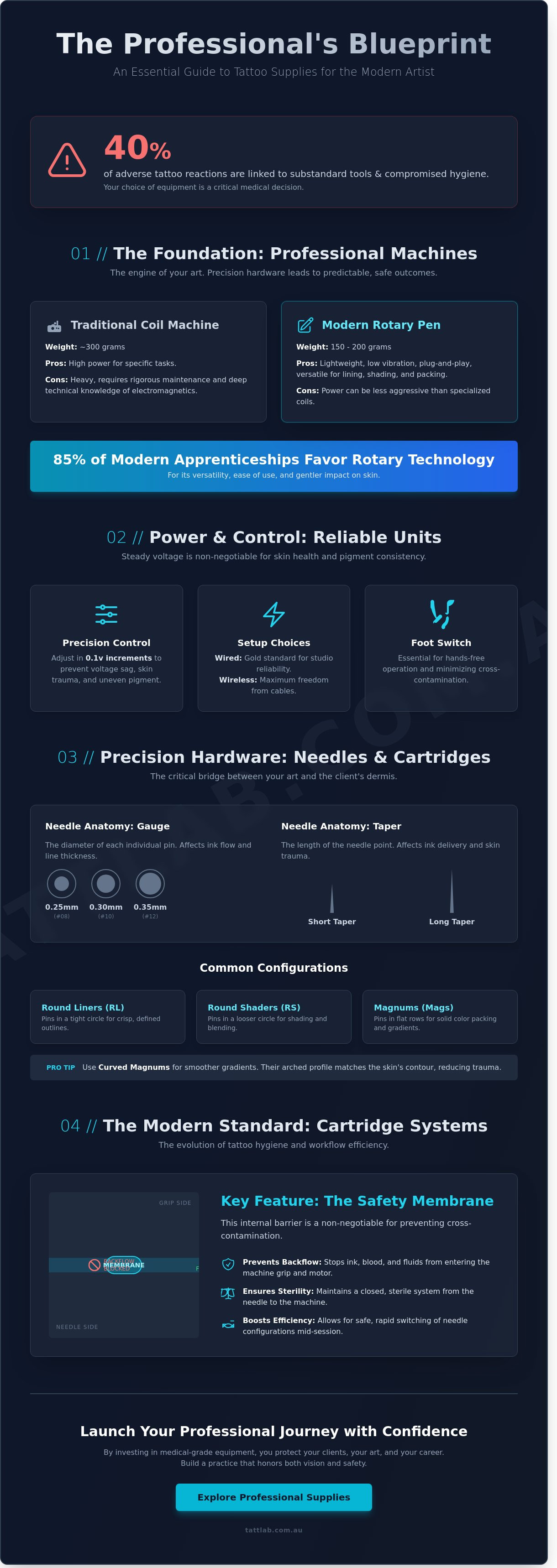
The tattoo machines used in modern studios have evolved significantly from their heavy, loud ancestors. Traditional coil machines are valued for their power, but they require a rigorous maintenance schedule and a deep understanding of electromagnetic physics. For those wondering what tattoo supplies do i need to start, rotary pens are the modern standard. These machines weigh roughly 150 to 200 grams, significantly less than a 300-gram coil setup, which reduces hand fatigue during five-hour sessions.
Rotary pens offer a plug-and-play experience that allows apprentices to focus on their technique rather than machine tuning. Their lower vibration levels lead to cleaner lines and more consistent needle depth. This versatility is why 85 percent of modern apprenticeships now favor rotary technology for their ability to handle lining, shading, and color packing with simple cartridge adjustments.
Reliable Power Supplies and Foot Switches
A professional machine is only as effective as the current driving it. Within the Process of tattooing, maintaining a steady voltage is non-negotiable for skin health. Cheap power units often suffer from voltage sag, a phenomenon where the power drops when the needle hits resistance in the skin. This leads to snagging and uneven pigment distribution. A high-quality power supply allows for adjustments in 0.1v increments, giving you total control over the needle's hit.
You must also choose between the traditional wired setup and modern wireless battery packs. While wireless packs offer liberation from cables, wired units remain the gold standard for long-term studio reliability. Regardless of your choice, the foot switch is an essential component. It facilitates a hands-free workspace, allowing you to stop and start the machine without touching your equipment. This minimizes cross-contamination risks and maintains the sterile, clinical environment necessary for professional work.
Precision Hardware: Navigating Tattoo Needles and Cartridges
The tattoo needle is the only physical bridge between your artistic intent and the client's dermis. It's a high-stakes interaction that requires absolute precision. Choosing the right hardware dictates whether a piece heals with clarity or becomes a lesson in skin trauma. When you're researching what tattoo supplies do i need to start, the needle configuration is your most critical technical decision. A professional needle is defined by its anatomy: the gauge, the taper, and the count.
The gauge refers to the diameter of the individual pins, typically ranging from 0.25mm (08) to 0.35mm (12). The taper is the length of the needle point, which affects how much ink is delivered and how the skin responds to the puncture. High-quality needles ensure consistent ink flow and prevent "ink spitting," a common issue where fluid builds up and obscures your stencil. Following the safety standards set by the Alliance of Professional Tattooists is essential for maintaining skin health throughout this process.
Liners, Shaders, and Magnums: Understanding Configurations
Round Liners (RL) are the industry standard for creating crisp, defined outlines. These needles are soldered in a tight circular pattern to deliver a concentrated point of ink. For filling and blending, you'll transition to Round Shaders (RS) or Magnums (Mag). While standard Magnums are excellent for solid color packing, using Curved Magnums is a superior choice for smooth gradients. Their slightly arched profile matches the natural contour of the skin, which significantly reduces trauma and promotes faster healing during the recovery journey.
Why Cartridge Systems are the Modern Standard
Modern tattooing has largely moved away from traditional needle-on-bar setups in favor of cartridge systems. These integrated units feature internal safety membranes that prevent blood and ink from backflowing into the machine's motor. This design isn't just about hygiene; it's about protecting the longevity of your equipment. The "click-and-lock" mechanism allows you to switch between a 3RL and a 15 Mag in seconds, maintaining the rhythm of your session without breaking focus.
Stability is the hallmark of a professional cartridge. Brands like Elite EVO and EZ V-Select are favored by specialists because they minimize needle wobble, ensuring that every mark is intentional. If you're building your first kit, investing in premium tattoo cartridges ensures your work starts with a foundation of safety and technical excellence. This methodical approach to equipment selection reflects a commitment to the craft, transforming the tattooing process into a predictable, clinical evolution for every client.
The Clinical Environment: Essential Medical and Safety Supplies
The professional tattoo studio operates as a controlled laboratory environment. Every surface represents a potential vector for cross-contamination, making medical-grade safety protocols the foundation of the craft. In the Australian industry, these standards aren't suggestions; they're the baseline for professional practice. Skin health begins with a sterile workstation long before the first drop of ink touches the dermis. When asking what tattoo supplies do i need to start, the answer doesn't begin with a needle. It begins with a sterile field.
Personal Protective Equipment (PPE) and Barrier Protection
Nitrile gloves are the industry standard for a reason. Unlike latex, powder-free nitrile offers superior chemical resistance and prevents allergic reactions in clients. This choice reflects a commitment to safety that defines the modern artist. Creating a sterile bubble involves more than just gloves. You'll need barrier film for your power supply, clip cord covers, and machine bags to isolate every piece of equipment. Understanding the role of medical supplies for tattoo artists is what separates a professional studio from a temporary home setup. It ensures the environment remains as pristine as the art produced within it. These barriers act as a physical shield, ensuring that biohazardous materials never reach your hardware.
Skin Preparation and Disinfection Protocols
The journey toward a successful tattoo starts with removing surface bacteria. Green soap and surgical-grade skin prep solutions are essential for decontaminating the area. This process respects the biological complexity of the skin. While preparing the canvas is vital, maintaining the station is equally critical. Hospital-grade disinfectants must be used to clean the entire area before and after every session. This rigorous cycle ensures a predictable, safe outcome for every client.
Safety also extends to the products used during the procedure. While artists focus on workstation hygiene, the FDA Regulation of Tattoo Inks provides a broader framework for product safety that every professional should understand. Finally, clinical waste management is non-negotiable. Sharps containers must be used for all needles to prevent accidental injury and ensure biological hazards are handled with the necessary rigor. When considering what tattoo supplies do i need to start, these clinical tools are your most important investment. They protect the artist, the client, and the integrity of the skin's healing process.
- Nitrile Gloves: High-puncture resistance and allergen-free.
- Barrier Film: Protects high-touch surfaces like lamps and power units.
- Hospital-Grade Disinfectant: For pre-session and post-session sterilization.
- Sharps Container: For the immediate disposal of used needles and cartridges.
The Palette and the Canvas: Professional Inks and Stencil Tools
Professional tattooing is a precise interaction between chemistry and biology. When you're asking what tattoo supplies do i need to start, you must look beyond the machine. The ink you choose is a suspension of solid pigment particles within a liquid carrier fluid. High-quality carriers, usually a mix of glycerin, ethanol, and distilled water, ensure the pigment remains sterile and evenly distributed. In contrast, low-grade inks often contain industrial-grade pigments or heavy metals that can trigger chronic inflammatory responses. Choosing professional-grade fluids isn't just about the immediate visual; it's about protecting the long-term skin health of your client.
Cheap inks frequently lead to "blowouts" or rapid fading because their pigment particles aren't ground to a consistent, microscopic size. This inconsistency makes it difficult for the body's immune system to stabilize the ink within the dermis. By investing in reputable brands, you ensure the ink heals with clarity and maintains its integrity for years, rather than months. This clinical approach to product selection is what separates a hobbyist from a professional technician.
Selecting High-Pigment Professional Inks
The industry standard is defined by brands like Panthera and Eternal Ink. These companies prioritize safety and pigment density. When building your kit, you'll realize that "black" isn't a single category. You need specific lining blacks, which have a high pigment load to prevent spreading, and shading blacks or "washes" designed for smooth, tonal transitions. Using a professional tattoo ink that meets international safety standards ensures you aren't introducing harmful surfactants into the lymphatic system.
- Lining Blacks: Formulated to stay crisp and resist migration.
- Grey Washes: Pre-mixed sets provide consistent gradients across multiple sessions.
- Color Pigments: Look for high-lightfastness ratings to prevent UV-induced fading.
Stencil Application: From Paper to Skin
The stencil is the blueprint of the entire procedure. For most beginners, thermal transfer paper provides the highest level of accuracy. It allows you to print complex designs directly from a digital file, ensuring symmetry and scale are perfect before the needle touches the skin. Freehand drawing is a vital skill, but it requires an advanced understanding of body anatomy that takes years to master. When determining what tattoo supplies do i need to start, a reliable stencil primer is non-negotiable.
Primers act as a polar bonding agent between the skin and the carbon. If you don't allow the primer to "set" for at least 8 to 10 minutes before starting, the design will likely wipe away during the first pass of the machine. This leads to "ghosting," where the artist loses their guide and risks anatomical distortion. Clean placement requires a clinical eye; if the stencil doesn't sit perfectly on the first try, wipe it off with alcohol and start again. Precision at this stage defines the final evolution of the piece.
Ready to master the science of skin? Start your journey with the right foundation by exploring the Tatt Lab professional resources for skin health and ink management.
Completing the Journey: Aftercare and Workstation Essentials
The tattoo process doesn't conclude when the needle stops moving. It ends when the skin has successfully regenerated and the pigment is locked securely within the dermal layer. When you're asking what tattoo supplies do i need to start, your focus must extend beyond the machine to the environment and the recovery phase. This final stage of the journey defines your reputation as a professional who prioritizes skin health above all else. A tattoo is a clinical procedure, and your setup should reflect that level of rigor.
Professional Aftercare for Long-Term Skin Health
The difference between a crisp tattoo and a blurry one often lies in the first seven days of healing. You shouldn't leave this to chance or supermarket lotions that contain petroleum or harsh fragrances. Specialized tattoo aftercare products like Dr. Pickles support the natural lymphatic response without clogging pores. Modern protocols also utilize breathable "second skin" bandages. These medical-grade films provide a sterile barrier, allowing 24-hour oxygen exchange while blocking pathogens during the critical 48-hour window.
Setting Up Your Ergonomic Lab Environment
Your studio is a laboratory where precision meets safety. High-quality furniture protects your health. An ergonomic artist's chair prevents chronic back issues that affect 65% of practitioners. A medical-grade, adjustable client bed ensures the correct angle for intricate work. Lighting is equally vital. High-CRI LED lights, ideally with a 95+ rating, allow you to see true ink tones. This precision prevents accidental over-saturation or patchy color packing that only becomes visible under natural sunlight.
Before you open your doors, ensure your workstation is organized for maximum hygiene. Stainless steel trolleys are the industry standard because they withstand harsh chemical disinfectants without corroding. As you finalize your inventory, use this checklist to ensure your first order is complete:
- Ergonomic Artist Stool: Must have adjustable height and lumbar support.
- Client Bed: Must be made of non-porous, medical-grade wipeable material.
- High-CRI LED Lamp: For shadow-free, color-accurate visibility.
- Stainless Steel Work Trolley: For sterile setup and easy mobility between sessions.
- Professional Aftercare Stock: Specialized creams and "second skin" films for client kits.
The Tatt Lab commitment is about more than just selling equipment. It's about providing the tools for a lifetime of safe artistry. When you choose your initial kit, you aren't just buying gear; you're investing in your evolution as an artist and the long-term integrity of your clients' skin. This methodical approach ensures that every piece of art you create has the best possible chance to heal perfectly and last a lifetime.
Elevate Your Craft with Technical Precision
Building a professional practice requires more than just artistic talent; it demands a clinical approach to your environment and equipment. You've learned that the foundation of a successful studio rests on high-performance machines and the precision of medical-grade cartridges. Prioritizing skin health through sterile workstation setups and 100% medical-grade PPE ensures every client's safety remains the top priority. Truly understanding what tattoo supplies do i need to start is the first milestone in your evolution as a trusted specialist.
Tatt Lab is an artist-owned and operated laboratory dedicated to supporting your professional journey with scientific rigor. We offer express nationwide shipping across Australia, delivering a comprehensive range of professional inks and safety essentials directly to your door. Our selection is vetted by industry experts who value skin integrity as much as aesthetic results. It's time to refine your toolkit with supplies that mirror your commitment to excellence.
Build your professional kit with Tatt Lab’s artist-vetted supplies.
Your transition into the professional world is a significant step, and we're ready to provide the technical edge you need to succeed.
Frequently Asked Questions
Is it safe to buy a tattoo starter kit from Amazon or eBay?
It's generally unsafe to purchase entry-level kits from mass-market retailers because they often lack the sterile certifications required for safe skin penetration. Professional grade equipment must meet ISO 13485 standards for medical devices. Kits priced under $100 frequently utilize non-regulated pigments containing heavy metals like lead or arsenic. These sub-standard materials increase the risk of systemic infection and poor pigment retention, compromising the long-term health of the skin.
What is the difference between a tattoo gun and a tattoo machine?
Professionals exclusively use the term tattoo machine, as the word gun carries negative connotations that don't reflect the clinical precision of the craft. A machine operates using either electromagnetic coils or a rotary motor to drive needles into the dermis. While the mechanics vary, the goal remains the same: creating a controlled medical procedure. Understanding this distinction is a vital step when researching what tattoo supplies do i need to start your career.
Do I really need medical-grade gloves, or are food-safe gloves okay?
You must use medical-grade nitrile gloves to ensure a proper barrier against bloodborne pathogens. Food-safe vinyl gloves often have a failure rate of up to 60 percent under stress, which is unacceptable in a clinical environment. Nitrile gloves are tested to ASTM D6319 standards, providing the puncture resistance and chemical integrity needed during a long session. This choice protects both the artist's safety and the client's skin health during the transformation process.
What are the most essential needle sizes for a beginner to buy first?
A beginner should prioritize 3 Round Liners (3RL) for fine detail, 7 Round Liners (7RL) for standard outlines, and 9 Magnum (9M) needles for consistent shading. These three configurations cover approximately 80 percent of foundational tattooing techniques. Ensure every needle is a membrane-style cartridge. This specific design prevents backflow of biological fluids into your machine, maintaining a sterile environment throughout the entire tattooing journey.
How much should I expect to spend on my first set of professional supplies?
Industry data from professional supply distributors suggests an initial investment between $1,000 and $2,500 for a reliable professional setup. This budget covers a high-quality rotary machine, a regulated power supply, and a stock of sterile disposables. While the cost is significant, investing in reputable brands ensures your equipment doesn't fail mid-session. High-quality tools are the foundation of a predictable, successful result for every client who trusts you with their skin.
Can I use regular drawing ink or calligraphy ink for tattooing?
You shouldn't use drawing or calligraphy ink for tattooing because these substances aren't formulated for subcutaneous injection. Calligraphy inks often contain acrylic binders and toxic solvents that the lymphatic system cannot safely process. Using non-sterile pigments can lead to severe granulomas or permanent scarring. When determining what tattoo supplies do i need to start, always select pigments that are REACH compliant and specifically manufactured for human skin.
Why is aftercare considered part of the tattoo supplies list?
Aftercare is essential because the tattooing process creates a controlled wound that requires specific biological support to heal correctly. Providing medical-grade films or specialized ointments ensures the skin barrier recovers without infection. Approximately 50 percent of a tattoo's final appearance depends on the healing phase. By including aftercare in your initial inventory, you're prioritizing long-term skin integrity and ensuring the clarity of the pigment remains intact for years.
Do I need an autoclave if I only use disposable cartridges and needles?
You don't need an autoclave if your practice utilizes a 100 percent disposable workflow with single-use cartridges and grips. Modern studios are shifting toward this model to eliminate the risk of cross-contamination associated with manual sterilization. You must still maintain a clinical environment using hospital-grade disinfectants to wipe down all surfaces. This methodical approach to hygiene reflects the scientific rigor required in a professional lab setting.


Comments (0)
There are no comments for this article. Be the first one to leave a message!