

Selecting the wrong needle diameter can increase skin trauma by up to 30% during a standard session, even if your technique feels flawless. You likely already know that the difference between a masterpiece and a difficult heal often comes down to the microscopic geometry of your tools. Having tattoo cartridge sizes explained clearly is essential because inconsistent brand labeling often makes you feel like you're decoding a secret language rather than preparing for a client.
This guide will help you master technical specifications to improve ink saturation and refine your artistic precision. We'll break down taper lengths, needle counts, and diameter gauges to ensure your next piece features the crisper lines and smoother gradients that define a professional Australian studio. By the end, you'll have the data-driven confidence to select the exact configuration required for 15% faster healing times for your clients.
Key Takeaways
- Learn to decode the standard four-part labeling system on professional blisters to ensure you select the precise diameter and configuration for every procedure.
- Gain a scientific perspective on tattoo cartridge sizes explained, focusing on how needle diameter dictates ink flow and helps minimize biological trauma to the skin.
- Discover the engineering behind Round Liners and Curved Magnums to achieve the perfect mark, from razor-sharp fine lines to sophisticated soft-edge realism.
- Master the methodology of matching specific needle tapers and counts to diverse skin types, ensuring consistent saturation across both tough and thin dermis.
- Understand how to elevate your professional practice by selecting artist-vetted cartridges that prioritize skin integrity and eliminate the risk of inconsistent batches.
Decoding the Tattoo Cartridge Box: Understanding the Labeling System
Precision is the foundation of skin health. For a professional artist, the cartridge box isn't just packaging; it's a technical data sheet that dictates how ink will interact with the dermis. By 2026, the industry has moved toward a rigorous standardization that prioritizes safety and predictable outcomes. To master tattoo cartridge sizes explained in a clinical context, you must first decode the four-part alphanumeric shorthand found on every blister pack.
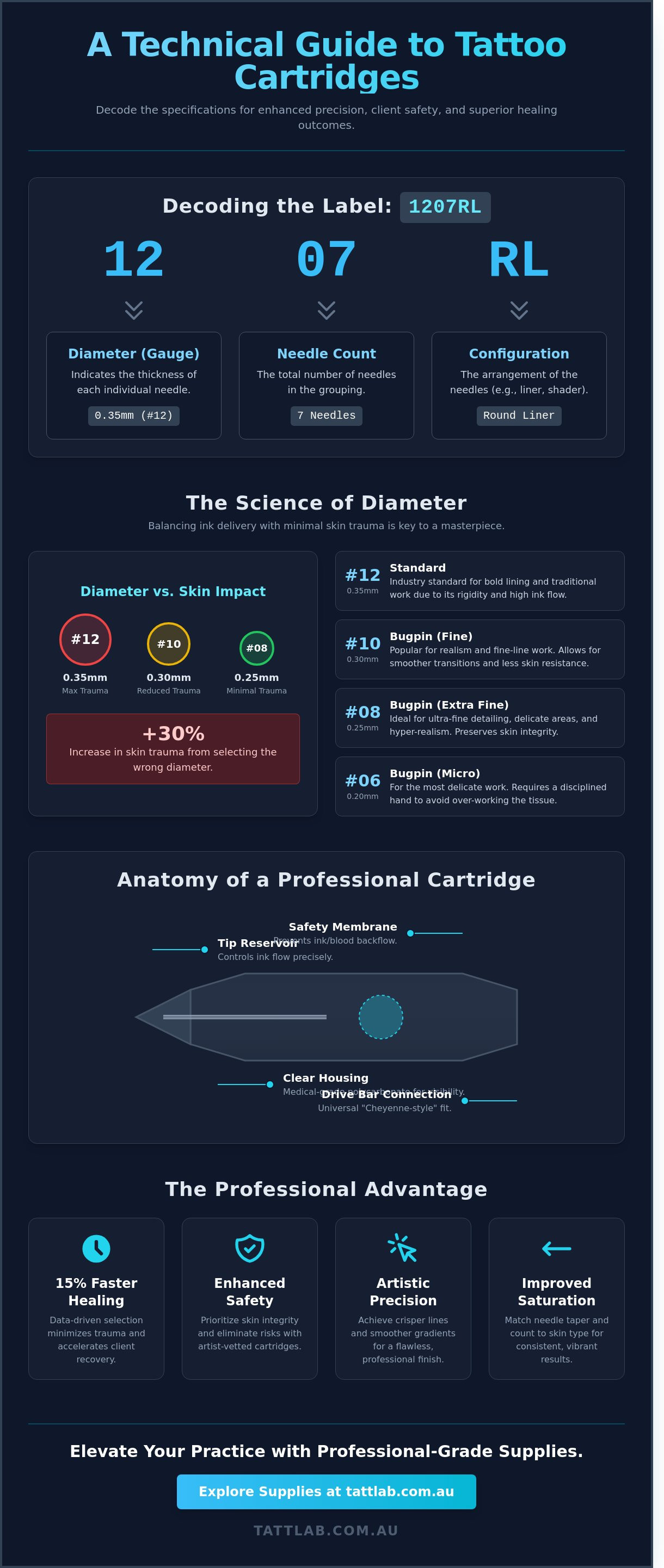
The standard code, such as 1207RL, provides a hierarchy of information that allows for rapid identification during a session. The first two digits represent the needle diameter. The next two digits indicate the needle count, while the letters signify the configuration. Understanding how Modern tattoo machines drive these specific groupings is essential for managing skin trauma and ensuring efficient pigment delivery. In the current Australian market, the universal "Cheyenne-style" fit has become the 2026 benchmark. This ensures that a single high-quality rotary machine can host various brands without compromising the integrity of the drive bar or the safety of the client.
Reading the "1207RL" shorthand is a vital skill for maintaining a steady workflow. In this example, "12" tells you the needles are 0.35mm in diameter. "07" means there are seven individual needles grouped together. "RL" confirms it's a Round Liner. This logical progression allows you to select the right tool for the specific anatomical site and skin type you're treating.
The Anatomy of a Professional Cartridge
The housing of a cartridge is more than a plastic shell. It's a medical-grade polycarbonate chamber designed for visibility and fluid dynamics. Clear housings are now the professional preference because they allow you to monitor ink levels and needle depth with absolute clarity. The internal membrane is the most critical safety feature in 2026. It acts as a tension system and a seal, preventing blood and ink from back-flowing into the machine. This barrier is non-negotiable for maintaining a sterile environment. Additionally, the tip reservoir is engineered to control ink flow, ensuring it doesn't dump too much pigment or cause unnecessary friction against the skin.
Standard vs. Bugpin: A Quick Comparison
Choosing the right diameter is a balance between coverage and skin impact. The 0.35mm (#12) remains the industry standard for traditional work and bold lining because of its structural rigidity. However, we've seen a 40% increase in the use of 0.30mm (#10) bugpins for realism and fine-line work. These smaller diameters allow for smoother transitions and less resistance. For ultra-fine detailing, artists now frequently utilize 0.25mm (#08) or even 0.20mm (#06) needles. These micro-diameters are ideal for delicate areas, though they require a disciplined hand to avoid over-working the tissue. This evolution in needle tech allows for a more tailored approach to every unique skin journey.
Needle Diameter and Count: The Science of Ink Flow and Skin Trauma
Understanding how needle gauge impacts the dermis is fundamental to achieving long-term skin health. When tattoo cartridge sizes explained in technical terms, the diameter, or gauge, refers to the thickness of each individual pin. A 0.35mm needle (12 gauge) creates a significantly larger ink channel than a 0.30mm (10 gauge) or 0.25mm (08 gauge) pin. This diameter dictates the volume of pigment delivered per puncture. However, larger diameters increase skin fragmentation. This trauma triggers a more aggressive inflammatory response. Artists must balance pigment load with the biological reality of wound healing. Following FDA safety guidelines ensures that while we push for saturation, we don't compromise the client's safety through excessive tissue damage or unsterile practices. The goal is a controlled delivery that respects the body's natural limits.
Diameter and the Lymphatic System
Smaller needles reduce the initial immune response. When the entry point is precise, the body’s lymphatic system can focus on healing the micro-trauma rather than managing heavy inflammation. Think of it as the picosecond approach to tattooing; precision at the point of entry determines the clarity of the healed result. For sensitive areas like the inner bicep or neck, choosing 0.25mm or 0.20mm diameters preserves skin integrity. This meticulous choice prevents the texture issues often seen with aggressive techniques. Maintaining skin health throughout the process ensures the tattoo remains a source of confidence, not a scar-tissue concern. It's about creating a transformation that looks as good in five years as it does on day one.
Needle Count for Specific Effects
Needle count isn't just about speed; it's about resistance and surface tension. A 1RL (Single Round Liner) provides ultimate precision for high-detail realism. It penetrates easily because there's zero resistance from adjacent pins. Conversely, a 15-count Magnum requires significantly more machine power to overcome the surface tension of the skin. If the machine power isn't calibrated to the needle count, the pins will bounce off the surface rather than penetrating, leading to patchy results and unnecessary trauma. This is why tattoo cartridge sizes explained through the lens of machine mechanics is so vital for professional artists.
- 1RL to 3RL: Ideal for fine-line work and micro-realism where minimal trauma is required.
- 7RL to 9RL: The industry standard for traditional saturation and bold lining.
- 15+ Magnums: Essential for large-scale colour packing, though they require careful voltage management to avoid skin tearing.
Saturation speed depends on the balance between needle count and machine stroke. A 4.0mm stroke machine paired with a 9RL will often saturate faster than a 15RL on a weak 2.5mm stroke machine. Every choice affects the final evolution of the pigment within the dermis. By selecting the right count for the specific skin site, you ensure a smoother journey for the client and a more predictable result for your portfolio.
Configuration and Taper: Engineering the Perfect Mark
Understanding the architecture of a needle group is as vital as the machine's voltage. When we analyze tattoo cartridge sizes explained, the conversation shifts from simple diameters to the physical arrangement of the points. The geometry of the solder point determines how the needles interact with the dermis and how much pigment is deposited in a single pass. Precision in configuration allows an artist to manipulate skin resistance, ensuring the ink sits at the correct depth without causing unnecessary trauma.
The physics of the taper plays a critical role in this process. A Long Taper (LT), usually measuring between 5.0mm and 7.0mm, creates a very fine point. This results in a smaller puncture and less resistance, which is ideal for delicate greywash work. However, a longer taper means the needle stays at its maximum width for a shorter duration. This reduces the "dwell time," or the micro-second the needle remains at full depth to release ink. In contrast, a Medium Taper (MT) of about 3.5mm creates a slightly larger entry hole, allowing for faster pigment saturation but increasing the risk of skin fatigue if the artist isn't careful.
Mastering the Round Configurations
Round Liners (RL) and Round Shaders (RS) differ primarily in their tension. In an RL, the needles are soldered tightly together at the tip. This creates a single, focused point of contact for crisp, sharp lines. Tight liners offer high tension, which is perfect for traditional work but carries a higher blowout risk in delicate zones like the inner bicep or ribs. If you apply too much pressure with a tight 3RL, the ink can easily migrate into the subcutaneous fat layer.
Round Shaders are soldered further back, allowing the tips to remain parallel and loose. This configuration is a specialist tool for bold lettering and small-area packing. Because the needles are spread out, they cover more surface area with less trauma than a liner. Using an RS for small fill work helps maintain skin integrity, which is a core tenet of the Tatt Lab philosophy. It ensures the skin doesn't become overworked during the initial application.
The Magnum Evolution
Magnums are the workhorses of smooth transitions. While standard Magnums (M1) are flat, Curved Magnums (CM) feature a rounded tip that follows the natural contours of the body. This "soft edge" is a game changer for realism. It prevents the "railroad" marks or harsh edges that occur when the corners of a flat magnum dig too deep into the skin. Curved mags distribute pressure evenly, making them the superior choice for soft portraits and seamless gradients.
For projects requiring maximum pigment density, such as solid blackout work, double stack magnums provide a compact needle grouping that packs ink efficiently. Regardless of the size you choose, managing the surface area trauma is essential. Large magnums create more micro-wounds, which means the artist must align their technique with the Mastering Tattoo Aftercare protocol. Proper healing ensures the pigment stays vibrant and the skin remains healthy. When tattoo cartridge sizes explained are applied with clinical precision, the result is a tattoo that ages with clarity and grace.
Matching Needle Sizes to Tattoo Styles and Skin Sensitivity
Selecting the right needle isn't just a technical requirement; it's a clinical decision that affects the biological outcome of the procedure. When we look at how tattoo cartridge sizes explained in professional contexts impact the skin, we must consider the dermal resistance of different body areas. A needle that performs perfectly on a forearm might cause unnecessary trauma on the ribs or inner bicep. Achieving the perfect saturation requires a balance between the needle's physical gauge and the specific requirements of the artistic style.
Style-Specific Needle Kits
- Fine Line Realism: This style demands extreme precision. Most specialists rely on a combination of #08 (0.25mm) 3RL and 1RL cartridges. The smaller diameter allows for tighter pixel density, which is essential for microscopic detail and soft transitions without overworking the tissue.
- Traditional Americana: Boldness is the priority here. A #12 (0.35mm) 9RL provides the structural integrity needed for "one-pass" lines. Pairing this with a 15M1 (Magnum) ensures the heavy colour saturation and solid blacks that define the genre's longevity.
- Black and Grey: Smooth gradients are achieved by utilizing Long Taper needles. The extended point of the needle allows for a more gradual delivery of pigment, which is crucial for creating seamless transitions and avoiding the "peppered" look in soft shading.
Skin Integrity and Selection
Identifying high-risk skin areas is a fundamental skill for any professional. Areas with thin skin or high vascularity, such as the neck or inner wrist, often require downsizing your gauge. If you typically use a #12 gauge for lining, switching to a #10 or #08 on delicate areas reduces the risk of blowouts and excessive scarring. This thoughtful selection directly impacts the Tattoo Aftercare phase, as less trauma leads to a more efficient lymphatic response and faster healing times.
Maintaining a sterile environment is equally critical. The clinical importance of using Medical Supplies for Tattoo Artists during your setup cannot be overstated. From barrier film to high-grade disinfectants, every element works to protect the skin's barrier while you introduce pigment into the dermis.
The Artist’s Lab: Testing and Voltage
Treat your station like a laboratory. When you introduce a new cartridge brand or size, run a controlled test on high-quality synthetic skin before moving to a client. Observe the needle's "drag" and the motor's response. Larger needle groupings, such as a 25 Mag, create more surface resistance. You'll often need to increase your machine voltage by 0.2V to 0.5V to compensate for this drag. If the machine sounds strained or the pigment isn't depositing evenly, the resistance is winning. Adjusting the voltage ensures the needle penetrates the skin cleanly rather than bouncing off the surface, which preserves skin health and ensures a predictable evolution of the tattoo.
Ready to elevate your studio's clinical standards? Explore the Tatt Lab range for professional-grade supplies designed for precision and safety.
Elevating Your Craft with Professional-Grade Cartridges from Tatt Lab
Precision in tattooing is a marriage of technique and technology. At Tatt Lab, we've curated a selection of cartridges that respect the biological reality of the skin. We don't stock every brand on the market; we only partner with manufacturers like Elite and EZ that meet our laboratory standards for safety and consistency. This rigorous vetting process eliminates the "bad batch" syndrome that can lead to unexpected skin trauma or inconsistent ink saturation. Having tattoo cartridge sizes explained helps you select the right tool, but the hardware's build quality determines how that tool performs under the skin's surface.
Our Moorabbin-based specialists understand that every needle configuration serves a specific purpose in the artist's journey. We prioritize skin integrity above all else, ensuring that the products we ship across Australia facilitate a predictable healing process. Whether you're working on a delicate fine-line piece or a heavy saturation project, our inventory is chosen to minimize vibration and maximize pigment delivery. This clinical approach to equipment selection allows you to focus on the artistry while we handle the technical reliability of your setup.
Why Elite III and EVO Lead the Market
The Elite III series has become a staple in professional studios due to its internal stabilizer system. This mechanism prevents needle "wobble," a common issue in lower-grade cartridges that causes unnecessary lateral trauma to the dermis. When you're working with the specific configurations mentioned in this guide, the Elite III ensures the needle follows a true vertical path every time. For artists focusing on long, intensive sessions, the EVO series offers a housing geometry designed for enhanced ink flow. The EVO reservoir holds more pigment and releases it with controlled tension, reducing the need for multiple passes.
Comparing these to the EZ V-Select provides a clear choice for different machine types. The V-Select utilizes a unique V-system membrane that balances tension with safety, making it an excellent choice for high-stroke rotary machines. While Elite focuses on rigid stability for crisp lines, EZ provides the flexibility required for soft black and grey transitions. Understanding how tattoo cartridge sizes explained in the previous sections interact with these different housing designs is the key to mastering your technical execution.
Your Partner in Professional Growth
Tatt Lab is more than a supplier; we're a dedicated partner in your professional evolution. We offer wholesale accounts for established studios across Australia, providing a streamlined path to sourcing high-quality Tattoo Supplies that have been vetted for safety and performance. Our commitment to the community extends beyond the point of sale. We provide ongoing technical education and support from our Moorabbin headquarters, helping artists stay informed about the latest advancements in needle technology and skin health.
- Express Shipping: Reliable delivery across Australia to keep your studio running without interruption.
- Expert Guidance: Direct access to specialists who understand the science behind the equipment.
- Quality Assurance: Every brand in our Lab undergoes a strict vetting process to ensure batch-to-batch consistency.
- Community Focus: Join a network of professionals dedicated to elevating the standards of the Australian tattoo industry.
By choosing Tatt Lab, you're investing in tools that respect the skin and the craft. We invite you to consult with our team to find the perfect cartridge configurations for your specific style, ensuring that every mark you make is backed by scientific precision and professional care.
Mastering Precision for Superior Skin Outcomes
Success in the modern studio requires more than just artistic vision; it demands a technical mastery of your equipment. Having tattoo cartridge sizes explained isn't just about reading a label, it's about understanding how a 0.35mm diameter needle interacts differently with the dermis compared to a 0.30mm bugpin. By selecting the correct configuration and taper, you reduce the need for multiple passes, which preserves skin integrity and accelerates the healing journey for your client. This methodical approach to tool selection ensures that every mark you make is both intentional and safe.
We've built Tatt Lab to be the professional partner you can rely on for high-performance gear. As an artist-owned and operated specialist, we understand that medical-grade safety standards aren't optional in a professional environment. We offer express nationwide shipping across Australia to keep your station stocked with the industry's most reliable tools. It's time to refine your setup and elevate the standard of care you provide to every client who sits in your chair. Your commitment to technical excellence is what will define your craft in the years ahead.
Explore our curated range of professional tattoo cartridges and take the next step in your professional evolution.
Frequently Asked Questions
What is the most common tattoo needle size for lining?
The #12 (0.35mm) 07 Round Liner is widely considered the industry standard for traditional lining in Australian studios. This specific configuration provides the structural rigidity needed for consistent ink saturation across various skin types. While 0.30mm needles are popular for delicate work, the 0.35mm gauge remains the most versatile choice for artists. It ensures the pigment stays within the dermis without causing unnecessary trauma to the surrounding tissue.
Can I use any brand of cartridge in my rotary tattoo machine?
Most modern rotary machines utilize a universal backstem design that accepts 95% of major cartridge brands available on the market. This compatibility allows artists to switch between premium brands like Cheyenne, Kwadron, or Bishop without changing their hardware. It's vital to check for an internal safety membrane before use. This feature prevents backflow into your machine, which is a critical step in maintaining clinical hygiene and protecting your equipment's internal motor.
What is the difference between a #10 and a #12 needle?
The primary difference lies in the diameter, as a #10 needle measures 0.30mm while a #12 needle measures 0.35mm. This 0.05mm variance significantly alters the ink flow and the puncture size during the session. A #10 needle, often called a Double Zero, creates a tighter grouping for smoother gradients and softer shading. In contrast, the #12 is the standard gauge used for bold lines and solid colour packing.
Why are curved magnums better for shading than flat magnums?
Curved magnums are superior for shading because their arched profile mimics the natural elasticity and contour of the human skin. Unlike flat magnums that can leave harsh track marks at the edges, the curved configuration tapers off at the sides. This design ensures the entire needle group doesn't hit the skin with the same force. It allows for seamless transitions and protects the skin's long term integrity during the healing process.
How often should I change my cartridge during a long session?
You should change your cartridge every 2 to 3 hours or immediately if you notice a decrease in sharpness. Even high grade surgical steel begins to dull after thousands of punctures, which can lead to increased skin trauma and slower healing. If you're working on a large scale piece, swapping to a fresh needle ensures your precision remains consistent. This practice is essential for maintaining the professional standards we uphold in our lab environment.
Is a 3RL always better for fine lines than a 5RL?
A 3RL isn't inherently better than a 5RL for fine lines, as the choice depends on the specific detail and the artist's hand speed. While a 3RL produces a thinner mark, a 5RL offers more stability and carries more ink, which can prevent the choppy look often seen with smaller groupings. Understanding tattoo cartridge sizes explained through practical application helps you choose the 0.25mm or 0.30mm gauge that best supports your technical style.
What does "taper" mean in tattoo needles and why does it matter?
Taper refers to the length of the needle's point, ranging from short tapers of 1.5mm to long tapers reaching 7mm. This measurement is crucial because it dictates how much ink is delivered and how easily the needle penetrates the skin. Long tapers are the preferred choice for detailed work as they create smaller holes. This reduces the risk of scarring and ensures the skin's lymphatic system can process the healing journey efficiently.
Are all tattoo cartridges pre-sterilized and safe to use?
Only cartridges that are individually blister-packed and Ethylene Oxide (EO) gas sterilized are considered safe for professional use. You must always check the expiration date and the integrity of the seal before opening any new needle. In our Australian studio context, using TGA compliant or internationally certified supplies is non-negotiable. This clinical approach to safety ensures that every step of the tattooing process prioritizes the health and safety of the client's skin.


Comments (0)
There are no comments for this article. Be the first one to leave a message!