

The smartest wholesale order may be the one you keep deliberately focused. Buying wholesale tattoo aftercare supplies can help you keep selected products available, but unclear eligibility, minimums and account terms can complicate the decision. A large order is not much help if the products do not suit your studio’s needs or your team cannot confidently explain them to clients.
Before committing stock or cash, compare suppliers using the same practical criteria. This guide will help you assess wholesale access and purchasing terms, plan a manageable assortment, and choose products your artists feel comfortable discussing as part of responsible aftercare guidance.
You’ll also find a straightforward way to assess client needs, product information and stock movement before ordering. The goal is not to fill shelves. It is to build a considered supply process that supports clear conversations with clients and gives your studio room to adjust as you learn what works for its practice.
Key Takeaways
- Treat wholesale as a purchasing arrangement, not a promise of savings. Compare the full terms before committing.
- Review intended use, ingredients, directions, storage guidance and manufacturer contact details before recommending an aftercare product.
- Compare wholesale tattoo aftercare supplies suppliers on range fit, product information, ordering, support and replenishment, not headline claims alone.
- Start with a focused stock plan informed by client enquiries and appointment patterns, then track sales and reorder signals.
- Before considering Tatt Lab, check product fit, available information, expected demand and current wholesale eligibility and terms.
Why tattoo studios source aftercare supplies wholesale
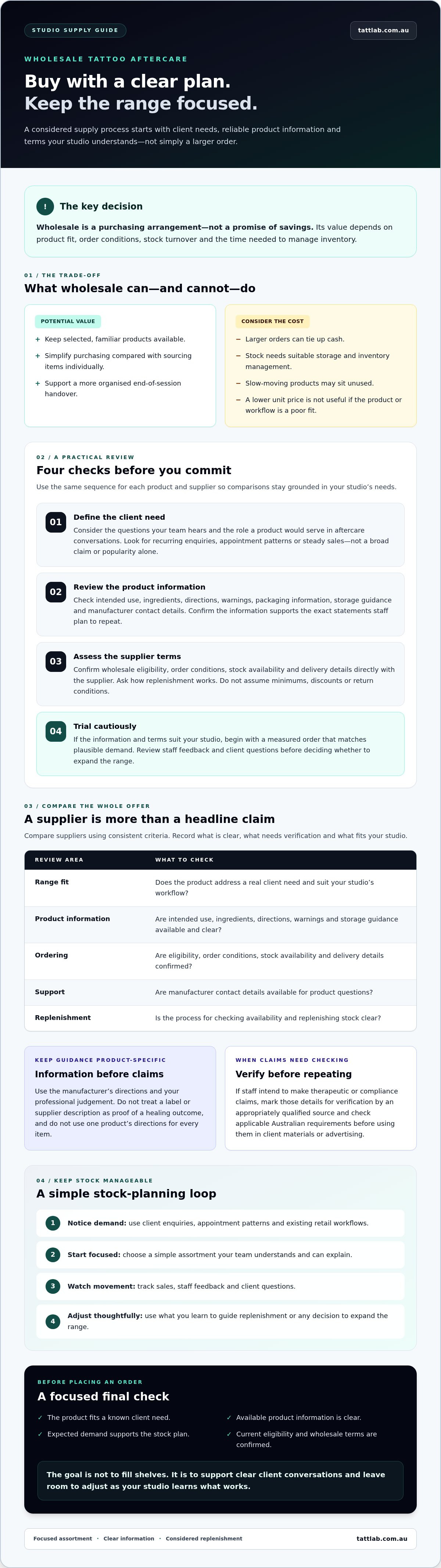
Clients need clear aftercare guidance when they leave a tattoo appointment. If your team regularly answers questions about what to use and where to find it, keeping selected aftercare products on hand may make that handover more straightforward. Wholesale purchasing can help maintain a consistent supply, but it does not guarantee savings. Its value depends on product fit, order conditions, stock turnover and the time needed to manage inventory.
Compared with sourcing products individually, wholesale ordering may simplify purchasing and help a studio keep familiar options available. It also places more responsibility on the studio. Larger orders can tie up cash and require suitable storage, while slow-moving products may sit unused. Before ordering, compare the full terms, including any minimums and delivery costs, and consider how quickly your studio is likely to use the stock. A lower unit price is not useful if the products do not suit your clients or workflow.
When wholesale aftercare stock makes sense for a studio
Look for evidence of recurring demand. Appointment patterns, client enquiries and existing retail workflows can help you judge whether keeping products on hand is practical. A product requested once or twice may not justify a bulk order. Repeated questions or steady sales offer a stronger signal. Start with a focused assortment your team understands, rather than adding variety without a clear reason. A simpler range is easier to monitor and explain.
Before selecting products, review the manufacturer’s directions and other available information. Intended use, ingredients, storage guidance and contact details can help your team assess whether a product is appropriate to stock and discuss. Recommendations should follow the supplier’s instructions and your professional judgement, not simply the fact that an item is available wholesale.
For general background on tattooing and tattoo aftercare procedures, readers can consult Wikipedia’s overview. Use general references as context, not as a substitute for the specific directions supplied with a product.
What clients gain from consistent aftercare conversations
Readily available products can support a clear end-of-session handover. Staff can explain what the studio stocks, direct clients to the relevant manufacturer guidance and respond consistently to common questions. This does not promise a particular healing outcome. It gives clients a more organised starting point and helps the team keep its explanations aligned.
Consistency comes from a shared process, not just the products on the shelf. Make sure staff know where to find current product instructions and how to direct clients to them. When details differ between products, do not use one set of directions for everything. Clear, product-specific conversations help clients understand the guidance they have been given and give the studio a more considered approach to aftercare.
How to assess wholesale tattoo aftercare products and supplier information
A disciplined review helps you distinguish useful product information from persuasive marketing. Before adding wholesale tattoo aftercare supplies to your range, work through the same checks for each option. Confirm details that could affect how your team describes or stores a product. This makes supplier comparisons more consistent and helps prevent unsupported claims from becoming part of your client guidance.
- 1. Define the client need. Identify the questions your team hears and the role a product would serve in your studio’s aftercare conversations. Do not select stock based only on a broad claim or a product’s popularity.
- 2. Review the product information. Check intended use, ingredients, directions, warnings, packaging information and storage guidance. Look for manufacturer contact details so you know where to direct product questions.
- 3. Assess the supplier terms. Confirm wholesale eligibility, order conditions, stock availability and delivery details directly with the supplier. Ask how replenishment works, and do not assume minimums, discounts or return conditions.
- 4. Trial cautiously. If the information and terms suit your studio, begin with a measured order that matches plausible demand. Review staff feedback and client questions before deciding whether to expand the range.
Which product details should studios verify?
Read the available information as a complete set, not as isolated claims on a product page. Check who the product is intended for, how the manufacturer says it should be used, what ingredients and warnings are disclosed, and whether packaging or storage instructions are clear. Then ask whether the documentation supports the exact statements your staff plan to repeat. A label or supplier description should not be treated as proof of a healing outcome.
For broader skin-care context, the American Academy of Dermatology provides dermatologist-recommended tattoo care. Keep general guidance separate from directions for a specific product. If staff intend to make therapeutic or compliance claims, mark those details for verification by an appropriately qualified source and check applicable Australian requirements before using them in client materials or advertising.
How to compare wholesale suppliers fairly
Use a simple comparison sheet to assess product information, responsiveness, ordering steps and clarity around replenishment. Record what each supplier confirms, what remains unclear and who provided the information. This turns a polished product presentation into a practical purchasing assessment.
Ask direct questions about eligibility, order conditions, current stock and delivery details before placing an order. Clear answers help you judge whether a supplier fits your operating needs. Unanswered questions are a reason to pause, not fill gaps with assumptions. If you’re comparing options, you can also review Tatt Lab’s tattoo aftercare range as part of your research.
How to compare wholesale tattoo aftercare suppliers for your studio
A supplier’s headline claims will not tell you whether its range fits your clients, your team or your purchasing workflow. Compare wholesale tattoo aftercare supplies using the same criteria for each supplier, then score what matters most to your studio. For example, a studio that prioritises clear product information might give documentation more weight than catalogue size.
A practical supplier comparison checklist
Use a simple scorecard. Rate each criterion against your studio’s priorities, and keep a separate note of facts the supplier has confirmed. This makes it easier to distinguish documented details from assumptions or general marketing language.
- Range fit: Do available product types suit common client needs and your consultation style? Are clients already familiar with any options?
- Documentation: Can you access clear directions, ingredients, warnings and manufacturer information? Do the documents support the claims your team would make?
- Ordering: Are eligibility steps, order conditions and payment processes clear? Confirm any minimums, discounts or return conditions directly.
- Support: How does the supplier respond to questions about products and purchasing? Record the clarity of the response, not just its speed.
- Replenishment: Can the supplier explain how stock availability is communicated and what delivery details apply to your order?
Leave space for unanswered questions and request written clarification before committing. A blank or unverified score is not the same as a poor score, but it shows where you need more information. For safety context, the US FDA’s tattoo safety information is a US resource, not a substitute for checking applicable Australian guidance or requirements.
How to weigh product range against simplicity
A larger catalogue is not automatically a better fit. Consider which formats address recurring client questions, which products staff can confidently explain, and whether the available information supports a consistent handover. If clients regularly ask about one type of aftercare, that may deserve more attention than options with no demonstrated demand. Familiarity can help conversations, but it should not replace checking product directions and suitability.
Use the professional tattoo aftercare guide for broader client-care context, then assess individual products using their own information. A focused range is often easier to explain and monitor than a shelf crowded with overlapping choices.
Once you’ve defined your criteria, you can compare them with Tatt Lab’s tattoo aftercare and wholesale information. Confirm current eligibility and terms directly before making a purchasing decision.
How to plan wholesale aftercare stock without over-ordering
A useful stock plan starts with evidence from your own studio, not a supplier’s suggested order size or a guess about what clients might want. Track demand before expanding your range, then use your records to decide what to keep available and when to reorder. This helps preserve cash flow while keeping wholesale tattoo aftercare supplies aligned with actual studio activity.
Estimate demand from studio activity
Choose a consistent tracking period that suits your appointment flow. Record appointment volume alongside aftercare questions and product sales, so you can distinguish regular interest from a seasonal shift or a one-off request. For example, a single enquiry may be worth noting, but repeated questions across appointments provide a stronger reason to consider stocking that product.
Begin with a conservative range, then review recorded sales before adding products or increasing order quantities. A simple log can capture:
- Stock received: product and quantity added to inventory.
- Units sold: movement by product, including dates if useful to your team.
- Client questions: recurring needs, requests or points of confusion.
- Reorder status: current stock and items approaching the studio’s chosen reorder point.
Set a review date and use your records to adjust the plan. If enquiries rise but sales remain low, investigate whether clients need clearer explanations before ordering more. If a product sells steadily, compare its observed movement with supplier-confirmed ordering and delivery details.
Create a simple replenishment routine
Assign one person to check stock and record product movement, with a backup process for busy periods. At each review, compare stock on hand with usage and the supplier-confirmed lead time. Set reorder reminders based on the time your supplier confirms an order may take, rather than relying on an assumed timeframe. Your chosen trigger should reflect real studio records and the time needed to replenish.
Store products and rotate stock according to the packaging and supplier instructions. Check the information on each item, keep directions accessible to staff, and make sure client recommendations remain consistent with current product guidance. If instructions change, update the material your team uses rather than relying on memory.
With a clear tracking routine, you can adjust stock gradually as demand becomes easier to assess. Explore Tatt Lab’s tattoo aftercare and wholesale information as you compare options, and confirm current eligibility and purchasing terms directly before ordering.
Getting started with wholesale tattoo aftercare supplies from Tatt Lab
Before placing a wholesale order, bring your product review and stock plan together. Confirm that the products suit your studio’s client needs, that the available information supports what your team intends to communicate, and that your demand estimate is based on recorded enquiries or sales. A clear checklist helps you move from browsing to a decision without treating wholesale access as a reason to buy more than you need.
Tatt Lab sells tattoo aftercare and offers wholesale pricing for registered professional studios and medical clinics. Confirm eligibility, available products and purchasing details directly, as account requirements and product information may need checking before you proceed.
What to confirm before opening or placing a wholesale order
Prepare specific questions so you can compare the answers with your studio’s needs. Ask Tatt Lab to confirm current registration requirements and the wholesale account process. Then verify which aftercare products are currently available and whether their product information covers intended use, ingredients, directions, warnings and storage.
- What eligibility information or documents are currently required?
- Which aftercare products are available for wholesale purchase?
- What ordering conditions, stock availability and delivery details apply?
- Where can staff find product information, and what support is available for product questions?
Record confirmed answers in writing, alongside anything still outstanding. This gives the person responsible for purchasing a reliable reference and helps the wider team avoid relying on assumptions about formats, terms or availability.
Make the decision with a clear next step
Compare Tatt Lab’s confirmed answers with your written supplier checklist. Consider product fit, information quality, expected demand and purchasing conditions together. If a key detail is unclear, ask before ordering. A careful pause is better than committing to stock your studio has not assessed.
For wider purchasing context, read the professional tattoo supplies guide. It can help frame aftercare within your studio’s broader supply decisions, while each product still needs to be assessed on its own information and fit.
Ready to review current options? Explore tattoo aftercare and wholesale options with Tatt Lab, then confirm current eligibility and wholesale details directly before placing an order.
Build a considered aftercare supply plan
Choosing wholesale tattoo aftercare supplies is less about filling shelves and more about making informed decisions. Check that products fit your clients and your studio’s approach, verify the information your team will rely on, and use recorded demand to guide your first order and future replenishment.
Tatt Lab is an artist-owned and operated supplier offering tattoo aftercare, with wholesale purchasing and pricing structures for registered professional studios and medical clinics. The business offers online shopping and express nationwide shipping. Confirm current wholesale eligibility, product availability, ordering conditions and delivery details directly before committing.
If Tatt Lab fits your studio’s checklist, explore tattoo aftercare and wholesale options with Tatt Lab. A focused range, clear product information and a measured stock plan can help your team have more consistent aftercare conversations. Review the current options and confirm the details that matter to your studio before ordering.
Frequently Asked Questions
How do tattoo studios buy aftercare supplies wholesale?
Tattoo studios can buy aftercare wholesale by first confirming that a supplier’s programme serves professional businesses, then checking current eligibility and purchasing details. Ask which products are available, how registration works, what ordering conditions apply, and what delivery arrangements to expect. Compare product information and support before ordering, and keep written supplier confirmations. Terms differ between suppliers. Tatt Lab states that wholesale pricing is available to registered professional studios and medical clinics.
What should I look for in wholesale tattoo aftercare products?
Review each product’s intended use, ingredients, directions, warnings, storage guidance and manufacturer information. Check that it fits your studio’s client-care approach and that staff can accurately explain how the manufacturer says to use it. Treat healing or therapeutic statements cautiously, and do not repeat claims unless reliable product information supports them and they meet applicable requirements. If a detail is unclear, ask the supplier for clarification before recommending or advertising the product.
Is wholesale tattoo aftercare cheaper than buying retail?
Wholesale may come with different purchasing terms, but it does not automatically reduce the total cost for every studio. Compare the supplier’s confirmed pricing and order conditions with the quantity you can reasonably sell, storage needs and the possibility of slow-moving stock. A headline discount alone will not show whether an order suits your business. Ask suppliers to confirm current account eligibility and pricing structures directly, as these can vary between suppliers.
How much tattoo aftercare stock should a studio order?
There is no single order quantity that suits every studio. Estimate likely demand using your recorded appointment volume, client questions and product sales. If you’re new to stocking aftercare, consider a cautious starting order, subject to the supplier’s conditions, then review stock movement before replenishing. Check packaging and supplier information for storage guidance and any expiry details, so your planned quantity can be managed appropriately rather than left unused.
Can tattoo studios resell aftercare products to clients?
A studio may choose to stock aftercare products for clients, but should first confirm the supplier’s terms and check applicable Australian requirements for sales and product claims. Staff should describe products accurately, follow the manufacturer’s directions and avoid promising healing outcomes. If you’re unsure about a product’s status or what claims can be made, seek clarification from the supplier or an appropriately qualified source before offering it to clients.
What questions should I ask a wholesale tattoo aftercare supplier?
Ask which products are currently available, who is eligible for an account, how ordering works and what conditions apply. Confirm delivery arrangements, product documentation, storage guidance and how the supplier communicates stock availability. Request written answers to details that affect your decision, such as order requirements or replenishment information. Do not assume minimum quantities, discounts, return conditions or delivery timeframes. Ask the supplier to confirm the current terms directly.


Comments (0)
There are no comments for this article. Be the first one to leave a message!