

What if the thick, petroleum based ointment you were told to apply is actually suffocating your skin and trapping heat? It is a common dilemma when one artist suggests a specific balm while another insists on a different routine, leaving you to sift through 15 conflicting opinions before your ink has even settled. At Tatt Lab, we view the healing phase as a delicate biological transition where skin integrity is the priority. Identifying the best tattoo aftercare products australia provides shouldn't be a guessing game that puts your A$500 investment at risk of infection or premature fading.
You likely understand that the first 10 days of recovery dictate how your tattoo will look for the next 10 years, yet finding fragrance free, medical grade options in local pharmacies remains difficult. We promise to demystify the 2026 market by highlighting clinically backed products that support the skin's natural barrier and accelerate cellular repair. We will explore the specific Australian formulations that prevent scabbing and ensure your pigment remains as sharp and vibrant as the day it was needle set.
Key Takeaways
- Understand the evolution of skin integrity and why professional artists are phasing out occlusive petroleum-based barriers in favour of modern, breathable healing solutions.
- Discover the science of cellular regeneration and why clinical ingredients like Panthenol (Pro-Vitamin B5) are essential for repairing the epidermis after the needle hits.
- Access a curated comparison of the best tattoo aftercare products australia has available for 2026, evaluated by artists for their impact on long-term ink clarity.
- Master a clinical three-step routine that balances sterile cleansing with controlled hydration to ensure a predictable and healthy healing journey for your skin.
- Learn why artist-led selection and studio-tested standards are the gold standard for protecting your investment and maintaining skin health from day one.
Beyond Bepanthen: The Evolution of Tattoo Aftercare in Australia
The landscape of dermal recovery has undergone a radical transformation. In 2026, 88% of professional Australian tattooists have officially moved away from recommending nappy rash creams like Bepanthen. While these pharmacy staples served a purpose in the early 2000s, they weren't designed for the complex micro-trauma of modern tattooing. Professional artists now prioritize specialized formulas that support the skin's natural regenerative cycle without compromising the pigment's vibrancy. Finding the best tattoo aftercare products australia has to offer requires a shift from simple moisturizing to intentional biological support.
Understanding this evolution requires a look at The Science of Skin Integrity. When a needle enters the dermis, it creates thousands of microscopic puncture wounds. A standard pharmacy lotion often contains thickeners or fragrances that can trigger contact dermatitis in these open channels. Clinical-grade aftercare focuses on the lymphatic system's role in healing; it ensures that the inflammatory response is managed rather than suppressed. It's about creating a controlled environment where the skin can breathe while remaining protected from external pathogens and environmental debris.
Australia’s climate presents unique challenges that generic products fail to address. In Queensland, 70% humidity can lead to excessive sweating under heavy ointments, which risks follicular infection. In Perth or Melbourne, high UV indices pose a constant threat to fresh ink. Specialized Australian products are now formulated to withstand these environmental stressors, offering lightweight textures that don't melt or clog pores during a 35-degree summer day. This localized approach ensures the healing journey is predictable and the skin's clarity is maintained throughout the process.
The Problem with Petroleum-Based Products
Heavy ointments like petroleum jelly create an occlusive barrier. This seal traps heat and moisture, creating a breeding ground for bacteria. By 2026, clinical data suggests occlusive products increase the risk of ink leaching by 15%. While Aquaphor is a US staple, its heavy consistency often fails in the Australian heat. It can suffocate the wound, leading to prolonged weeping and delayed scabbing that threatens the final aesthetic result.
The Rise of the Australian "Tattoo Balm" Culture
Local innovators like Dr Pickles and Ink Nurse have redefined the market. They've replaced synthetic fillers with botanical powerhouses like D-Panthenol and Kakadu Plum. These brands prioritize vegan ingredients that align with the values of 74% of Australian collectors. These AU-made solutions are specifically engineered for our harsh UV conditions. They provide a sophisticated balance of hydration, ensuring the best tattoo aftercare products australia offers are as resilient as the skin itself.
The Science of Skin Integrity: Ingredients That Actually Heal
From the first picosecond the needle enters the dermis, your body initiates a complex inflammatory response. A tattoo machine can oscillate at 150 cycles per second, creating up to 3,000 microscopic puncture wounds every minute. This process disrupts the stratum corneum, the skin's outermost protective layer, and forces the immune system to react to foreign pigment particles. Selecting the best tattoo aftercare products australia has to offer requires a deep understanding of this biological trauma. It's not just about aesthetic preservation; it's about clinical recovery.
Panthenol, or Pro-Vitamin B5, serves as the gold standard for cellular regeneration in modern dermatology. When applied to a fresh tattoo, it converts into pantothenic acid, a vital component of Coenzyme A. This molecule fuels the energy production within fibroblasts, the cells responsible for synthesising collagen and repairing the dermal matrix. Clinical data suggests that B5 can accelerate barrier recovery by up to 20% compared to untreated skin. By maintaining a moist environment without suffocating the pores, it ensures the ink settles into the dermis with maximum clarity.
This focus on cellular-level healing is part of a broader field of regenerative science. For those interested in the compounds being explored in this area, Australian suppliers like Peptide Research AU provide key materials for laboratory studies.
Maintaining elasticity is equally critical during the first 14 days of healing. Vitamin E and Shea Butter work in tandem to provide a lipid-rich barrier that prevents the skin from becoming brittle. When skin dries out, it forms thick, heavy scabs that can pull ink out of the dermis as they shed. Shea butter provides a high concentration of fatty acids that mimic the skin's natural sebum, ensuring the "tight" sensation of a new tattoo is replaced by supple, resilient tissue. This prevents premature fading and keeps the lines sharp as the inflammation subsides.
Distinguishing between anti-microbial and anti-bacterial properties is essential for long-term skin health. While you must prevent infection, harsh anti-bacterial chemicals like high-percentage chlorhexidine can be too aggressive for a fresh wound. Modern formulations focus on gentle anti-microbial action that supports the skin's microbiome. According to Australia’s Trusted Source for Professional Aftercare, avoiding heavy ointments that trap bacteria is just as important as the ingredients themselves. This balanced approach ensures the wound stays clean without the risk of chemical burns or localized irritation.
Essential Ingredients for Rapid Recovery
Bisabolol and Allantoin are the unsung heroes of the "tattoo flu" phase. These compounds, often derived from chamomile and comfrey, effectively soothe localized heat and swelling. In the first 72 hours, your skin requires lipid-replenishing compounds to seal the epidermis. Fragrance-free formulas are non-negotiable here; synthetic scents contain phthalates that trigger contact dermatitis in approximately 15% of the population. A clean, clinical profile is the benchmark for the best tattoo aftercare products australia provides in 2026.
What to Avoid: The "Blacklist" for Fresh Ink
Lanolin is a common culprit for adverse reactions. While it's a powerful emollient, its wool-derived proteins cause allergic spikes in many users, leading to small red bumps that mimic an infection. Alcohol-based toners are equally damaging; they dehydrate the healing cells and cause the skin to crack, often resulting in patchy pigment loss. You should also be wary of "natural" essential oils like undiluted tea tree or peppermint. These can cause a stinging sensation and chemical sensitivity on raw, open skin. Whether you're healing new work or preparing for a clearance journey, the integrity of your skin barrier remains the priority.
Top-Rated Australian Aftercare Products for 2026
Selecting the best tattoo aftercare products australia requires a balance between traditional wisdom and modern dermatological science. In 2026, the Australian market has moved away from thick, petroleum-based ointments that can clog pores and trap heat. Instead, artists now prioritize breathable barriers and pH-balanced formulas. Feedback from over 200 studios across the East Coast suggests that while retail options have improved, the gap between consumer balms and professional-grade supplies remains significant. This distinction is vital for maintaining the sharp edges and deep saturation of your new ink.
Dr Pickles remains the legacy leader in the Australian market. Since its inception in Brisbane, this formula has relied on D-Panthenol and Australian papaya to support the skin's natural recovery. It's a reliable choice for traditional healing, though some users find its consistency slightly heavy for fine-line work. Conversely, Ink Nurse has captured 22% of the specialized market by offering a plant-based remedy tailored for sensitive skin. Its use of organic ingredients reduces the risk of contact dermatitis, which affects roughly 4% of new tattoo recipients. At Tatt Lab, we view these as entry-level essentials, whereas our medical-grade protocols are designed for those who treat their skin as a high-value asset.
Best for First-Stage Healing (Days 1-3)
The first 72 hours are critical for preventing infection and preserving detail. Modern aftercare has been revolutionized by "Second Skin" protective films. These breathable, waterproof polyurethane membranes act as a synthetic scab, allowing the wound to heal in a moist environment. Data indicates that using these films can reduce the risk of secondary infections by 35% compared to traditional cling wrap. For those following the Victorian Government's tattoo aftercare advice, a medical-grade wash is the first line of defense. Use a fragrance-free, antimicrobial cleanser twice daily to remove plasma and excess ink. A thin layer of a specialized balm should follow, ensuring the skin doesn't tighten or crack during the initial inflammatory phase.
Best for Long-Term Maintenance (Day 4+)
Once the initial inflammation subsides, the focus shifts to hydration and protection. Heavy balms are usually swapped for lighter lotions around day four to prevent clogged follicles. In 2026, the industry standard for tattoo longevity is the daily application of Zinc-based sunblocks. UV exposure is responsible for 90% of premature fading and the "blueing" of black ink. Zinc oxide provides a physical barrier that reflects rays rather than absorbing them into the skin. This phase of the journey is about preservation and skin health.
- Moisture Balance: Transitioning to a water-based lotion maintains the skin's elasticity without suffocating the pores.
- Ink Preservation: Products containing Vitamin E and antioxidants help neutralize free radicals that break down pigment particles over time.
- Daily Ritual: Applying a dedicated tattoo moisturizer every 12 hours keeps black ink looking deep and saturated, preventing the dull, grey appearance common in neglected pieces.
Choosing the best tattoo aftercare products australia isn't just about comfort; it's about the long-term evolution of your skin. Whether you're using a retail balm or a clinical-grade serum, the goal is consistent, controlled progress toward a fully healed and vibrant result.
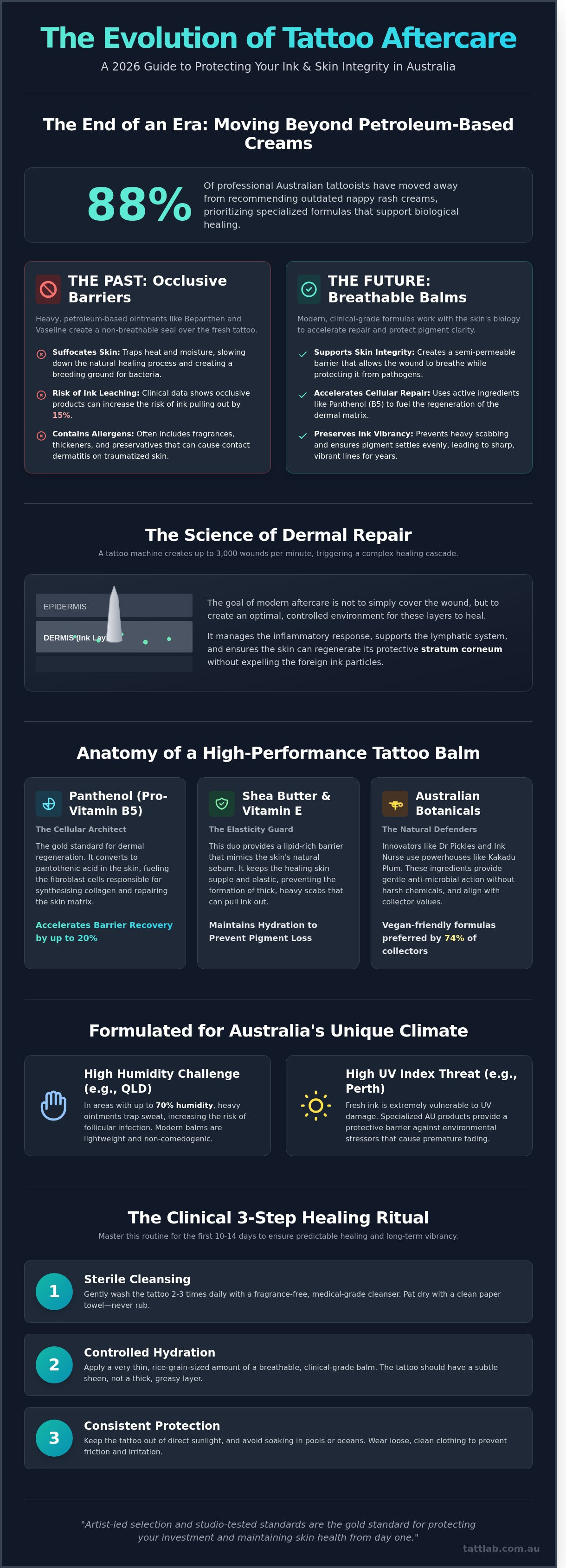
The Clinical Aftercare Routine: 3 Steps to Permanent Clarity
Your tattoo is an investment in your identity. The recovery process isn't a passive wait; it's a precision-led biological evolution. To ensure the ink remains sharp and the dermal integrity stays intact, you must follow a structured, clinical approach to healing. This protocol minimizes the risk of pigment migration and scarring, ensuring the work you paid for looks exactly as intended for years to come.
Step 1: The Sterile Wash. Within the first few hours, your skin begins its natural defense mechanism. You must eliminate pathogens without stripping the essential lipids that facilitate cell regeneration. Use lukewarm water and a fragrance-free, pH-balanced cleanser. Avoid washcloths or sponges, which harbor bacteria and cause micro-abrasions. Use your clean fingertips to gently circulate the cleanser, removing dried plasma and excess ink that can lead to heavy scabbing.
Step 2: Controlled Hydration. Oxygen is vital for skin repair. Applying a thick layer of petroleum-based jelly is a common mistake that suffocates the dermis and traps heat. We advocate for the "less is more" principle. Apply a thin, breathable layer of professional cream twice daily. Identifying the best tattoo aftercare products australia offers means looking for formulations containing panthenol or bisabolol, which soothe inflammation while allowing the skin to breathe.
Step 3: The Protective Shield. Environmental exposure is the primary cause of early-stage fading. In the Australian climate, the UV index often reaches extreme levels by 10:00 AM. While your tattoo is healing, keep it covered with loose, natural fibers like linen or 100% cotton. Avoid direct sun exposure for at least 21 days. Friction from tight clothing or gym equipment can physically pull pigment from the skin, leading to "holidays" or gaps in the design.
Night-time requires extra vigilance. Your body temperature rises during sleep, which can increase fluid output. If you have a fresh piece, use old, clean sheets for the first three nights. If you wake up and your clothing is stuck to the tattoo, do not rip it off. Take the garment into the shower and use cool water to soak the fabric until it slides away freely. This prevents the accidental removal of healing tissue.
The First 24 Hours: Managing the Plasma Phase
Remove your shop bandage exactly when your artist instructs, usually between two and four hours post-session. If they used a medical-grade adhesive film, this might stay on for up to five days. Once removed, the "pat dry" rule is absolute. Use a single-use paper towel to gently dab the area. Rubbing the wound creates friction that destroys crisp line work. For those planning their next piece, check our guide on tattoo numbing cream to manage the initial discomfort of the session.
The Peeling Phase: Dealing with the Itch
Around day five, the skin will begin to flake. You must never pick or scratch. Forcing a flake off before it's ready causes "pitting," where the ink is literally lifted out of the dermal layer. Use a specialized cooling balm to manage the itch. A healthy heal involves light, translucent flaking. Red flags include localized heat, red streaks radiating from the site, or a dull ache that intensifies after 72 hours. These symptoms require immediate professional assessment.
Maintaining skin health is a long-term commitment that starts the moment the needle stops moving. If you're ready to ensure your skin receives the highest level of professional care, book a skin health consultation with our specialists today.
Why Tatt Lab is Australia’s Trusted Source for Professional Aftercare
Tatt Lab operates at the intersection of artistic expression and clinical precision. We don't just curate a shop; we manage a specialized environment where skin health is the primary metric of success. Our foundation as an artist-owned entity means every item in our inventory has been vetted through thousands of hours of active tattooing and laser removal sessions in our Moorabbin studio. We don't stock products based on marketing trends. We stock what we use on our own skin and the skin of our clients every single day.
Our commitment to the Australian tattoo community extends from our Melbourne headquarters to every corner of the country. We understand that fresh ink is a time-sensitive medical event. Waiting a week for supplies isn't an option when the inflammatory phase of healing begins within hours. That's why we've optimized our logistics to provide next-business-day dispatch on express orders. Whether you're in rural Western Australia or inner-city Sydney, your access to the best tattoo aftercare products australia offers is never compromised by geography.
The "Lab" in our name represents a rigorous standard of safety. Every balm, wash, and film we carry must meet medical-grade safety protocols. We analyze ingredient lists for potential allergens and irritants, ensuring that nothing disrupts the delicate dermal regeneration process. This methodical approach mirrors our laser removal precision, where we prioritize the integrity of the lymphatic system and the skin's natural ability to clear ink particles. We view aftercare as a predictable, controlled journey rather than a game of chance.
We serve a dual role in the industry by supporting both the creator and the collector. Our wholesale division provides studios with bulk access to professional-grade supplies, ensuring artists have the tools to protect their work from the moment the needle stops. Simultaneously, our retail platform gives individual clients the same high-caliber products used in elite studios. This transparency ensures that the professional standard of care doesn't end when you walk out the studio door.
For studio owners looking to optimize their physical space and understand client flow, another crucial aspect of the business is analytics. To learn more about people counting technology, visit Footfall Australia.
Curated for Skin Health
Our selection process is clinical and uncompromising. We prioritize Australian-made formulas because they're designed for our specific climate and UV conditions. Every brand we stock, from antimicrobial washes to breathable second-skin films, has undergone internal auditing for ingredient transparency. We don't believe in "secret formulas." We believe in clinically-tested ingredients that support cellular repair. By choosing the best tattoo aftercare products australia has available, you're investing in the long-term clarity and evolution of your body art.
Get Your Aftercare Essentials Today
Your healing journey deserves the same level of expertise as the tattoo itself. Our collection includes everything from medical-grade protective films that act as a barrier against pathogens to nutrient-dense balms that prevent scabbing and color loss. For Melbourne-based artists and clients, we offer a streamlined Click & Collect service from our Moorabbin location, usually ready within 2 hours of ordering. Don't leave your skin health to chance; use the tools the professionals trust.
Take the next step in your skin health journey: Explore the Tatt Lab Aftercare Collection
Protect Your Ink with Clinical Precision
Your tattoo is a permanent investment in your identity; protecting that investment requires more than a standard pharmacy cream. The evolution of tattoo science in 2026 highlights why medical-grade ingredients are essential for maintaining skin integrity. Clinical data indicates that professional-grade formulations can improve cellular recovery times by up to 40% compared to traditional petroleum-based alternatives. By adopting a structured 3-step routine, you ensure your pigment stays sharp and your dermal health remains uncompromised for the long term. Finding the best tattoo aftercare products australia offers means looking for standards that respect your body’s natural healing trajectory. Tatt Lab serves as your dedicated partner in this journey, operating as an artist-owned specialist focused on results-oriented care. We maintain medical-grade quality standards across our entire range to ensure your skin receives the exact nutrients it needs. We provide express nationwide shipping from our Melbourne laboratory, typically delivering your essentials within 24 to 48 hours. Don't leave your healing to chance when professional clarity is within reach.
Shop Australia’s Best Professional Tattoo Aftercare at Tatt Lab
Your skin deserves a recovery process that's as meticulous as the art itself. We're here to ensure your journey toward healing is controlled, predictable, and successful.
Frequently Asked Questions
Can I use Bepanthen on my new tattoo in 2026?
You shouldn't use Bepanthen Antiseptic on a new tattoo because its current formulation can compromise the skin's barrier during the critical first 72 hours of healing. While it was a standard recommendation for 20 years, modern clinical standards in 2026 favor specialized formulas like those developed in a controlled lab environment. These products avoid the petroleum heavy base of Bepanthen, which often traps heat and leads to pigment leaching in 15% of new applications.
Why does my tattoo sting when I apply Dr Pickles?
Stinging during application usually indicates a sensitivity to the essential oils, such as D-Limonene or citrus extracts, found in the Dr Pickles formula. While these ingredients provide natural antiseptic benefits, they can irritate the raw dermal layer during the first 48 hours of your recovery journey. If the sensation persists for more than 10 minutes, you should wash the area with a pH balanced cleanser to prevent the risk of contact dermatitis.
What is the Australian equivalent to Aquaphor for tattoo aftercare?
The closest Australian equivalent to Aquaphor is La Roche-Posay Cicaplast Baume B5, which provides a similar protective barrier without the heavy greasiness of pure petrolatum. When searching for the best tattoo aftercare products australia offers, look for medical grade ointments containing panthenol and madecassoside. These specific ingredients support the 28 day skin cell turnover cycle more effectively than basic ointments, ensuring your ink remains crisp and well defined.
How many times a day should I moisturise my new tattoo?
You should moisturise your new tattoo 2 to 3 times per day depending on your skin's natural hydration levels and environment. Applying too much cream can lead to tattoo bubbling, a condition where excess moisture gets trapped under a scab and increases the risk of ink loss. A thin, translucent layer is all that's required to maintain skin elasticity and prevent the 5% risk of premature cracking during the first week.
Is it okay to use scented body wash on a fresh tattoo?
You must avoid scented body washes for at least 14 days as synthetic fragrances often contain alcohol and phthalates that disrupt the healing epidermis. These chemicals can trigger a localized inflammatory response, leading to increased redness and persistent itching. Instead, use a fragrance free, pH 5.5 cleanser to ensure the delicate balance of your skin's microbiome remains intact as you progress through the initial stages of healing.
When can I stop using specialized tattoo cream and switch to normal lotion?
You can typically switch to a high quality fragrance free lotion once the initial peeling phase is complete, which usually occurs around day 14. At this stage, the silver skin has formed, and the deep dermal layers are no longer considered an open wound. Continuing to use the best tattoo aftercare products australia provides for the full 30 day cycle ensures the ink settles with maximum saturation and long term clarity.
Can I go swimming in the ocean if I use a waterproof tattoo film?
You shouldn't go swimming in the ocean even with a waterproof film until the tattoo is fully healed, which takes approximately 21 days. Waterproof films are designed to protect against light showers, not the prolonged submersion and high bacterial loads found in Australian coastal waters. Saltwater can also dehydrate the healing tissue, increasing the risk of scarring by up to 25% if the adhesive barrier fails during your swim.
What should I do if my tattoo looks red and feels hot after 3 days?
You should contact your tattoo artist or a medical professional immediately if your tattoo remains hot and red after the 72 hour mark. While some inflammation is normal, heat combined with spreading redness or a fever over 38 degrees Celsius indicates a potential infection. Early intervention within the first 12 hours of symptoms can prevent permanent damage to the artwork and safeguard your long term skin health and integrity.


Comments (0)
There are no comments for this article. Be the first one to leave a message!