

Could a single millimetre of depth be the difference between a pristine portfolio and a permanent scar? In the high-precision environment of the Tatt Lab, we recognise that technical mastery is often overshadowed by artistic flair, leading to common tattooing mistakes to avoid that can compromise a client's long-term skin health. You likely understand that every pass of the needle is a clinical interaction with the dermis, yet the fear of causing a blowout or managing inconsistent ink saturation remains a persistent stressor for many Australian artists. According to recent industry observations, nearly 25% of touch-up sessions are required due to preventable technical errors during the initial application rather than the client's aftercare routine.
By mastering the biological nuances of pigment suspension and skin integrity, you can ensure your reputation remains as sharp as your linework. This guide provides a professional roadmap to protecting the skin, ensuring your work achieves predictable, vibrant healing without the risk of cross-contamination. We will explore the specific technical adjustments required for flawless saturation, the science of dermal trauma, and the clinical protocols that turn a standard studio into a trusted laboratory for skin transformation. It's time to replace uncertainty with the controlled, predictable progress that defines a true specialist.
Key Takeaways
- Shift your focus from pure artistry to a clinical methodology that prioritizes biological precision and long-term skin health.
- Identify the critical mechanical variables, such as needle depth and machine voltage, to effectively navigate common tattooing mistakes to avoid like blowouts and scarring.
- Elevate your studio standards by distinguishing between "clean" and "sterile" protocols to eliminate cross-contamination in your workstation’s grey zones.
- Understand the technical science behind pigment load and needle quality to ensure your material selection supports the skin’s natural evolution.
- Extend your professional care through a structured education framework that empowers clients to protect their ink throughout the healing journey.
The Artist vs. The Technician: Adopting a Clinical Mindset
Every tattoo begins as a creative spark, but its survival depends on technical precision. Professional artists must transition from being purely creators to becoming skin technicians. This "Lab" mindset treats the studio as a controlled clinical environment where safety and biology take precedence over aesthetics. Understanding the tattooing process is about more than just steady hands; it's about managing a complex biological interaction between foreign pigment and living tissue. One of the most common tattooing mistakes to avoid is prioritising the visual result over the physiological reality of the dermis.
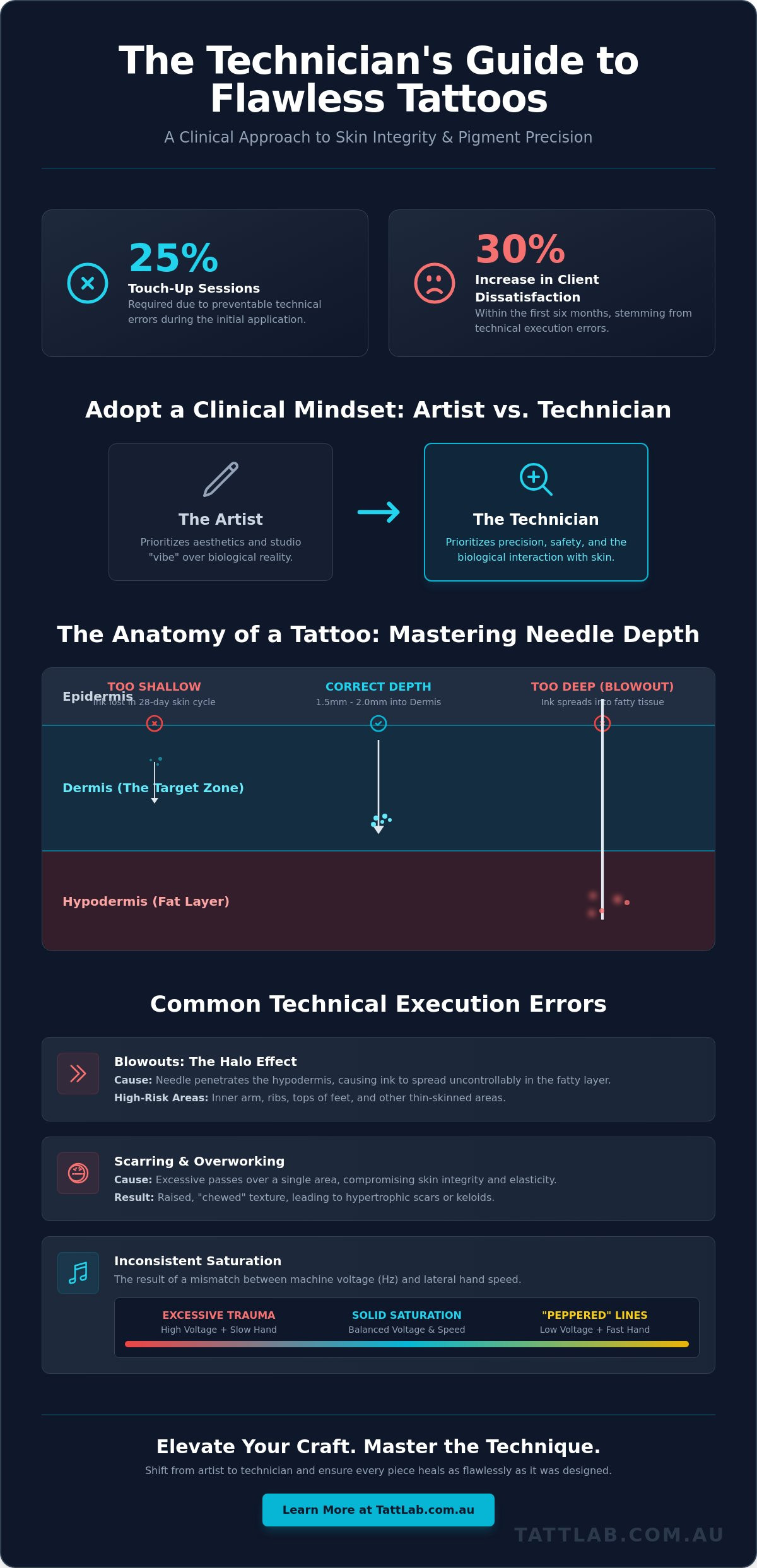
The journey of ink is a deliberate migration. While the needle passes through the epidermis, the goal is to deposit pigment into the upper papillary dermis. If the ink stays too shallow, it's lost during the skin's natural 28-day shedding cycle. If it's driven too deep, it enters the subcutaneous fat, leading to permanent structural damage. Maintaining this balance requires a specialist's focus on skin health rather than just the final image.
The Biological Canvas: How Skin Reacts to Needle Trauma
When a needle penetrates the skin, it triggers an immediate inflammatory response. Your body doesn't recognise the ink as art; it identifies it as a wound and a foreign invader. White blood cells swarm the site while the lymphatic system begins attempting to clear the pigment particles immediately. This biological resistance is why technical precision is non-negotiable. Excessive trauma causes heavy scabbing, which physically pulls pigment out of the skin during the healing phase. Skin integrity is the balance between pigment saturation and minimal tissue trauma.
The Cost of "Artistic" Shortcuts
Rushing the design or the technical setup leads to micro-errors that compromise the client’s long-term clarity. Poor ergonomics don't just cause artist fatigue; they result in inconsistent needle depth and shaky line work. In Australia, the professional standard is evolving toward medical-grade specialist environments. A 2023 industry report suggested that technical execution errors during the initial application account for a 30% increase in client dissatisfaction during the first six months of wear. Moving from a hobbyist approach to a clinical specialist mindset involves several key shifts:
- Prioritising aseptic techniques over studio "vibe."
- Using high-quality pigments that resist excessive fragmentation.
- Adjusting machine voltage to match the specific resistance of the client's skin.
Adopting this disciplined approach ensures the tattoo remains a clear, vibrant piece of history rather than a blurred reminder of technical oversight. It's about respecting the skin as a living organ, not just a surface for expression. This evolution from artist to technician—which can be further professionalised by using TrackMyBusiness to manage studio workflows—is what defines a professional in the modern Australian industry.
Technical Execution Errors: Blowouts, Scarring, and Saturated Lines
Precision in tattooing isn't just about the aesthetic outcome; it's about the scientific management of the skin's architecture. The dermis, located between 1.5mm and 2mm below the surface, is the specific layer capable of holding pigment permanently. One of the most common tattooing mistakes to avoid is failing to maintain this precise depth. If the needle remains in the epidermis, the ink will simply shed during the standard 28 day skin regeneration cycle. Conversely, pushing beyond the dermis leads to permanent tissue trauma and aesthetic failure.
Overworking the skin is the primary driver of poor healing and long-term scarring. When an artist makes excessive passes over a single area, the skin's structural integrity is compromised. This results in a "chewed" texture that often leads to hypertrophic scars or thick, raised keloids. Understanding these tattoo risks and precautions is vital for maintaining the health of the canvas. Skin that has been overworked loses its elasticity, making any future modifications or removals significantly more complex.
The Anatomy of a Blowout
Blowouts occur when the needle penetrates the hypodermis, the fatty layer beneath the dermis. Because this layer lacks the dense structure of the dermis, the ink spreads uncontrollably, creating a blue or grey "halo" around the line. This is particularly common in areas where the skin is less than 1mm thick, such as the inner arm, ribs, or tops of the feet. Identifying the warning signs, such as a slight "pop" sensation or immediate ink spreading, allows an artist to adjust their angle and depth before the damage becomes widespread.
Voltage and Hand Speed Synchronisation
Achieving consistent saturation is a mathematical balance between machine hertz (Hz) and lateral hand speed. If the machine runs at a high voltage but the hand moves too slowly, the needle strikes the same point too many times. This creates excessive trauma. On the other hand, fast movements with low voltage result in "peppered" or shaky lines that lack solid pigment. Calibration is key; a round liner requires a different voltage profile than a large magnum to ensure the ink is deposited evenly without tearing the tissue. Proper skin stretching is also essential to provide a firm surface, yet over-stretching can distort the design once the skin is released.
Clinical Safety & Hygiene: Beyond Basic Glove Use
Hygiene is often misunderstood as a visual state rather than a biological one. One of the most common tattooing mistakes to avoid is the dangerous assumption that a "clean" studio is a sterile one. While a tidy workstation looks professional, sterility requires the total elimination of all living microorganisms. At Tatt Lab, we view skin health as a scientific discipline. Cross-contamination often thrives in the "grey zones" of a workstation—those overlooked areas like the underside of a massage table, the lamp switch, or the ink bottle caps. If these surfaces aren't correctly shielded or treated with medical-grade chemistry, they become silent vectors for infection.
Setting Up a Sterile Workstation
Precision in safety begins before the first drop of ink is poured. Artists must apply barrier film to every high-touch point, including the power supply, clip cords, and the machine itself. Dental bibs are essential for creating an absorbent, waterproof field that prevents fluid runoff. Relying on premium medical supplies for tattoo artists ensures these barriers don't degrade during a six-hour session. We recommend a strict "clean hand, dirty hand" protocol. Your dominant hand, which handles the machine and the client's skin, is considered "dirty." Your non-dominant hand stays "clean" to adjust the power supply or reach for fresh supplies. This simple logic prevents the invisible migration of pathogens across your workspace.
Sterilisation vs. Disinfection
There's a critical divide between disinfection and sterilization. Disinfection reduces the number of pathogens on a surface, but sterilization—achieved only through a validated autoclave—kills everything. For professional Australian studios, any reusable tool must undergo this process. When it comes to surfaces, your choice of sanitiser is a matter of client safety. Use TGA-approved, hospital-grade disinfectants that specifically target bloodborne viruses like Hepatitis B and C. This level of rigor is necessary because even the products you use carry risks. Research regarding tattoo ink safety highlights that pigments can be contaminated before they even reach your shop. Proper disposal is the final step in this journey. Sharps must go directly into yellow Australian Standard containers, never left on a tray or in a general bin. This methodical approach to waste management is what separates a hobbyist from a specialist who respects the integrity of the skin.
Material Selection: The Impact of Low-Quality Supplies
Choosing subpar tools is one of the common tattooing mistakes to avoid because the initial savings of A$20 per box often result in hundreds of dollars in lost time and skin trauma. Cheap needle cartridges are the most expensive mistake an artist can make. They often lack the structural integrity to maintain consistent depth, leading to snagging that tears the epidermis rather than piercing it cleanly. This compromise in skin health isn't just an aesthetic issue; it's a clinical failure that complicates the healing process and increases the risk of permanent scarring.
Understanding the science of tattoo ink is vital for long-term clarity and client safety. Professional-grade pigments prioritize a high pigment load and safe carriers like vegetable glycerine or sterile water. Needle tapers also play a critical role in how the skin receives these pigments. While short tapers are effective for bold color packing, long taper needles, typically 5mm to 7mm, are far superior for creating smooth gradients. The extended point allows for more precise control and less skin displacement, which is essential for delicate shading and realism.
The Mechanics of Professional Cartridges
High-quality membranes act as a physical barrier that prevents ink and biological fluids from backflowing into your machine's motor. Without this seal, cross-contamination becomes a systemic risk that can't be fixed by external cleaning. Professional tattoo supplies also incorporate internal needle stabilisers to eliminate lateral vibration. This stability ensures the needle enters the skin at a perfect angle, preventing the side-swipe trauma that causes excessive bleeding and ink rejection. Every piece of equipment must be artist-vetted to ensure it meets the rigorous quality control standards required for professional studio environments.
Pigment Science and Ink Stability
Low-quality inks often contain heavy metals or industrial-grade carbon that can trigger delayed hypersensitivity reactions or rapid fading within the first 12 months. Adhering to REACH-compliant standards, which set a global benchmark for safety in January 2022, ensures that pigments don't contain prohibited substances that compromise long-term skin health. The lymphatic system’s ability to "clear" the tattoo depends heavily on pigment particle size, where larger, stable particles remain anchored in the dermis while smaller, unstable fragments are more easily transported away from the site. Using stable, high-quality pigments is another way to navigate common tattooing mistakes to avoid and ensure the longevity of the artwork.
Prioritise your client's skin health by choosing professional-grade equipment. Consult with Tatt Lab to learn more about maintaining skin integrity throughout the tattoo lifecycle.
Aftercare Failures: Protecting the Evolution of the Ink
The artist's responsibility doesn't end when the machine stops. One of the most common tattooing mistakes to avoid is failing to bridge the clinical gap between the studio and the client's home environment. When a client walks out the door, they become the primary caregiver of a complex biological wound. If the education you provide is vague or rushed, they will inevitably seek advice from "Dr. Google," where conflicting misinformation can lead to secondary skin trauma and compromised pigment retention.
This educational bridge is a hallmark of professional studios worldwide; for example, those providing tatuering stockholm midsommarkransen utilize structured aftercare resources to safeguard their technical work long after the client leaves.
The science of tattoo aftercare centers on the balance between occlusion and oxygenation. While the skin requires a barrier against external pathogens, it also needs gas exchange to facilitate efficient cellular repair. You must teach your clients to distinguish between a normal inflammatory response and early signs of infection. A healthy tattoo will exhibit localised redness and warmth for the first 24 to 48 hours. If that redness begins to spread, or if the client notices yellow discharge or a foul odour, it indicates a breach in skin integrity that requires immediate professional attention.
The Critical First 48 Hours
The first two days are the most volatile period for the "evolution" of the ink. Adhesive "second skin" wraps are now the industry standard because they mimic the skin's natural barrier, but applying them incorrectly is another of the common tattooing mistakes to avoid. These wraps should only be applied to skin that is completely dry and free of residual plasma. If using traditional medical dressings, instruct the client to wash the area with a fragrance-free, pH-balanced cleanser within 2 to 4 hours. A major error in this phase is over-moisturising; applying thick layers of ointment creates a hypoxic environment that can cause the skin to macerate, leading to significant ink leaching and blurred line work.
Professional Solutions vs. Home Remedies
Recommending home remedies or petroleum-based products is a disservice to the craft. Petroleum is a heavy lipid that traps body heat and bacteria against the wound, which frequently leads to folliculitis or delayed healing. Instead, the focus should be on specialist balms designed for cellular regeneration. These products provide essential fatty acids that support the skin's lipid barrier without clogging pores. By shifting the conversation from "healing a tattoo" to "optimising skin health," you position yourself as a trusted specialist. Elevate your craft and ensure your work stays as sharp as the day it was finished by using professional-grade supplies from Tatt Lab.
Elevating Your Craft Through Clinical Precision
Mastering the art of tattooing requires a shift from being a technician to a specialist who prioritizes skin health. Identifying common tattooing mistakes to avoid, such as improper needle depth or compromising on hygiene, is essential for the longevity of every piece. It's a commitment that safeguards the skin's integrity throughout the biological healing process. Success depends on the synergy between technical skill and the use of medical-grade materials. By maintaining a sterile environment and selecting high-quality consumables, you protect both the client's safety and the long-term evolution of the ink.
Tatt Lab is an artist-owned and operated hub with deep industry expertise. We provide a comprehensive range of medical-grade PPE and sterile consumables to help you maintain a controlled, clinical environment. With express nationwide shipping across Australia, your studio stays equipped with the tools necessary for precision. Explore the Specialist Selection of Professional Tattoo Supplies to support your journey toward technical excellence. Your dedication to meticulous care is what builds lasting trust with every client.
Frequently Asked Questions
What is the most common technical mistake beginner tattoo artists make?
The most common technical mistake beginner artists make is inconsistent needle depth, which often leads to poor ink retention or scarring. Maintaining a precise depth of 1.5mm to 2mm ensures the pigment settles in the dermis rather than the epidermis or subcutaneous fat. This precision is vital for skin health. When depth fluctuates, the result is an uneven healing journey that may require laser correction later in the skin's evolution.
How can I avoid causing a blowout during fine linework?
You can avoid causing a blowout by maintaining a 90 degree needle angle and reducing hand pressure when working on thin-skinned areas like the wrist or inner bicep. Blowouts occur when ink is injected into the hypodermis, causing the pigment to spread laterally. This is one of the common tattooing mistakes to avoid if you want to maintain crisp clarity. Monitoring your machine speed against your hand movement prevents the needle from lingering too long in one spot.
Is it okay to use rubbing alcohol to clean a fresh tattoo?
No, you shouldn't use rubbing alcohol on a fresh tattoo because it dehydrates the tissue and can delay the natural 28 day skin cell turnover cycle. Alcohol is a harsh solvent that destroys the lipid barrier, leading to irritation and potential pigment loss. Instead, use a pH balanced, fragrance free cleanser to maintain skin integrity. Proper aftercare ensures the lymphatic system can effectively manage the healing process without unnecessary chemical interference.
Why does my tattoo ink look dull after it has fully healed?
Tattoo ink often looks dull after healing because a new layer of epidermis has formed over the pigment, acting like a frosted window. This biological process is normal, but excessive sun exposure can accelerate the degradation of ink particles. To maintain the transformation of your skin, use a 50 plus SPF sunscreen daily. If the dullness is significant, it might indicate that the pigment wasn't packed densely enough during the initial session.
What are the signs that I am overworking the skin?
The primary signs of overworking the skin include excessive redness, a "chewed" texture to the tissue, and localized swelling that persists beyond 24 hours. Overworking occurs when you pass over the same area more than 3 or 4 times, causing unnecessary trauma. This damage compromises skin health and increases the risk of hypertrophic scarring. Recognizing these physical cues is essential for a specialist who prioritizes the long term health of the client's skin.
How do I prevent cross-contamination when reaching for my power supply?
To prevent cross-contamination, you must wrap your power supply and all touchpoints in a disposable barrier film before the session begins. Even if you only touch the dial once, the risk of pathogen transfer is high. Following the Australian Guidelines for the Prevention and Control of Infection in Healthcare is the standard for a professional lab. Always use a fresh piece of barrier film for every new client to ensure a sterile environment.
Can I use any nitrile gloves for tattooing, or do they need to be medical grade?
You must use medical grade, powder free nitrile gloves that meet the AS/NZS 4011.1:2014 standards for tattooing in Australia. Standard industrial gloves don't provide the same level of puncture resistance or protection against bloodborne pathogens. Using high quality, 4 mil thick nitrile gloves ensures both your safety and the client's skin integrity. This choice reflects a clinical approach to the tattooing process, prioritizing safety over cheaper alternatives.
What happens if a tattoo cartridge membrane fails during a session?
If a tattoo cartridge membrane fails, ink and biological fluids can backflow into the grip and machine motor, creating a serious cross-contamination risk. This failure means the machine is no longer sterile and must be professionally cleaned or decommissioned according to manufacturer specs. It's one of the common tattooing mistakes to avoid by never using unbranded cartridges. High quality membranes are tested for over 5 hours of continuous vibration to prevent such breaches.


Comments (0)
There are no comments for this article. Be the first one to leave a message!