

Within 72 hours of leaving the studio, you notice a faint, blue shadow blurring the once-sharp edges of your new script. This isn't the typical swelling you expected; it's the beginning of a permanent shift in your skin's aesthetic. You've likely spent weeks planning this piece, so seeing the ink migrate into unwanted areas feels like a compromise on your vision. Understanding exactly what causes tattoo blowout is the first step in moving from frustration toward a clinical solution.
At Tatt Lab, we view skin as a complex biological canvas that requires precise technical handling. It's natural to feel a loss of control when your healing process takes an unexpected turn, but knowledge is the most effective tool for restoration. This guide examines the mechanical and physiological triggers of ink migration, noting how a mere 1.5 millimetres of needle depth can be the difference between a crisp line and a permanent smudge. We'll outline how to distinguish a blowout from standard bruising and explore the advanced laser technologies we use to return clarity to your skin.
Key Takeaways
- Explore the biological mechanics of skin histology to understand why the dermis is the essential "sweet spot" for stable pigment entrapment.
- Gain professional insight into what causes tattoo blowout by examining the technical relationship between needle depth, entry angles, and machine calibration.
- Identify high-risk anatomical zones and placement variables where skin thinness increases the likelihood of unintended ink migration.
- Learn how to safeguard your skin integrity by prioritising mechanical consistency and artist-vetted tools during the tattooing process.
- Master the ability to distinguish between immediate procedural complications and the natural, long-term evolution of ink settling within the tissue.
Defining Tattoo Blowout: Beyond the Blurry Edges
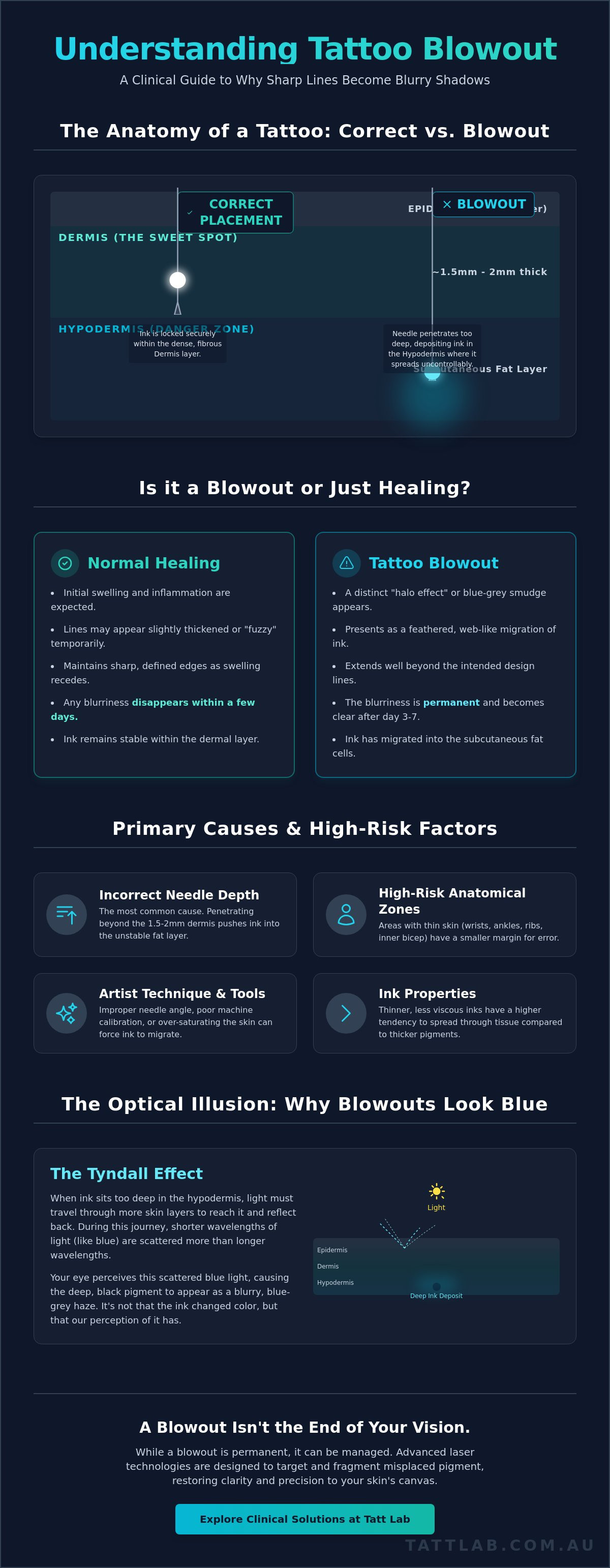
A tattoo blowout isn't merely a minor aesthetic smudge. It's a structural deviation in how pigment interacts with your skin's anatomy. While standard tattooing deposits ink into the dermis, a blowout occurs when the needle penetrates too deeply, sending ink into the subcutaneous fat layer. This deeper tissue is less dense and lacks the tight cellular structure of the dermis, allowing the pigment to spread uncontrollably. Understanding what causes tattoo blowout requires a clinical look at these deeper tissue layers where ink behaves more like a liquid in a porous sponge than a precise mark.
The visual markers are distinct and often distressing for the client. You'll typically notice a "halo effect" or a soft, blue-grey smudge radiating from the original line. This happens because of light scattering, where the ink sits so deep that the light must travel through more skin layers to reach it, altering its perceived colour. This phenomenon is often misidentified as bruising during the first 48 hours. While a bruise is a temporary vascular response that the body's lymphatic system will clear, a blowout is a permanent displacement of pigment within the hypodermis. While many complications fall under the umbrella of tattoo health risks, a blowout is specifically a mechanical failure of ink placement rather than a biological rejection.
Blowout vs. Normal Healing
Distinguishing between a healing tattoo and a procedural blowout is vital for managing expectations. During the initial recovery phase, every tattoo undergoes some degree of inflammation. This natural response can cause lines to appear slightly thickened or "fuzzy" as the skin swells. However, healthy healing maintains sharp, defined edges within the dermal layer. A true blowout presents as a feathered, web-like migration that extends well beyond the intended design. This transition usually becomes permanent between day 3 and day 7. If the "blur" doesn't recede as the swelling goes down, the ink has likely migrated into the fat cells. Understanding what causes tattoo blowout helps clients identify this shift early, allowing for a more informed conversation with their specialist.
The Psychology of the 'Ink Journey'
Discovering a blowout can trigger significant anxiety. It often feels like a permanent mark on one's confidence. At Tatt Lab, we frame this not as a failure, but as a manageable stage in your skin health journey. We prioritize transparent, clinical information to lower the emotional weight of the situation. Framing the correction process as a controlled evolution of the skin helps move the client from a state of panic to a state of progress. Maintaining an open communication loop between the artist and the client is essential for long-term satisfaction. We view every consultation as a partnership, using our expertise in laser fragmentation to reclaim the clarity of your skin. This methodical approach ensures that even when the initial application goes off-track, the path to a clean result remains predictable and safe.
The Biological Mechanics: What Actually Causes a Blowout?
Understanding what causes tattoo blowout requires a precise look at the skin's three-layer architecture. The skin isn't a single uniform surface; it's a complex system of the epidermis, dermis, and hypodermis. The epidermis is the outer shield that constantly regenerates, while the dermis is the structural "sweet spot" for tattooing. This middle layer, roughly 1.5mm to 2mm thick, contains the collagen and fibroblasts necessary to trap and hold pigment particles in a stable, permanent position.
When a needle penetrates at the correct depth, the ink stays locked within this fibrous matrix. However, if the needle bypasses the dermis and enters the hypodermis, the biological environment changes. The hypodermis consists primarily of subcutaneous fat and loose connective tissue. Unlike the dense dermis, this layer offers no structural resistance. The ink doesn't stay put; it follows the path of least resistance, spreading through the fatty tissue like a drop of dye on a damp paper towel. This migration is the fundamental catalyst for a blowout.
The Subcutaneous Trap
The subcutaneous layer is a dangerous zone for precision work. Because fat cells don't have the same "grip" on pigment as the dermis, the ink spreads laterally and unevenly. This depth also alters the optical properties of the tattoo. When ink sits too deep, it's viewed through more layers of tissue, which changes how light reflects back to the eye.
The Tyndall effect is the phenomenon where light scatters through the skin's upper layers, causing deep, misplaced pigment to appear as a blurred blue or grey haze instead of its intended sharp colour.
Tissue Integrity and Pigment Loading
While depth is the primary factor, tissue integrity and pigment loading are critical secondary contributors. If a technician over-saturates the dermis, the skin reaches a physical limit of how much ink it can hold. This excess pigment is often forced into the surrounding interstitial spaces. The viscosity of the ink also dictates how far it travels; thinner inks move more rapidly through compromised tissue than high-viscosity pigments.
- Inflammatory Response: Excessive trauma during the procedure triggers an influx of interstitial fluid.
- Ink Migration: This fluid can carry pigment away from the needle's entry point.
- Lymphatic Clearance: Your body's immune system views misplaced ink as a foreign invader, and the lymphatic system begins the slow process of trying to transport these particles away, often resulting in a "smudged" aesthetic.
Maintaining skin health during the procedure is vital. If the skin is overworked, the barrier breaks down, leading to "weeping" where ink and plasma mix and travel outside the lines. This loss of integrity makes it nearly impossible for the dermis to retain the sharp edges required for a high-quality tattoo. At Tatt Lab, we often see the results of these biological missteps, where the skin's natural clearance processes have failed to resolve the blurred edges of a deep-seated blowout.
Technical Factors: Needle Depth, Angle, and Machine Calibration
The technical execution of a tattoo is a delicate balance between physics and biology. Many clients mistakenly believe a "heavy hand" refers to physical pressure alone. In reality, the issue is almost always about depth. When an artist pushes the needle beyond the safe threshold of the dermis, they enter the hypodermis. This subcutaneous layer consists of fat cells and loose connective tissue that lacks the structural density to hold pigment in place. The ink spreads uncontrollably through these layers, which is exactly what causes tattoo blowout in most technical scenarios.
The angle of the needle plays a critical role in the trajectory of the ink delivery. If a needle enters the skin at an overly acute angle, it can create a "sideways" delivery. This pushes the pigment laterally rather than vertically into the dermal pocket. Similarly, machine calibration is a variable that requires constant monitoring. High voltage combined with an aggressive "hit" creates unnecessary trauma. This setup can rupture delicate capillary walls, allowing ink to migrate through the interstitial fluid before the skin has a chance to begin the healing process.
Precision in Needle Depth
Targeting the 1.5mm to 2mm range is the gold standard for consistent dermal placement. Achieving this requires a technique known as "floating the needle," where the artist relies on tactile feedback and visual cues rather than the physical guard of the tube. It takes years of practice to develop the muscle memory needed to maintain this precision. During long sessions exceeding four or five hours, artist fatigue becomes a genuine risk. A tired hand might unintentionally "dig" into the skin, breaching the dermal-epidermal junction and triggering an immediate blowout.
Cartridge Stability and Vibration
Equipment quality is a non-negotiable factor in maintaining skin integrity. Low-grade cartridges often suffer from needle wobble, where the needle moves laterally within the plastic housing. This instability creates micro-tears and an erratic "ink spray" effect rather than a clean, saturated line. Using high-quality cartridges with internal safety membranes ensures the needle remains centered and stable.
These membranes also serve to dampen vibration, providing a smoother hit that respects the skin's natural architecture. When you understand what causes tattoo blowout, it becomes clear that mechanical consistency is just as vital as the artist's creative vision. Choosing superior tools reduces the likelihood of trauma and ensures the final result retains the clarity and sharpness intended at the start of the journey.
High-Risk Variables: Skin Anatomy and Placement
Skin isn't a uniform canvas. Its thickness, elasticity, and structural integrity vary significantly across the body, creating a complex landscape for any practitioner. Understanding what causes tattoo blowout requires a deep dive into these anatomical nuances. In areas where the dermis is exceptionally thin or sits directly over bone, the margin for error shrinks to fractions of a millimetre. When an artist applies standard pressure to a delicate zone, the needle often bypasses the stable dermis and enters the subcutaneous fat, where ink particles spread uncontrollably.
Joint areas like elbows, knees, and inner wrists present a secondary challenge. These zones are subject to constant mechanical stress and skin "bunching." The constant movement can compromise the healing process, shifting ink before the skin has a chance to lock it in place. Furthermore, the "stretch" factor is a critical technical variable. If an artist fails to maintain proper skin tensioning, the needle depth becomes inconsistent. Over-stretching thin skin can lead to micro-tears, while under-stretching often results in the artist pushing too hard to achieve saturation, both of which are primary drivers of ink migration.
Thin Skin and High-Movement Zones
The inner bicep and ribs are notorious "danger zones" for apprentices and experienced artists alike. These areas lack significant subcutaneous cushioning, meaning the needle reaches the fat layer with very little resistance. Success in these zones requires a calibrated technique, often involving a lighter "hand" and a faster machine speed to prevent over-saturation. Previous trauma or scarring also complicates the field. Scar tissue is denser and less predictable than healthy skin, often causing ink to pool or blow out along the edges of the fibrous tissue.
Client Factors and Skin Prep
Biological variables often dictate the success of the procedure before the needle even touches the skin. In the harsh Australian climate, chronic sun damage is a frequent concern. UV radiation degrades collagen and elastin, leaving the skin "papery" and less capable of holding ink in a tight suspension. Dehydration also plays a role; poorly hydrated skin lacks the turgor needed for a clean puncture, leading to ragged entry points and potential blowout.
- Blood Thinners and Alcohol: These substances increase vascularity and thin the blood, which can "wash" ink out of the dermal layer during the process.
- Ageing: As we age, the dermal-epidermal junction flattens, making the skin more prone to tearing and ink spread.
- Professional Environment: Using medical-grade supplies is essential to maintain a sterile, calm field that allows the artist to focus entirely on depth precision.
Skin health is the foundation of every successful tattoo. If you are concerned about existing ink migration or wish to restore your skin's clarity, consult with our clinical specialists to discuss your removal and revision options.
Prevention and Management: Protecting Skin Integrity
Minimising the risks associated with what causes tattoo blowout requires a dual commitment from both the artist and the client. It starts with mechanical consistency. Professional artists invest in vetted, high-end rotary or coil machines to ensure needle depth remains stable across varying skin textures. This precision protects the dermis from unnecessary trauma and prevents the needle from dipping into the subcutaneous fat layer where ink spreads uncontrollably.
Supporting the skin's biological response is the next priority. Utilizing specialised aftercare solutions helps maintain the integrity of the dermal barrier during the critical first 72 hours. When the skin is hydrated and the inflammatory response is managed, the pigment is more likely to stay locked within the intended macrophages. This proactive approach to skin health ensures the tattoo remains a sharp piece of art rather than a blurred medical curiosity.
The Artist’s Prevention Checklist
Precision is a technical discipline that requires constant vigilance. An artist's workstation must be optimised for visibility and stability to prevent the micro-slips that lead to ink migration. Key preventative measures include:
- Depth Monitoring: Artists must adjust their technique for different zones; the skin on the inner wrist is often less than 1mm thick, while the back can be over 4mm.
- Ink Selection: Choosing the right tattoo ink for specific styles, as high-pigment loads behave differently in the skin than thinned-out washes.
- Ergonomics and Lighting: Utilizing 1000+ lux LED lighting and adjustable armrests to ensure the needle entry angle remains a consistent 45 to 90 degrees.
Managing an Existing Blowout
If you notice a blue or grey halo forming around your fresh lines, the first step is patience. We recommend a "wait and see" period of at least 8 to 12 weeks. This allows the skin to fully remodel and the lymphatic system to naturally clear any superficial pigment. Once the area is stable, several clinical pathways can restore the skin's aesthetic clarity.
Picosecond lasers represent the gold standard for blowout correction. These devices deliver energy in trillionths of a second, creating a mechanical vibration that shatters misplaced ink into tiny particles without overheating the skin. This targeted fragmentation allows for precise clearance of the "halo" while leaving the primary tattoo lines intact. Alternatively, strategic camouflage can be effective. A skilled artist can use soft grey shading or background textures to mask linear blowouts, turning a technical error into a deliberate design element. At Tatt Lab, we view this process as a journey toward reclaiming your skin's evolution, prioritising health and precision at every stage.
Elevating Your Craft with Clinical Precision
Mastering the delicate balance between ink saturation and skin health defines a professional's career. Understanding what causes tattoo blowout requires a deep dive into the anatomy of the dermis, which typically measures between 1mm and 2mm in thickness depending on the body site. When needles penetrate too deeply into the subcutaneous fat, ink particles disperse uncontrollably. Precision isn't just about technique; it's about the synergy between your machine calibration and the high-quality consumables you select for every session.
By prioritising skin integrity and mechanical accuracy, you transform a standard procedure into a predictable, high-end result. Every artist’s journey is built on the trust of their clients and the reliability of their tools. Maintaining this standard ensures your work remains sharp for years, avoiding the blurred edges that compromise a studio's legacy. Our Lab is dedicated to supporting this evolution through scientific rigor and premium equipment.
Secure your studio's reputation with professional-grade supplies from Tatt Lab. As an artist-owned and operated specialist, we provide a specialised selection of medical-grade consumables with express nationwide shipping across Australia. You've got the talent; we've got the science to protect it.
Frequently Asked Questions
Can a tattoo blowout happen weeks after the appointment?
A tattoo blowout occurs during the initial application, but the visual evidence often becomes more apparent 3 to 7 days after your session as the skin heals. While the ink is misplaced into the hypodermis immediately, it takes time for the initial inflammation to subside and the pigment to settle. If you notice blurring 21 days later, it’s likely the original ink migration becoming visible as the epidermis fully regenerates.
Is a tattoo blowout the artist's fault or my skin's fault?
Determining what causes tattoo blowout usually involves a combination of technical application and anatomical factors. In 90% of cases, the ink is deposited too deeply into the subcutaneous fat layer by the artist. However, areas with thin skin, such as the inner wrist or ankle, have a higher vulnerability. Maintaining skin integrity is a shared responsibility between the professional's precision and your skin's natural density.
Will a tattoo blowout eventually fade on its own?
Tattoo blowouts don't fade away naturally because the ink is trapped in the hypodermis, a layer where the body's lymphatic system cannot easily reach it. Unlike the dermis, this fatty tissue allows ink to spread laterally over time. While the edges might soften after 5 to 10 years, the halo effect remains permanent without clinical intervention like laser fragmentation. Our Lab specialists focus on breaking down this deep pigment to restore your skin's original clarity.
Does tattoo numbing cream increase the risk of a blowout?
Numbing creams containing epinephrine can occasionally increase blowout risks by altering local skin texture. These topical anaesthetics can cause "spongy" skin or localized swelling, making it harder for an artist to gauge needle depth accurately. If the skin’s resistance changes, the needle might penetrate deeper than intended. Always discuss the use of specific brands with your specialist at least 48 hours before your appointment to ensure optimal results.
Can I fix a small blowout with more white ink?
Using white ink to cover a blowout is rarely successful and often results in a muddy, greyish appearance. White pigment is translucent and sits above the migrated ink; this means the dark blowout will still show through. Most specialists recommend laser treatment to clear the excess pigment rather than adding more ink to an already compromised area. This ensures the skin's health is prioritized and the visual outcome is clean.
What is the difference between a blowout and an infected tattoo?
A blowout is a painless visual blurring of ink, whereas an infection is a biological response characterized by heat, swelling, and discharge. If your tattoo looks fuzzy but feels fine after 4 days, it’s likely a blowout. If you experience a fever or the area feels hot to the touch 48 hours post-procedure, you should seek medical advice immediately. These are two distinct issues that require different recovery paths on your skin journey.
Are stick and poke tattoos more likely to blow out?
Stick and poke tattoos have a higher incidence of blowouts because manual pressure is significantly harder to regulate than a calibrated machine. Amateur applications often lack the consistent 1.5mm to 2mm depth required for a clean line. Without professional equipment, it’s easy to push the needle into the deeper adipose tissue. This results in the characteristic "halo" effect often seen in non-professional work where depth control is absent.
How much does it cost to fix a tattoo blowout in Australia?
In the Australian market, laser correction for a blowout typically starts at A$150 per session for a small area. Most clients require 3 to 6 sessions to achieve significant clearance of the migrated pigment. Prices vary across Melbourne and Sydney clinics depending on the technology used, such as Picosecond lasers. It’s best to book a consultation to receive a precise quote and start your journey toward clearer skin.


Comments (0)
There are no comments for this article. Be the first one to leave a message!