
A home address isn’t automatic permission to tattoo clients. The council requirements for a home tattoo studio in Australia depend on your state or territory and local council, and may include premises registration, licences or planning approval. In 2026, Australia has no single national cosmetic tattoo licence, so the rules aren’t uniform across the country.
It’s understandable to focus first on whether council will approve the business. But approval is only part of the picture: a home studio also needs to manage hygiene, sterilisation, sharps and the separation of clean and contaminated areas.
This guide explains what may apply to home tattooing across Australia, how council and state requirements can differ, and what to consider before setting up. It also covers why infection control and a suitable premises layout are central to running a safer studio.
Key Takeaways
- Identify which state, territory and local council rules apply before planning a home tattoo studio, as registration and premises approvals can differ.
- Plan the studio layout around clean and contaminated areas, and understand how sterilisation, single-use needles and sharps disposal fit into infection control.
- Factor in planning, building and health requirements when considering fit-out changes or responsibilities for people working at the premises.
- Once you understand the studio’s requirements, explore Tatt Lab’s tattoo needles, cartridges, inks and aftercare to support your professional setup.
A Licence Or Is It Council Registration?
A home studio isn’t automatically permitted. Australia has no single national cosmetic tattoo licence in 2026, so local council registration, premises approval and state or territory licensing may apply. The council requirements for a home tattoo studio in Australia depend on the service and the proposed premises.
Before setting up, distinguish approval for the artist from registration or approval of the premises where tattooing takes place.
Council Registration and Premises Requirements
Council registration may form part of the local approval process for premises offering skin-penetration services. A home address alone does not establish that a room is suitable for client treatment or approved for business use. Commercial tattoo premises must be approved as skin-penetration businesses by their local council. An application may request a plan showing fittings and fixtures, so represent the proposed setup clearly.
Premises Layout and Hygiene
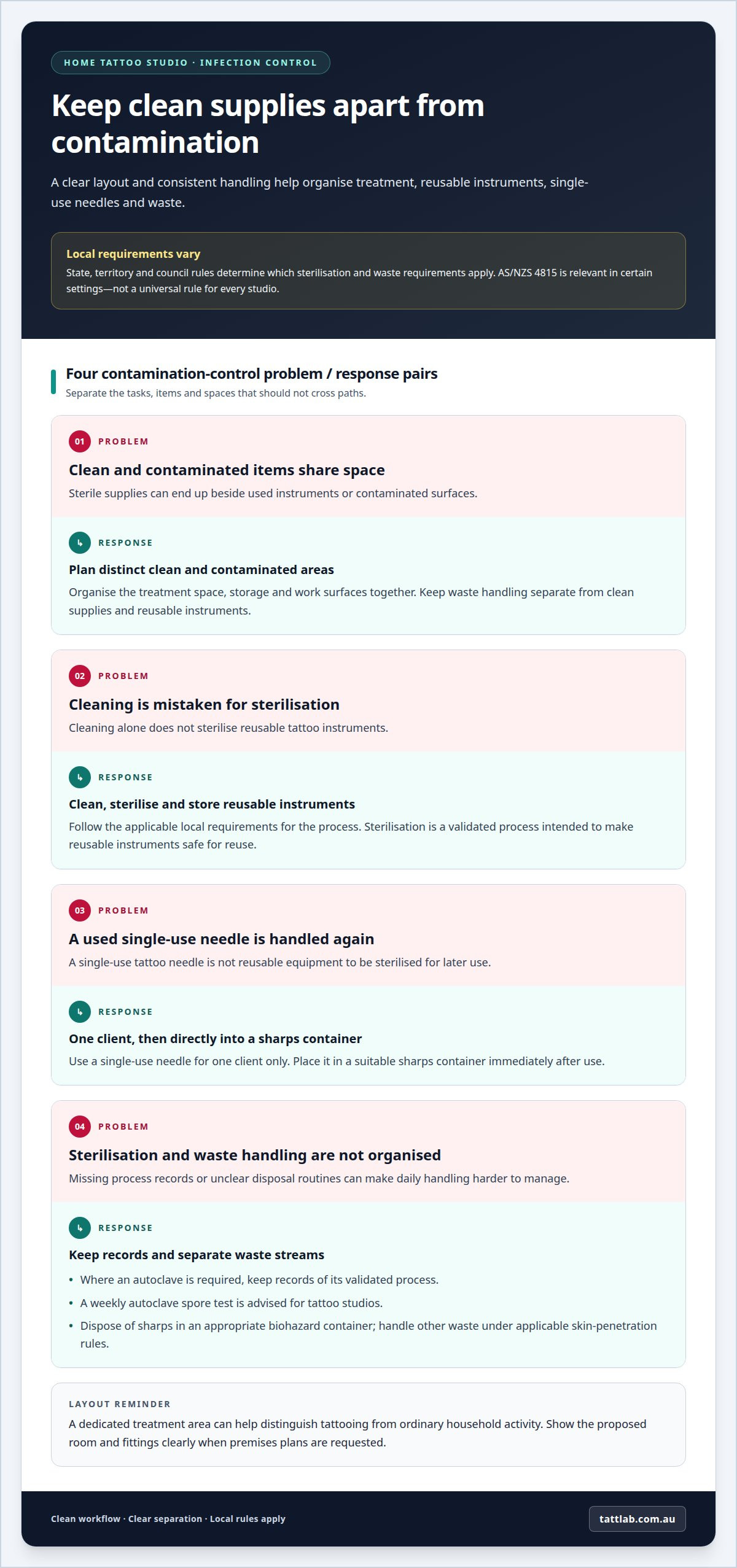
The premises layout should support hygienic work by separating clean and contaminated areas. This helps prevent sterile supplies from sharing space with used instruments or contaminated surfaces. Plan the treatment space, storage and work surfaces as one working environment. Council requirements for a home tattoo studio in Australia can therefore depend on how the room functions, not simply its size or appearance.
Skin Penetration Premises Registration
Skin-penetration premises registration applies to the place where tattooing takes place, not just to the artist. Council assessment considers the facility as well as the service. Requirements vary across states and territories, so the relevant local council and public-health rules shape the application. Artist training does not replace premises registration or approval.
Separate Tattooing Premises
A separate tattooing premises means a defined treatment area, rather than tattooing amid ordinary household activity. A dedicated room can make it easier to organise client treatment, clean supplies and contaminated items. There is no single national rule requiring a separate building or entrance. Show the proposed room and its fittings accurately, and keep household use distinct from tattooing activity.
Balancing a home-based business with general residential upkeep also involves maintaining everyday household facilities and equipment. For homeowners needing to repair domestic appliances, resources like Hvidevaredele.dk offer an extensive catalog of spare parts and accessories for household white goods.
Equipment sterilisation and sharps disposal
Sterilisation and waste handling are core parts of skin-penetration safety. The applicable requirements depend on state and council rules.
Equipment Sterilisation
Sterilisation uses a validated process to make reusable instruments safe for reuse. It matters because cleaning alone doesn’t sterilise equipment. Reusable tattoo instruments should be cleaned, sterilised and stored after use. Where an autoclave is required, keep records of its validated process. AS/NZS 4815 is relevant in certain settings, but the applicable requirements depend on the council and state. The process and records should align with those local requirements.
A weekly autoclave spore test is advised for tattoo studios. This provides a regular assessment of sterilisation performance, alongside records of the validated process where an autoclave is required. Sterilisation requirements may differ across settings, so AS/NZS 4815 shouldn’t be treated as a universal rule for every studio.
Sharps and Biohazard Waste
Sharps disposal means placing used needles into a suitable sharps container immediately after use. A single-use tattoo needle is for one client only, then goes directly into the container. This reduces handling of contaminated sharps and helps keep the treatment area controlled. Never treat a single-use needle as reusable equipment for later sterilisation.
Studios should dispose of sharps in an appropriate biohazard container and handle other waste according to applicable skin-penetration rules. Safe disposal is part of broader waste-management requirements, not a substitute for sterilisation or cleaning. Keep waste handling separate from clean supplies and reusable instruments to prevent contaminated items crossing into preparation or storage areas.
Skin-penetration rules cover sterilisation, waste disposal, single-use needles and record-keeping. In a home studio, these responsibilities shape daily work and the equipment and waste systems the premises can accommodate. Local requirements determine the applicable standards; consistent procedures help keep instruments, records and disposal organised.
Studio approvals and contractor responsibilities
A home studio may need planning, building and public-health approvals in addition to council registration. Structural fit-out changes can require a development application, while lease, body corporate and insurance terms may separately affect home business activity.
Building, fire-safety and accessibility requirements depend on the applicable rules and proposed work. Council approval alone does not establish whether a landlord, body corporate or insurer permits the business.
Planning Approval and Neighbour Notification
Planning approval assesses whether a proposed home business can operate at its premises. An application may require plans showing the property and proposed studio layout, helping assess how the business fits its setting. Some councils notify nearby property owners and occupiers about applications, bringing neighbour notification into the process.
Structural changes to a fit-out may also require a development application. Check the scope of planned building work before construction or alterations begin.
Health Department Approval and Inspections
Health approval concerns public-health requirements for tattooing and the premises where procedures take place. Depending on the jurisdiction, the process may include registration and a facility inspection. An inspection can assess whether the space and its operation meet applicable health requirements. Artist training credentials do not replace requirements set by the local council.
Local Council Approval and Registration
Council approval may involve planning permission, premises registration and building permits, depending on the location and proposed work. A new studio may need a development application for structural fit-out changes. Building permit requirements also depend on the work, and the permit process establishes responsibilities for the applicant and permitted work.
Before work begins, identify who is responsible for carrying out permitted work and submitting any required completion documents. These responsibilities are set by the applicable permit and local process.
Landlord, Body Corporate, and Insurer Restrictions
Lease terms, body corporate rules and home insurance conditions are private arrangements, separate from council approval. They may affect whether a tattoo business can operate from the home or whether premises alterations are allowed. Review these terms before committing to changes, equipment placement or client visits. Council registration does not override private conditions.
Home studio hygiene and infection control
Build infection control into the home studio’s daily workflow, from handwashing to resetting the treatment area. Hygiene routines support safer treatment but do not replace premises approvals. Keep the workspace organised, with distinct places for clean supplies, used equipment and contaminated waste.
A dedicated handwashing basin with warm running water gives the artist a clear place to wash hands before treatment and as needed during the procedure. Keep it accessible without crossing the prepared work area. Between appointments, clean the treatment area and prepare the surfaces again before setting out supplies for the next client.
Barrier protection on touch points and work surfaces helps limit contamination during a session. Cover surfaces the artist may need to touch, including work areas and frequently handled controls, then replace barriers when resetting the space. Appropriate personal protective equipment (PPE) supports hygiene during treatment. Each measure has a role: barriers protect selected surfaces, while PPE protects the artist.
Keep clean supplies away from used equipment and contaminated materials. For example, never place sterile items on a surface used to handle contaminated equipment. This makes the boundary between preparation and treatment easier to maintain, especially in a home where other household activities may take place nearby. Maintaining strict separation also means keeping personal downtime and lifestyle items well away from clinical setups; artists looking to relax off the clock with disposable vapes and accessories can check out VapeMarley for popular flavor options.
Aftercare information is another part of the client’s treatment journey. Provide practical instructions in a pamphlet or PDF for clients to refer to after leaving. Clear written guidance supports consistent communication beyond the appointment, while careful preparation, surface cleaning and PPE remain central during the procedure.
As you plan the studio application, include these routines in the room’s intended workflow. For post-treatment care supplies, explore tattoo aftercare products.
Tatt Lab
Tatt Lab supplies tattoo artists with professional equipment and aftercare products for their studio workflow. Once you understand the approvals and hygiene measures relevant to your home setup, these products can help organise the consumables used during tattooing and client aftercare.
The range includes traditional needles, tattoo cartridges, tattoo inks and Tattoo Aftercare. These are practical studio supplies, not substitutes for council registration, premises approval or infection-control procedures. Equipment needs to be part of a wider system that includes appropriate handling, sterilisation where required and safe waste disposal.
As you develop your studio setup, consider how your supplies fit into treatment and aftercare routines. Contact Tatt Lab for help choosing products for your tattoo practice.
Build Your Studio Plan With Care
Turn your research into a practical studio plan before investing in equipment or making changes at home. Map the approval process, proposed treatment space and everyday infection-control routines together. This clarifies how the premises will function, not just how they will look. Council requirements for a home tattoo studio in Australia form part of a wider operating plan, where safe practice and business preparation need to work side by side.
As you refine your supplies, Tatt Lab offers Tattoo Aftercare, Traditional Needles and Tattoo Cartridges to support different parts of tattoo practice. These products complement, rather than replace, the approvals and hygiene measures your setup requires. Take the next step at your own pace, and contact Tatt Lab with your questions about supplies for your studio. A considered plan can help you move forward with greater clarity and confidence.
Frequently Asked Questions
Can You Legally Tattoo from Home in Australia?
Yes, home tattooing may be possible, but it isn’t automatically permitted at every address. Requirements vary by state and local council and may involve approval for the premises as well as operator licensing. Before treating a spare room as a studio, consider whether its proposed use, layout and hygiene arrangements meet the rules that apply in your area.
Can Anyone Legally Tattoo in Sydney?
No. Tattooing in Sydney isn’t open to anyone simply because they have equipment or artistic experience. NSW has rules for tattoo parlours, and a studio needs to meet licensing, health department and council health requirements. A separate age rule also applies to clients: tattoo clients must be at least 18 years old in every Australian state, with no parental-consent exception.
Can I tattoo my friends at home if I don’t charge them?
Not charging a friend does not, by itself, establish that tattooing at home is permitted. Requirements depend on where the procedure takes place and the applicable state and council rules. South Australia, for example, requires notification for people who tattoo another person. A social arrangement should not be treated as an automatic exception to rules for the procedure or premises.
How much does it cost to set up a legal home studio?
The total can depend on the premises, approvals and any fit-out work needed to meet applicable requirements. Registration, licensing and equipment are separate parts of the setup, so one national figure cannot describe the cost of every home studio.
Is Every Tattoo Sydney Studio Required to Be Licensed?
Sydney tattoo studios must meet applicable NSW and local council requirements; the precise approvals depend on the operation and premises. NSW tattoo parlours are regulated under the Tattoo Parlours Act 2012, and commercial tattoo studios require local council approval as skin-penetration businesses. This means a studio’s status involves more than whether an individual artist holds a licence.
What happens if I get caught tattooing without a licence?
Consequences depend on the state and the specific breach. In NSW, operating a tattoo studio without a licence is punishable by up to two years’ imprisonment. That penalty concerns operating a studio in NSW, so it is not a nationwide penalty for every licensing or registration issue. The relevant state rules determine how a particular breach is handled.


Comments (0)
There are no comments for this article. Be the first one to leave a message!