
The best machine for dotwork isn’t defined by its brand name alone. Look for a machine that supports steady, repeatable needle strikes and suits your hand, with a 2.5-3.5 mm stroke as a useful guide for this style. Consistency matters because dot size and spacing shape the texture, shading and clarity of the finished design.
Choosing the best machine for dotwork means balancing control, comfort and the pace of your work. A machine should support your technique, not dictate it. The right fit depends on the designs you create and how you prefer to work.
This guide explains which machine features can support controlled dot placement, how rotary machines and wireless pens compare, and how needle choice affects the result. Use these criteria to select equipment that suits your tattooing style, whether you create geometric patterns, mandalas or finely shaded motifs.
Key Takeaways
- Consider a 2.5-3.5 mm stroke as a starting point, then weigh how the machine’s feel supports your dot placement and shading.
- Steady, repeatable needle strikes can help keep dot size and spacing controlled across detailed designs.
- Needle configuration and operating voltage influence how fine dotwork feels in practice; match them to the work you create.
- Choose between machine styles based on your preferred handling and the demands of your designs, rather than brand name alone.
Machine requirements for dotwork and geometric tattooing
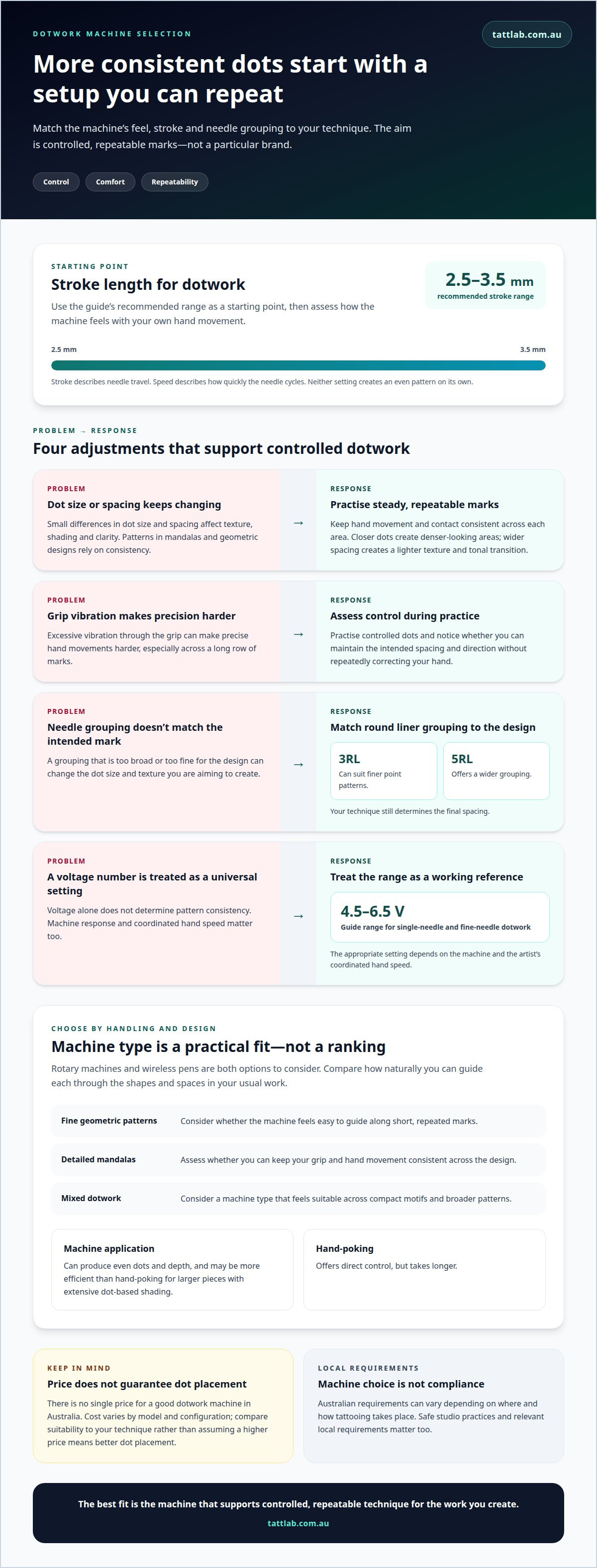
A suitable tattoo machine supports controlled, repeatable needle movement for precise dots. For dotwork, the guide recommends a 2.5-3.5 mm stroke as a starting point.
Dotwork Shading and Texture
Dotwork builds images from small marks, with dot size and spacing shaping the shading and texture. Closer dots create denser-looking areas, while changes in spacing form tonal transitions and geometric details. Consistent patterns matter in mandalas and symbolic designs. Machine tattooing can produce even dots and depth; hand-poking offers direct control but takes longer.
Machine Features and Suitability
A suitable machine matches its handling and stroke to the artist’s technique and design. Rotary machines and wireless pens are options to consider, but neither is a universal beginner choice. New artists can compare how each feels during controlled practice and choose according to the work they want to create. A poor fit can make dot size and spacing harder to repeat, reducing pattern consistency.
Australian requirements can vary depending on where and how tattooing takes place. Machine choice alone does not establish compliance; safe studio practices and relevant local requirements matter too.
There is no single price for a good dotwork machine in Australia. Cost varies by model and configuration, so compare equipment for suitability to your technique rather than assuming a higher price means better dot placement.
No single brand is right for every Australian artist. Choose according to your work, whether that means fine geometric patterns or larger shaded designs. The best machine for dotwork is the one that supports a controlled, repeatable technique.
Rotary machines and wireless pens are equipment types to consider, not a ranked list of named models. Dotwork tattoos can fade if applied without sufficient depth, while sun protection and proper aftercare can help slow ageing. Protecting a healed geometric design from sun exposure, for example, helps maintain its appearance over time.
Dotwork also suits intricate spiritual motifs. Machine application can be more efficient than hand-poking for larger pieces, especially when a design calls for extensive dot-based shading.
Vibration and repeatable needle strikes
Consistent dotwork depends on controlled needle movement, not speed settings alone. Needle configuration, machine feel and hand movement all shape each mark.
Stable Needle Strikes
Stable strikes are repeatable needle movements that help create consistently placed dots. Excessive vibration through the grip can make precise hand movements harder, particularly across a long row of marks. Practise controlled dots and notice whether you can maintain the intended spacing and direction without repeatedly correcting your hand.
Round liners are commonly used for dotwork because their grouping suits controlled, defined marks. The guide recommends 3RL or 5RL round liners. A 3RL can suit finer point patterns, while a 5RL offers a wider grouping; the choice should reflect the dot size and texture you intend to create. Your technique still determines the final spacing.
Stroke Length and Speed
A 2.5-3.5 mm stroke is the recommended range for dotwork in this guide. Stroke length describes the needle’s travel, while speed describes how quickly it cycles. Neither setting creates an even pattern by itself. Repeatability also relies on maintaining a steady hand movement and consistent contact across each design area.
For single-needle and fine-needle dotwork, the guide gives an operating range of 4.5-6.5 V. Treat voltage as a working range, not a universal prescription: the appropriate setting depends on the machine and the artist’s coordinated hand speed. A denser area may call for closer dots, while open spacing creates a lighter texture. Keep the intended dot pattern in view as you assess how the machine’s strike and your movement work together.
Choosing a machine to suit an artist’s style
Choose a tattoo machine for the work you create, not its brand name alone. An artist placing repeated points in geometric designs may have different priorities from someone creating broad, intricate mandalas. Start with your most common designs, then consider which machine type feels manageable for the precise movements they require. The right fit supports your approach rather than forcing you to change it.
Rotary machines and wireless pens are both worth considering. Compare how naturally you can guide each through the shapes and spaces in your usual work. An artist creating compact geometric motifs, for example, may prioritise control through small sections. Someone working on larger mandalas may focus on a comfortable, consistent grip over a longer design. These are practical criteria, not a universal ranking.
- Fine geometric patterns: Consider whether the machine feels easy to guide along short, repeated marks.
- Detailed mandalas: Assess whether you can keep your grip and hand movement consistent across the design.
- Mixed dotwork: Consider a machine type that feels suitable across both compact motifs and broader patterns.
Once you have considered the machine type, compare brands against your work. Reputation alone cannot show whether a machine suits your style. Consider the kind of tattooing you do and your experience handling that machine type. This keeps the decision grounded in practical use rather than popularity.
When refining your setup, consider how a machine works with your established technique. If your practice centres on carefully spaced points, assess whether the machine feels predictable during that movement. If your designs combine point patterns with varied geometric forms, consider how comfortably you can transition between them. Basing the decision on your actual work helps narrow the options without assuming one machine suits everyone.
Beginners can consider rotary machines or wireless pens for dotwork, choosing the type that feels manageable and predictable when placing carefully spaced points. Neither is universally best; the right fit depends on the artist’s work and handling.
Equipment selection for dotwork
Selecting equipment means matching the machine type and handling to your dotwork technique. Compare how consistently you can guide the machine through your intended designs.
Machine Type for Dotwork
A suitable dotwork machine supports controlled movement for your chosen pattern. Rotary machines and wireless pens are options, but neither is automatically right for every artist. For compact geometric motifs, for example, consider how easily a machine moves through short, repeated sections.
Make the decision around your work, not a universal ranking. Consider the patterns you create, your preferred handling and whether the machine lets you maintain deliberate movement across each design. A mandala with tightly arranged details may demand different control from a more open geometric composition.
Rotary, Pen, and Coil Machines
Artists may compare rotary, pen-style and coil machines for dotwork. The options discussed here include rotary machines and wireless pens, but there is no basis for declaring one category universally superior. A coil machine should not be ruled in or out by its label alone.
Compare machine types by how well they support your working style. Can you guide the machine comfortably through a repeated pattern while keeping your movements consistent? Your experience with a particular type matters, as familiarity can affect how confidently you manage detailed work.
Use a practical selection process: identify your usual dotwork designs, choose a machine type that suits your technique, then assess whether its handling supports precise movement. This narrows the options without relying on brand popularity or assumed advantages. The choice is personal, but keep it grounded in the work you actually create.
For the needle component of your setup, browse tattoo cartridges suited to your equipment choices.
Tatt Lab
Tatt Lab is a natural next step for sourcing the supplies you use with your chosen dotwork machine. Machine selection depends on your handling and style, while compatible needles, tattoo inks and aftercare are also part of a considered setup. Tatt Lab offers traditional needles, tattoo cartridges, tattoo inks and tattoo aftercare for artists building out these essentials.
Once you have chosen a machine type, consider which consumables suit your approach, such as round liners for defined dot patterns. Aftercare matters once the tattoo is complete, too. Explore Tatt Lab’s needles, inks and aftercare to find supplies for your setup.
Build a Setup That Grows With Your Work
Your equipment choice does not have to define your style permanently. As your dotwork develops, your designs and control of each mark may change. Let your practice guide future decisions: notice which parts of your setup support your process and where a different configuration might suit your next projects.
Ultimately, the best machine for dotwork is the one that fits your technique and the designs you want to create. Treat selection as part of developing your craft, not a race to own a particular model. Understanding your working preferences gives you a more useful basis for choosing equipment and related supplies.
If you’d like to explore supplies for your setup, contact Tatt Lab about your setup. Take the next step at your own pace, with your individual approach to dotwork leading the way.
Frequently Asked Questions
How to Choose the Best Tattoo Machines Among the Top Brands?
Compare brands by how well each machine suits your daily work, then assess it through repeatable practice marks. For small geometric panels, a familiar grip and straightforward controls may matter more than extra versatility. Before deciding, review the manufacturer’s operating guidance, compatible needle systems and replacement-part support. Reputation alone cannot predict how well a machine will suit your technique.
How do you set up a tattoo machine for consistent dotwork?
Follow the machine manufacturer’s instructions and choose a needle configuration suited to your intended dot size. Practise short rows of dots on practice skin, observing their spacing and shape. Adjust one variable at a time, such as hand pace or the machine setting, to identify what changes the result. Keep your setup and movement consistent as you practise different patterns.
What features should you compare when choosing a dotwork tattoo machine?
Compare the grip, control layout, balance with your needle system and the manufacturer’s maintenance guidance. A machine that feels comfortable during brief linework, for example, may become tiring during a dense mandala. Prioritise features that support controlled movement throughout your usual work. A feature is useful when it helps your process, not simply because it appears in the specifications.


Comments (0)
There are no comments for this article. Be the first one to leave a message!