

Hand speed and machine-measured bat speed tell different parts of the same swing story: hand speed tracks how quickly the hands move, while bat speed records how quickly the bat travels. The gap between them helps show how effectively movement transfers through the swing. Hand speed and bat speed offer different perspectives on a swing, so neither reading alone explains the whole movement.
It makes sense to focus on the number that seems most direct. But speed without control can obscure what’s happening during a pass. Grip, wrist mobility, posture and the machine’s response all influence how steadily the artist guides the needle and maintains the intended path.
This article explains how to interpret connection readings, why wrist action shapes control, and what rotational acceleration reveals about swing timing. You’ll also see how kinetic-chain sequencing helps explain the relationship between hand speed and bat speed, so the readings become useful feedback rather than isolated numbers.
Key Takeaways
- Interpret hand and bat-speed readings together: the difference can reveal how efficiently movement transfers through the swing.
- Use connection, wrist action and rotational acceleration to understand control and sequencing, not speed alone.
- Build speed with attention to technique and the physical demands of training, rather than chasing a higher reading at any cost.
- Recognise that improving control and protecting the body are part of developing a more effective swing.
How is machine speed measured and specified?
In tattooing, machine speed describes how quickly the needle moves through its reciprocating cycle. Specifications may express this as cycles per second, measured in Hertz, or as strokes per minute. These terms describe frequency, not the depth the needle enters the skin. A rotary machine converts motor rotation into needle movement, while a coil machine uses electromagnetic action. In either design, the stated speed needs context.
Measurement depends on what the manufacturer records and under which conditions. A sensor or high-speed recording can track needle cycles over time, producing a frequency reading. An unloaded machine may behave differently from one fitted with a cartridge and working against resistance. A listed figure is most useful alongside its test conditions, rather than as a universal measure of performance.
Voltage and speed are related, but they aren’t interchangeable specifications. A power supply displays voltage; the machine’s motor and mechanism determine how that setting translates into needle movement. For example, two rotary machines at the same displayed voltage may not cycle identically. Stroke length also matters: it describes the needle’s travel distance, not how often it completes that travel.
Compare specifications by separating three details: operating voltage, needle frequency and stroke length. Then consider the machine type and intended setup. Frequency describes movement speed; stroke length describes travel; voltage describes electrical input. Keeping these measures distinct makes hand speed vs machine speed easier to interpret, without assuming one setting predicts the entire result.
For a practical comparison, start with the manufacturer’s stated speed range and operating conditions. Note whether the figure refers to cycles per second or strokes per minute. Then compare like for like, including the cartridge and power supply. A machine’s specification describes its mechanical output, while hand movement reflects the artist’s technique. Neither number alone captures control, needle stability or how smoothly the artist maintains a line.
What factors affect hand speed and machine speed?
Machine speed depends on the motor, power supply and resistance during operation. A rotary machine may respond differently as voltage changes, while cartridge fit and needle grouping affect the load. For example, a setup that runs smoothly without skin contact may feel less consistent during a pass. The machine’s mechanism determines its cycling behaviour, but the working setup influences how that movement is delivered.
Hand speed comes from the artist’s movement, not the motor. Grip pressure, wrist mobility, arm position and the distance travelled all shape the stroke. A short, wrist-led movement can suit a small curve, while a longer line may rely more on forearm movement. If the artist tightens their grip, the hand can become less fluid even while the machine maintains its pace.
Technique links the two speeds. During a line, the artist coordinates hand travel with needle cycling while keeping the skin stable. Moving the hand too quickly for the machine’s action can leave a broken or uneven line; moving too slowly can concentrate the needle’s work in one area. The appropriate relationship changes with the task, such as outlining a curve or shading a broader section.
Body position also matters. A supported forearm can help maintain a steady path, while an awkward reach may make wrist control harder. Fatigue can affect grip and movement over a session, so a line that feels controlled early may become less consistent later. Deliberate pacing and a stable working posture help reduce those fluctuations.
For a practical assessment, observe a line from start to finish: note whether the hand moves evenly, whether the machine sounds consistent, and whether the result matches the intended mark. Change one variable at a time, such as grip or voltage, so the effect is easier to interpret. A considered setup begins with choosing tattooing essentials that suit the work, then matching movement to the machine rather than forcing speed.
What are the costs of increasing hand speed versus machine speed?
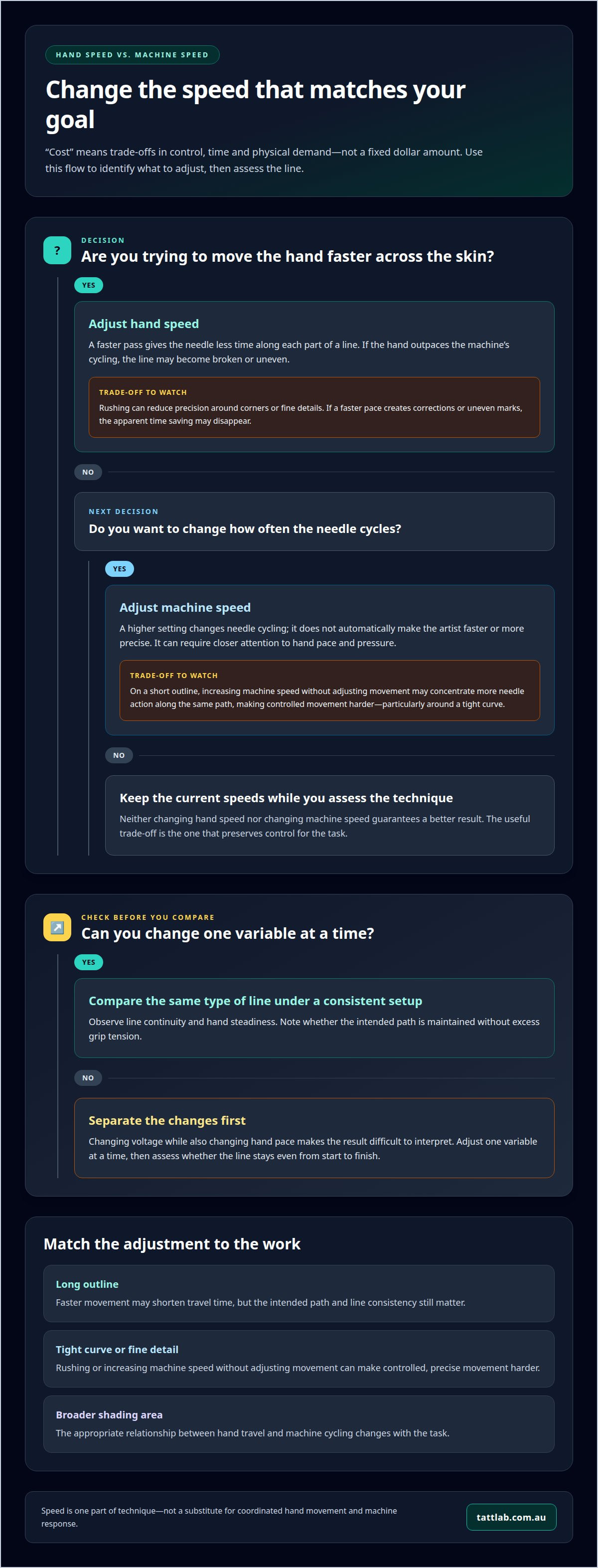
In tattooing, “cost” means trade-offs in control, time and physical demand, not a fixed dollar amount. Increasing hand speed changes how quickly the artist moves across the skin. For example, a faster pass gives the needle less time along each part of a line. If the machine setting stays constant, the hand may outpace its cycling, affecting line consistency.
Increasing machine speed changes needle cycling, but doesn’t automatically make the artist faster or more precise. A higher setting can require closer attention to hand pace and pressure. On a short outline, increasing machine speed without adjusting movement may concentrate more needle action along the same path. That can make controlled, even movement harder to maintain, particularly around a tight curve.
Each adjustment also has a different learning cost. Hand speed depends on coordination, posture and a repeatable path. Machine speed depends on the machine’s response and the chosen setup. For instance, changing voltage while also changing hand pace makes the result difficult to interpret. Adjust one variable at a time, then assess whether the line stays even from start to finish.
Faster movement can shorten the time spent travelling across a section, but rushing may reduce precision around corners or fine details. A faster machine setting can change the working feel without reducing the time needed for careful placement. Neither change guarantees a better result. The useful trade-off is the one that preserves control for the task, such as a long outline or a small shaded area.
To assess the practical cost, compare the same type of line under a consistent setup. Observe line continuity and hand steadiness, and note whether the artist can maintain the intended path without excess grip tension. If a faster pace creates corrections or uneven marks, its apparent time saving may disappear. Treat speed as one factor in technique, not a substitute for coordinated hand movement and machine response.
What are the safety risks of working at high hand or machine speeds
In tattooing, speed without coordination can reduce control over needle placement. If the hand moves too quickly for the machine’s cycling, a line may become uneven. If the hand slows while the machine continues cycling, the needle works repeatedly over a smaller area. Either mismatch can increase unnecessary skin trauma. A tight curve makes these control demands especially clear.
High hand speed can also make it harder to keep a stable path. For example, a rushed change in direction may cause the needle to stray from the intended line. Excessive grip tension can limit wrist movement, while fatigue can make consistent pressure more difficult. If the artist notices shaking, loss of control or repeated corrections, continuing at the same pace may compromise precision.
Machine speed brings different risks. A setting that feels too aggressive for the task can make needle contact harder to manage, particularly during fine details. Changing voltage and hand pace together also makes it difficult to identify what caused an unwanted result. A controlled approach is to adjust one variable at a time, assess the movement and pause if the artist cannot maintain a steady working path.
Good technique accounts for the whole setup, not just speed. Stable positioning, a relaxed grip and an unobstructed view help the artist guide the machine accurately. For example, repositioning the client or artist can reduce an awkward reach across a curved area. Clean working practices remain essential throughout tattooing, regardless of the machine setting or hand pace.
Safety depends on matching movement to the task and responding to signs of reduced control. Slowing down, resetting posture, or taking a pause can help restore deliberate movement. For ongoing work, explore tattoo aftercare essentials as part of a considered approach to skin care after tattooing.
A bat-speed benchmark of 60-70 mph is given for high school varsity hitters, but that figure describes a different activity and does not set a safe tattoo-machine speed. Tattooing calls for judging control at the point of contact, rather than treating a high speed as a goal. The relevant safeguard is whether movement remains steady and appropriate to the task.
Tatt Lab
Tatt Lab supplies tattooing essentials for artists refining their technique and setup. Understanding the relationship between hand movement and machine speed is one part of consistent work; having suitable supplies for the task is another. Tatt Lab offers Traditional Needles, Tattoo Cartridges, Tattoo Inks and Tattoo Aftercare, alongside other tattooing essentials.
Turn to Tatt Lab when you’re organising supplies for studio work or restocking items used in your practice. The right equipment supports a considered workflow, while controlled hand movement and machine settings remain central to technique. For questions about supplies, contact Tatt Lab.
Make your next adjustment with intention
Let your next practice session focus on repeatability, not simply speed. Choose a familiar task, settle into a comfortable working position and notice whether your movement stays controlled from start to finish. This measured approach can turn hand speed vs machine speed from an abstract comparison into a practical consideration for your technique.
Suitable supplies are part of the broader workflow. Tatt Lab offers Traditional Needles, Tattoo Cartridges and Tattoo Aftercare for artists organising studio essentials and post-tattoo care. Choose products suited to your work, then continue refining your technique with attention to control and consistency.
If you’d like to discuss supplies for your tattooing practice, contact Tatt Lab. A thoughtful next step can help you keep building confidence in your process, one considered adjustment at a time.
Frequently Asked Questions
What does hand speed mean compared with machine speed?
Hand speed is the artist’s movement across the skin; machine speed is the needle’s cycling rate. They describe separate actions, so one can’t substitute for the other. For example, during a short curve, an artist may move their hand deliberately while the machine cycles steadily. Considering both helps explain why a consistent machine setting alone doesn’t ensure a controlled tattooing pass.
What are typical hand speeds compared with machine speeds?
There isn’t one meaningful typical pair for every tattooing task. Hand movement changes with the line, curve or shading area, while machine cycling depends on the machine and setup. Rather than applying a universal target, compare the movement and result for the same task. For instance, assess whether a short outline remains controlled before changing the setup or attempting a faster pass.


Comments (0)
There are no comments for this article. Be the first one to leave a message!