
What if a full box of gloves still leaves a tattoo station exposed to cross-contamination? PPE matters, but it’s only one part of a controlled workflow. The right infection control supplies for tattoo studios work together, supporting hand hygiene, surface barriers and cleaning between clients.
It’s easy to feel unsure about what’s essential for each task. A pile of supplies isn’t a safety system unless each item has a clear role and fits into a repeatable routine. This practical guide helps you identify key supply categories and organise them around setup, tattooing and post-session reset.
You’ll also learn what to verify before using a product, including its manufacturer instructions and the current infection-control requirements in your Australian state or territory. Requirements can vary, so general guidance shouldn’t replace checking the rules that apply to your studio. A clear checklist makes each station easier to prepare, use and reset consistently.
Key Takeaways
- Organise infection control supplies for tattoo studios around the tasks they support, from preparation and tattooing to station reset.
- Understand the distinct roles of PPE, hand hygiene and barriers in a consistent contamination-control routine.
- Compare supplies by intended use, single-use or reusable status, and the manufacturer’s instructions.
- Use a before, during and after-session checklist to make station setup and reset more repeatable.
- Assign responsibility for stock checks, expiry monitoring and storage, and verify procedures against current local guidance in your Australian state or territory.
What infection-control supplies do tattoo studios need?
Infection-control supplies are the hygiene, protective, cleaning and waste-handling items used to support safe studio procedures. Tattooing equipment is the gear used to create the tattoo. The distinction matters: needles, cartridges, inks and stencils support the tattooing process, while infection control supplies for tattoo studios help manage contamination risks around each task.
There isn’t one shopping list that suits every studio. A more useful checklist follows the work: prepare hands and the station, protect people and selected surfaces during the procedure, then clean and manage waste during the reset. Supplies support these steps, but they can’t guarantee sterility or establish that a studio meets every applicable requirement. Procedures, training, correct use and current local guidance matter too.
Which supply categories support different studio tasks?
Think in categories, then assign each one a place in the workflow:
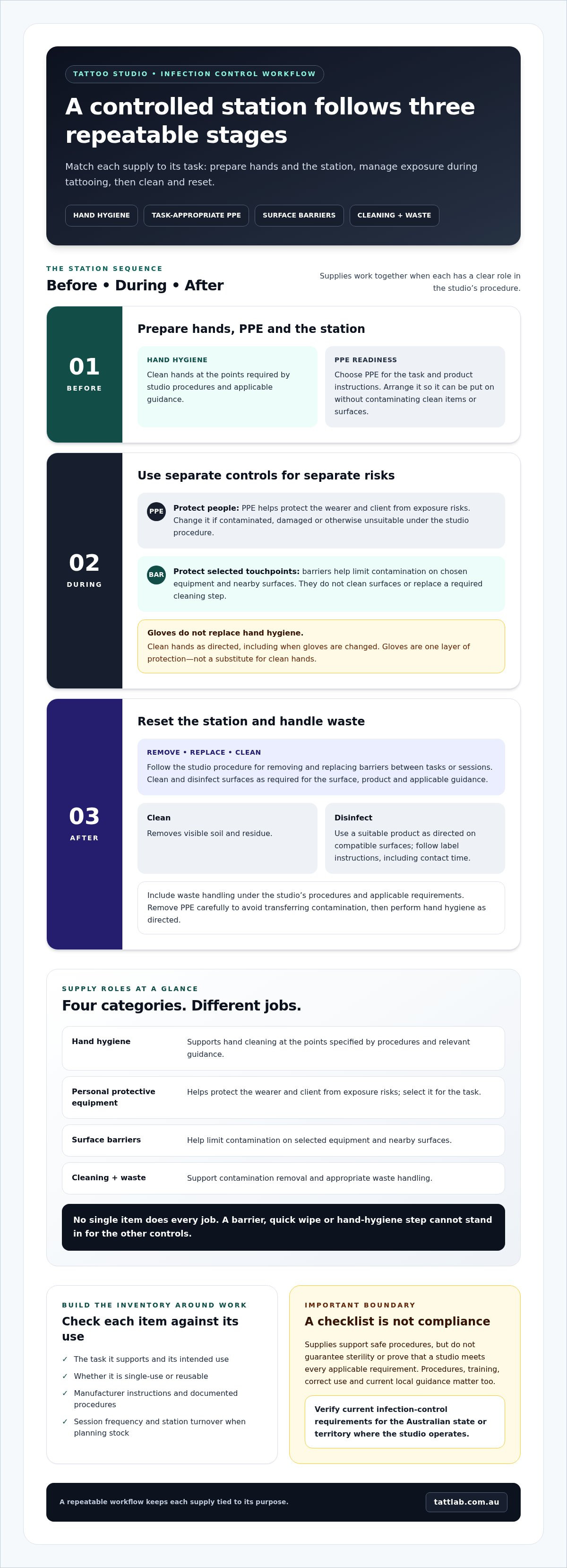
- Hand hygiene: supports hand cleaning at the points specified by the studio’s procedures and relevant guidance.
- Personal protective equipment: helps protect the wearer and client from exposure risks. Choose it for the task and use it according to its instructions.
- Surface barriers: help limit contamination on selected equipment and nearby surfaces. They don’t replace cleaning when a surface needs to be cleaned.
- Cleaning and waste handling: support the removal of contamination and appropriate waste handling under the studio’s procedures and applicable requirements.
These categories serve different purposes, so one can’t substitute for another. The Wikipedia overview of Studio Hygiene Standards also describes hygiene practices and equipment used in tattoo studios. Treat it as general background, not a replacement for current Australian guidance.
What should artists consider before building an inventory?
Base stock levels on session frequency, station turnover and the studio’s documented procedures, rather than an arbitrary quantity. Consider what’s needed at each step and how quickly supplies are used during a typical working period. A task-based inventory makes gaps easier to spot before a station is prepared.
Separate routine consumables from reusable items. Consumables are replaced as part of the relevant procedure; reusable items need their own handling process, following applicable guidance and manufacturer instructions. A supply checklist alone doesn’t establish compliance. Requirements can differ across Australian states and territories, so verify the current rules that apply to your studio. For a broader overview of studio safety, read the professional studio safety guide.
How do PPE, barriers, and hygiene supplies work together?
Each control has a defined role. Personal protective equipment (PPE) helps protect the wearer and client from exposure risks, barriers limit contamination on selected touchpoints, and hygiene and cleaning procedures address hands and surfaces. Infection control supplies for tattoo studios are most useful when they support a planned sequence, rather than when one item is expected to do every job.
Gloves do not replace hand hygiene. Clean hands at the points required by the studio’s procedures and applicable guidance, including when gloves are changed. Gloves can become contaminated or damaged during work, so they’re one layer of protection, not a substitute for clean hands.
What role do gloves and other PPE play?
Select PPE according to the task, the studio’s risk-control procedure and the product instructions. A routine that suits one activity may not suit another, and no single glove type or changing schedule should be assumed to cover every task or person.
Prepare PPE so it can be put on without contaminating clean items or surfaces. During work, change it if it becomes contaminated, damaged or otherwise unsuitable under the studio’s procedure. Remove it carefully to avoid transferring contamination to your hands, then perform hand hygiene as directed. Mayo Clinic’s overview of tattoo safety precautions provides health context for the hygiene and equipment practices studios use to reduce risks.
Why are barriers and surface cleaning separate controls?
Barriers can help limit contamination on selected equipment and nearby surfaces that may be touched during a session. They protect chosen touchpoints, but they don’t clean those surfaces or make a cleaning step unnecessary. Follow the studio’s procedure for removing and replacing barriers between tasks or sessions.
Cleaning and disinfection aren’t interchangeable. Cleaning removes visible soil and residue; disinfection uses a suitable product as directed to address microorganisms on compatible surfaces. The required process depends on the surface, the product and current local guidance. Follow label instructions for intended use and contact time, and check surface compatibility. A quick wipe, a barrier or hand hygiene can’t stand in for the other controls.
Think of the workflow as connected steps: clean hands, use task-appropriate PPE, protect selected touchpoints, and clean or disinfect surfaces as required. If your studio is reviewing its broader supply needs, consider professional tattoo and medical supplies alongside documented procedures and current Australian guidance.
How can studios assess supplies without mistaking a checklist for compliance?
A checklist helps artists make supply selection and station preparation more consistent. It doesn’t, by itself, show that a studio meets every applicable health or workplace requirement. Treat it as one working document within a broader system of procedures, training and risk controls, then verify that system against current guidance for your location.
Assess each item against the task it supports, its intended use, whether it’s single-use or reusable, and the manufacturer’s instructions. For example, a surface product and an instrument-processing method aren’t interchangeable simply because both are described as cleaning. Infection control supplies for tattoo studios need to fit the relevant task and the studio’s documented process, not just appear on an inventory sheet.
How should studios distinguish single-use and reusable items?
Check product labelling and instructions before use. Items labelled for single use shouldn’t be reused. Reusable instruments need a separate, appropriate cleaning and reprocessing procedure that follows the manufacturer’s instructions and applicable guidance. Keep this process distinct from routine surface care: wiping or disinfecting a surface does not sterilise an instrument.
If the instructions or the studio’s procedure leave an item’s intended use unclear, don’t guess. Resolve the uncertainty using the relevant manufacturer information and current local guidance before adding the item to the workflow.
Which Australian guidance should artists check?
Start with the health department for your state or territory and review current local public-health guidance relevant to tattooing and skin penetration. Requirements can differ between jurisdictions and may change, so don’t assume a checklist prepared for another location applies to your studio.
For workplace risk-management context, consult Safe Work Australia resources. These can help inform a studio’s approach to workplace hazards, but they aren’t a universal tattoo-studio checklist and don’t replace the requirements that apply in your jurisdiction. Before relying on a named standard, training unit or legal obligation, check its current applicability through the relevant official sources.
A practical review can follow a simple sequence:
- Match: Does the item suit the task and its intended use?
- Verify: Do the label and manufacturer instructions support the way the studio plans to use it?
- Apply: Does the procedure align with current state or territory health guidance and relevant workplace safety information?
- Document: Can artists follow the same process consistently, and is it reviewed when guidance or product instructions change?
This approach turns an inventory into a useful prompt for review while keeping the distinction clear: supplies support safe procedures, but they don’t establish legal compliance on their own.
What infection-control checklist should artists follow before, during, and after a session?
A repeatable sequence helps make infection-control supplies for tattoo studios part of a considered workflow. Use this as a prompt, not a substitute for your studio’s documented procedures. Adapt every step to current state or territory guidance and the relevant product instructions.
Before the client session
- Prepare the station: Follow the studio’s documented cleaning and setup procedure. Confirm that surfaces and equipment are ready for the planned work.
- Organise supplies: Lay out task-appropriate PPE and barriers before starting, following their instructions for use. Keep clean supplies apart from used items and anything that may be contaminated.
- Plan the sequence: Identify the supplies needed for each task, including hand hygiene, protecting selected touchpoints and managing waste. Make sure the relevant disposal procedure is understood before work begins.
Preparation should make the clean-to-used workflow clear. If a supply is missing, damaged or unsuitable for its intended use, pause and follow the studio’s procedure rather than improvising.
During the session
- Follow hand-hygiene steps: Clean hands at the points set out in current guidance and the studio’s procedure, including when changing tasks as required.
- Use PPE and barriers as intended: Follow product instructions and the studio’s risk-control procedure. Change PPE or barriers if they become contaminated, damaged or a task change requires it.
- Keep clean and used items distinct: Avoid placing used items back with clean supplies. Segregate waste and sharps according to the studio’s applicable disposal procedure.
Keep the sequence calm and deliberate. If an unexpected contamination event interrupts the workflow, use the relevant documented procedure and current guidance to decide how to proceed.
After the session
- Manage used items: Separate single-use items and sharps for disposal as directed by the studio’s procedure and applicable requirements. Handle reusable items through their separate reprocessing pathway.
- Reset the station: Remove used barriers and complete the required cleaning and disinfection steps. Follow product labels for intended use, contact time and surface compatibility.
- Prepare for the next session: Return clean supplies to their designated storage and check whether anything needs replenishing before another setup.
Consistency comes from matching each step to the task, not rushing through a generic checklist. Explore professional tattoo and medical supplies as you review the items that support your studio’s documented workflow.
How can studios maintain a reliable infection-control supply system?
A well-organised supply system helps studio procedures stay repeatable. Assign someone to oversee stock checks, expiry monitoring and storage conditions, and make sure everyone knows how to flag a low or unsuitable item. This gives the studio a clear point of responsibility while keeping inventory management connected to day-to-day safety routines.
How can studios make restocking predictable?
Set a regular review that reflects actual session volume and the supplies required by documented procedures. Track use over time, then adjust replenishment to match the studio’s workflow rather than relying on a generic quantity. The aim is to spot a potential shortage before it disrupts a planned session, without holding stock the studio can’t store appropriately.
During each review, check packaging condition and expiry details where applicable. Store supplies according to their instructions, and keep product information accessible to the people who prepare stations and manage stock. Purchase records can help identify what was obtained and make it easier to retrieve relevant instructions if a question arises.
Take care when replacing an item with an alternative. Similar appearance or a broad category doesn’t necessarily mean identical intended use. Review the manufacturer’s instructions and confirm that the item fits the studio’s documented procedure and current local guidance before introducing it into the workflow. Infection control supplies for tattoo studios support a wider safety system, but stocking decisions alone don’t establish compliance.
Where can artists explore professional supplies?
Tatt Lab is an artist-owned Australian supplier of professional tattoo equipment and medical supplies, serving tattoo professionals and studios across Australia through online sales. Its range includes tattoo aftercare, needles, cartridges, inks and stencils. For a wider perspective on selecting tattoo equipment and supplies, read the professional tattoo supplies guide.
Use your documented procedures and current Australian guidance to shape purchasing decisions, then keep a clear record of the supplies your studio uses and how they fit into its routines. When you’re ready to review options for your professional setup, explore Tatt Lab supplies. Thoughtful selection is one part of a reliable system, alongside correct use, storage and consistent procedures.
Make your studio’s safety routine more consistent
Reliable infection control supplies for tattoo studios work as part of a wider system, not as a substitute for one. Match supplies to the task, use PPE, barriers and cleaning products as directed, and build a repeatable routine for setup, tattooing and station reset. Keep stock organised, and review product instructions and current requirements for your Australian state or territory.
When your supply process is clear, it’s easier to spot gaps and keep studio routines moving steadily. Tatt Lab is an artist-owned and operated Australian supplier, serving professional studios nationally online. Wholesale purchasing is available to registered professional studios and medical clinics.
Explore professional tattoo and medical supplies to support your studio’s supply planning. A thoughtful checklist and consistent procedures can help you approach each session with greater clarity and care.
Frequently Asked Questions
What infection-control supplies does a tattoo studio need?
A tattoo studio’s needs depend on its procedures, the tasks being performed and applicable local guidance. A planning framework for infection control supplies for tattoo studios includes hand-hygiene supplies, task-appropriate PPE, barriers for selected touchpoints, cleaning and disinfection products, and supplies for safe waste handling. This isn’t a universal legal inventory. Check each product’s instructions and current health guidance for your Australian state or territory when setting studio requirements.
Are gloves enough to prevent infection in a tattoo studio?
No. Gloves are one protective measure, not a replacement for hand hygiene, suitable barriers, cleaning and disinfection, safe sharps handling or consistent procedures. Select gloves for the task and follow their instructions. Change them when contaminated or when the workflow requires a change, then follow the appropriate hand-hygiene procedure. Safety relies on layered controls working together, rather than assuming any single item can prevent infection.
How often should tattoo studios replace surface barriers?
As a practical prompt, change barriers between clients and whenever they become contaminated, damaged or unsuitable for continued use. Follow the studio’s documented procedure, current local guidance and the barrier product’s intended use, since needs can vary by surface and task. Barriers limit contamination on selected touchpoints; they don’t clean or disinfect a surface. Complete any required cleaning and disinfection separately, following the relevant product instructions.
Can tattoo studios reuse disposable infection-control supplies?
No. Items labelled for single use shouldn’t be reused. Reusable items need a separate handling and reprocessing procedure based on their intended use, manufacturer instructions and applicable local requirements. Wiping an item or applying a surface disinfectant doesn’t automatically make it safe for reuse or equivalent to validated reprocessing. Don’t improvise a reuse method; follow the appropriate procedure for the item and current guidance relevant to your studio.
What is the difference between cleaning and disinfection in a tattoo studio?
Cleaning removes soil and residue, while disinfection uses a product intended to reduce microorganisms on appropriate surfaces when used as directed. The terms aren’t interchangeable, and the right process depends on the task and surface. Follow product instructions, including contact time and surface compatibility. Surface disinfection doesn’t sterilise instruments, replace hand hygiene or remove the need for other studio controls. Use the procedure that applies to each item.
Do infection-control requirements for tattoo studios vary across Australia?
Yes. Public-health guidance and workplace requirements can vary between Australian states and territories, and information may change. Check current guidance from the health department relevant to your location, alongside applicable workplace safety information. A general checklist can help organise studio routines, but it shouldn’t be treated as a complete legal answer. Verify whether any named standard, training requirement or procedure applies to your studio before relying on it.
How should a tattoo studio organise infection-control supplies?
Organise supplies by task and workflow, keeping clean items separate from used or potentially contaminated items. Make product instructions accessible to the people responsible for studio routines. Assign responsibility for regular stock checks, and review actual session volume, packaging condition and expiry information where relevant. Predictable restocking supports consistent procedures, but inventory should still reflect the studio’s documented practices, product instructions and current local guidance.


Comments (0)
There are no comments for this article. Be the first one to leave a message!