
Opening a professional tattoo studio in Australia isn't just about artistic talent; it's a high-stakes exercise in clinical compliance where the margin for error is zero. You've likely spent hours scrolling through conflicting state guidelines, feeling the weight of potential health department inspections and the complexity of police-vetted licensing. It's natural to feel overwhelmed by the sheer volume of red tape involved in protecting both your craft and your clients' physical integrity.
This guide provides a definitive roadmap to the legal requirements for opening a tattoo studio australia, ensuring you move from initial concept to a fully compliant, sterile facility with absolute confidence. We'll demystify the dual-track process of satisfying both national business standards and the rigorous HLTINF005 infection control mandates. You'll gain a clear understanding of the latest AS 5369:2023 standards for instrument reprocessing and the specific licence fees applicable in 2026. By the end of this checklist, you'll have the technical knowledge to transform your vision into a modern, boutique studio that prioritises safety as much as aesthetic excellence.
Key Takeaways
- Identify the optimal business structure for your studio, ensuring your ABN registration and tax foundations align with Australian commercial standards.
- Navigate the state-specific legal requirements for opening a tattoo studio australia, including the critical distinction between operator licences and mandatory practitioner vetting.
- Adopt the latest AS 5369:2023 infection control protocols to ensure your facility meets the highest clinical safety benchmarks for skin penetration services.
- Streamline your local council approval process by mastering the zoning and fit-out requirements essential for a compliant, professional treatment environment.
- Establish a reliable supply chain for medical-grade PPE and artist-vetted consumables to maintain consistent safety standards from your very first client.
Establishing Your Business Foundation: National Requirements
Opening a professional studio requires a calculated shift in perspective. You're moving from the role of an artist to that of a clinical operator. This transition demands a structured approach to your corporate framework. The legal requirements for opening a tattoo studio australia begin at the federal level with the Australian Securities and Investments Commission (ASIC) and the Australian Taxation Office (ATO). Establishing this foundation correctly ensures that your creative space is built on a stable, legally sound platform.
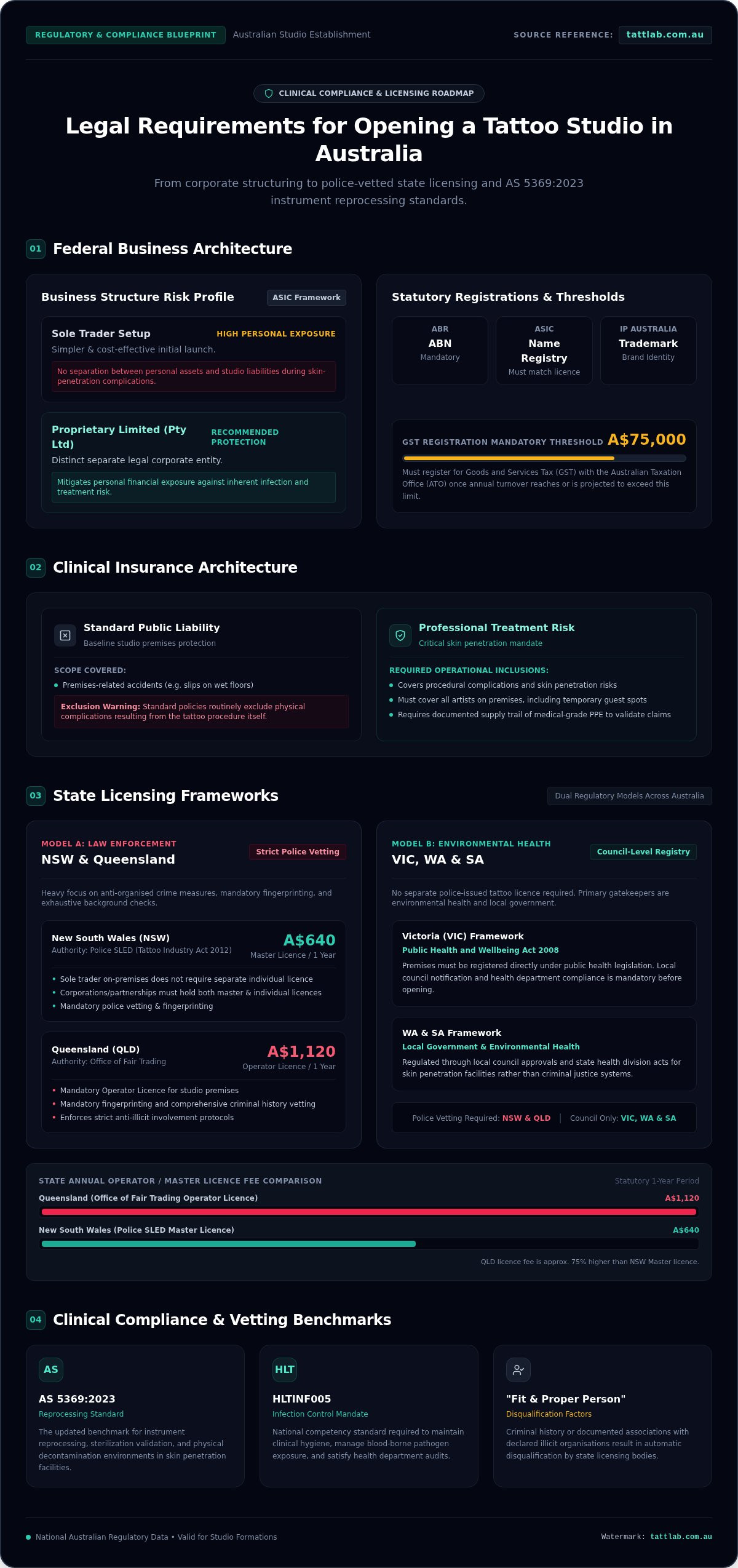
Choosing between a Sole Trader structure and a Proprietary Limited (Pty Ltd) company is your first critical decision. A Sole Trader setup is simpler and more cost-effective for initial setups, but it offers no separation between your personal assets and business liabilities. In contrast, a Pty Ltd company provides a significant layer of protection; it's a separate legal entity. Given the inherent health risks and infection complications associated with skin penetration, many modern operators opt for a company structure to mitigate personal financial exposure. This methodical approach to liability mirrors the precision required in the treatment room itself.
ABN and Business Name Registration
Every studio must register for an Australian Business Number (ABN) through the Australian Business Register. If you choose to trade under a name other than your own, you'll need to register that business name with ASIC. Accuracy is paramount here. Your registered name should match your state-issued tattoo master licence to avoid administrative delays during health department inspections or police vetting processes.
Tax compliance is equally vital. You must register for Goods and Services Tax (GST) if your annual turnover reaches or is projected to exceed A$75,000. Monitoring this threshold is a standard part of professional studio management. Additionally, consider protecting your visual identity by trademarking your logo and studio name through IP Australia; this ensures your brand remains yours as your reputation grows.
Insurance for the Modern Studio
In 2026, basic public liability is no longer the industry ceiling. A professional studio requires a policy that specifically includes "professional treatment risk." While public liability covers a client slipping on a wet floor, treatment risk covers the actual tattooing process. This distinction is vital because standard policies often exclude complications arising from the procedure itself. It's a layer of security that protects both your artists and the physical integrity of your clients.
Your coverage should reflect a "medical-grade" standard of protection. This means ensuring your policy extends to all artists working under your roof, including those on temporary guest spots. When sourcing your tattoo supplies, remember that using unvetted or low-quality consumables can sometimes complicate insurance claims. Maintaining a relationship with a reputable medical PPE provider creates a transparent paper trail of safety that insurers value. It demonstrates a commitment to clinical rigour that goes beyond the minimum legal requirements for opening a tattoo studio australia.
Navigating State-Specific Tattooing Licences
State-based regulations create a fragmented landscape for studio owners. In New South Wales and Queensland, the focus is heavily weighted toward law enforcement vetting and anti-organised crime measures. In Victoria, South Australia, and Western Australia, the emphasis shifts toward environmental health and council-level registration. Understanding these legal requirements for opening a tattoo studio australia requires a state-by-step analysis. This dual layer of regulation ensures that while you focus on the art, the government focuses on the integrity of the industry.
Licensing Requirements by State
In NSW, the Police Force Security Licensing & Enforcement Directorate (SLED) manages the *Tattoo Industry Act 2012*. A Master Licence for one year currently costs A$640. If you're a sole trader who tattoos on-premises, a separate individual tattooist licence isn't required. However, corporations or partnerships must hold both master and individual tattooist licences. Queensland requires an Operator Licence through the Office of Fair Trading, costing A$1,120 for a single year. These states mandate fingerprinting and thorough background checks to disrupt illicit involvement.
Conversely, Victoria, Western Australia, and South Australia don't require a separate police-issued tattoo licence. Instead, you must register your premises under the *Public Health and Wellbeing Act 2008* (Victoria) or similar state legislation. You must notify your local council before opening. This process is often detailed in a broader Australian Government guide to starting a business, where local government approvals act as the primary gatekeeper for skin penetration services.
Personal Suitability and Background Checks
Authorities use a "Fit and Proper Person" test to evaluate every applicant. Factors like criminal history or associations with declared organisations can disqualify your application before it begins. Fingerprinting fees, such as the A$113.30 charge in Queensland, are mandatory for each person involved in the business. This vetting often extends to "close associates" who may influence the studio's operations. For international guest artists, most states offer temporary permits, provided they meet specific health standards and vetting criteria during their stay.
Maintaining your licence requires a proactive compliance calendar. Renewal fees are often lower than initial grants, but missing a deadline can lead to immediate studio closure and heavy fines. As you navigate these administrative hurdles, consider setting up a wholesale account for professional supplies to ensure your facility meets the clinical expectations of these regulators from day one. This methodical preparation transforms a complex legal process into a predictable narrative of progress and professional self-assurance.
Clinical Safety and Infection Control Standards
The transition from a creative concept to a functioning clinical environment hinges on your mastery of infection control. While business registration provides your legal identity, adhering to public health acts defines your operational legitimacy. The legal requirements for opening a tattoo studio australia mandate a rigorous approach to preventing cross-contamination. This isn't merely a matter of cleanliness; it's about the technical precision of a sterile facility. Understanding the nuances of WA Department of Health skin penetration regulations, which mirror standards across the country, is essential for any modern operator.
Historically, studios relied on AS/NZS 4815 for reprocessing reusable instruments. However, the 2026 industry standard has shifted decisively toward 100% disposable systems. Using pre-sterilised, single-use tattoo cartridges removes the immense compliance burden of maintaining validated steam autoclaves under the newer AS 5369:2023 standard. This shift simplifies your workflow but increases the need for robust clinical waste management. You must execute formal contracts with EPA-licensed contractors for the disposal of biohazard waste and sharps containers compliant with AS 4031.
Infection Control Qualifications
The HLTINF005 unit, "Maintain infection prevention for skin penetration treatments," is the non-negotiable benchmark for all practitioners. This nationally recognised qualification ensures every artist understands the science of bloodborne pathogens and the biological necessity of aseptic techniques. It's your responsibility to ensure that every staff member, including guest artists, holds a current certificate. The Infection Control Officer in a professional studio is the designated specialist responsible for auditing sterilisation logs, managing waste contracts, and ensuring the facility’s physical integrity never wavers.
Medical PPE and Consumable Compliance
Selecting TGA-approved medical supplies for tattoo artists is a core safety requirement. In an era of increased scrutiny, tattoo ink traceability has become critical for passing health department audits. You should log every batch and lot number on client intake forms. This creates a transparent narrative of safety that protects your studio if a client experiences an adverse reaction. Your floor plan must reflect this methodical approach, clearly separating 'Sterile Zones' where procedures occur from 'Clean Zones' used for stencil preparation and staff breaks. This spatial precision mirrors the clinical rigour required to meet the legal requirements for opening a tattoo studio australia.
Premises Requirements and Local Council Zoning
Your choice of location is as much a clinical decision as a commercial one. The legal requirements for opening a tattoo studio australia dictate that your physical space must facilitate a seamless, sterile workflow. Local councils categorise tattoo studios as "high-risk personal appearance services," which means zoning is strictly controlled to ensure public health safety. Before signing a commercial lease, you must confirm that the site is approved for skin penetration services under the local planning scheme.
Zoning and Council Approval
Every local government area operates under a Local Environmental Plan (LEP). This document defines what activities can occur in specific zones. You'll likely need to lodge a Development Application (DA) or a Change of Use application even if the shopfront was previously a retail store. If you're considering a home-based studio, the hurdles are significantly higher. Most councils require a completely separate entrance and a dedicated clinical bathroom to maintain the physical integrity of the treatment zone. Once your fit-out is complete, you'll receive a Certificate of Occupancy; this is the final legal green light that confirms your space meets the National Construction Code and local health standards.
Studio Fit-Out Standards
The physical environment of a modern studio mirrors that of a minor surgical suite. Every surface in the treatment area must be non-porous, smooth, and resistant to hospital-grade disinfectants. This means carpets are strictly prohibited in procedure zones; high-quality vinyl with coved skirting is the industry benchmark for ease of sanitisation. Work surfaces and artist furniture must also be constructed from materials that don't harbour biological contaminants.
Plumbing is a frequent point of failure during inspections. You must install a dedicated hand-wash basin within the treatment area that is separate from any equipment cleaning or staff kitchen sinks. This basin requires hands-free operation, such as elbow-action levers or electronic sensors, and must provide warm potable water through a single mixing spout. Adequate lighting is equally vital; your space must be bright enough to ensure clinical precision and shadow-free visibility during procedures. Adequate ventilation or air filtration systems help maintain a controlled environment, reducing the risk of airborne contaminants settling on sterile fields.
During the final pre-opening phase, an Environmental Health Officer (EHO) will conduct a thorough site inspection. They'll verify that your plumbing, lighting, and surface materials meet the specific criteria outlined in your state's Health Act. To ensure your studio is ready for this scrutiny, you can set up a wholesale account to secure the medical-grade PPE and sanitisation supplies required to pass your first inspection with confidence. This methodical approach to your premises ensures that your studio isn't just a gallery for art, but a trusted facility for personal transformation.
Professional Supply Readiness and Final Setup
The final threshold of compliance is often the most detailed. While your physical fit-out satisfies the council's building standards, your supply chain satisfies the health department's ongoing audit requirements. Meeting the legal requirements for opening a tattoo studio australia involves more than just a one-off inspection; it requires a sustainable system for procurement and meticulous record-keeping. This stage is where your clinical rigour meets daily operations, transforming your studio into a high-end laboratory for body art.
Stocking Your Studio
Your inventory is a direct reflection of your commitment to safety. Sourcing tattoo supplies from reputable Australian distributors ensures that your needles, cartridges, and inks meet national standards. This isn't just about performance; it's a legal safeguard. You're required to maintain a digital or physical folder of Safety Data Sheets (SDS) for every chemical and pigment on-site. These documents provide essential information on chemical composition and first-aid procedures, which are vital during a health audit.
Establishing a wholesale account with a specialist provider like Tatt Lab allows for consistent access to medical-grade PPE and sanitisers. This partnership ensures you never run low on essential barriers, reducing the risk of procedural shortcuts that could lead to cross-contamination. A professional supply chain creates a transparent narrative of safety that builds immediate trust with both regulators and clients.
Client Documentation and Aftercare
Your duty of care extends beyond the procedure itself. Australian law requires studios to verify the identity of every client and retain these records for a minimum of seven years. A digital intake system is the modern standard, allowing you to capture government ID, health contraindications, and ink batch numbers efficiently. This data must be managed in accordance with privacy laws, ensuring sensitive health information is stored securely and never mishandled.
Providing written tattoo aftercare instructions is a non-negotiable part of your legal obligations. It empowers the client to maintain skin integrity during the healing phase, reducing the likelihood of infections that could be traced back to your facility. This educational approach replaces uncertainty with a sense of controlled, predictable progress for the client.
The Final Walkthrough: A Self-Audit Checklist
Before you welcome your first client, conduct a methodical self-audit to ensure every legal requirement for opening a tattoo studio australia is met. This final check bridges the gap between preparation and performance:
- Confirm all hand-wash stations are stocked with antimicrobial soap and single-use paper towels.
- Verify that sharps containers are wall-mounted and within arm's reach of every treatment station.
- Ensure your clinical waste contract is active and the collection schedule is confirmed.
- Check that all artists have their HLTINF005 certificates and state licences clearly displayed.
- Audit your SDS folder to ensure every pigment and sanitiser on your shelves is documented.
Launching a Compliant, Clinical-Grade Studio
Establishing a professional space in the Australian market is a meticulous process that balances artistic vision with clinical rigour. You've navigated the complexities of state-specific licensing and the precise requirements of local council zoning. By prioritising the legal requirements for opening a tattoo studio australia, you're not just checking boxes; you're building a liberating narrative of safety and self-assurance for your future clients.
The transition to a fully operational facility requires a commitment to physical integrity, from non-porous surfaces to a supply chain that reflects your professional standards. Success in 2026 demands a methodical approach to infection control and a transparent record of traceability. As you prepare to open your doors, ensure your facility meets the highest safety benchmarks. Set up your professional studio with Tatt Lab's specialist medical and tattoo supplies. With artist-vetted professional equipment, specialist medical-grade PPE, and express nationwide shipping for new studio setups, we serve as your dedicated partner from initial setup to long-term results. Your journey toward a modern, boutique studio begins with a foundation of scientific rigor.
Frequently Asked Questions
Do I need a specific licence to open a tattoo shop in Australia?
Yes, the legal requirements for opening a tattoo studio australia vary significantly between jurisdictions. In New South Wales and Queensland, you must obtain a police-vetted operator or master licence under specific tattoo industry legislation. In states like Victoria and Western Australia, the focus is on registering your premises with the local council under public health acts. You cannot legally perform skin penetration procedures without formal government approval and premises registration.
How much does it cost to get a tattoo operator licence in 2026?
In 2026, a one-year Master Licence in New South Wales costs A$640 for the initial grant, while a three-year licence is A$1,540. Queensland remains more expensive, with a one-year Operator Licence priced at A$1,120, plus mandatory fingerprinting and background check fees totaling A$160.65. These costs are administrative investments in your studio's legitimacy. You should always check your specific state authority for the most current fee schedules before submitting your application.
Is the HLTINF005 infection control certificate mandatory in every state?
The HLTINF005 unit, "Maintain infection prevention for skin penetration treatments," is the nationally recognised benchmark for clinical safety. While some local councils might accept older beauty-specific units, most modern Australian regulators mandate HLTINF005 for high-risk body art. It ensures every artist understands the biological science of bloodborne pathogens. Displaying this certification in your studio builds immediate trust with clients and satisfies environmental health officers during their routine inspections.
Can I open a tattoo studio in a residential area?
Opening a studio in a residential zone is possible but technically challenging due to strict local council zoning laws. Your property must be approved for "Skin Penetration" services under the Local Environmental Plan. Most councils require a completely separate entrance for clients and a dedicated clinical bathroom that isn't shared with the household. You'll need to lodge a Development Application to ensure your home-based setup meets professional health and safety standards.
What kind of insurance is legally required for a tattoo studio?
You must maintain both public liability and professional indemnity insurance, specifically including "treatment risk" coverage. While public liability protects against general accidents on your premises, treatment risk covers complications arising directly from the tattooing procedure. Many modern insurers now require studios to use artist-vetted consumables and follow documented safety protocols. This comprehensive coverage protects your artists' livelihoods and ensures the physical integrity of your client base is financially secured.
What happens if I operate a tattoo studio without a licence?
Operating without the necessary permits carries severe legal and financial consequences. In states like New South Wales and Queensland, you risk immediate studio closure and heavy fines. In Victoria, failure to register your premises under the Public Health and Wellbeing Act can result in significant penalties exceeding A$10,000 for individuals. Beyond the legal requirements for opening a tattoo studio australia, unlicensed operation voids your insurance, leaving you personally liable for any health complications.
How often do health inspectors visit tattoo studios in Australia?
Environmental Health Officers typically conduct routine inspections once per year to ensure your facility maintains clinical standards. These visits focus on your sterilisation logs, waste management contracts, and the physical condition of your treatment zones. Inspectors may also visit in response to a public complaint or if you've recently renovated your studio. Maintaining a meticulous, laboratory-style environment ensures these visits remain a predictable part of your professional routine and studio progression.
Do guest artists from overseas need an Australian tattoo licence?
International guest artists are not exempt from Australian regulations and must hold a valid temporary permit or licence to work. In New South Wales, for example, visiting artists must apply for a temporary tattooist permit before they can legally perform procedures. They must also demonstrate a thorough understanding of Australian infection control standards. Managing this paperwork is a critical duty for the studio owner to ensure the entire facility remains compliant during guest spots.


Comments (0)
There are no comments for this article. Be the first one to leave a message!