

Your high-end rotary machine is only as precise as the needle it drives; even the most expensive setup fails when paired with tattoo cartridge needles that wobble or leak. You've likely felt the frustration of a session interrupted by inconsistent ink flow or the anxiety of seeing pigment travel back toward your machine's motor. It's a common struggle for professionals who value physical integrity and clinical safety above all else.
Mastering these technical nuances is the most direct way to enhance your precision, protect skin integrity, and elevate your artistic outcomes. By understanding the science of membrane resistance and the physics of taper lengths, you can transform a technical procedure into a narrative of personal transformation for your clients. This guide provides a methodical breakdown of needle gauges, configurations, and backflow prevention standards like EN 17169:2020. We will explore how to select the right tools to reduce hand fatigue and ensure predictable, medical-grade results in every session.
Key Takeaways
- Understand why 316L medical-grade stainless steel is the professional standard for minimizing skin trauma and promoting a more efficient healing process.
- Match your artistic style to the correct tattoo cartridge needles by selecting specific gauges, such as #08 bugpins for realism or #12 long tapers for bold traditional lines.
- Safeguard your equipment and clients by identifying cartridges with integrated safety membranes that prevent cross-contamination and machine failure.
- Learn how precision-molded housing stabilizes the needle grouping to eliminate horizontal play, ensuring your ink flow remains steady throughout the session.
Understanding Tattoo Cartridge Needles: The Modern Standard
A tattoo cartridge is a self-contained needle system engineered specifically for rotary and pen-style machines. This modular design replaces the traditional needle-on-bar setup, integrating the needle grouping, housing, and return mechanism into a single, sterile unit. For the modern professional, using high-quality tattoo cartridge needles isn't just about convenience; it's a commitment to clinical safety and technical precision. This evolution reflects a broader shift toward medical-grade standards in the studio environment, prioritizing the physical integrity of the client and the longevity of the equipment.
The clinical advantages of this system are profound. By utilizing a modular approach, artists significantly reduce the risk of cross-contamination while achieving faster setup times. Professional artists prioritize internal membrane integrity because it serves as a critical barrier, preventing pigment and biological fluids from entering the machine's motor. This methodical focus on safety ensures that the process remains a controlled, predictable progression toward a successful aesthetic outcome.
The Evolution of Needle Technology
The transition from traditional needles to modular systems represents a timeline of increasing efficiency and safety. Historically, changing a needle grouping required multiple machines or a complete breakdown of the grip and tube assembly. The introduction of modern tattoo machine mechanisms revolutionized this workflow. These advancements allowed for the rise of ergonomic pen-style machines that offer a more intuitive, paintbrush-like feel. In a professional studio, using artist-vetted equipment like Elite or Cheyenne cartridges ensures that the tools match the artist's expertise. This progression isn't just mechanical; it's a shift toward a more sophisticated, boutique-studio persona that values health and science as much as art.
Cartridge vs. Traditional Bar Needles
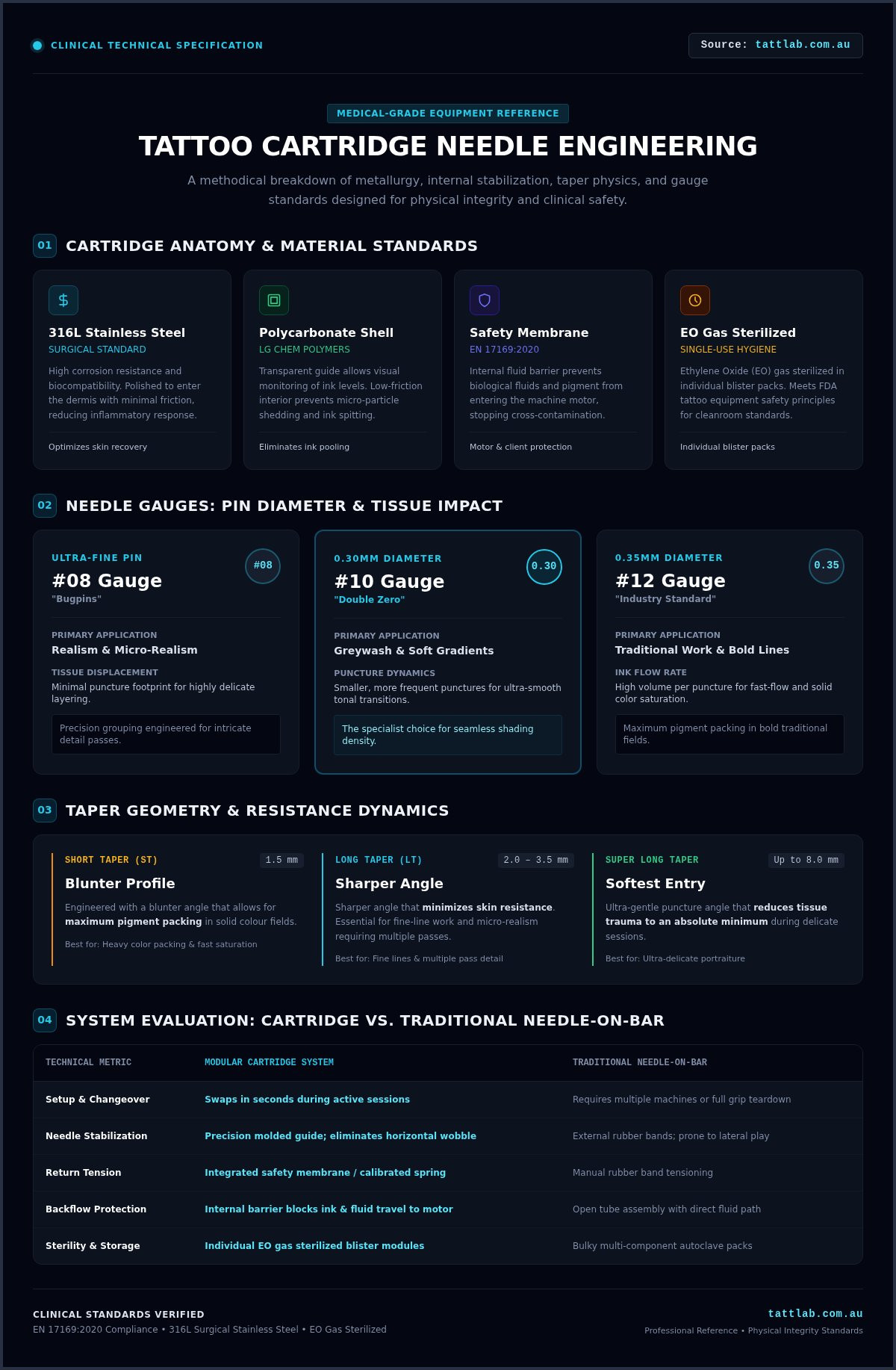
The primary benefit of the cartridge system is the speed of configuration changes. During a single session, an artist might transition from a round liner for crisp script to a magnum for smooth saturation in seconds. This versatility allows for a more fluid creative process without the distraction of technical delays. Precision and throw are also handled differently; while traditional needles rely on rubber bands for tension, tattoo cartridge needles use internal membranes or springs to provide consistent resistance. This internal stabilization reduces needle "wobble," which is essential for delicate micro-realism. Finally, storage and sterility are simplified. Each module is individually blister-packed and sterilized via Ethylene Oxide (EO) gas, maintaining a high-end laboratory standard that builds immediate trust with the audience.
The Anatomy of a High-Performance Cartridge
High-performance tattoo cartridge needles are built upon a foundation of metallurgy and advanced polymer science. To protect skin integrity, the industry standard utilizes 316L medical-grade stainless steel. These alloys are chosen for their high corrosion resistance and biocompatibility, which reduces the body's inflammatory response during the healing process. When the needle grouping is polished to a surgical standard, it enters the dermis with minimal friction, allowing the skin to recover more efficiently. This methodical approach to material selection ensures that the technical procedure supports a narrative of safe, predictable transformation.
The external housing is equally vital to the outcome. Manufacturers typically use medical-grade polycarbonate or LG Chem plastics to create a smooth internal guide. This transparency allows for visual monitoring of ink levels, while the low-friction surface prevents micro-particles of plastic from being introduced into the puncture site. Following FDA tattoo equipment safety guidelines ensures that these materials are pre-sterilized and designed for single-use, which is the cornerstone of modern studio hygiene. Choosing the right housing design also impacts ink flow, preventing the pooling or "spitting" that can compromise delicate work.
Needle Gauges and Skin Integrity
The gauge refers to the diameter of each individual needle pin. A #10 gauge (0.30mm), often called "Double Zero," is the specialist choice for smooth greywash and soft gradients because it creates smaller, more frequent punctures. In contrast, the #12 gauge (0.35mm) is the standard for fast-flow traditional work and bold saturation. The needle gauge directly determines the volume of ink delivered per puncture, influencing both the saturation density and the level of tissue displacement. Selecting the appropriate gauge is a clinical decision that balances the desired aesthetic with the physical limits of the client's skin.
Taper Lengths and Technical Precision
Taper geometry dictates how the needle tip narrows toward the point. Long Tapers (LT), ranging from 2.0mm to 3.5mm, provide a sharper angle that minimizes skin resistance. This is essential for fine-line work and micro-realism where multiple passes may be required. Short Tapers (ST) at 1.5mm have a blunter profile, which allows for maximum pigment packing in solid colour fields. Understanding these nuances helps you select professional-grade supplies that align with your specific technique. For ultra-delicate portraiture, Super Long Tapers reaching up to 8.0mm offer the softest possible entry, reducing tissue trauma to an absolute minimum.
Configurations: Choosing the Right Tool for the Task
Selecting the correct configuration is a fundamental step in ensuring the physical integrity of the skin during a procedure. Each grouping of tattoo cartridge needles is engineered to perform a specific biological task, from crisp dermal punctures for outlines to broad saturation for colour packing. This methodical selection process allows the artist to act as a specialist, minimizing unnecessary trauma while maximizing pigment retention. It's about finding the perfect synergy between the machine's stroke and the needle's footprint on the body.
Liners and Shaders: The Foundations of Structure
Round Liners (RL) consist of needle pins soldered into a tight, circular grouping. This design provides the stability needed for crisp outlines and detailed script work, reducing needle whip that can lead to blurred edges or inconsistent depth. In contrast, Round Shaders (RS) feature pins that are spaced further apart. This increased distance allows more ink to flow between the needles; it makes them ideal for soft shading and small-scale filling where a less aggressive puncture is desired. For a deeper understanding of how these tools fit into a broader studio setup, you can consult The Professional Guide to Tattoo Supplies in Australia. Using the right shader ensures you don't overwork the skin, which is vital for a liberating healing experience.
Magnums: Mastering Large Scale Saturation
Magnums represent the most efficient way to achieve solid saturation across larger surface areas. The Curved Magnum (CM), also known as a Soft Edge Magnum, features a slight radius at the tip. This curvature mimics the natural contours of the body and prevents the edge pins from digging too deeply into the dermis. This design effectively reduces skin trauma and ensures smoother transitions in greywash or colour blends. Traditional Weaved Magnums (M1) remain the standard for heavy pigment packing and solid black-work where a flat, consistent application is required. Selecting these tattoo cartridge needles based on the specific anatomical site is a hallmark of a modern, knowledgeable professional.
Session management is a critical skill that impacts both the artist and the client. Choosing a larger Magnum size for broad areas doesn't just save time; it reduces the total number of punctures required to achieve saturation, which supports a faster healing narrative. Whether you are using specialized Turbo liners for bold traditional work or micro-groupings for realism, adhering to the OSHA Bloodborne Pathogens Standard ensures that every configuration change is handled with the highest level of clinical safety. This disciplined approach to tool selection transforms the technical task into a reassuring process of personal transformation.
Matching Cartridges to Your Tattooing Style
The relationship between your artistic style and your choice of tattoo cartridge needles is a synergy of technical precision and creative intent. Selecting the wrong tool for a specific genre doesn't just make the process more difficult; it risks the physical integrity of the skin and can lead to inconsistent healing. A professional-only approach requires matching the puncture volume and needle stability to the desired visual outcome, ensuring every mark contributes to a liberating narrative for the client.
Technical Requirements for Fine Line Work
Fine line and micro-realism styles demand absolute stability. Because these techniques often utilize #08 (0.25mm) or #10 (0.30mm) bugpin round liners, even the slightest vibration in the cartridge housing can cause visible "chatter" in the skin. High-quality housing acts as a stabilizing ring; it eliminates horizontal play at high machine stroke lengths. This precision allows for single-pass lines with consistent ink flow, which is non-negotiable for delicate facial work or intricate script. For these specialized tasks, professional artists rely on configurations that offer a controlled, predictable progress toward the final result.
Saturation Strategies for Bold Work
American Traditional tattoos require bold, lasting lines that maintain their clarity over time. This is best achieved using #12 (0.35mm) long tapers, which provide a faster flow and larger puncture diameter for maximum pigment load. For Neo-Traditional artists, mixing gauges is the standard method for creating depth and varied line weights within a single piece. When executing high-intensity colour packing, it is vital to balance your needle grouping with high-quality pigments. You can learn more about this in The Professional Guide to Tattoo Ink. Using larger groupings for saturation reduces skin inflammation by achieving the desired density in fewer passes.
Black and grey realism relies on the synergy of curved magnums and soft-edge shading to create smooth, photographic transitions. By using a radius-tip magnum, you protect the skin from edge trauma while building layers of greywash. This methodical approach mirrors the precision of a laboratory, where every choice is grounded in science and safety. If you are ready to elevate your studio's performance, you can shop our artist-vetted range of cartridges for nationwide express shipping.
Safety and Quality Control in Professional Studios
Maintaining a clinical environment is the final, non-negotiable step in the tattooing process. While artistic skill defines the visual result, the safety protocols behind your tattoo cartridge needles define your reputation as a trusted specialist. A professional studio functions much like a high-end laboratory; every tool must meet rigorous medical-grade standards to protect the physical integrity of both the artist and the client. This commitment to physical wellness ensures that the procedure remains a safe, liberating experience rather than a health risk.
The Membrane System: Your First Line of Defense
The safety membrane is your primary engineering control against cross-contamination. Unlike budget alternatives that use simple rubber bands, high-performance cartridges utilize a resilient silicone barrier. This membrane serves a dual purpose: it provides the necessary needle "rebound" for consistent depth and creates a fluid-impermeable seal. This seal prevents pigment, blood, and interstitial fluid from traveling up the drive bar and contaminating the machine's internal motor. When selecting supplies, testing for needle centering and membrane tension is a vital quality control step. Tatt Lab only stocks brands like Cheyenne, Elite, and EZ because they feature proven safety barriers that meet EN 17169:2020 hygiene standards.
Sterilization is another pillar of studio safety. Every professional cartridge must be individually sealed in a blister pack and processed using Ethylene Oxide (EO) gas in accordance with ISO 11135. You should always verify the sterilization indicator on the packaging and monitor expiry dates; typically, these modules are valid for three to five years from the production date. Once a session concludes, immediate disposal into a puncture-resistant biohazard sharps container is mandatory. This methodical approach to disposal is a core component of the Medical Supplies for Tattoo Artists protocol, ensuring your workspace remains pristine.
Sourcing Reliable Supplies in Australia
Sourcing your tattoo cartridge needles from unvetted marketplaces carries significant risks, including the potential for counterfeit needles or compromised sterilization. Tatt Lab's artist-led approach eliminates this uncertainty by providing a curated selection of studio-ready supplies. By prioritizing artist-vetted quality and nationwide express shipping from Victoria, we ensure that Australian professionals have access to the highest standards of safety. It's not just about the technical task; it's about being a dedicated partner in your client's journey of self-assurance. Choosing vetted equipment reflects a transparent, results-oriented approach that builds immediate trust with your audience.
Elevating Your Art Through Technical Rigor
Choosing the right tattoo cartridge needles is a fundamental investment in your craft and your client's physical integrity. By mastering the nuances of needle gauges and membrane science, you move beyond mere technicality into a space of liberating artistic expression. We've explored how medical-grade materials like 316L stainless steel and integrated safety barriers aren't just features; they're the guardians of a predictable, successful healing narrative. Precision in the studio is built on a foundation of trust and specialized knowledge.
As an artist-owned and operated specialist, Tatt Lab understands that your reputation depends on the quality of your tools. We maintain strictly medical-grade quality control across our entire range, ensuring every session meets the highest clinical standards. Whether you're refining micro-realism or packing bold traditional color, the right equipment ensures your focus remains on the art itself. It's about creating a modern, boutique experience that values health as much as aesthetics.
Explore the Professional Cartridge Range at Tatt Lab and take advantage of nationwide express shipping on all professional orders. We're here to support your journey toward more precise, safer, and more impactful artistic outcomes.
Professional Insights: Frequently Asked Questions
What is the difference between a bugpin and a regular tattoo needle?
A bugpin needle features a smaller diameter pin, typically #08 (0.25mm) or #10 (0.30mm), compared to the standard #12 (0.35mm) grouping. This reduced size allows for more punctures in a smaller surface area, resulting in smoother gradients and finer detail in micro-realism. Professionals choose these specialized tattoo cartridge needles to minimize tissue displacement. It's a clinical choice that balances the volume of ink delivered with the physical limits of the client's skin healing process.
Can I use any brand of cartridge in my rotary tattoo machine?
Most modern rotary pens utilize a universal click and notch system, allowing for broad compatibility across major brands. While you can technically fit various cartridges into your machine, you must ensure they feature an integrated safety membrane. Using non-membrane cartridges can void your machine's warranty and risk motor contamination. Tatt Lab focuses on artist-vetted brands that adhere to these universal standards, ensuring your equipment maintains its physical integrity and longevity throughout its operational life.
How do I know if a tattoo cartridge has a safety membrane?
You can identify a safety membrane by inspecting the internal housing for a flexible silicone barrier rather than a metal spring or rubber band. A reliable test involves pushing the needle drive bar forward with a sterile tool; a membrane system will provide firm resistance and snap back to its original position immediately. This rebound is essential for preventing backflow. High-quality tattoo cartridge needles use this engineering control to protect your machine from biological fluids and pigment.
What needle configuration is best for fine line tattooing?
Round Liners (RL) are the optimal configuration for fine line work because the needle pins are soldered into a tight, circular grouping. For ultra-delicate script or micro-realism, artists frequently select a 1RL or a tight 3RL bugpin. These groupings provide the stability required to prevent needle whip at high machine speeds. By selecting a configuration with high-quality housing, you ensure consistent ink flow and crisp dermal punctures that support a successful aesthetic outcome and predictable healing.
Why do some tattoo cartridges rattle or vibrate more than others?
Excessive rattling or vibration is usually caused by a lack of internal stabilization within the cartridge housing. High-performance modules incorporate internal guide rails or stabilizing rings to eliminate horizontal play. When a needle grouping has too much "wobble," it leads to inconsistent line weights and increased skin trauma. Choosing artist-vetted supplies ensures that the polycarbonate housing is precision-molded, providing the steady, methodical needle throw required for professional results and reduced hand fatigue during long sessions.
How often should I change my cartridge during a long tattoo session?
How often should I change my cartridge during a long tattoo session?
You should change your cartridge if the needle pins become dull or if you notice any "barbing" at the tip, which can cause excessive skin trauma. During a long session, some artists choose to swap modules every few hours to ensure the sharpest possible entry. If the ink starts to pool or the flow becomes inconsistent, it's often a sign that the housing is clogged. Maintaining a fresh needle grouping is a commitment to the client's physical integrity and long-term results. To help track these intervals during extended work, a Timeqube provides a non-intrusive visual way to manage your session time effectively.
Australian professionals most commonly utilize #10 (0.30mm) and #12 (0.35mm) needle gauges for their daily work. The #12 gauge is the standard for bold traditional lines and solid color packing, while the #10 is favored for smooth greywash and soft shading. For specialists in micro-realism, the #08 (0.25mm) bugpin is increasingly popular. These selections are grounded in the science of dermal penetration, ensuring that the pigment is delivered efficiently while respecting the body's natural healing narrative.
Is it safe to buy tattoo cartridges from non-specialist retailers?
Buying from non-specialist retailers is risky because these marketplaces often lack medical-grade quality control and verified sterilization protocols. Professional-grade cartridges must undergo Ethylene Oxide (EO) gas processing and carry clear batch codes and expiry dates. Sourcing from an artist-owned specialist like Tatt Lab ensures that every product is studio-ready and safe for use on the body. We prioritize physical wellness by only stocking supplies that meet the highest clinical standards for the Australian tattoo industry.


Comments (0)
There are no comments for this article. Be the first one to leave a message!