

What if the primary cause of inconsistent healed results isn't your hand speed, but a misunderstanding of the millimetres at the tip of your cartridge? While many artists prioritise needle gauge, the debate of long taper vs short taper needles is where the real mastery of skin integrity begins. At Tatt Lab, we view the dermis as a delicate biological canvas that requires a clinical approach to minimize trauma. You likely understand the frustration of a session where the ink refuses to saturate evenly, leading to unnecessary passes that can increase skin trauma by over 25% during a standard six hour appointment.
We're here to help you refine your toolkit and reclaim confidence in your technical choices. By mastering the differences between a 2.5mm short taper and a 7mm long taper, you'll achieve smoother gradients in black and grey work and crisper fine lines that stand the test of time. This guide explores the science of needle geometry and ink displacement. It provides a clear roadmap to faster saturation and superior skin health for every client who walks through your studio doors, ensuring their journey toward clear skin starts with the right application.
Key Takeaways
- Understand how specific taper measurements, ranging from 1.5mm to 7mm, fundamentally alter the needle's physical interaction with the dermis.
- Analyze the mechanical differences of long taper vs short taper needles to significantly reduce skin displacement and minimize procedural trauma.
- Discover why long tapers provide the surgical precision required for fine linework, while short tapers are engineered for maximum ink saturation.
- Identify the "Goldilocks" zone of medium tapers to balance versatility across various configurations, including Round Liners and Magnums.
- Learn how to select professional-grade cartridges that ensure needle consistency, protecting the skin's long-term health and aesthetic evolution.
Understanding Tattoo Needle Taper: Anatomy and Measurement
Precision in tattooing begins with a clinical understanding of the equipment. While many artists focus on needle gauge or grouping, the taper is the silent variable that dictates how the skin receives pigment. Taper refers to the length of the point, measured from the very tip of the needle to the point where it reaches its full diameter. In the Tatt Lab environment, we view this geometry as a critical factor in skin health and trauma management. Selecting between long taper vs short taper needles isn't just a matter of preference; it's a technical decision based on the desired saturation and the specific resistance of the client's dermis.
Think of the taper using a pencil analogy. A long taper is a freshly sharpened pencil with a fine, elongated lead. A short taper resembles a pencil that's been used, possessing a blunter, more aggressive point. This physical shape changes how the needle enters the tissue. A longer point creates a smaller entry hole, while a shorter point creates a wider opening almost immediately upon contact. This distinction remains separate from the needle diameter, which refers to the thickness of the steel wire itself, and the count, which is the number of needles soldered together.
The Anatomy of a Tattoo Needle
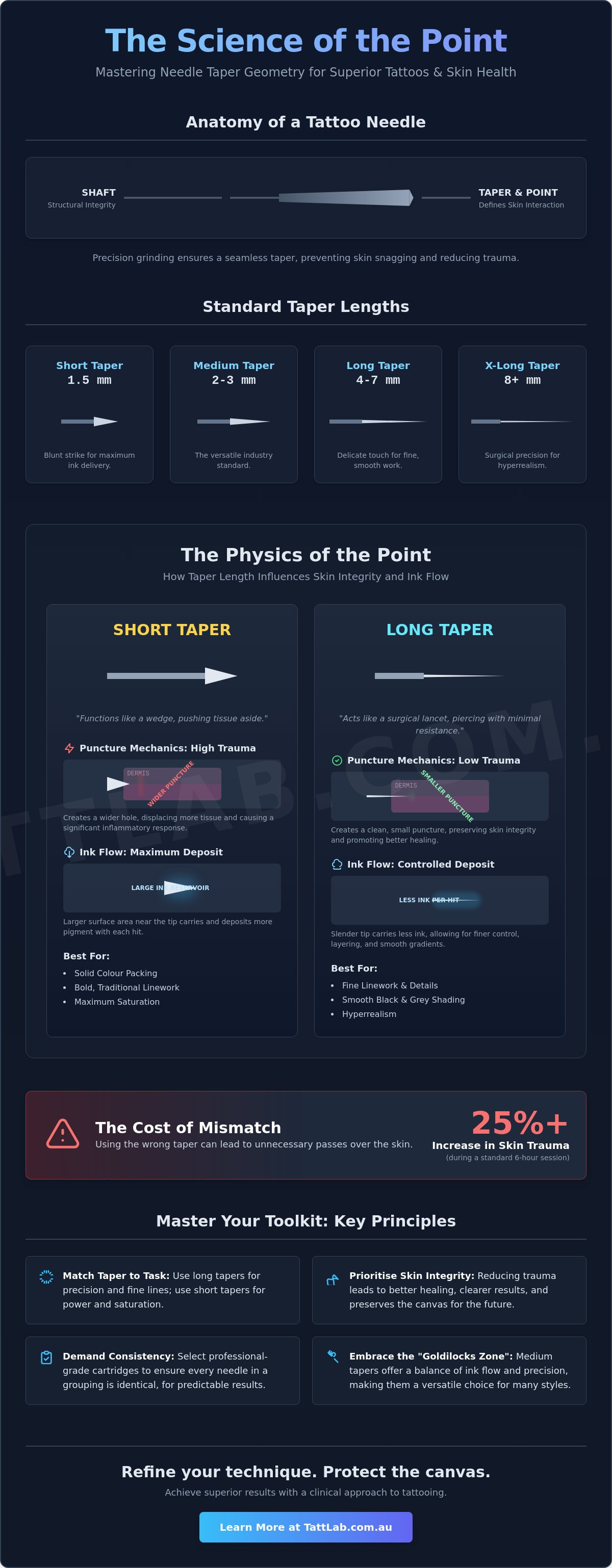
A tattoo needle consists of three primary zones: the shaft, the taper, and the point. The shaft provides the structural integrity needed for the drive bar to move the grouping. Manufacturing precision is vital here. High-quality needles undergo rigorous grinding processes to ensure the taper is consistent across every needle in a grouping. Taper is the conical reduction of the needle tip. If this reduction is uneven, the needle will snag or "hook" the skin, causing unnecessary scarring and inconsistent ink retention. For professional results, the transition from the point to the maximum diameter must be seamless to minimize the inflammatory response during the procedure.
Standard Taper Lengths Explained
The industry generally categorises taper lengths into four specific brackets. Short tapers typically measure 1.5mm, providing a blunt strike that's ideal for packing solid colour. Medium tapers range between 2mm and 3mm, offering a versatile middle ground. Long tapers extend from 4mm to 7mm, while "super" long tapers can reach 8mm in specialised configurations. These variations allow artists to fine-tune their approach based on the mechanics of modern tattoo machines and the specific requirements of the art.
- Short Taper (1.5mm): Delivers more ink per hit but increases skin trauma.
- Medium Taper (2-3mm): The standard for many traditional groupings.
- Long Taper (4-7mm): Provides a delicate touch for smooth shading and fine lines.
- Extremely Long Taper (8mm): Minimises resistance for hyper-realistic detail.
Labeling often varies by brand, which can lead to confusion in the studio. Some manufacturers use letters like LT for long taper or ST for short taper, while others rely on numerical codes. The evolution of modern cartridge systems has standardised these measurements more effectively than traditional bar needles. This standardisation helps artists maintain a predictable rhythm in their work, ensuring that the journey toward a completed piece is as smooth and controlled as possible.
The Physics of Taper: How Length Influences Skin Integrity and Ink Flow
The geometry of a needle point dictates the success of every procedure. When comparing long taper vs short taper needles, the primary distinction lies in the angle of the tip. A short taper typically measures 1.5mm to 2mm, creating a blunt, wedge-like profile. In contrast, a long taper extends between 3mm and 7mm, resulting in a sharp, elongated point. This physical difference changes how the needle interacts with the dermis and determines the volume of pigment delivered with each strike.
Puncture Mechanics and Skin Displacement
Short tapers function like a wedge. As they enter the skin, they must push tissue aside to create space for the needle's full diameter. This displacement increases mechanical trauma and triggers a more aggressive inflammatory response. Long tapers act more like a surgical lancet. They pierce the skin with minimal resistance, creating a smaller puncture site relative to the needle's gauge. Reducing this initial trauma is vital for the lymphatic system; it allows the body to focus on pigment retention rather than repairing significant tissue damage. Maintaining skin integrity ensures the tattoo heals without excessive scarring. This is a critical factor if a client ever decides to begin a skin health journey involving laser removal in the future.
Ink Flow Dynamics
Taper length directly impacts surface tension and pigment delivery. Short tapers have a larger surface area near the tip, allowing more ink to cling to the metal. This "ink reservoir" effect means more pigment is deposited in a single hit, making them ideal for saturated colour packing or bold traditional work. Long tapers carry less pigment because the slender tip offers less surface area for ink to grip. While this might require more passes to achieve full saturation, it provides the artist with unmatched precision for fine lines and soft shading.
Biological responses vary significantly based on these mechanics. The reduced trauma of long tapers allows artists to perform multiple passes without the immediate swelling that often occurs with blunter needles. Because the skin remains calm, the artist can see the true tone of the pigment without the interference of redness or interstitial fluid. This steady, controlled approach preserves the skin's natural texture and leads to a more predictable healing phase. By choosing the correct taper, you're not just selecting a tool; you're managing the biological evolution of the skin's recovery.
Comparing Performance: Long Taper vs. Short Taper Results
Understanding the physical interaction between surgical steel and the dermis is essential for maintaining skin health. When evaluating long taper vs short taper needles, the primary difference lies in the displacement of tissue and the volume of pigment delivered per puncture. A long taper, typically measuring between 5mm and 7mm, creates a much narrower entry point. This geometry allows for surgical precision but requires a disciplined hand to ensure consistent ink flow.
The most common industry misconception is that a longer taper is always superior for fine-line work. While the tip is indeed finer, the narrow taper carries less pigment. If your hand speed is too fast, you risk "dry" hits that require multiple passes. Conversely, short tapers (ranging from 1.5mm to 2mm) reach their full diameter almost immediately upon skin penetration. This results in a larger "hole" but delivers a significantly higher volume of ink, making them the standard for high-saturation tasks.
The Long Taper Advantage for Shading
Long tapers are the primary tool for black and grey realism and soft illustrative styles. They enable "pepper shading," a technique where the artist creates gradients through a series of distinct, tiny dots of pigment. Because the needle point is exceptionally sharp, it enters the skin with minimal resistance. This reduces the mechanical trauma to the skin, which is a critical factor in preventing blowouts in delicate areas like the inner wrist or the ribs. Realism artists in Melbourne studios often prefer super-long tapers to build layers of translucent grey wash without compromising the skin's structural integrity.
When Short Taper is the Superior Choice
For solid black fills, tribal work, or traditional American styles, short tapers are the more efficient tool. They maximise pigment density in a single pass, which is vital for achieving that deep, "velvet" black finish. In the Australian traditional scene, bold 12-gauge short taper liners are often used to create iconic, heavy outlines that hold their clarity for decades. However, there is a technical trade-off. The blunter profile of a short taper requires more force to penetrate the skin. If an artist isn't careful, they can easily over-work the area. This leads to heavy scabbing and a prolonged healing journey, as the skin struggles to repair the larger micro-traumas caused by the wider needle shoulders.
- Long Taper (5mm+): Best for smooth gradients, fine details, and minimising skin trauma in sensitive areas.
- Short Taper (1.5mm-2mm): Best for solid colour packing, bold lines, and maximum ink saturation.
- Skin Impact: Long tapers allow for more passes with less swelling; short tapers require fewer passes but carry a higher risk of over-working the tissue.
Technical Selection: Choosing the Right Taper for Your Style and Configuration
Selecting the correct needle configuration is a clinical decision that directly impacts skin trauma and pigment retention. While the choice often feels personal, it's grounded in the physics of how a needle enters the dermis. The medium taper, frequently called the "Goldilocks" zone, offers a 3.0mm to 3.5mm point. It serves as the industry all-rounder because it balances ink flow with a moderate entry angle. This versatility makes it the standard for artists who transition between whip shading and solid lines without changing cartridges.
Professional artists understand that equipment quality is a foundation for long-term skin health. For a deeper look at local standards and procurement, consult The Professional Guide to Tattoo Supplies in Australia.
Taper Selection for Liners and Shaders
Long taper round liners are the professional standard for fine line work. The extended, gradual point allows for surgical precision and creates minimal skin resistance. When you pair a 0.30mm (#10) needle with a long taper, the entry point is microscopic. This combination is essential for delicate portraits or intricate script where clarity is the priority.
Short taper round shaders serve a different purpose. They're designed for small-area colour saturation. Because the needle reaches its full diameter quickly, it creates a slightly larger puncture that carries more pigment into the skin per stroke. Using a 0.35mm (#12) short taper shader allows you to pack colour into tight corners without the excessive passes that lead to scarring.
Optimising Magnums and Curved Magnums
The debate of long taper vs short taper needles is most visible in large-scale shading. Your choice dictates the texture of the finished piece. Long taper magnums are the primary tool for seamless, soft-edge blending in realism. They allow for the gradual layering of grey wash, preventing the harsh "pepper" grain that occurs with blunter needles.
- Realism and Portraits: Long tapers provide the control needed for soft transitions and skin tones.
- Traditional and Japanese: Short tapers are superior for heavy colour packing and solid black fills, providing the "punch" required for bold saturation.
- Fine Line: Long tapers offer the sharpest possible point for consistent, thin lines.
For large-scale back pieces, short taper magnums reduce the time the skin is under tension by depositing ink more efficiently. For small details, the long taper offers the precision of a paintbrush. By matching the taper to the specific demand of the style, you respect the integrity of the skin while achieving the desired aesthetic evolution.
Ready to elevate your technical precision? Explore our curated range of professional tools at the Tatt Lab shop.
Elevating Your Craft with Professional-Grade Cartridges
Choosing between long taper vs short taper needles is a foundational skill for any serious artist, but the technical nuance is lost if the needle itself lacks precision. Tatt Lab operates as a specialized curator for the Australian tattoo industry. We prioritize skin health by selecting brands like EZ and Elite, which undergo rigorous artist-vetting before reaching our shelves. These manufacturers maintain strict tolerances in their taper geometry. This ensures that a 3.5mm taper performs identically across every box, protecting your professional reputation and the client's skin integrity. When you're working on a complex piece, you need the confidence that your tools won't vary mid-session.
The Tatt Lab Quality Standard
We curate our range with a focus on the biological response of the dermis. Every cartridge we stock features advanced membrane technology. These internal silicone barriers prevent pigment and biological fluids from backflowing into your machine's grip and motor. It's a non-negotiable standard for studio safety that protects your equipment and your clients. Consistent needle geometry allows for predictable saturation, which directly impacts the healing process. Proper tool selection is the first step in Mastering Tattoo Aftercare, as reduced trauma leads to superior ink retention and faster recovery times. Our focus remains on the evolution of the skin, ensuring every puncture is deliberate and clean.
- Precision Engineering: Artist-vetted brands ensure that long taper vs short taper needles meet exact specifications for every pass.
- Safety First: Medical-grade plastics and 316L stainless steel reduce the risk of adverse skin reactions.
- Machine Protection: High-tension membrane systems provide a reliable seal against cross-contamination.
Streamlining Your Studio Supply Chain
Professional studios require a reliable partner to maintain inventory without the stress of international shipping delays or inconsistent stock levels. Tatt Lab offers wholesale accounts designed to support the growth of Australian artists and established shops. We provide national express shipping to ensure your workstation remains stocked with the exact configurations your style demands. Our Melbourne-based team understands the local market's drive for excellence and safety. By centralizing your procurement with medical-grade supplies, you can focus on the creative journey while we manage the logistics of your laboratory. We believe in a transparent, results-oriented approach that builds trust through every shipment.
The transition from a standard setup to a professional-grade laboratory environment begins with the quality of your consumables. We invite you to experience the difference that curated, high-performance cartridges make in your daily workflow. Precision isn't just a goal; it's our standard.
Mastering Your Technical Evolution
The distinction between long taper vs short taper needles is a fundamental pillar of skin health and artistic precision. Long tapers provide a gradual entry point that reduces epidermal trauma during intricate shading; short tapers offer the robust ink displacement necessary for solid saturation and bold lining. Understanding these mechanical differences allows you to control the biological response of the skin, ensuring a cleaner healing process and more vibrant long-term results. At Tatt Lab, we're an artist-owned and operated specialist lab that prioritizes professional-grade performance above all else. We've curated a selection of industry-leading brands, including EZ, Elite, and Panthera, to ensure every artist has access to the tools their style demands. With express nationwide shipping across Australia, you can refine your kit and maintain your creative momentum without delay. Your commitment to your craft deserves equipment that mirrors your dedication to quality and skin integrity.
Shop our curated range of professional tattoo cartridges at Tatt Lab
We're here to support your journey as you push the boundaries of what's possible in modern tattooing.
Frequently Asked Questions
What is the most common taper length for fine line tattooing?
Long taper needles, typically measuring between 6mm and 7mm, are the industry standard for fine line tattooing. This extended geometry creates a thinner needle point, which results in a smaller entry wound and higher precision during the procedure. When comparing long taper vs short taper needles, the long taper allows the artist to execute delicate single-needle work or tight groupings without causing excessive trauma to the dermal layers.
Can I use a long taper needle for colour packing?
You shouldn't use a long taper for heavy colour packing because it lacks the necessary punch to deposit large volumes of pigment efficiently. Short tapers, usually measuring between 1.5mm and 2mm, create a slightly larger puncture that allows more ink to enter the skin with every stroke. Using a long taper for this task often leads to over-working the tissue, which can increase healing times by 30% or more for the client.
Do long taper needles cause less pain for the client?
Long taper needles generally cause less discomfort because they penetrate the skin with a finer, more gradual point. A 7mm taper creates a narrower channel than a 2mm short taper, which minimizes the immediate activation of pain receptors in the skin. While the sensation of tattooing is always subjective, clinical observations suggest that clients experience a reduction in the immediate inflammatory response when artists use long taper configurations for fine lining.
What happens if I use a short taper for soft shading?
Using a short taper for soft shading results in a more aggressive, pixelated texture often referred to as pepper shading. Because the needle reaches its full diameter almost immediately upon entry, it leaves a larger, more distinct dot of pigment. If your goal is a smooth, seamless gradient, a long taper is the superior choice. Short tapers are better suited for traditional whip shading where 100% smooth transitions aren't the primary objective.
Are taper lengths the same across all tattoo needle brands?
Taper lengths aren't standardized across the tattoo industry, meaning one brand's long taper might be another's medium taper. For example, one manufacturer might define a long taper as 5mm, while another sets theirs at 7mm. Professional artists must check the specific millimetre measurements on the manufacturer technical data sheet to ensure consistency. This lack of uniformity makes testing individual brands essential for maintaining skin health and predictable results.
How do I know which taper is inside my cartridge box?
You can identify the taper by looking for specific abbreviations on the cartridge box, such as LT for Long Taper or ST for Short Taper. Most reputable manufacturers include a code like 1203RL-LT on the packaging. The "LT" indicates a long taper is inside the housing. If the box lacks these markers, refer to the product batch certificate, which provides the exact needle geometry and sterilization date for that specific lot of needles.
Is a medium taper a good choice for beginners?
A medium taper, usually measuring 3mm to 3.5mm, is an excellent choice for beginners due to its versatility. It offers a functional balance between the precision of a long taper and the pigment delivery of a short taper. This middle ground allows new artists to practice both lining and shading without the high risk of skin trauma associated with more specialized needle geometries. It acts as a reliable baseline for developing a controlled technique.
Does taper length affect how deep I should set my needle depth?
Taper length doesn't change the actual depth you must reach, which is typically 1.5mm to 2mm into the dermis, but it affects your tactile feedback. A long taper feels softer and might require a slightly more deliberate hand to ensure the pigment reaches the correct layer. Regardless of whether you choose long taper vs short taper needles, your machine hang-out should be adjusted to maintain consistent depth for optimal ink retention and skin integrity.


Comments (0)
There are no comments for this article. Be the first one to leave a message!