

The difference between a tattoo that heals with surgical clarity and one that suffers from 15% more inflammatory trauma often comes down to a fraction of a millimetre in needle taper. In the precision-driven environment of a modern Australian studio, understanding the technical physics of a round liner vs round shader is the fundamental variable that determines whether you're respecting the biological canvas or unnecessarily compromising skin integrity. It's not just about the immediate visual result; it's about the microscopic impact on the dermis and the long-term evolution of the work.
You've likely experienced the frustration of inconsistent line weights or ink spitting in tight corners, knowing that every redundant pass increases the risk of tissue trauma. We agree that protecting the client's skin health is just as vital as the artistic execution. This guide promises to help you master these needle distinctions to achieve faster saturation with fewer passes and significantly crisper line work. We'll break down the science of needle groupings, the mechanics of ink delivery, and how to select the optimal configuration for superior healing outcomes.
Key Takeaways
- Understand how needle geometry and solder points dictate pin tension to ensure every stroke respects the skin’s biological integrity.
- Master the science of the Round Liner to create a crisp, high-definition skeleton for your work while overcoming skin resistance with technical precision.
- Discover why the Round Shader is a specialist tool for bold lining and efficient saturation, offering a softer mechanical impact on sensitive tissue.
- Navigate the technical round liner vs round shader decision matrix to select the optimal configuration for specific Australian styles, including Fine Line and Traditional.
- Elevate your professional outcomes by adopting cartridge standards that eliminate needle wobble and protect the client's skin health through advanced membrane technology.
Understanding Needle Geometry: The Fundamentals of Round Groupings
Selecting the right needle configuration is a clinical decision that directly impacts skin trauma and pigment retention. At Tatt Lab, we view needle selection through a technical lens, treating the dermis as a reactive biological canvas rather than just a surface. The choice between a round liner vs round shader determines how the pins interact with the skin's structural integrity and how the lymphatic system eventually interacts with the deposited ink. These two configurations serve as the pillars of tattoo geometry, each engineered for a specific mechanical purpose.
The performance of any round grouping is dictated by the solder point. This is the exact location where the individual pins are joined together. A solder point set close to the needle tips creates high tension and a rigid feel, which is ideal for precision. Conversely, soldering the pins further back allows for more lateral movement. Professional Australian studios prioritize 316L surgical stainless steel for these components. This specific grade of steel is the industry standard because it offers maximum corrosion resistance and biocompatibility, ensuring the skin's health is protected throughout the procedural journey.
The Anatomy of a Round Liner (RL)
Round liners are engineered for high-compression ink delivery. The pins are angled inward, tapering to a sharp, singular point that focuses the force of the tattoo machine into a concentrated area. This tight grouping is designed for maximum precision and high-detail delivery. Common configurations range from a 1RL, often used for delicate micro-realism, to a 14RL for traditional bold outlines. Because the pins are pulled together so tightly, they provide the resistance necessary to break the skin's surface tension with minimal effort, allowing for crisp, consistent lines in a single pass.
The Anatomy of a Round Shader (RS)
Unlike liners, round shaders feature a parallel configuration. The pins run straight and are soldered further back on the shaft. This creates a "loose" grouping that offers significantly more give when the needle hits the skin. This flexibility is vital for skin health; it allows the needle to move with the tissue rather than forcing its way through it. While primarily used for filling small areas or creating soft transitions, many artists utilize the RS as a "loose liner." This technique produces a thicker, more textured line that carries a different aesthetic weight than the clinical sharpness of an RL.
Capillary Action and Ink Flow
The physics of ink delivery relies on capillary action, which is the ability of a liquid to flow in narrow spaces without the assistance of external forces. Tight RL groupings hold a smaller volume of ink but deliver it under higher pressure. In contrast, the spacing in a round liner vs round shader setup allows the RS to hold more pigment between the pins. This increased volume requires careful management of ink viscosity. If the ink is too thin or the needle-to-tube fitment is loose, the configuration may "spit" pigment, obscuring the artist's view and compromising the precision of the work. Proper fitment ensures a steady, controlled flow that respects the skin's natural healing process.
The Round Liner (RL): Precision, Tension, and Fine Detail
The Round Liner (RL) serves as the structural architect of a tattoo. Its primary function is to create the "skeleton" of the piece, providing the foundational clarity that allows a design to remain legible as the skin ages. By soldering needles into a tight, circular formation that converges at a single point, the RL delivers a concentrated stream of pigment. This configuration is essential for crisp outlines, intricate script, and the technical precision required in styles like Fine Line or Traditional Americana.
Understanding the science of skin penetration is vital for any professional. Human skin is a resilient, elastic organ that naturally resists foreign objects. The tight grouping of a round liner overcomes this resistance by focusing the machine's kinetic energy into a very small surface area. This allows the needles to puncture the epidermis with minimal force, ensuring the ink reaches the dermis efficiently. When comparing a round liner vs round shader, the liner is the specialist for tension and definition, while the shader is designed for dispersion.
However, the concentrated pressure of a tight liner introduces specific risks. Blowouts occur when an artist applies excessive force or works at an incorrect angle, pushing the pigment into the subcutaneous fat layer where it spreads uncontrollably. To maintain skin health and achieve professional results, artists must balance hand speed with voltage to ensure the needle enters and exits the tissue cleanly. For a comprehensive breakdown of hardware options available in Australia, you can consult The Ultimate Guide to Tattoo Needles & Cartridges.
Standard vs. Bugpin Liners
The diameter of the individual pins within the grouping dictates the weight of the line. Standard #12 (0.35mm) needles are the industry staple, offering a reliable balance of ink flow and structural strength. For artists focused on ultra-fine illustrative work, #10 (0.30mm) bugpins are the preferred choice. These thinner pins create a smaller entry wound, which reduces trauma and can lead to faster healing times. While bugpins offer incredible detail, they require a steady hand to ensure the pigment retention remains consistent throughout the healing process.
Taper Length and Line Quality
Taper length refers to the shape of the needle point, with Long Taper (LT) and Extra Long Taper (XLT) being the most common for round liners. A longer taper creates a more gradual point, which reduces the "punch" or impact felt by the skin. This allows the artist to build saturation through controlled layers without causing excessive inflammation. The taper length dictates the initial inflammatory response, directly shaping the skin's regenerative journey from the moment the needle exits the dermis.
If you are looking to refine your technical setup or transition between styles, our team at Tatt Lab provides the clinical expertise needed to support your artistic evolution.
The Round Shader (RS): Saturation, Softness, and Bold Lines
While many practitioners view the Round Shader (RS) solely as a tool for filling, experienced artists treat it as a precision instrument for skin preservation. The primary distinction in the round liner vs round shader debate lies in the pin configuration. In an RS, the needles run parallel rather than being pinched to a tight point. This geometry provides a softer entry into the dermis, significantly reducing the "hamburgering" effect often associated with multiple passes over the same area.
This parallel alignment offers a distinct mechanical advantage. Because the pins don't converge, they displace the skin more evenly. This results in less resistance and a more predictable inflammatory response. From a clinical perspective, cleaner micro-perforations lead to a more efficient healing process, as the body's lymphatic system can focus on pigment integration rather than repairing excessive tissue trauma.
The RS as a "Loose Liner"
Traditional and Neo-Traditional artists often swap their liners for shaders when seeking a classic, bold aesthetic. A 7RS delivers a thicker, more saturated line in a single pass compared to a standard 7RL. This efficiency is vital for skin health. By achieving the desired weight immediately, you minimize the risk of scarring. When lining with a shader, you'll need to slightly increase your voltage and maintain a steady, deliberate hand speed to ensure the ink flows consistently through the wider grouping.
Soft Shading and Blending
The RS excels where Magnums struggle. In tight anatomical curves or intricate details, the circular grouping allows for seamless transitions. It's the primary choice for whip shading and building dot-work textures. Because the pins are spread further apart, they carry a larger volume of ink, facilitating maximum saturation in smaller gaps. This configuration also allows for more nuanced control over grey wash dilutions. The "open" nature of the pins lets the artist build layers of tone without overworking the tissue, ensuring the skin's integrity remains intact throughout the transformation.
- Pin Spacing: Parallel pins allow for higher ink flow with less skin tension.
- Saturation: Ideal for packing pigment into small areas where a magnum is too cumbersome.
- Healing: Reduced trauma leads to faster recovery and better long-term clarity of the pigment.
Choosing between a round liner vs round shader often comes down to the specific goals of the session. If the objective is a soft, blended transition or a bold, traditional line that heals with minimal scabbing, the RS is the superior choice. It prioritises the long-term health of the dermis while providing the saturation required for high-end professional work.
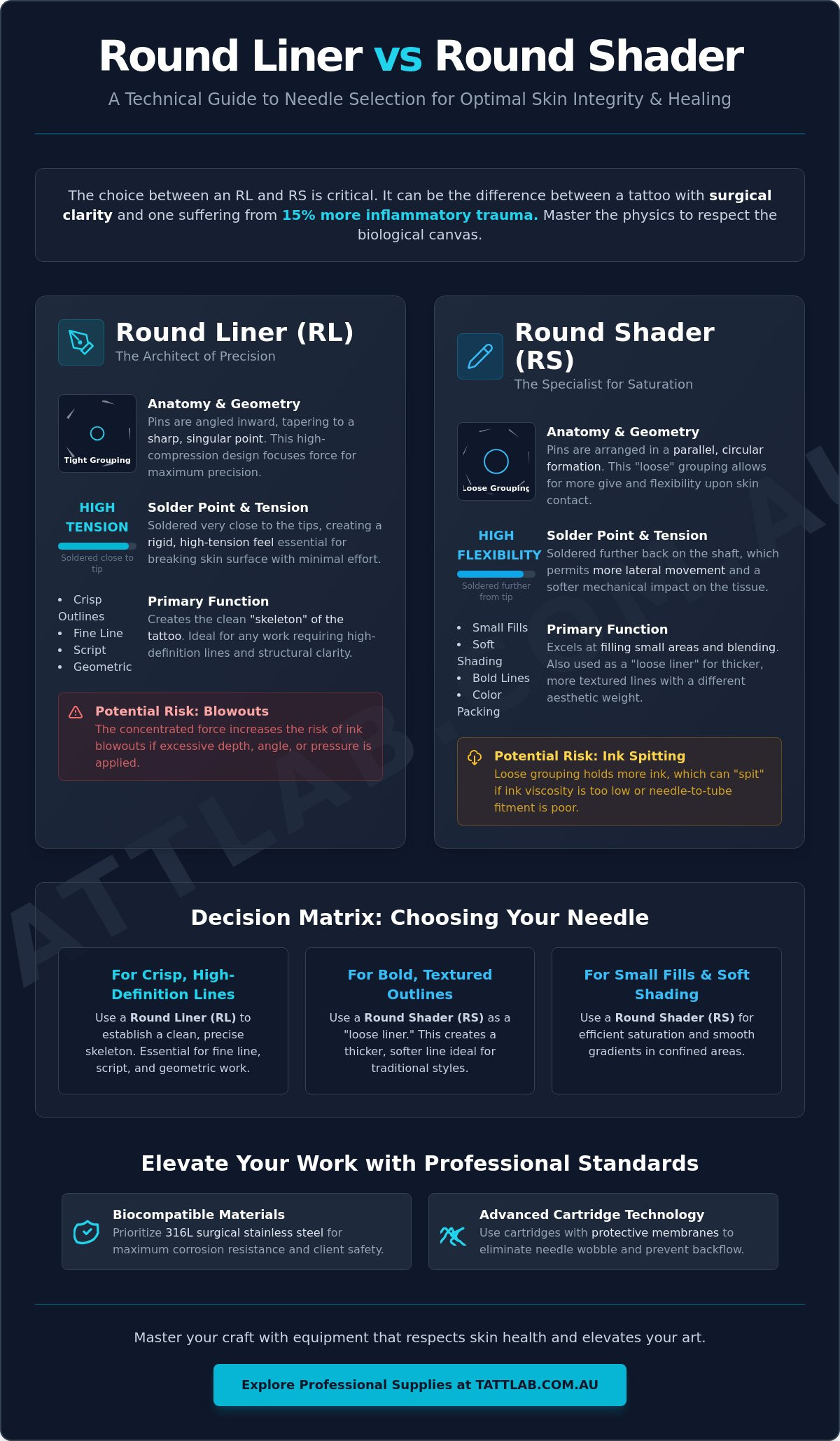
Round Liner vs. Round Shader: The Professional Decision Matrix
Choosing between a round liner vs round shader isn't just about the design on the stencil; it's a clinical decision regarding skin trauma and pigment saturation. A round liner (RL) focuses energy into a concentrated point. This is ideal for crisp definition but carries a higher risk of "slicing" if the hand speed isn't calibrated. Conversely, a round shader (RS) distributes that same pressure across a wider surface area. This reduces the mechanical stress on the dermis, allowing for smoother saturation without the immediate inflammatory response often seen with tight liners.
Style-Based Selection Guide
In the Australian tattoo landscape, needle choice defines the longevity of the work. For Fine Line specialists in Melbourne or Sydney, a 3RL or 5RL remains the gold standard. These groupings provide the necessary precision for delicate geometry while maintaining skin integrity. For American Traditional work, many artists opt for a 7RS or 9RS to create "bulletproof" lines. Because the pins are parallel rather than tapered to a point, they deposit a thicker, more consistent wall of pigment that heals with a bold, vintage aesthetic. In realism and portraiture, small round shaders are often the secret to soft eyelid textures or subtle skin pores, providing a stippled effect that a tight liner cannot replicate.
When to Swap: Troubleshooting Your Session
A professional's intuition is often found in their fingertips. If the skin begins to swell rapidly or exhibits a "glassy" texture, it's a signal that the needle grouping is too aggressive for that specific anatomical site. Switching from a tight RL to a looser RS can mitigate further trauma while continuing the pigment delivery. Identifying this shift early is vital for the client's long-term skin health. If the ink isn't "taking" in a single pass, evaluate the taper and the grouping tension. Low-quality pigments often require more passes, which compounds skin damage. Using high-quality Tattoo Ink ensures that the needle’s delivery is efficient, reducing the need for repetitive trauma.
Maintaining a sterile environment is the foundation of this process. Every session must begin with a rigorous setup using professional Medical Supplies for Tattoo Artists to ensure the journey from ink to skin remains safe and predictable. When the needle choice is fighting the skin, the artist feels a "bounce" or resistance. This tactile feedback suggests the skin is over-saturated or the needle depth is incorrect for the chosen grouping.
The Tatt Lab Standard: Premium Cartridges for Professional Outcomes
Precision is the non-negotiable foundation of professional tattooing. The technical distinction between a round liner vs round shader becomes irrelevant if the hardware fails at the point of contact. At Tatt Lab, we recognize that needle stability is the bridge between an artist's vision and a client's permanent skin evolution. High-performance cartridges are designed to facilitate this transition with clinical accuracy.
Cartridge Technology and Stability
Modern cartridge engineering has revolutionized how ink enters the dermis. High-end brands like Elite and EZ incorporate dedicated internal stabilizers that virtually eliminate needle wobble. This lateral movement, even at a microscopic level, causes unnecessary tissue trauma and blurred edges. When you choose a round liner vs round shader, the stabilizer ensures the needle grouping remains centered, providing a predictable hit every time the drive bar moves.
The housing of these cartridges utilizes medical-grade plastics. This material choice is critical because it minimizes friction between the metal needle and the casing. Reduced friction leads to less heat generation; this preserves the skin's biological integrity and improves the patient's comfort during long sessions. Cheap, generic needles often use inferior plastics that can shed micro-particles or cause the needle to snag, compromising the final aesthetic outcome.
- Internal Membranes: Every cartridge we stock features a safety membrane to prevent the backflow of ink and biological fluids into the machine, ensuring a sterile environment.
- Precision Soldering: Consistent needle alignment ensures that every round liner provides the sharpest possible entry.
- Friction Reduction: Medical-grade housings prevent heat buildup and protect the skin's surface.
Sourcing Professional Supplies in Australia
Tatt Lab operates as a specialized laboratory for the Australian tattoo industry. We are artist-owned and deeply familiar with the rigors of a busy studio environment. Every needle configuration in our inventory undergoes a vetting process to ensure it meets our standards for skin health and performance. We don't just sell supplies; we curate the tools necessary for clinical excellence.
For studios across Australia, we provide express nationwide shipping to ensure your workstation is never compromised by stock shortages. Professional artists can join the "Lab" by setting up a wholesale account, which offers streamlined ordering and dedicated support. This partnership allows you to focus on the art while we handle the technical logistics of your supply chain.
The journey of a tattoo doesn't end when the machine stops. Once you've mastered the application using the correct tools, the focus must shift to preservation. Long-term pigment clarity depends on how the skin recovers. You can ensure your work remains vibrant by following the protocols in our guide to Mastering Tattoo Aftercare, which prioritizes skin integrity and professional healing outcomes.
Mastering the Geometry of Your Next Session
Selecting the right configuration between a round liner vs round shader defines the technical success of a tattoo. It's about the mechanical interaction between the needle and the skin's surface. Precision linework demands the tight, concentrated tension of a Round Liner to ensure ink is deposited with surgical accuracy. Conversely, the deliberate spacing of a Round Shader allows for softer saturation and bold, consistent fills that respect the skin's integrity. Understanding these fundamental differences reduces unnecessary trauma and accelerates the healing process for your clients. As an artist-owned and operated supplier, Tatt Lab prioritizes clinical-grade quality in every tool we provide. Our premium medical-grade tattoo cartridges are engineered to meet the rigorous standards of modern Australian studios. We offer express nationwide shipping across Australia so you don't have to worry about inventory gaps. Your choice of needle is the final bridge between technical skill and a flawless result. We're here to support your evolution as an artist with tools that never compromise on safety or performance.
Explore our range of professional Round Liners and Shaders at Tatt Lab
Frequently Asked Questions
Can I use a Round Shader for lining?
You can use a Round Shader for lining when you require a softer, more diffused edge or a "bold will hold" traditional aesthetic. While a Round Liner groups needles tightly for precision, a Round Shader features parallel needle placement that delivers more ink per pass with less clinical sharpness. This technique is common in American Traditional work where a 7RS or 9RS creates a robust 1.0mm to 1.5mm line that ages with better skin integrity than a thin, over-worked liner.
What is the main difference between a tight liner and a loose liner?
The primary difference lies in the proximity of the needle points at the tip. Tight liners are soldered closer together to create a single, concentrated point of entry for high-detail precision. Loose liners allow for more space between the needles, which results in a thicker, textured line. In our Lab observations, tight liners require more voltage to break skin tension, whereas loose liners reduce the risk of blowouts by distributing pressure across a wider surface area.
Why does my Round Liner keep "spitting" ink?
Ink spitting usually occurs because the needle is set too far back in the tube or the air hole is blocked. If the needle doesn't create a proper vacuum within the tip, the ink flow becomes erratic instead of a steady stream. Check that your needle hang is between 1.5mm and 2.0mm. If the issue persists, the needle grouping might be too small for the tube size, causing the ink to pool and splatter during high-frequency vibration.
Is a Round Shader better for sensitive skin?
A Round Shader is often gentler on sensitive skin because the needle points are spread out, which reduces the "guillotine effect" of tightly packed liners. By distributing the puncture force, you minimize the risk of scarring and promote a more efficient healing journey. When comparing a round liner vs round shader for reactive skin types, the shader allows for smoother saturation with fewer passes, preserving the dermal structure and supporting long-term skin health.
What needle size is best for fine line tattoos?
The industry standard for fine line work is a 03 Round Liner (03RL) with a 0.25mm (8 gauge) or 0.30mm (10 gauge) needle diameter. These configurations allow for microscopic precision when executing intricate geometry or single-needle realism. Using a 0.25mm "Bugpin" needle reduces the puncture hole size by approximately 20 percent compared to standard 12 gauge needles. This leads to faster closure of the skin barrier and clearer healed results.
How do I know if I need a long taper or a short taper needle?
Choose a long taper needle (5.0mm to 7.0mm) for fine lines and smooth black-and-grey transitions because they stay in the skin for a shorter duration per hit. Short tapers (1.5mm to 2.5mm) are better for solid colour packing as they create a larger hole, allowing more pigment to enter the dermis quickly. At the Lab, we find that long tapers offer the artist more control, which is vital for maintaining skin integrity during complex sessions.
Can Round Shaders be used for color packing?
Round Shaders are excellent for colour packing in small or tight areas where a magnum needle won't fit. Their circular configuration provides a dense saturation of pigment that is ideal for small floral elements or traditional "spit shading" techniques. When analysing the round liner vs round shader debate for saturation, the shader wins for small-scale fills because it provides even coverage without the aggressive trauma associated with multiple passes from a tight liner.
Do I need different machines for liners and shaders?
Modern rotary machines are designed to handle both lining and shading by adjusting the voltage or stroke length. However, traditional coil setups require specific tuning; a liner typically has a shorter stroke and faster cycle, while a shader needs a longer, softer throw to push ink without damaging the tissue. For artists in Australia using high-end rotary tech, a 3.5mm to 4.2mm stroke provides the versatility needed to switch between configurations safely.


Comments (0)
There are no comments for this article. Be the first one to leave a message!