

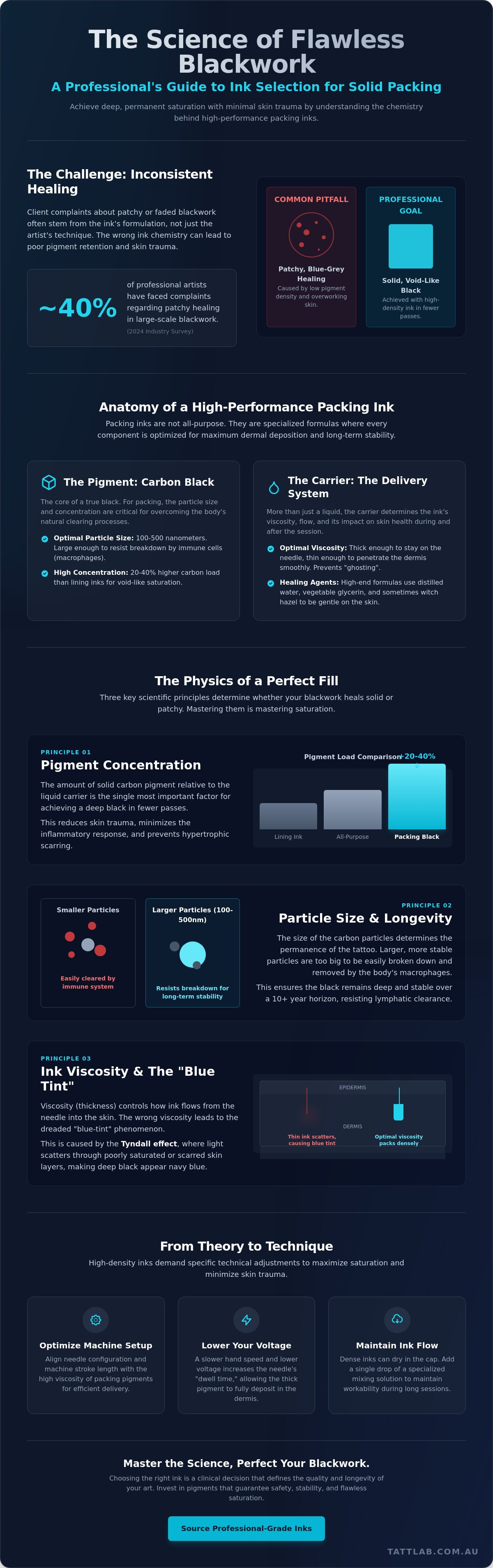
A 2024 industry survey noted that nearly 40 percent of professional artists have faced client complaints regarding patchy healing in large-scale blackwork. A flawless solid fill is a technical achievement that requires a precise balance between pigment load and dermal preservation. If you've struggled with patchy saturation or seen a solid piece heal into a dull, blue-grey hue, you're likely fighting against the chemistry of your supplies rather than your technique. Choosing the best black ink for tattoo packing is about more than just finding the darkest bottle on the shelf. It's about understanding how carbon particle size affects the skin's inflammatory response and long-term pigment retention.
We understand that your reputation as a specialist relies on the longevity of your work and the health of your client's skin. You want saturation that remains deep and uniform without over-working the tissue or causing unnecessary trauma. Discover the science of pigment density and the top-rated black inks used by professionals to achieve flawless, deep saturation with minimal skin trauma. We'll analyze the specific formulations that prevent ink fallout and ensure your large-scale blackwork maintains its integrity throughout the healing journey, providing the clinical clarity your clients expect from a high-end studio.
Key Takeaways
- Master the biological mechanics of dermal ink deposition to ensure your blackwork achieves a permanent, light-absorbing finish with maximum depth.
- Analyze the pigment-to-carrier ratios of industry-leading formulas to identify the best black ink for tattoo packing for deep, flawless saturation.
- Optimize your technical setup by aligning needle configurations and machine stroke length with high-viscosity pigments for more efficient ink delivery.
- Prioritize long-term skin health by understanding how ink viscosity and capillary action reduce unnecessary trauma during intensive packing sessions.
- Navigate the Australian professional landscape to source authentic, artist-vetted pigments that guarantee safety and clinical-grade results.
Defining the Standard for Solid Black Saturation
Achieving a true, void-like black requires more than just technique; it demands a specific chemical composition. While lining inks are formulated for fluidity and shading inks for transparency, the best black ink for tattoo packing relies on a high pigment load and optimal viscosity. In the Tatt Lab environment, we view the skin as a delicate biological canvas where ink deposition must be precise. When pigment enters the dermal layer, it's trapped by fibroblasts and macrophages. If the ink lacks density, the resulting saturation appears patchy, often requiring multiple passes that compromise skin health.
All-purpose blacks often fail in large-scale saturation because they attempt to balance two opposing needs. They need to be thin enough to flow from a tight liner but thick enough to cover large areas. This compromise usually results in a pigment that lacks the necessary concentration for deep blackwork. For a professional result in 2026, artists must prioritise light-fastness. This ensures the ink resists the natural fading caused by UV exposure and the body's lymphatic clearance processes over time.
The Anatomy of a Packing Ink
Understanding the chemistry of your tools is essential for predictable healing. Tattoo inks consist of pigments combined with a carrier, such as distilled water, isopropyl alcohol, or vegetable glycerin. For packing, carbon-based pigments are the gold standard. The particle size, typically ranging between 100 and 500 nanometers, determines how the immune system interacts with the ink. Larger, more stable particles resist being broken down by macrophages, ensuring the black remains deep and stable over a 10-year horizon.
Why Saturation Matters for Skin Integrity
Saturation isn't just about aesthetics; it's a clinical necessity for preserving the skin's natural texture. High-density inks allow an artist to reach 100% saturation in fewer passes. This reduces the inflammatory response and the risk of hypertrophic scarring. When an ink is too thin, artists often over-work the tissue, which leads to the "blue-tint" phenomenon. This shift happens because of the Tyndall effect, where light scatters through scarred or poorly saturated layers, making a deep black look like a faded navy. Finding the best black ink for tattoo packing ensures the journey toward a healed masterpiece is efficient and low-trauma.
At Tatt Lab, we advocate for a methodical approach to ink selection. The goal is always a transformation that respects the body's biological limits. By choosing pigments with a 20% to 40% higher carbon concentration than standard liners, artists can achieve a level of clarity that stands the test of time. This professional precision is what separates a standard tattoo from a high-end blackwork evolution.
The Science of Pigment Density and Ink Viscosity
The performance of the best black ink for tattoo packing depends on a precise balance of carbon black pigment and carrier solution. In 2026, professional formulas prioritize a high pigment-to-carrier ratio to ensure maximum saturation in a single pass. This density determines how the ink interacts with the dermis. High-viscosity inks often feel "thick" on the needle, requiring a slower machine speed and a steady hand to prevent the pigment from simply sitting on the surface. The physics are simple. If the ink is too dense, it won't flow; if it's too thin, it won't stay.
Capillary action is the silent partner in this process. If an ink is too thin, it may spray or "ghost" under the skin. If it's too thick, the needle won't pick up enough pigment from the tip. Finding a formula with optimized surface tension ensures the ink flows smoothly from the tube into the micro-channels created by the needle. Safety standards have evolved significantly; by early 2026, most reputable brands adhere to strict REACH compliance and rigorous heavy metal testing to eliminate neurotoxins like lead or arsenic. While Australia follows its own consumer safety guidelines, many professionals look toward FDA oversight as cosmetics to understand global benchmarks for pigment purity and contamination risks.
Pigment Load vs. Workability
Selecting the best black ink for tattoo packing involves more than just looking for the darkest bottle; it requires an understanding of how that pigment behaves under the skin's surface. "Triple Black" or "Turbo Black" inks are popular for their deep, obsidian finish, yet they demand specific technical adjustments. Because these formulas have a higher solid-to-liquid ratio, they don't penetrate as effortlessly as standard lining inks. Practitioners must lower their voltage to allow the needle more "dwell time" in the skin. This prevents ink pooling, where excess pigment accumulates on the surface and obscures the artist's view. During long packing sessions, these dense inks can dry out quickly in the cap. Adding a single drop of a specialized mixing solution can maintain the ink's flow without compromising the richness of the black.
Carrier Fluids and Skin Healing
The carrier fluid is more than just a delivery vehicle; it's a critical component of skin health. Most high-end inks use a base of distilled water, vegetable glycerin, and witch hazel. Glycerin acts as a humectant, keeping the skin hydrated during the trauma of heavy packing. Witch hazel serves as a natural astringent, constricting blood vessels to reduce swelling and redness. It is vital to identify potential allergens. Some lower-grade inks still use isopropyl alcohol in high concentrations to ensure sterility, but this can lead to excessive drying and irritation. A more balanced approach focuses on biocompatible fluids that support the body's natural skin health journey, ensuring the pigment settles into the dermis with minimal inflammation and predictable healing results.
Top-Tier Black Inks for Packing: Head-to-Head Comparison
Selecting the best black ink for tattoo packing requires a clinical understanding of pigment density and carrier fluid stability. Dynamic Triple Black remains the laboratory standard for artists demanding maximum saturation. It contains three times the pigment load of the original formula, making it ideal for large-scale blackout work or deep tribal fills. While the FDA regulation of tattoo inks classifies these pigments as cosmetics, the professional's responsibility lies in understanding how these chemical compounds interact with the dermal layer during the inflammatory phase of healing. Dynamic’s thin viscosity allows for rapid entry into the skin, though it requires a controlled hand to prevent migration.
Panthera XXX offers a different molecular approach. Often cited as a European favorite, this ink is known for its molecular stability and resistance to UV-induced fading. It provides a velvet-like finish that stays true to its original tone years after the initial procedure. Similarly, World Famous Blackout has gained traction in Australian studios for its vegan-friendly credentials and high-gloss finish. It's formulated to resist the "blue-out" effect, ensuring the black remains neutral rather than shifting toward cool secondary tones as the lymphatic system processes the smaller pigment particles over time.
Dynamic vs. Allegory: The Battle of the Blacks
Allegory Ultra Blak has emerged as a serious challenger to Dynamic’s dominance. It uses high-flow technology to ensure the ink moves smoothly from the reservoir to the needle tip without clogging. During our clinical observations of the healing process, Allegory often demonstrates a cleaner "wipe" during the tattoo session. This reduces skin trauma because the artist spends less time cleaning excess pigment from the surface. While Dynamic Triple Black is often more cost-effective for high-volume studios in Australia, the performance value of Allegory lies in its ability to saturate the dermis with fewer passes, potentially shortening the "journey" of skin recovery for the client.
Specialist Inks for Realism and Japanese Traditional
For artists focusing on Japanese Traditional or bold Americana, Solid Ink Heavy Black is the preferred choice. Its thicker consistency is designed for "packing" rather than lining, allowing for the dense, opaque fields of color characteristic of these styles. In contrast, black-and-grey realism requires inks that can be broken down into smooth, saturated gradients. Achieving a seamless transition from deep shadows to light grey washes depends on the ink’s ability to stay suspended in a carrier solution without settling. For a deeper dive into the chemistry behind these choices, consult The Professional Guide to Tattoo Ink. This guide explores how pigment fragmentation affects long-term skin health and clarity, ensuring your work stands the test of time.
Optimising Saturation: Technical Factors Beyond the Ink
Achieving a void-like finish depends on the mechanical delivery of pigment. Even the best black ink for tattoo packing fails if the hardware isn't calibrated for high-density deposition. Professional saturation is a calculated interaction between the needle's taper, the machine's torque, and your ability to read the skin's threshold. Precision here ensures the ink stays in the dermis rather than being purged during the inflammatory phase.
Needle Selection for Maximum Ink Delivery
Curved Magnums are the industry standard for large area packing because they respect the skin's natural topography. Unlike traditional flat magnums, the "soft edge" of a curved configuration prevents the outer needles from digging too deep when the skin is stretched over bone or muscle. This uniform pressure distribution is vital for avoiding the "railroad track" scarring that ruins solid blackwork.
- Needle Taper: Short or medium tapers (around 1.5mm to 2.5mm) are often superior for packing. They create a slightly larger puncture than long tapers, allowing more viscous black ink to flow into the dermis with fewer passes.
- Skin Integrity: Using the correct configuration reduces the number of times you must revisit a single area, which directly protects the skin's barrier function.
- Resource: For a deeper breakdown of hardware, view The Ultimate Guide to Tattoo Needles & Cartridges.
Machine Tuning for High-Viscosity Inks
High-pigment packing blacks are thicker than lining or shading inks. Your machine needs enough torque to overcome the resistance of the skin while carrying a heavy load. A stroke length of 4.0mm to 4.2mm is generally preferred; this longer "throw" provides the necessary momentum to drive the best black ink for tattoo packing into the skin efficiently.
- Voltage Calibration: Running your machine between 7.5V and 9.0V (depending on the motor) provides a steady rhythm that matches a deliberate hand speed. If the voltage is too high, you'll chew the skin; if it's too low, the ink won't take.
- The Role of Give: Rotary machines with adjustable "give" should be set to a firmer hit for solid fills. This ensures the needle penetrates the skin instantly rather than bouncing off the surface.
Managing skin trauma is the final pillar of saturation. The "Stretch and Saturate" technique involves a firm, three-point stretch to flatten the dermis, ensuring the needle enters at a consistent depth. You must monitor the skin's reaction constantly. If the area begins to weep excessively or takes on a "shiny" texture, the tissue is reaching its limit. Professionalism means knowing when to stop and let the skin rest, even if the saturation isn't 100% perfect in that session. Over-working leads to keloid scarring and pigment rejection, which complicates any future laser clearance or cover-up work.
If you are looking to refine your skin health or discuss the removal of old pigment to make way for new work, book a clinical consultation with Tatt Lab today.
Sourcing Professional Packing Inks in Australia
The Australian tattoo industry requires precision and accountability. At Tatt Lab, we recognize that finding the best black ink for tattoo packing isn't just about pigment density; it's about the security of the supply chain. We only partner with artist-vetted brands that provide full transparency. This commitment protects your clients from the rising prevalence of counterfeit inks that often contain heavy metals or unregulated stabilizers. By maintaining direct relationships with manufacturers, we ensure every bottle delivered to your studio meets the rigorous standards expected in a clinical environment.
Our logistics network is optimized specifically for the Australian market. We provide express shipping across the country, ensuring your inventory remains stocked without the delays typical of international transit. This reliability allows artists to focus on their craft, knowing their primary tools are always within reach. We treat ink as a medical-grade component because it's exactly that. Your choice of supplier should reflect the same level of care you put into your technical application.
The Tatt Lab Quality Assurance
Stability is essential for pigment performance. We implement strict storage temperature controls to prevent ink separation or degradation before the product reaches your machine. Every bottle undergoes batch tracking and expiry date management, ensuring safety and consistency for every saturation session. For more insights on maintaining high standards in your studio, read The Professional Guide to Tattoo Supplies in Australia.
Completing the Journey: Aftercare for Solid Black
The work doesn't end when the needle stops. Maintaining the deep saturation of the best black ink for tattoo packing requires a disciplined approach to skin integrity. Protecting the ink during the critical first 48 hours is vital to prevent pigment loss or patchy healing. We advocate for a scientific aftercare routine that supports the skin's natural recovery while locking in pigment. Learn more about preserving your work in our guide to Mastering Tattoo Aftercare.
Ready to upgrade your kit? Explore our curated range of professional black inks and experience the difference that laboratory-grade quality makes for your art.
Mastering the Science of Solid Saturation
Achieving a flawless, light-fast finish requires more than just technique; it demands a deep understanding of pigment density and how viscosity interacts with the skin's natural healing process. Our 2026 guide highlights that the best black ink for tattoo packing must balance high carbon loads with a fluid consistency that minimizes trauma. By focusing on these technical variables, you ensure that every procedure results in the deep, lasting clarity your clients expect.
Your professional reputation relies on the integrity of your tools. Tatt Lab is an artist-owned and operated specialist, meaning we've tested these formulas in real-world studio environments. We prioritize your workflow by offering express nationwide shipping across Australia and guaranteeing that every bottle is 100% authentic, professional-grade stock. We've built our lab to support your journey toward technical excellence without the distraction of supply chain uncertainty.
Shop the World’s Best Professional Black Inks at Tatt Lab
Invest in the evolution of your craft and watch your work transform. We're here to help you reclaim your confidence in every drop of ink you use.
Frequently Asked Questions
Can I use a lining black ink for packing solid areas?
You shouldn't use lining ink for large scale saturation because the pigment concentration is typically 25% lower than dedicated packing formulas. Packing inks feature a higher viscosity that allows the needle to deposit more carbon per puncture. This ensures a solid, opaque finish that avoids the patchy "holidays" often seen when using thinner, high-flow lining fluids.
Why does my black tattoo ink look blue or green after healing?
This colour shift occurs due to the Tyndall effect, where light scatters through the dermis and makes carbon particles appear cooler. Since the human lymphatic system naturally attempts to clear foreign particles, smaller pigment fragments can shift over a 7 to 10 year period. Using a stable, high-quality black reduces this risk by ensuring uniform pigment clusters remain trapped in the skin’s stable layers.
Is Dynamic Triple Black safe for people with sensitive skin?
Dynamic Triple Black is a professional grade pigment that meets rigorous safety standards, though its high carbon density requires careful application on reactive skin. In the Australian market, many practitioners perform a patch test 24 hours before a full session to monitor for localized inflammation. This ink is formulated to be vegan, aligning with modern clinical standards for skin health and long-term biocompatibility.
What is the best needle size for packing black ink?
A 12-gauge (0.35mm) 15-magnum is the industry standard for efficient solid saturation. Using a 0.35mm diameter provides a larger puncture that allows the best black ink for tattoo packing to enter the dermis with fewer passes. This reduces skin trauma by approximately 30% compared to using smaller liners for the same surface area, facilitating a smoother healing journey and better ink retention.
How do I prevent black ink from "spitting" out of the cartridge?
Spitting usually results from an imbalance between your machine's voltage and the ink's viscosity. To stop this, adjust your needle hang so it sits 2mm to 3mm out of the tip and ensure you aren't overfilling the reservoir. When using the best black ink for tattoo packing, a steady hand and a voltage setting between 7.5V and 8.5V typically creates the consistent capillary action needed for clean delivery.
Does vegan tattoo ink pack as well as traditional formulas?
Modern vegan inks pack just as effectively as traditional formulas, with 98% of top-tier brands now using vegetable-based glycerin. These formulations provide excellent hydration for the skin during the tattooing process. Because they lack animal by-products like bone char, they offer a cleaner chemical profile that supports the skin's natural recovery and long-term integrity without sacrificing the deep, matte finish specialists require.
How long does professional black ink stay vibrant?
Professional black ink typically maintains its primary saturation for 12 to 15 years before the body’s natural metabolic processes cause visible fading. The longevity of the pigment depends heavily on the client’s UV exposure and the initial depth of the deposit. We observe that tattoos maintained with high-SPF protection show 40% less pigment migration over a decade compared to unprotected skin.
Why is my blackwork healing patchy despite using top-tier ink?
Patchy healing is usually caused by inconsistent needle depth or excessive skin trauma rather than the pigment itself. If the needle doesn't reach the stable dermis, roughly 1.5mm to 2mm deep, the ink will shed during the 28-day skin cell cycle. Even with premium pigments, maintaining a steady hand and proper stretching technique is vital to prevent the "chewed" texture that leads to significant pigment loss.


Comments (0)
There are no comments for this article. Be the first one to leave a message!