

What if the very pigment designed to express your identity is actually triggering a localized inflammatory response? For the 33% of Australians who report having sensitive or reactive skin, selecting the correct tattoo ink for sensitive skin is a clinical necessity rather than a simple preference. You likely feel that a vibrant, long-lasting piece is a high-stakes gamble, particularly when the industry lacks a singular, regulated definition for the term "hypoallergenic."
At Tatt Lab, we believe that true confidence comes from transparency and scientific rigor. Your skin deserves precision. This guide demystifies the molecular composition of modern pigments, helping you protect your skin health without compromising on the saturation of your art. We'll examine the specific heavy metal concentrations to avoid, the importance of biocompatible carriers, and the precise steps required to ensure your next tattoo journey results in absolute clarity and long-term stability.
Key Takeaways
- Distinguish between standard inflammatory responses and genuine allergic reactions to navigate the tattooing process with clinical clarity.
- Identify the "Big Three" allergens—Nickel, Chromium, and Cobalt—to make informed decisions when choosing tattoo ink for sensitive skin.
- Understand why the term "hypoallergenic" requires a nuanced perspective, as no pigment can be guaranteed 100% reaction-free for every individual.
- Learn how to implement a rigorous, "Lab-style" patch test protocol to mitigate risks before the first drop of ink is even placed.
- Gain insight into the high-dispersion, low-reactivity formulations from industry leaders that balance vibrant aesthetics with long-term skin integrity.
Understanding Skin Sensitivity in the Tattooing Process
Successful tattooing requires a delicate balance between artistic intent and biological tolerance. For most, the procedure involves a controlled level of dermal trauma. However, for those seeking tattoo ink for sensitive skin, the interaction between the immune system and foreign pigments is more complex. True skin health serves as the essential foundation for any aesthetic transformation. Without a stable dermal environment, even the most precise artistry can succumb to poor healing or pigment rejection. In Australia, where the sun's intensity can aggravate skin recovery, selecting the right chemistry is a clinical necessity rather than a luxury.
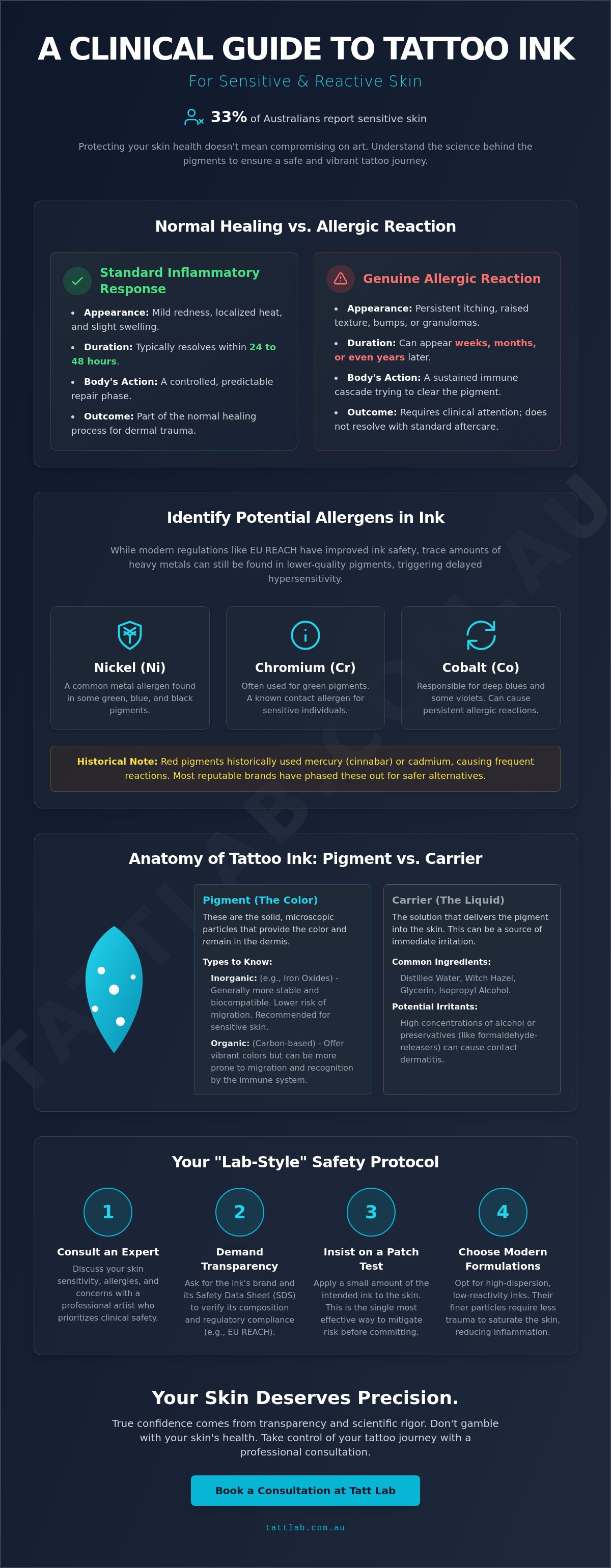
It's vital to distinguish between the standard inflammatory response and a pathological reaction. A typical tattoo will exhibit redness and localized heat for approximately 24 to 48 hours as the body initiates the repair phase. In contrast, an allergic reaction involves a sustained immune cascade that doesn't resolve with standard aftercare. Understanding Tattoo Ink Composition and Safety is the first step in identifying why certain skin types react poorly to specific formulations. Ink sensitivity is a localized immune response to specific pigment carriers or metal oxides.
Symptoms of Ink Reactivity
Reactivity often manifests in two distinct ways. Immediate contact dermatitis appears shortly after the needle enters the skin, often triggered by preservatives or alcohols in the carrier fluid. Delayed hypersensitivity is more deceptive. This reaction can occur weeks or even years after the tattoo is completed, appearing as persistent itching, raised texture, or localized swelling. These physical markers indicate that the body’s immune system is attempting to "clear" foreign particles it has identified as a threat. When the body can't break down these particles, it may form granulomas, which are small knots of tissue that encapsulate the offending pigment.
The Role of the Lymphatic System
The lymphatic system acts as the body’s internal filtration network, responsible for managing the pigment that doesn't remain locked in the dermis. When ink fragmentation occurs, whether through natural degradation or external stressors, these microscopic particles travel to the lymph nodes. Sensitive individuals often report systemic fatigue or prolonged healing times because their immune system remains in a state of high alert. Choosing a high-quality tattoo ink for sensitive skin ensures greater pigment stability. This stability reduces the risk of ink migration and chronic irritation, allowing the skin to maintain its integrity while the lymphatic system processes the procedure without unnecessary stress. A methodical approach to ink selection ensures the journey toward clear, healthy skin remains predictable and safe.
The Science of Reactivity: Common Allergens in Tattoo Inks
Understanding how the immune system interacts with foreign pigments is the first step in a successful skin journey. For those searching for tattoo ink for sensitive skin, the focus usually lands on the "Big Three" allergens: nickel, chromium, and cobalt. These heavy metals are often found as trace contaminants in lower-quality pigments. When these elements enter the dermis, they can trigger delayed hypersensitivity reactions, leading to persistent itching or localized swelling years after the initial procedure.
Historically, red pigments were the primary culprits for adverse reactions. Formulations once relied heavily on mercury-based cinnabar or cadmium to achieve vibrant hues. While these have largely been phased out in reputable Australian studios, the legacy of "red ink allergy" persists. The evolution of the industry reached a pivotal point in January 2022 with the implementation of EU REACH regulations. This framework restricted over 4,000 hazardous chemicals, forcing manufacturers to refine their palettes for better skin integrity. This global shift has significantly improved the safety profile of inks available in Melbourne and across Australia, providing a more predictable outcome for reactive clients.
The term "organic" often creates confusion in a clinical context. In the tattoo world, organic pigments are carbon-based molecules. While they offer incredible brightness, they aren't always the safest choice for highly reactive skin. Some organic dyes are more prone to migration or can be recognized as foreign invaders by an overactive immune system. In contrast, high-quality inorganic pigments, such as iron oxides, tend to be more stable and biocompatible. This distinction is vital for long-term clearance and skin health, as outlined in the FDA Guidance on Tattoo Ink Safety.
Pigment vs. Carrier: Where the Danger Lies
The pigment provides the colour, but the carrier solution delivers it. Common carriers include distilled water, witch hazel, and isopropyl alcohol. For sensitive individuals, high concentrations of alcohol or certain preservatives like formaldehyde-releasers can cause immediate irritation. High-dispersion inks are a modern solution; they feature pigments ground into microscopic particles that require less mechanical trauma to saturate the skin. This precision reduces the inflammatory response during the "Lab" phase of your tattoo's healing. If you're concerned about how your skin might react to specific formulations, reclaiming your skin's health starts with a professional consultation and a patch test.
Vegan-Friendly and Cruelty-Free Formulations
The rise of vegan inks has been a game-changer for tattoo ink for sensitive skin. These formulations replace animal-derived glycerin and bone char with plant-based alternatives. Because vegan manufacturers often target a health-conscious demographic, they tend to be more transparent about their ingredient lists and avoid common heavy metal contaminants. For a deeper analysis of how these ingredients impact the lymphatic system and long-term fading, explore The Professional Guide to Tattoo Ink. This transition toward cleaner science ensures that your transformation is both aesthetic and biologically respectful.
Hypoallergenic Tattoo Ink: Myth vs. Reality
The term "hypoallergenic" is often used as a marketing shield, yet in a clinical context, it's a misnomer. No pigment can be guaranteed 100% reaction-free for every individual because the human immune system is highly idiosyncratic. While some brands market themselves as "sensitive-safe," the reality is that any foreign substance introduced into the dermis carries a baseline risk. Understanding Dermatological Reactions to Tattoos is essential for anyone with reactive skin, as even the purest formulations can trigger an immune response if the body identifies the pigment as a threat.
The difference between standard products and high-tier tattoo ink for sensitive skin lies in batch consistency and manufacturing rigor. Professional-grade brands operate in ISO-certified cleanrooms to prevent cross-contamination. This clinical-grade approach ensures that the chemical profile of a pigment remains identical across every bottle produced. For the client, this means fewer variables and a significantly lower risk of unexpected "flare-ups" during the healing process. Purity isn't just a buzzword; it's a technical requirement for skin health.
Professional Standards for Pigment Purity
When we vet pigments at the Lab, we start with the Safety Data Sheet (SDS). We look for heavy metal concentrations that fall well below 1 part per million (ppm) for sensitizers like nickel and chrome. High-end manufacturers utilize gamma-ray sterilization to ensure the ink is completely sterile before it reaches the studio. This process eliminates bacteria without compromising the pigment's molecular structure. We prioritize brands that align with the 2022 EU REACH regulations, which currently represent the most stringent safety benchmarks for the Australian market. This level of scrutiny protects the skin's integrity and ensures a predictable outcome for your transformation.
Vibrancy and Longevity in Sensitive-Safe Inks
It's a common misconception that choosing tattoo ink for sensitive skin requires a compromise on colour density. Modern pigment chemistry has evolved beyond the need for harsh carriers or toxic stabilizers. Today's "sensitive-safe" inks often feature refined particle sizes that provide exceptional clarity and saturation. These picosecond-friendly pigments are designed to stay stable in the skin while remaining easier to fragment should you choose laser clearance in the future.
- Reduced Trauma: High-quality inks have a smoother flow rate, allowing the artist to saturate the skin with fewer passes.
- Faster Healing: Research indicates that optimized pigment suspension can reduce localized inflammation by up to 20% during the first 48 hours.
- Long-term Clarity: Pure pigments are less prone to "muddying" or shifting hue as the lymphatic system interacts with the ink over several years.
Choosing a specialist-grade ink isn't about playing it safe; it's about using superior science to achieve a result that looks as good in five years as it does on day one. By focusing on pigment stability and biocompatibility, we ensure the tattooing process is a controlled, professional journey toward the aesthetic you desire.
Managing Sensitive Clients: Studio Protocols and Testing
Professionalism in the tattoo industry is defined by how an artist manages the variables they can control. For clients with reactive skin, the consultation serves as the diagnostic foundation of the entire project. This isn't a casual chat; it's a clinical assessment of the skin’s history. You must ask direct questions regarding past reactions to jewellery, specifically nickel or costume pieces, as these often correlate with sensitivities to metal oxides in pigments. Identifying these triggers early allows the artist to curate a selection of tattoo ink for sensitive skin that avoids common irritants like cobalt or chromium.
The "Lab" approach treats every high-risk client as a unique biological case. We don't guess; we verify. By establishing a clear protocol for testing and documentation, you transition from a service provider to a trusted specialist. This methodical progression lowers client anxiety and replaces uncertainty with a predictable path toward their new tattoo.
Step-by-Step Patch Testing
A patch test is the only definitive way to gauge how a client’s immune system responds to specific pigments. This protocol should be standard for anyone reporting a history of dermatitis or previous tattoo complications.
- Location: Select a discreet, thin-skinned area such as the inner upper arm or behind the ear.
- Application: Using a single-use sterile needle, deposit a tiny dot of the intended tattoo ink for sensitive skin into the dermis.
- Observation: Monitor the site for 48 to 72 hours. Delayed hypersensitivity reactions often don't appear in the first 24 hours.
- Documentation: Record the specific brand, batch number, and colour. This builds a "safe list" for the client's future sessions.
Reducing Trauma During the Session
Skin integrity is the priority. For sensitive clients, the goal is to achieve saturation with the fewest passes possible. Selecting needles with a long taper can minimize epidermal disruption, as they penetrate the skin more cleanly than short-taper alternatives. The environment must remain strictly controlled. Utilizing high-quality Medical Supplies for Tattoo Artists ensures that the workstation prep meets clinical standards, reducing the risk of secondary irritation from environmental contaminants.
The journey doesn't end when the machine stops. Educating the client on their specific "healing journey" is vital. Sensitive skin often stays in the inflammatory phase longer than average. You must integrate a professional routine by Mastering Tattoo Aftercare to ensure the skin’s barrier is restored without triggering a breakout or rejection. This holistic focus on skin health ensures the art remains as clear and vibrant as the day it was finished.
Ready to elevate your studio's safety standards? View our specialist range at Tatt Lab.
The Specialist’s Selection: Leading Inks for Sensitive Skin at Tatt Lab
Selecting the right tattoo ink for sensitive skin requires a precise balance of pigment density and biocompatibility. At Tatt Lab, we curate brands that prioritize dermatological safety without compromising the vibrancy of the final piece. Our selection focuses on formulations that respect the skin's natural barrier, ensuring that the healing process is as predictable as the artistic result.
- World Famous Ink: This brand has established itself as a global leader by focusing on high-pigment, low-reactivity formulas. Their commitment to vegan-friendly ingredients and strict adherence to EU REACH regulations ensures that artists can deliver bold colours with a significantly reduced risk of dermal inflammation.
- Dynamic Ink: A staple in the industry since 1990, Dynamic is the benchmark for reliable, high-dispersion blacks. Its fluid consistency allows for smooth entry into the dermis, which minimizes the mechanical trauma often associated with repetitive passes on delicate skin.
- Panthera Black: Panthera utilizes molecularly advanced technology to create inks that are remarkably gentle. Their products are gamma-ray sterilized to meet the highest safety standards, making them a preferred choice for clients prone to reactive skin conditions.
Tatt Lab serves as the bridge between global innovation and the Australian tattoo community. We understand that skin integrity is the foundation of every successful tattoo. By sourcing only artist-vetted supplies, we ensure that every bottle on our shelves meets the rigorous demands of professional studios across the country.
Why Order from Tatt Lab?
We provide more than just supplies; we offer a partnership rooted in clinical quality and professional reliability. Every product in our inventory undergoes a strict vetting process to ensure it supports healthy skin recovery. Australian artists benefit from our express nationwide shipping, which provides the agility needed to manage studio inventory without delays. Registered studios can also access professional wholesale accounts, streamlining the procurement of high-grade tattoo ink for sensitive skin and other essential medical-grade supplies.
Elevating Your Studio Safety
Choosing premium ink is a direct investment in your studio's reputation. When a client with reactive skin experiences a complication-free healing journey, it builds a level of trust that leads to long-term referrals. This commitment to transparency and safety is what defines the Tatt Lab philosophy. We believe that the evolution of the industry depends on a meticulous approach to the materials we put into the body. It's time to refine your practice and prioritize skin health at every stage of the process. Upgrade your kit with our specialist ink selection today and experience the difference that professional-grade science makes.
Prioritising Skin Integrity in Every Session
Managing reactive skin requires a shift from guesswork to clinical precision. By identifying specific allergens and implementing rigorous studio protocols, artists can significantly reduce the risk of inflammatory responses. Research indicates that using high-purity pigments helps minimize the presence of heavy metals, which are responsible for approximately 80% of documented tattoo-related skin sensitivities. Selecting the right tattoo ink for sensitive skin isn't just a preference; it's a fundamental requirement for maintaining long-term skin health and ensuring a predictable healing journey for your clients.
Tatt Lab is an artist-owned and operated specialist provider dedicated to transparency and safety. We supply only clinical-grade medical supplies and pigments that meet the highest safety standards for the Australian market. When you choose our professional range, you're backed by a commitment to excellence and the convenience of express nationwide Australian shipping. We're here to support your evolution as a specialist who values skin health as much as the final aesthetic.
Shop our curated range of professional tattoo inks for sensitive skin and elevate your practice today. Your clients' confidence starts with the integrity of the materials you use.
Frequently Asked Questions
Can I get a tattoo if I have a nickel allergy?
Yes, you can get a tattoo with a nickel allergy if you select high-quality, REACH-compliant inks that prioritize purity. Nickel is often found in trace amounts in lower-grade pigments, particularly in greens and reds. You should request a Material Safety Data Sheet from your artist to verify the metal content before your session. This ensures your skin health remains the priority during your ink journey.
How do I know if I am allergic to tattoo ink before getting tattooed?
A professional patch test conducted by an allergist or a small spot test by your tattooist is the most reliable way to identify a reaction. You can also review the ingredient list for specific sensitizers like PPD or cobalt. If you have a history of reacting to costume jewellery or hair dye, your risk profile is higher. Testing a small, inconspicuous area 48 hours before the full procedure provides a controlled baseline for your skin's response.
Is there such a thing as 100% hypoallergenic tattoo ink?
No ink is guaranteed to be 100% hypoallergenic because every immune system reacts differently to foreign substances. While many brands market themselves as safe, any pigment can trigger an inflammatory response in sensitive individuals. Choosing tattoo ink for sensitive skin that is free from heavy metals and preservatives like formaldehyde reduces the likelihood of a reaction. We recommend focusing on brands that provide full transparency regarding their chemical formulations.
What are the safest tattoo ink colours for sensitive skin?
Black ink is the safest choice because it's typically carbon-based and lacks the complex metallic salts found in vibrant pigments. Statistics from clinical dermatology studies show that red inks are responsible for roughly 80% of all reported allergic tattoo reactions. If you have reactive skin, it's best to avoid reds, purples, and certain blues. These shades often contain cinnabar or cobalt, which are known triggers for chronic skin irritation.
What should I do if my tattoo starts itching or swelling months after healing?
You should consult a dermatologist immediately because late-onset swelling often signals a delayed hypersensitivity reaction or a granulomatous response. This can happen even 12 months after the initial procedure. Avoid scratching the area, as this can damage the skin's integrity and lead to secondary infections. A specialist may prescribe topical corticosteroids or suggest laser fragmentation to help the lymphatic system clear the irritating pigment particles.
Are vegan tattoo inks better for sensitive skin than traditional inks?
Vegan inks aren't inherently safer, but they do eliminate animal-based ingredients like bone char or glycerin derived from animal fat. This reduces the risk for those with specific animal-product sensitivities. However, vegan pigments still rely on synthetic chemicals and minerals for colour. When selecting tattoo ink for sensitive skin, the focus should be on the absence of heavy metals and harsh preservatives rather than just the vegan label alone.
Does Tatt Lab ship professional tattoo ink Australia-wide?
Yes, Tatt Lab ships our curated range of professional tattoo supplies to every state and territory across Australia. Whether you're in Melbourne, Sydney, or a regional area, we ensure your products arrive via secure, tracked delivery. Our logistics process is designed to maintain the integrity of the pigments from our lab to your studio. Most orders are processed within 24 hours to support the steady rhythm of your professional practice.
How long does a patch test take to show a reaction?
A standard patch test requires a minimum of 48 to 72 hours to reveal an acute allergic reaction. Some hypersensitivity issues, known as Type IV reactions, can take up to 7 days to manifest fully on the skin. It's crucial to monitor the test site for redness, raised bumps, or persistent itching during this window. Patience during this phase ensures a more predictable and safe outcome for your long-term skin health journey.


Comments (0)
There are no comments for this article. Be the first one to leave a message!