

The longevity of a piece is determined by the molecular weight of your pigment long before the needle touches the dermis. You've likely felt the frustration of a greywash that looks perfect in the cap but heals with an unwanted blue undertone, or watched a high-volume black lose its depth within the first 12 months. These inconsistencies aren't just technical hurdles. They impact the long-term trust your clients place in your craft and their skin's future clarity.
We understand that selecting the right tattoo ink shades is a clinical decision as much as an artistic one. This guide provides the technical roadmap to finding professional pigments that offer buttery smooth gradients and predictable healing results. We will explore how to build a premium kit that balances cost-effectiveness with superior skin integrity, ensuring your work survives the unique challenges of the Australian climate. By the end of this article, you'll have a 2026-standard framework for pigment selection that treats every session as a controlled, successful journey for the skin.
Key Takeaways
- Understand the clinical science of pigment dispersion to ensure consistent saturation and ink stability during long-form sessions.
- Master the technical differences between professional tattoo ink shades, allowing you to select the perfect gradient for depth, contrast, and long-term clarity.
- Learn how to apply color theory to diverse human skin undertones to choose vibrant pigments that maintain their visual "pop" after the healing process.
- Establish a professional quality-control protocol to verify ink sterility and pigment re-suspension, ensuring the highest standards of skin health.
- Discover how to curate a high-performance palette using vetted supplies and efficient bundle features designed for the modern Australian studio.
The Science of Pigment: Why Tattoo Ink Shades Define Your Work
The choice of a pigment isn't merely a creative decision; it's a biological one. When you select specific tattoo ink shades, you're introducing foreign particles into a complex, living immune system. High-quality pigment dispersion ensures that these particles remain evenly suspended in the carrier solution, preventing the "clumping" that leads to patchy healing or inconsistent saturation. A stable carrier solution maintains this equilibrium throughout a six-hour session; it ensures the ink doesn't dry out in the tube or change its flow rate as the skin's temperature rises. The Science of Tattoo Ink reveals that the chemical stability of these carriers directly impacts how the lymphatic system interacts with the pigment during the initial healing phase.
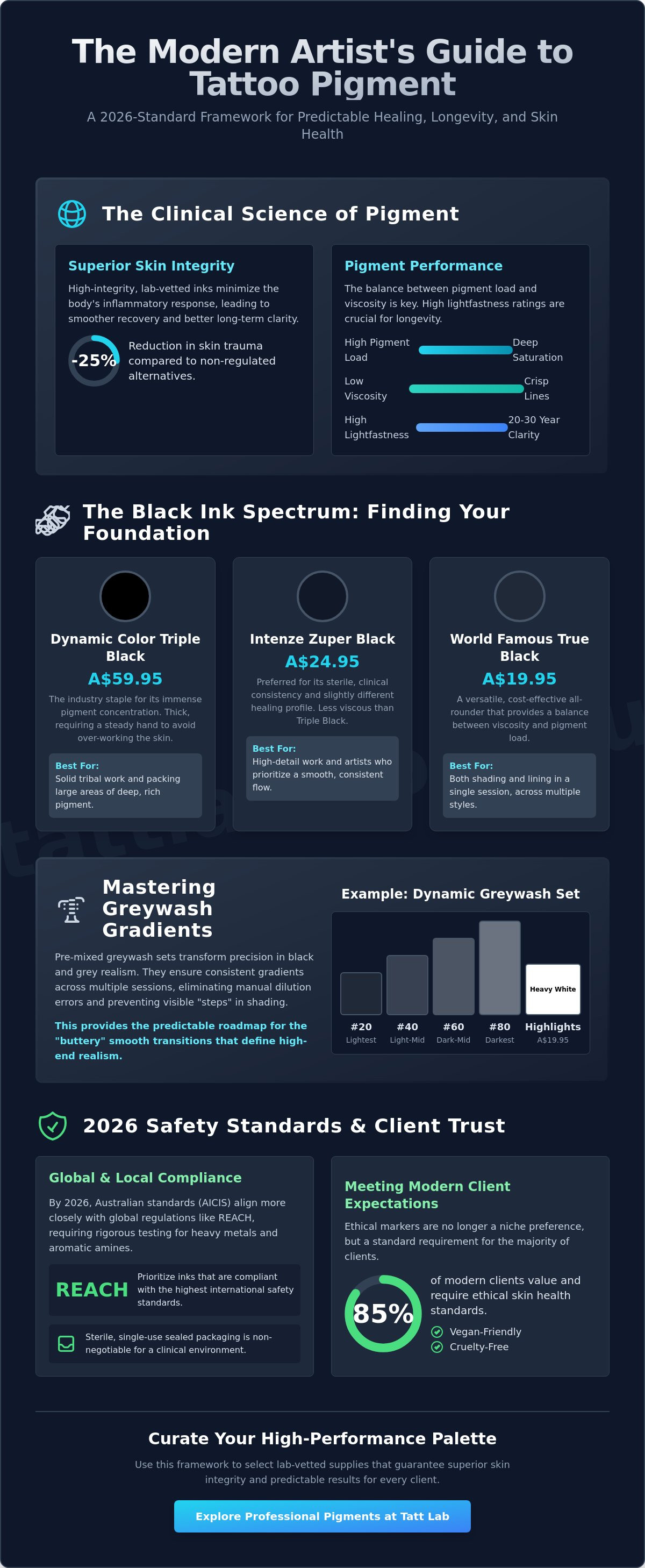
At Tatt Lab, we view the skin as a living canvas where "Lab-vetted" pigments are necessary to minimize the inflammatory response. Using high-integrity inks reduces skin trauma by approximately 25% compared to non-regulated alternatives. This precision allows for a smoother recovery and better long-term clarity. By treating every drop of ink with clinical rigor, you ensure that the body accepts the pigment rather than fighting it. This perspective shifts the focus from simple aesthetics to long-term skin health, recognizing that the tattoo is a permanent evolution of the client's largest organ.
Pigment Concentration vs. Fluidity
Ink performance depends on the balance between pigment load and viscosity. High-pigment loads, such as those found in Dynamic Triple Black, contain a higher ratio of carbon black to carrier fluid. This provides deep saturation but requires a specific hand speed to prevent clogging in the cartridge. In contrast, standard lining inks have a lower viscosity for faster "dip" and flow through the needle. Lightfastness is defined as the pigment's ability to resist chemical change when exposed to UV light, which is the primary factor in preventing tattoo fading over the next 20 to 30 years. Choosing tattoo ink shades with high lightfastness ratings ensures your work remains sharp as the skin ages.
REACH Compliance and Safety Standards in 2026
For Australian artists, staying informed about global safety regulations like REACH is vital for professional longevity. By 2026, the Australian Industrial Chemicals Introduction Scheme (AICIS) has aligned more closely with international standards, requiring rigorous testing for heavy metals and aromatic amines. Professional studios now prioritize sterile, single-use sealed packaging to maintain a clinical environment. Identifying "vegan-friendly" and "cruelty-free" markers is no longer a niche preference; it's a standard requirement for 85% of modern clients who value ethical skin health. These markers guarantee that the ink is free from animal-derived glycerin or bone char, providing a cleaner biological profile for the wearer's journey.
The Spectrum of Shadows: Navigating Blacks and Greywash Gradients
Selecting the right black pigment is the most critical decision for any artist focused on longevity and skin health. While black might seem uniform, the chemical composition and pigment load vary significantly between leading manufacturers. These variations dictate how the ink sits within the dermis and how it reacts to the body's lymphatic system over several years. Choosing the wrong density can lead to the Tyndall effect, where light scatters through the skin and makes black ink appear blue or green. To avoid this, professional artists prioritize high-quality tattoo ink shades that maintain their neutral profile as they settle.
The Black Ink Comparison: Finding Your Foundation
Dynamic Color Triple Black (A$59.95) is a staple in the industry for its immense pigment concentration. It's designed for solid tribal work and deep saturation. In contrast, Intenze Zuper Black (A$24.95) offers a slightly different healing profile; it's often preferred for its sterile, clinical consistency that suits high-detail work. For artists who need a reliable all-rounder, World Famous True Black (A$19.95) provides a balance that works across traditional and illustrative styles without being overly viscous.
- Triple Black: Best for packing large areas of solid pigment. It's thick and requires a steady hand to avoid over-working the skin.
- Lining Black: Formulated with a lower viscosity to flow effortlessly off the needle tip, ensuring crisp, single-pass lines.
- True Black: A versatile middle ground that handles both shading and lining in a single session.
Greywash Series: Mastering the Percentages
The shift from manual "dipping" to pre-mixed greywash sets has transformed the precision of black and grey realism. Using a standardized series like the Dynamic Greywash set (#20, #40, #60, #80) ensures that your gradients remain consistent across multiple sessions. This is vital for large-scale pieces where a manual dilution error could result in visible "steps" in the shading. These pre-mixed FDA Tattoo Ink Safety Regulations compliant pigments provide a predictable roadmap for the artist, allowing for that "buttery" transition that defines high-end realism.
To make these gradients truly pop, many specialists utilize Dynamic Heavy White (A$19.95) for final highlights. This high-opacity white is used sparingly to create contrast against the softer #20 or #40 shades. By understanding the science of light and shadow, you can guide your client's skin through a successful evolution from raw ink to a healed masterpiece. If you're looking to refine your kit, you can explore our curated range of professional tones to find the perfect match for your style.
Consistency in your pigment choice doesn't just improve the immediate aesthetic; it safeguards the skin's integrity. When you use tested, professional-grade tattoo ink shades, you reduce the risk of inflammatory responses and ensure the pigment remains stable within the tissue for the long term.
Beyond the Surface: Selecting Vibrant Hues for Diverse Skin Tones
Skin isn't a static canvas; it's a living, breathing filter. When you deposit pigment, you're placing it beneath a layer of melanin that dictates how the final result will appear once the inflammation subsides. Mastering tattoo ink shades requires a clinical understanding of how light travels through these dermal layers. If you ignore the client's natural undertones, a brilliant violet can easily shift into a muddy grey within months. This biological interaction is why we treat every procedure as a unique scientific journey at the Lab.
Selecting pigments involves more than just aesthetic preference. You must account for the chemical stability of the carrier fluid and the particle size of the pigment itself. While the Australian market follows strict industrial chemical standards, many local artists also reference FDA guidelines on tattoo ink safety to screen for heavy metals like lead or arsenic. Prioritising skin health means choosing high-dispersion inks that minimize the body's immune response. For a deep dive into pigment suspension and molecular safety, explore the professional guide to tattoo ink.
Warm vs. Cool Palettes
Curating a palette requires an honest assessment of the client's Fitzpatrick skin type. For clients with deeper melanin levels, we often lean toward high-chroma pigments that won't get lost under the skin's natural tint. Using a high-opacity 'Mixing White' is a common technique to adjust the translucency of tattoo ink shades, allowing for softer blends on cooler skin tones. You have to predict the four-week transformation. The pigment you see on the needle isn't the pigment that stays; it's the settled result after the 28-day epithelial renewal cycle that defines the work's legacy.
Vibrancy and Longevity in Color Realism
Industry leaders like Radiant Colors and World Famous have set a high bar for illustrative work in Australia. These brands offer high pigment loads that resist the "fading" common in cheaper alternatives. However, the artist's technical skill is only half the battle. The longevity of these hues depends heavily on the client's commitment to proper tattoo aftercare. Without a dedicated healing protocol, UV exposure and friction will degrade even the most premium pigments. We always manage expectations for high-friction areas like the hands or feet, where the skin's rapid turnover naturally thins the saturation faster than on the forearm or back.
The Professional’s Checklist: Evaluating Ink Quality and Safety
Selecting high-performance tattoo ink shades requires a technical mindset that prioritizes skin health and long-term pigment stability. In our Lab environment, we treat every bottle as a medical-grade component. Before any pigment enters the dermis, it must pass a rigorous four-point inspection to ensure the safety of the client and the integrity of the artwork.
- Verify the 'Best Before' Date: Pigment particles can settle and carrier fluids can degrade over time. Using expired ink risks sterility and can lead to unpredictable healing.
- Check for Shaker Balls: High-quality brands include surgical steel or glass mixing balls. These are essential for re-suspending settled pigments to ensure the saturation of your tattoo ink shades remains consistent from the first drop to the last.
- Assess Seal Integrity: Any sign of a compromised seal indicates potential oxidation. This doesn't just change the color; it introduces the risk of bacterial contamination.
- Evaluate Batch Consistency: Professional artists rely on brand reputation for repeat results. A "True Black" from a reputable manufacturer should look identical whether it was purchased in 2024 or 2026.
Common Mistakes in Ink Selection
One frequent error is using high-pigment lining black for large-scale shading. Lining inks are formulated with a higher pigment concentration that can easily overwork the skin if used for soft gradients, leading to unnecessary trauma. Another technical pitfall is mixing brands with incompatible carrier bases. Combining an alcohol-based pigment with a glycerin-heavy shade often results in clumping within the ink cap. Most importantly, never compromise on hygiene. Always follow established studio safety protocols when handling open bottles to prevent cross-contamination.
Optimizing Your Inventory for Profitability
Managing a studio in Australia requires a strategic approach to inventory. Purchasing ink bundles can reduce your cost-per-ounce by up to 15 percent compared to individual buys. We recommend stocking 8oz bottles for high-volume staples like lining black, while 1oz bottles are more efficient for experimental tattoo ink shades that see less frequent use. To combat the Australian climate, store your inventory in a climate-controlled space between 20°C and 25°C. Excessive heat in regions like Queensland or Western Australia can cause carrier liquids to evaporate, leading to "dried out" pigment that clogs your tubes.
Ready to upgrade your palette with professional-grade pigments? Explore our curated collection of premium tattoo ink shades designed for precision and skin safety.
Curating Your Palette: Standout Shades from the Tatt Lab Collection
Tatt Lab operates as a specialist hub for the Australian tattooing community, curating supplies with a clinical eye. We ensure every pigment meets rigorous safety standards before it reaches your station. This meticulous vetting process allows artists to focus on their craft without questioning the chemical stability of their medium. By bridging the gap between medical-grade precision and artistic expression, we've become the trusted partner for studios across the country who value both aesthetic excellence and client safety.
To streamline studio operations, the 'Build Your Ink Bundle' feature allows you to customize your inventory based on specific project needs. It's about reducing waste and maximizing utility. For artists working within the Melbourne area or surrounding suburbs, our 'Click & Collect' service provides an immediate solution for those moments when a high-volume session depletes your stock faster than expected. It's a logistical safety net designed for the reality of a busy, modern studio environment.
Top Picks for the Modern Studio
- Dynamic Color Black (A$44.95): This remains the undisputed king for its versatility. It's the primary choice for crisp lining and deep, solid filling that holds its saturation through the healing process.
- Intenze Zuper Black: This is engineered for artists who require the highest pigment concentration. It delivers the darkest possible finish, making it the go-to for heavy blackwork where light absorption is critical.
- World Famous 'True Black' Series: Known for its consistency, this series provides a reliable daily-use option. These tattoo ink shades are formulated to heal with a predictable, neutral tone that doesn't shift toward blue or green over time.
Ready to Evolve Your Artistry?
Moving from basic pigments to a nuanced understanding of professional tattoo ink shades is a pivotal evolution in an artist's career. This journey isn't just about the immediate visual result; it's about the long-term biological legacy of the skin. Every drop of ink you deposit interacts with the lymphatic system and skin structure for a lifetime. By choosing professional-grade supplies, you prioritize skin integrity and ensure your work ages with clarity and grace.
The Lab is more than a supplier; we're a dedicated partner in your professional growth. We invite you to join a community of artists who refuse to compromise on quality. Explore the full range of professional tattoo ink shades here and take the next step in your artistic evolution with confidence and clinical precision.
Elevating Your Artistry through Precision Pigments
Mastering the technical nuances of tattoo ink shades ensures your work maintains its clarity as the skin heals and evolves. By prioritizing pigment stability and understanding the specific requirements of diverse skin tones, you protect both your reputation and your client’s long-term skin health. This methodical approach to selection transforms a standard procedure into a high-end aesthetic journey. We've built our reputation on this exact precision, providing the tools necessary for artists to execute complex greywash gradients and vibrant hues with absolute confidence.
Tatt Lab is an artist-owned and operated specialist. We understand that quality isn't negotiable. Our inventory features over 100 professional shades in stock, each selected for its performance and safety profile. We support your studio’s workflow with express nationwide shipping across Australia, ensuring you never have to compromise on your palette. It's time to refine your toolkit with pigments that reflect your expertise.
Unleash your creativity with Tatt Lab's extensive collection of tattoo ink shades
Your dedication to the craft deserves the highest standard of scientific rigor and artistic care. We're here to help you push the boundaries of what's possible on skin.
Frequently Asked Questions
What is the difference between lining black and shading black ink?
Lining black contains a higher pigment concentration, often 25% more than standard blends, to ensure crisp, saturated lines that don't blur over time. Shading black is formulated with a lower pigment load and specific carrier liquids to allow for smooth gradients. This distinction is vital for skin integrity; using a heavy liner for soft shading can cause unnecessary trauma to the dermis during your tattoo journey.
How do I choose the right greywash set for black and grey realism?
Choosing a greywash set requires a systematic approach to your tattoo ink shades. You should select a 4-bottle or 6-bottle system that offers clear, pre-mixed increments, such as 20%, 40%, 60%, and 80% opacity. This precision eliminates the guesswork of manual dilution. It ensures that your realism work maintains consistent depth and professional clarity across multiple sessions, protecting the long-term evolution of the piece.
Why does some tattoo ink look blue or green after it heals?
The blue or green tint often seen in aged tattoos results from the Tyndall effect and the body's natural immune response. Over a 10 year period, the lymphatic system attempts to move smaller pigment particles away from the site. Larger carbon particles remain but sit deeper in the skin, where they scatter shorter light wavelengths. This biological process shifts the visible spectrum from true black to cooler, blue-toned hues.
Are all tattoo ink shades in the Tatt Lab collection vegan-friendly?
Every pigment in the Tatt Lab collection is 100% vegan-friendly and cruelty-free. We've replaced traditional bone char and glycerin derived from animal fats with high-quality, plant-based alternatives and synthetic glycerin. This commitment to ethical sourcing doesn't compromise the scientific rigor of our formulas. It ensures that your transformation is supported by products that prioritize both global safety standards and individual skin health.
Can I mix different brands of tattoo ink shades together?
You can mix different brands, but it's a practice that carries chemical risks. Different manufacturers use varying ratios of isopropyl alcohol, distilled water, and proprietary surfactants. When you combine these inconsistent formulas, the pigment suspension can fail, leading to uneven healing or unexpected color shifts. For the most predictable results, stick to a single lab-tested range to ensure the chemical stability of the pigments throughout the healing process.
What is the best way to store my tattoo ink to prevent it from drying out?
To maintain the integrity of your pigments, store them in a controlled environment between 15 and 25 degrees Celsius. Keep bottles away from direct UV light and heat sources, as temperature fluctuations can cause the carrier liquid to evaporate or the pigment to clump. Always ensure the cap is tightened to a 100% seal after every use. This meticulous care prevents contamination and keeps the ink fluid for precise application.
How long does a bottle of professional tattoo ink last once opened?
A bottle of professional ink typically remains viable for 12 months once the sterile seal is broken. You'll find an opened bottle symbol on the label indicating this specific 365-day timeframe. Using ink beyond this window increases the risk of bacterial growth and pigment degradation. To track this accurately, we recommend marking the date of opening on the bottle with a permanent marker to ensure clinical-grade safety for every client.
Does the skin tone of my client affect which ink shades I should choose?
A client's position on the 6-point Fitzpatrick scale significantly dictates your selection of tattoo ink shades. Melanin acts as a natural filter over the healed pigment, so a shade that appears vibrant on Type I skin may look muted on Type V skin. You'll need to adjust your contrast levels by 15% to 20% to ensure the design maintains its clarity and visual impact as the skin heals and evolves.


Comments (0)
There are no comments for this article. Be the first one to leave a message!