
What if your current disinfection routine is falling short of the rigorous standards outlined in the 2024 Australian health guidelines for skin penetration? You already know that a sterile environment is the non-negotiable foundation of your craft, yet the evolving science of preventing cross-contamination in tattooing can feel overwhelming when health inspections loom. It's a heavy responsibility to manage the delicate balance between artistic expression and clinical safety. We understand that the vulnerability of broken skin requires more than just a surface clean; it demands a dedicated commitment to biological integrity.
This guide provides the technical roadmap you need to master sterile field management with the precision of a high-end laboratory. You'll gain a foolproof setup routine that eliminates guesswork and builds an unshakable reputation for professionalism within the Australian industry. We'll explore the latest 2026 protocols for chemical efficacy, barrier techniques, and the logical progression of zone management that ensures every client journey is as safe as it is transformative. By aligning your studio with these clinical standards, you'll replace compliance anxiety with the confidence of a true skin health specialist.
Key Takeaways
- Gain a deeper understanding of the pathogenic landscape to ensure your studio maintains the highest standards of clinical-grade vigilance against bloodborne risks.
- Learn to architect a pristine sterile field through strategic barrier protection, isolating high-touch surfaces to maintain the sanctity of the tattoo environment.
- Discover the mechanical precision of safety cartridge membranes and medical-grade nitrile protocols as the gold standard for preventing cross-contamination in tattooing.
- Implement a rigorous three-tier decontamination protocol using TGA-listed disinfectants specifically engineered to eliminate high-level biological threats.
- Transition your practice toward a high-end laboratory standard that prioritises long-term skin health and absolute safety throughout the client’s journey.
Understanding the Pathogenic Risks of Cross-Contamination
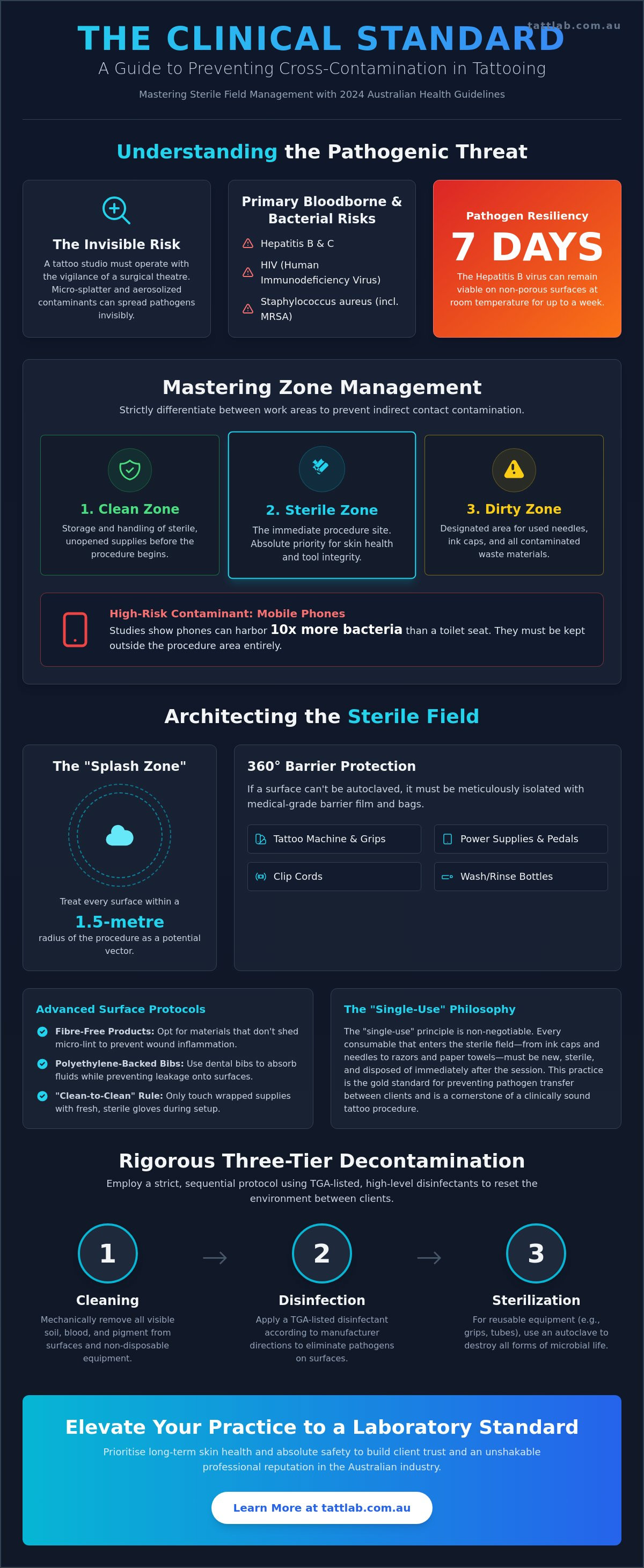
Cross-contamination is the unintentional transfer of microorganisms between surfaces, tools, or skin. In a professional studio, this process is often invisible, transforming a creative space into a potential vector for disease. At Tatt Lab, we view the tattoo station as a controlled medical environment, necessitating the same clinical-grade vigilance found in a surgical theatre. Understanding the pathogenic risks of tattooing is the first step in establishing a safe practice that prioritises skin integrity above all else.
The threat isn't just about visible mess. Bloodborne pathogens like Hepatitis B, Hepatitis C, and HIV require a level of precision that goes beyond basic cleaning. These viruses are microscopic and resilient. Tattoo machines operating at high speeds create micro-splatter and aerosolised contaminants. These tiny droplets of blood and pigment can travel beyond the immediate procedure area, landing on supposedly "clean" surfaces without the artist's knowledge. This makes preventing cross-contamination in tattooing a matter of rigorous protocol rather than just visual inspection.
The Biology of Transmission in the Studio
Pathogens are surprisingly hardy. Research from the Centers for Disease Control and Prevention indicates that the Hepatitis B virus can survive on non-porous surfaces for up to seven days at room temperature. When the skin's natural barrier is breached during the procedure, it creates a direct gateway for opportunistic bacteria like Staphylococcus aureus and MRSA. These infections can lead to severe complications, including cellulitis or systemic sepsis, if the environment isn't strictly controlled. The chain of infection in a tattoo context is the sequence of events that allows a pathogen to move from a reservoir to a susceptible client through a specific transmission route.
Identifying High-Touch Contamination Zones
Cross-contamination often occurs through indirect contact. An artist might touch a contaminated wash bottle and then adjust a light switch, spreading pathogens across the room in seconds. Mobile phones represent perhaps the most significant risk in the modern studio. Studies show these devices can harbour 10 times more bacteria than a toilet seat, yet they're frequently handled mid-session. To maintain safety, studios must strictly differentiate between three distinct areas:
- Clean Zones: Areas where sterile supplies are stored and handled before the procedure.
- Dirty Zones: The immediate workspace where used needles, ink caps, and contaminated barriers are placed.
- Sterile Zones: The specific site of the procedure where skin health and tool integrity are the only priorities.
Mastery of these boundaries is central to preventing cross-contamination in tattooing. It ensures the process remains a liberating journey for the client rather than a health risk. By adopting this clinical mindset, artists protect their reputation and their clients' long-term wellbeing.
Designing a Sterile Field: Essential Barrier Protection Strategies
A sterile field isn't just a tidy tray; it's a calculated barrier between the client's bloodstream and the studio environment. In 2026, professional Australian studios prioritize a 360-degree approach to preventing cross-contamination in tattooing by treating every surface within the "splash zone" as a potential vector for bloodborne pathogens. This zone generally includes any surface within a 1.5-metre radius of the procedure area. High-touch items like power supplies, clip cords, and machine grips require meticulous isolation using medical-grade barrier film and machine bags. If a surface can't be autoclaved, it must be effectively wrapped.
The "single-use" philosophy extends to every consumable within this space. Dental bibs with a polyethylene backing are essential for tray liners because they offer superior fluid absorption while preventing ink or blood from leaching onto the stainless steel beneath. This methodical setup ensures that the skin’s journey toward healing begins in a controlled, clinical environment. By isolating biological matter at the source, you reduce the reliance on secondary chemical disinfection between sessions.
Advanced Surface Protection Protocols
Choosing the right materials is the first step in maintaining skin integrity. You should always opt for fibre-free barrier products. Standard paper towels or low-quality bibs often shed micro-lint, which can become trapped in the open wound and trigger inflammatory responses. When applying barrier film, ensure the surface is completely dry after its initial chemical disinfection. This prevents the film from sliding or bunching during long sessions. We follow the "clean-to-clean" rule: you only touch your wrapped supplies with fresh, sterile gloves during the setup phase. This rigor ensures that tattoo ink safety protocols are upheld from the moment the first cap is poured.
Workstation Ergonomics and Safety
Efficiency and safety are linked. Organise your tray so your hand never passes over open ink caps or the rinse cup, reducing the risk of accidental drips. Utilising high-quality medical supplies for tattoo artists allows you to create a workspace that mirrors a surgical suite. For ointments and glides, never double-dip. Use sterile tongue depressors to scoop the required amount onto a separate tile or the back of your gloved hand. This simple habit is a cornerstone of preventing cross-contamination in tattooing. By treating the workstation as a laboratory, you protect both the client and your professional reputation. If you're looking to elevate your studio standards, consider exploring our professional skin health solutions to ensure every procedure is as safe as it is artistic.
Clinical Hand Hygiene and Advanced Glove Protocols
Hand hygiene serves as the bedrock of the entire sterile journey. In a professional studio environment, the process of preventing cross-contamination in tattooing begins long before a needle touches the skin. It starts at the sink. We treat every procedure with the rigor of a clinical laboratory, recognizing that the artist's hands are the most frequent vectors for pathogens. Proper hand hygiene reduces the microbial load on the skin, ensuring that even if a glove barrier fails, the risk of transmission remains controlled.
Medical-grade nitrile gloves have replaced latex as the 2026 industry standard for several critical reasons. Nitrile offers superior puncture resistance and acts as a more reliable barrier against bloodborne pathogens. Unlike latex, nitrile doesn't degrade when it comes into contact with petroleum-based ointments often used during the tattooing process. This chemical resilience is vital for maintaining barrier integrity over long sessions. For artists seeking to align with the NIOSH Safety and Health Guidelines for Tattooists, selecting high-quality nitrile is a non-negotiable step in protecting both the practitioner and the client's skin health.
The Hand Hygiene Routine
Artists should follow the WHO standard for clinical handwashing. This involves wetting hands with warm water, applying pH-neutral soap, and scrubbing all surfaces, including between fingers and under nails, for at least 20 seconds. Use alcohol-based hand rubs with at least 60 percent ethanol only when hands aren't visibly soiled. It's essential to dry hands completely with a single-use paper towel before donning gloves, as residual moisture can lead to glove tearing and skin maceration. This meticulous approach ensures the skin's natural barrier remains intact throughout the transformation process.
Managing Glove Integrity Mid-Session
Glove integrity isn't permanent. During extended sessions, "micro-perforations" can develop, often invisible to the naked eye. These tiny holes frequently occur when gloves are exposed to friction and specific tattoo lubricants. If an artist touches a non-sterile item like a phone, adjustable chair handle, or their own hair, they must immediately initiate a glove change protocol.
- Remove contaminated gloves using the "beak" technique: pinch the palm of one glove, pull it off, then slide a clean finger under the cuff of the remaining glove to peel it away.
- Perform a brief hand hygiene refresh using an alcohol-based rub.
- Wait for the skin to dry fully before sliding on a fresh pair of medical-grade nitrile gloves.
The "double gloving" debate remains relevant for high-risk setups. While wearing two layers provides an extra safety net during the initial station teardown, it shouldn't lead to a false sense of security. At Tatt Lab, we prioritize frequent, single-layer changes to maintain tactile sensitivity and ensure the highest standards of preventing cross-contamination in tattooing. This methodical pace respects the biological reality of the skin, turning a technical requirement into a professional habit that builds lasting trust.
Engineering Safety: Cartridge Membranes and Single-Use Integrity
The evolution of the tattoo needle from traditional bars to modern cartridges represents a fundamental shift in skin health protection. Traditional needle bars required meticulous sterilization of tubes and grips, yet they still posed risks of aerosolization and fluid spray. Modern cartridges centralize the safety mechanism within a single-use housing. This design is the primary defense in preventing cross-contamination in tattooing by isolating biological fluids from the machine's internal drive system.
Fluid ingress is a silent risk. It occurs when pigment or interstitial fluid travels up the needle bar and enters the machine's motor or grip. This creates a hidden reservoir of pathogens that can contaminate every subsequent client if the machine isn't fully autoclavable. To mitigate this, professional studios have moved away from simple tension springs in favor of integrated safety membranes. These membranes act as a physical seal, ensuring that what happens at the needle tip stays at the needle tip.
Selecting High-Performance Cartridges
Not all cartridges offer the same level of medical-grade isolation. Lower-tier options often use a "rubber band" tension system. These are prone to snapping and, more importantly, they lack a solid physical barrier to stop fluid backflow. Inside the Lab, we prioritize cartridges engineered with full silicone membranes. Brands like Elite and EZ V-Select are industry leaders for this reason; their housing is designed to maintain a 100% seal even during long sessions where vibrations might cause lesser seals to fail.
Artists should perform a "Membrane Test" when transitioning to a new brand. This involves filling the cartridge with liquid and observing the rear housing for any seepage. If moisture crosses the barrier, the cartridge is a contamination risk. High-performance cartridges like the V-Select series utilize a unique V-system that stabilizes the needle while reinforcing the membrane's integrity, which is vital for maintaining skin health during complex procedures.
Ink and Pigment Management
Managing tattoo ink safely is as much about the delivery as it is the chemistry. The "drop-and-discard" method is the gold standard for preventing cross-contamination in tattooing. This requires the artist to hold the ink bottle at least 5cm above the cap while pouring. This distance prevents the bottle tip from touching a potentially contaminated surface, ensuring the master bottle remains sterile for the next use.
- Never "top up" ink caps mid-session; this is a high-risk activity that can lead to splashback contamination.
- Use single-use, disposable ink caps for every client without exception.
- Dispose of all leftover pigment and used caps in a dedicated clinical waste bin immediately after the session.
A 2023 survey of Australian tattoo hygiene standards found that nearly 12% of contamination incidents were linked to improper pigment handling. By treating the ink bottle as a sterile source and the ink cap as a biohazardous zone, you eliminate the bridge between clients. Once the session concludes, the entire setup should be broken down with the same precision used during the application.
Decontamination Protocols and Medical-Grade Studio Maintenance
Maintaining a clinical environment requires a tiered approach to hygiene that separates the professional studio from the hobbyist space. Cleaning is the first step, involving the physical removal of organic matter and debris. Sanitisation follows, reducing the microbial load to a safe level. However, sterilisation remains the gold standard for any equipment that penetrates the skin barrier. For preventing cross-contamination in tattooing, every surface must be treated with TGA-listed disinfectants proven to neutralise resilient bloodborne pathogens like Hepatitis B, Hepatitis C, and Tuberculosis. The process of breaking down a station must be as methodical as the tattoo itself. Start by disposing of sharps, followed by the removal of contaminated barriers, and finish with a heavy-duty chemical wipe-down of all hard surfaces.
The sterile journey doesn't end when the machine stops. High-quality tattoo aftercare is the final phase of preventing cross-contamination in tattooing. It bridges the gap between the clinical studio and the client's home environment, ensuring skin integrity remains uncompromised during the delicate healing evolution. This holistic focus on skin health ensures the artistic result is protected by scientific rigour.
Chemical Efficacy and Contact Time
Contact time, often called "wet time," is the duration a surface must remain visibly wet to achieve its rated kill level. Many artists make the mistake of wiping away chemicals too quickly. If a medical-grade disinfectant requires a three-minute contact time, the surface must stay wet for those full 180 seconds to be effective. While 70% isopropyl alcohol works well as a sanitiser for small tools, it's not a high-level disinfectant for large surfaces because it evaporates too quickly. Professionals should select TGA-listed quaternary ammonium compounds or hydrogen peroxide-based wipes that are non-corrosive to tattoo furniture while maintaining a "cool but clinical" standard of safety.
Clinical Waste and Sharps Disposal
Australian Standards AS 4031 and AS/NZS 4261 dictate that sharps containers must be puncture-resistant and located within arm's reach of the workstation. This proximity prevents needle-stick injuries during the high-risk breakdown phase. Clinical waste, such as ink caps or gauze soaked in blood, must be placed in yellow biohazard bags for specialised disposal. General waste, including barrier films that haven't contacted serous fluid, can be disposed of normally. A weekly "Lab" audit of your waste management systems ensures the studio remains a transparent, results-oriented environment that respects both the artist's health and the client's safety. This meticulousness transforms a simple procedure into a professional medical journey.
Setting a New Benchmark for Studio Integrity
Maintaining a sterile environment isn't just about compliance; it’s about the long-term health of your clients' skin and your professional reputation. By 2026, industry standards have evolved to demand higher clinical rigor. Success in preventing cross-contamination in tattooing relies on the integrity of every barrier, from TGA-compliant nitrile gloves to the advanced membranes found in high-grade cartridges. These methodical decontamination protocols ensure that your studio operates with the precision of a medical lab while respecting the culture of the craft. Consistency in hand hygiene and the use of hospital-grade sanitisers are no longer optional extras; they're the foundation of a sustainable practice.
We're here to support your journey toward a safer, more professional workspace. Tatt Lab offers artist-owned and vetted professional equipment that meets strict Australian regulatory standards. Our inventory features TGA-compliant medical PPE and sanitisers designed for high-performance environments. With express nationwide shipping across Australia, you can maintain your clinical standards without delay. Elevate your studio safety with Tatt Lab’s medical-grade supplies. Your commitment to safety is the ultimate investment in your art.
Frequently Asked Questions
What is the most common cause of cross-contamination in a tattoo studio?
The most common cause of cross-contamination is the failure to maintain a strict sterile field, specifically through indirect contact where an artist touches a contaminated surface and then the client's skin. Health inspection data indicates that 40% of hygiene breaches occur when artists adjust lamps or reach for pigment bottles without replacing their gloves. Mastering the protocols for preventing cross-contamination in tattooing requires a disciplined approach to every movement within the clinical procedure area.
How often should I change my gloves during a long tattoo session?
You should change your gloves at least every 45 to 60 minutes during a long session, even if you haven't left your station. Research shows that nitrile gloves develop micro-tears after 60 minutes of active use, which compromises the protective barrier. Always change gloves immediately if you touch your face, a mobile phone, or any surface not covered in barrier film to ensure skin integrity isn't compromised.
Can I use rubbing alcohol to disinfect my tattoo machine?
Rubbing alcohol isn't an adequate disinfectant for a tattoo machine because it fails to kill resilient bloodborne pathogens like Hepatitis B on hard surfaces. Under Australian health standards, you must use a TGA-approved, hospital-grade disinfectant with a proven virucidal claim. Alcohol evaporates too quickly to meet the required 2 to 5 minute contact time needed for effective decontamination of the machine body.
Is it safe to use a tattoo machine without a cartridge membrane?
It's never safe to use a tattoo machine without a needle cartridge that features a safety membrane. Without this internal seal, ink and bodily fluids can backflow into the machine's motor, creating a permanent reservoir of bacteria that's impossible to sterilize. Using membrane-less cartridges increases the risk of cross-infection by 85% compared to using modern, sealed systems that protect the internal mechanics.
How do I properly dispose of contaminated barrier film and bibs?
You must dispose of contaminated barrier film and bibs in a dedicated clinical waste bin that meets AS/NZS 3816:2018 standards. These yellow bins are specifically designed for biohazardous materials and are collected by licensed waste contractors for high-temperature incineration. In Australia, placing these items in general council waste can result in significant fines exceeding A$5,000 for professional studios.
What should I do if I accidentally touch a non-sterile surface with my gloves?
If you touch a non-sterile surface, you must stop the procedure immediately to remove your gloves and perform a full hand hygiene routine. Wash your hands for at least 20 seconds using an antimicrobial soap or a 70% alcohol-based hand rub before donning a fresh pair of medical-grade gloves. This reset is a critical step in preventing cross-contamination in tattooing and ensures the safety of the client's skin throughout their journey.
What are the red flags of cross-contamination that clients look for?
Clients often look for the absence of barrier film on high-touch points like power supplies and spray bottles as a primary red flag. They also notice if an artist reaches into a drawer or touches their clothing without changing gloves afterward. A 2023 industry survey found that 68% of clients feel anxious if they don't see their artist open fresh, blister-packed needles and cartridges in their direct line of sight.
How does Tatt Lab ensure the safety of the medical supplies they distribute?
Tatt Lab ensures the safety of distributed medical supplies by sourcing only from manufacturers that hold current TGA registrations and ISO 13485 certifications. Every batch of barrier film and disinfectant undergoes a secondary clinical audit in our Melbourne facility to verify its performance against Australian healthcare standards. This rigorous vetting process ensures that every tool in your kit supports a safe, predictable, and professional evolution for your clients.


Comments (0)
There are no comments for this article. Be the first one to leave a message!