
Your technical skill as an artist is only half of the equation; the other half is the invisible science of skin integrity. In 2026, a single breach in protocol can dismantle a decade of reputation in a matter of hours. Understanding the shifting landscape of tattoo hygiene standards australia isn't just about avoiding a fine from the local council. It's about evolving your studio into a high-performance clinical environment where safety and aesthetics coexist. We know that balancing the 8 different sets of state and territory health regulations while managing the rising costs of medical-grade disposables feels like a full-time job on its own.
This guide provides the clarity you need to master these clinical requirements and protect both your clients and your craft. You'll learn how to optimize your workflow through the lens of our Lab-tested methodologies. We'll examine the specific infection control updates for the 2026 calendar year, the science of cross-contamination prevention, and the most efficient ways to maintain a sterile field without sacrificing your creative rhythm. By the end of this article, you'll have a streamlined roadmap for total regulatory compliance and a studio that projects absolute professional authority.
Key Takeaways
- Align your practice with the Australian Guidelines for Infection Control and state-based Public Health Acts to establish a foundation of clinical authority.
- Master the science of barrier protection and medical-grade PPE to elevate your tattoo hygiene standards australia while safeguarding your clients' skin integrity.
- Evaluate the evolution of sterilisation by comparing the safety profile and economic efficiency of 100% disposable workflows against traditional autoclave overheads.
- Learn the methodical sequence for establishing "clean" and "dirty" zones within your booth to create a controlled, predictable environment for every procedure.
- Discover why sourcing artist-vetted, medical-grade consumables from specialist distributors is the final step in achieving a sophisticated, compliant studio culture.
Understanding Tattoo Hygiene Standards in Australia
The 2026 landscape for tattoo hygiene standards australia reflects a sophisticated convergence of art and clinical science. Professional studios now operate under a framework heavily influenced by the Australian Guidelines for the Prevention and Control of Infection in Healthcare. This alignment means that your local studio functions with the same biological rigor as a minor surgical theatre. It isn't just about aesthetics; it's about the precision of aseptic technique. The evolution of these standards ensures that every procedure prioritizes the prevention of bloodborne pathogens through a methodical, multi-layered approach to safety.
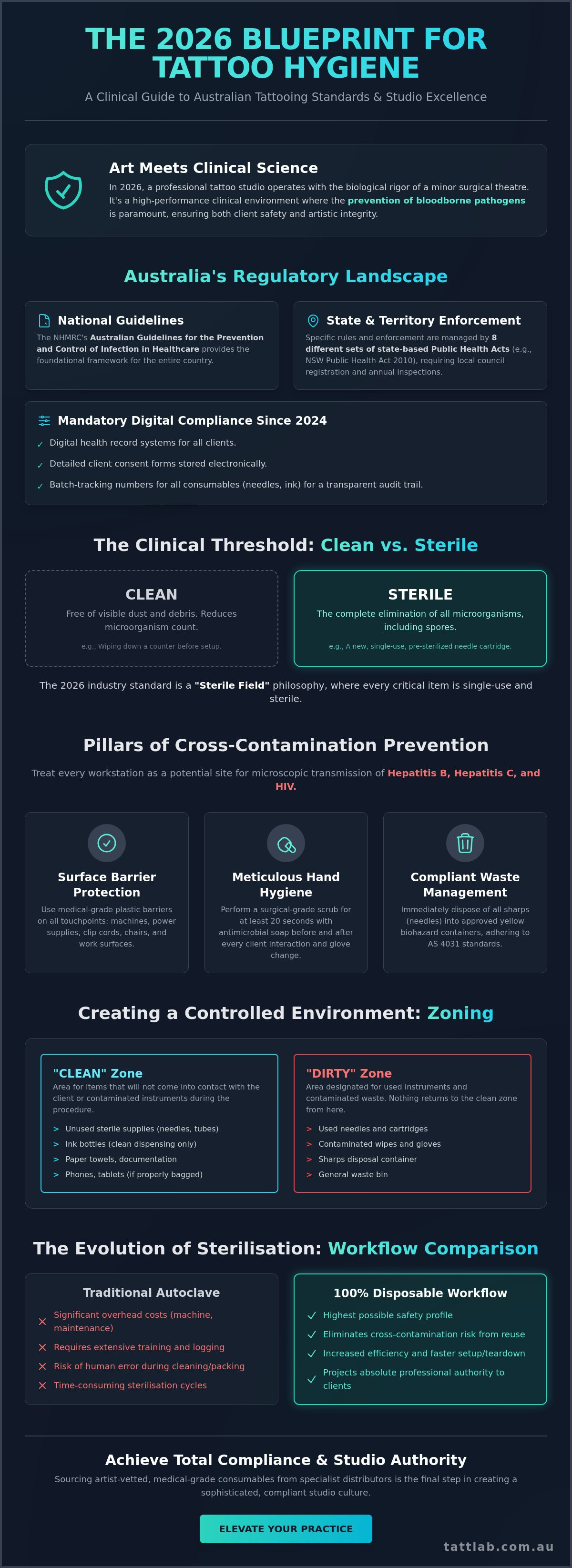
Distinguishing between "clean" and "sterile" is the clinical threshold that separates a hobbyist from a professional specialist. A clean environment is free of visible debris, but a sterile environment is one where microorganisms are completely eliminated. In 2026, the industry has moved toward a "Sterile Field" philosophy. This involves the use of single-use, pre-sterilized cartridges and the rigorous application of TGA-approved high-level disinfectants on all non-porous surfaces. This clinical meticulousness protects the skin's integrity, ensuring the body's largest organ can heal without the interference of opportunistic bacteria.
The Legal Framework for Australian Studios
Operating a studio requires more than artistic talent; it demands strict adherence to state-based Public Health Acts. While the NHMRC provides national guidelines, specific enforcement falls under state jurisdictions such as the NSW Public Health Act 2010 or the VIC Public Health and Wellbeing Act 2008. These laws mandate that every studio must be registered with their local council and undergo annual inspections. Since 2024, 100% of reputable Australian studios have transitioned to digital health record systems. These systems maintain detailed client consent forms and batch-tracking numbers for all consumables, creating a transparent audit trail for every drop of ink used.
Bloodborne Pathogens and Cross-Contamination
The primary biological focus of modern tattoo hygiene is the total elimination of cross-contamination risks. Understanding the potential health risks associated with skin penetration is the first step in establishing a professional protocol. Professionals manage three specific viral threats with extreme caution: Hepatitis B, Hepatitis C, and HIV. Because these pathogens can survive on surfaces for days, the "Lab" mindset is essential. We treat every workstation as a potential site for microscopic transmission.
- Surface Barrier Protection: Use of medical-grade plastic barriers on all touchpoints, from power supplies to clip cords.
- Hand Hygiene: Implementation of the "Five Moments for Hand Hygiene" adapted from clinical settings.
- Waste Management: Immediate disposal of sharps into yellow biohazard containers as per AS 4031 standards.
Protecting skin health is a journey that begins long before the needle touches the dermis. By viewing the tattoo process through a clinical lens, artists provide a liberating experience where the client feels both seen and safe. This methodical approach replaces uncertainty with a sense of controlled, predictable progress, ensuring the final result is a testament to both art and safety.
The Clinical Barrier: PPE and Infection Control Science
Maintaining a sterile field isn't just a preference; it's a fundamental requirement of tattoo hygiene standards australia. Professional artists operate within a controlled environment where the skin’s natural defense is intentionally bypassed. This process demands a sophisticated understanding of barrier protection to ensure that pathogens like Hepatitis B or Staphylococcus aureus don't find a host. By treating the studio as a high-end laboratory, artists protect both the client’s physical safety and the long-term integrity of the artwork.
Infection risk is managed through the Spaulding Classification system, which categorises equipment based on its contact with the body. Critical items, such as needles and tubes, penetrate the tissue and must be single-use or sterile. Semi-critical items touch mucous membranes or non-intact skin, while non-critical items, like the tattoo chair or power supply, only touch intact skin. Adhering to Queensland's Public Health Act for tattooing ensures that these classifications are strictly followed, providing a legislative backbone to studio safety protocols.
Hand hygiene remains the primary defense against cross-contamination. Artists must perform a surgical-grade scrub before donning gloves and after every instance of touching a non-sterile surface. This isn't a quick rinse; it's a methodical process using antimicrobial soap and water for at least 20 seconds, focusing on the subungual areas under the nails where bacteria often hide. This commitment to cleanliness mirrors the precision we value in our own skin health journey at the Lab.
Selecting Medical-Grade Gloves
Nitrile gloves have replaced latex as the industry standard because they offer superior puncture resistance and are free from common allergens. When selecting gloves, look for an Acceptable Quality Level (AQL) of 1.5 or lower, which indicates a medical-grade rating for barrier integrity. Proper removal is equally vital; artists use the "glove-to-glove, skin-to-skin" technique to peel the material away from the body, ensuring the contaminated exterior never touches the artist's bare wrist.
Surface Sanitisers and Skin Prep
Skin preparation requires 70% Isopropyl alcohol to effectively dissolve lipids and kill transient micro-organisms before the first needle pass. While higher concentrations exist, the 70% ratio contains enough water to prevent the alcohol from evaporating too quickly, allowing it to penetrate the cell walls of bacteria more effectively. For studio surfaces, hospital-grade disinfectants with virucidal and bactericidal properties are mandatory for all high-touch zones.
Effective surface sterilisation requires the disinfectant to remain visibly wet on the treated area for a specific contact time, typically ranging from two to ten minutes depending on the manufacturer's clinical data.
Disposable vs. Autoclave: Choosing Your Sterilisation Path
The landscape of Australian tattooing is undergoing a significant transformation. Historically, the autoclave was the heartbeat of the studio. In 2026, the industry has shifted toward a more streamlined approach. Over 80% of modern studios now opt for a 100% disposable workflow to meet evolving tattoo hygiene standards australia. This evolution isn't just about speed; it's about eliminating the biological variables that compromise skin health.
An autoclave requires a substantial upfront investment, often exceeding $5,000 for a compliant Class B unit. This doesn't include the annual $700 calibration costs or the electricity required for high-pressure steam cycles. Conversely, disposable setups shift the cost to a per-client basis. While this creates more clinical waste, the reduction in labor hours spent cleaning tubes allows artists to focus on the client's creative journey. Managing this clinical waste is a critical pillar of the modern Lab. Studios must partner with licensed waste disposal services to handle contaminated plastics, ensuring ecological responsibility remains a priority.
The Case for Fully Disposable Equipment
Human error remains the primary cause of cross-contamination in a studio environment. By removing the need for manual scrubbing and ultrasonic cleaning, artists bypass the most dangerous stages of the sterilisation cycle. High-quality medical supplies for tattoo artists now include pre-sterilised, EO gas-treated needle cartridges. These systems feature internal membranes that prevent fluid backflow into the rotary motor. This mechanical barrier is a revolutionary step in infection control. It ensures the machine's internal components remain a clean environment, protecting the integrity of every procedure.
Maintaining Traditional Autoclave Standards
For studios that retain traditional stainless steel grips, adherence to the AS/NZS 4815 standard is non-negotiable. This involves daily steam penetration tests and the use of Class 5 chemical indicators in every load. Every 6 months, biological indicator tests must confirm the unit is effectively killing microorganisms. Bagged instruments must be stored in dust-proof drawers and re-sterilised if the packaging integrity is compromised. Maintaining these tattoo hygiene standards australia requires a methodical approach that mirrors the precision of a clinical laboratory. It's a commitment to safety that leaves no room for uncertainty.
Whether you choose a disposable path or a traditional autoclave system, the goal remains the same. You're not just applying ink; you're managing a complex biological interaction. A "cool but clinical" mindset ensures that the studio stays safe, professional, and prepared for the future of skin health.
The Sterile Field: Step-by-Step Workstation Setup
Maintaining a sterile field isn't just a recommendation; it's the clinical foundation of every safe procedure. Professional artists must divide their booth into a "clean zone" and a "dirty zone" to prevent cross-contamination. The clean zone holds your sterilized equipment, unused ink caps, and fresh paper towels. The dirty zone is strictly for items that have come into contact with biological fluids or used needles. This physical separation ensures that your workflow remains predictable and safe, protecting both the client's skin health and your professional reputation.
Barrier film application must follow a logical sequence. Start from the top of your workstation and move downward. Apply film to the lamp handle, the power supply dials, and the clip cord before any procedure begins. When handling inks, never allow the bottle tip to touch the ink cap. Use single-use caps and discard any remaining pigment immediately after the session. These meticulous steps are central to the tattoo hygiene standards australia enforces to ensure the highest level of infection control.
Pre-Tattoo Setup Checklist
- Step 1: Wash your hands for at least 40 seconds using an antimicrobial cleanser. Don your initial PPE, including a fresh fluid-resistant apron and medical-grade nitrile gloves.
- Step 2: Disinfect the entire workstation using TGA-listed hospital-grade wipes. Ensure the surface remains wet for the manufacturer’s recommended contact time, which is typically between 2 and 5 minutes.
- Step 3: Carefully set up the tattoo stencil and arrange your ink palette on a sterile, barrier-protected tray to avoid any contact with non-sterile surfaces.
Safe Disposal and Sharps Management
Post-procedure breakdown is the most vulnerable time for needle-stick injuries. You must use yellow sharps containers that comply with Australian Standard AS 4031:1992. These containers should be placed within arm's reach but away from the clean zone. It's vital to differentiate your waste streams correctly. Items saturated with blood or serous fluid are classified as clinical waste and must be placed in heavy-duty yellow biohazard bags. General waste, such as barrier film and dry paper towels, can be disposed of in standard waste bins.
The legal framework in most Australian states requires that you maintain a detailed sharps disposal logbook to track the collection and destruction of biohazardous materials by licensed contractors. This documentation serves as a record of your commitment to safety and compliance. When you prioritize these clinical details, you're not just following a rule; you're honoring the client's trust in your expertise.
If you're ready to evolve your approach to skin health and professional care, explore the specialized services at Tatt Lab.
Professional Supplies for Australian Hygiene Compliance
Adhering to the tattoo hygiene standards australia mandates in 2026 requires more than just a clean workspace; it demands a rigorous, medical-grade supply chain. At Tatt Lab, we view consumables as the front line of infection control. We prioritize artist-vetted supplies because the margin for error during skin penetration is non-existent. By sourcing from a specialist Australian distributor, studios eliminate the risks associated with unregulated international imports that frequently fail to meet Therapeutic Goods Administration (TGA) benchmarks or Australian Industrial Chemicals Introduction Scheme (AICIS) requirements.
A professional’s responsibility doesn't end when the machine stops. The safety cycle only concludes once the dermal layer has fully regenerated. Integrating high-quality tattoo aftercare into your protocol ensures that the sterile environment you maintained during the session continues at home. This holistic approach protects the integrity of the art and the client's biological health, transforming a standard procedure into a premium clinical journey. Education is the ultimate tool for studio growth; when clients see a studio prioritizing medical-grade integrity, trust is built instantly.
The Tatt Lab Quality Assurance
Our "Lab-tested" philosophy means every needle cartridge, ink batch, and piece of PPE undergoes a vetting process by industry veterans. We don't just stock products; we verify their performance against the specific tattoo hygiene standards australia expects from top-tier professionals. To support the fast-paced nature of Australian studios, we provide express nationwide shipping, often achieving 24-hour dispatch to ensure your station is never compromised. We act as a dedicated partner in your studio’s evolution, ensuring your gear matches your expertise through every stage of the process.
Next Steps for Your Studio
Maintaining elite safety levels is an ongoing commitment to excellence. Start by auditing your current inventory. If your supplies lack clear batch tracking or medical-grade certification, it’s time to upgrade your baseline. Transitioning to a professional supply model reduces the risk of cross-contamination and enhances skin recovery rates. Setting up a wholesale account ensures a consistent flow of premium tools, allowing you to focus on the creative process while we manage the science of safety. You can explore our range of professional medical supplies to begin your studio's transition toward a higher standard of clinical care.
Future-Proofing Your Studio Through Clinical Precision
Adhering to tattoo hygiene standards australia requires more than a basic checklist; it demands a commitment to skin integrity and technical excellence. The 2026 landscape focuses on the rigorous application of TGA-compliant consumables and the maintenance of a validated sterile field. By implementing medical-grade PPE and transitioning to disposable systems, you eliminate the variables that lead to cross-contamination. This methodical approach mirrors the evolution of the industry toward a higher clinical standard. It transforms your workspace into a controlled laboratory where safety and art coexist seamlessly. Tatt Lab is an artist-owned and operated partner, bringing deep industry expertise to every product selection. We supply medical-grade PPE and TGA-compliant consumables that meet the strictest Australian regulations. Our express nationwide shipping ensures your studio never faces a supply gap during critical sessions. You've built your reputation on the quality of your ink, so let's ensure your hygiene protocols are equally uncompromising. Your clients trust you with their skin, and we're here to help you honor that trust with every procedure.
Equip your studio with medical-grade supplies from Tatt Lab
We're ready to support your professional evolution every step of the way.
Frequently Asked Questions
What are the mandatory tattoo hygiene standards in Australia?
Mandatory tattoo hygiene standards australia are governed by state-specific legislation, such as the NSW Public Health Regulation 2022 and the Victorian Public Health and Wellbeing Act 2008. These laws require artists to maintain a sterile environment, use single-use equipment where possible, and follow strict infection control protocols. Compliance ensures the integrity of the skin health journey. You must register your premises with the local council, which monitors adherence to these statutory health standards.
Do I need an autoclave if I use 100% disposable tattoo needles?
You don't need an autoclave if your studio exclusively uses 100% pre-sterilised, single-use disposable equipment. This shift toward disposable technology simplifies the Tatt Lab workflow while maintaining clinical precision. However, if you use any reusable stainless steel grips or tubes, Australian standards require a TGA-approved Class B autoclave. You must keep digital or paper records of every sterilisation cycle for 7 years to meet mandatory audit requirements.
How often should a tattoo studio be inspected by health authorities?
Most local councils in Australia conduct inspections at least once every 12 months to ensure compliance with health regulations. These audits focus on your waste management, sterilisation logs, and overall studio cleanliness. Some high-performing studios in Melbourne or Sydney might see less frequent visits, while new businesses often face 2 inspections in their first year. Maintaining a cool but clinical environment ensures you're always prepared for an unannounced health officer visit.
What is the difference between disinfection and sterilisation in a tattoo studio?
Sterilisation is the total destruction of all microbial life, including resilient bacterial spores, whereas disinfection only reduces pathogens to a safe level. In a professional studio, you must sterilise all equipment that penetrates the skin barrier using high-pressure steam. For environmental surfaces like benches, a hospital-grade disinfectant is sufficient. This distinction is vital for protecting the lymphatic system and ensuring the long-term clarity and health of the client's skin.
Are all nitrile gloves suitable for tattooing under Australian standards?
Not all nitrile gloves meet the necessary tattoo hygiene standards australia; they must be TGA-listed medical-grade and powder-free. Look for the AS/NZS 4011:2014 certification on the packaging to ensure they provide an adequate barrier against blood-borne pathogens. Using high-quality gloves is a non-negotiable part of the skin health protocol. It protects both the artist and the client during the delicate fragmentation of ink particles within the dermis.
What should I do if a needle stick injury occurs in the studio?
If a needle stick injury occurs, immediately wash the site with soap and running water for 30 seconds. Don't scrub the wound or use bleach; instead, encourage gentle bleeding. You must report the incident in your studio's injury log and consult a medical professional within 2 hours for baseline blood tests. This proactive approach mirrors our commitment to safety and ensures any potential exposure is managed with absolute clinical authority.
How do I dispose of clinical waste safely in Australia?
Dispose of sharps in rigid, yellow puncture-resistant containers that comply with AS 4031-1992. Soft clinical waste, such as blood-stained paper towels, belongs in heavy-duty yellow biohazard bags. You must contract a licensed medical waste company to collect these items at least every 90 days. Proper segregation of waste is a fundamental step in the professional journey, ensuring the studio remains a safe, minimalist laboratory environment for every client.
Is it mandatory to use medical-grade skin prep before tattooing?
It's mandatory to use an approved skin antiseptic, such as 70% isopropyl alcohol or 0.5% chlorhexidine, before the first needle penetration. This step removes surface bacteria that could lead to infection or compromised healing. Effective skin prep is the first stage of ensuring skin integrity. It sets the foundation for a successful transformation, allowing the artist to work with the precision required for high-end aesthetic and health outcomes.


Comments (0)
There are no comments for this article. Be the first one to leave a message!