

The difference between a crisp, single-pass line and a blurred, traumatized outcome isn't just in the artist's hand; it's a calculated result of needle geometry. When you're executing intricate work, even a microscopic amount of needle wobble can compromise the physical integrity of the skin. You've likely experienced the frustration of inconsistent line weights or excessive trauma during fine-line sessions, issues that often stem from low-quality round liner needles or a misunderstanding of taper dynamics. These technical hurdles don't just slow down your session; they impact the healing process and the long-term clarity of the work.
This professional guide will help you master the technical nuances of round liner configurations to achieve flawless precision and optimal skin health in every session. We'll demystify the science behind these tools, moving from the mechanical benefits of 304 medical-grade steel to the specific impact of various taper lengths on ink flow. By understanding the relationship between needle gauge and skin resistance, you'll gain the predictable control needed for faster healing times and truly professional results. We'll explore how to select the right configuration for your specific style, ensuring your technical choices support both your artistic vision and your client's well-being.
Key Takeaways
- Understand how the circular grouping and specific soldering of needles facilitate focused ink delivery for superior structural longevity.
- Learn to decode complex configuration codes to precisely manage the volume of ink deposited and the degree of skin resistance in every session.
- Discover how to choose the ideal round liner needles to prevent line spread and maintain the crisp aesthetic of your work as it heals.
- Identify the essential indicators of EO Gas sterilization on medical-grade packaging to ensure the highest level of clinical safety for your clients.
- Explore the benefits of utilizing artist-vetted tools from premium ranges like Elite III and EZ V-Select to achieve predictable, high-performance outcomes.
What are Round Liner Needles? Defining the Artist's Primary Tool
Precision is the foundation of every enduring tattoo. Round liner needles are the specialized instruments designed to provide that foundation, functioning as the primary tool for creating structure, borders, and fine details. Unlike other configurations, these needles consist of multiple pins grouped in a circular arrangement and soldered together at a specific point. This tapered convergence creates a focused delivery system, allowing for high ink saturation within a concentrated area. It's this concentrated force that enables an artist to deposit pigment with enough density to survive the body's natural healing processes without losing its sharp definition.
The role of these needles extends beyond the initial session. The structural integrity of a tattoo depends on the depth and consistency of the line work. Because round liner needles are engineered for resistance and tension, they allow the artist to feel the skin's feedback more acutely than with broader groupings. This feedback is essential for maintaining a uniform depth, which prevents the ink from spreading or "blowing out" over time. The evolution of the electric tattoo machine has directly influenced the refinement of these needle clusters, shifting the industry toward higher standards of manufacturing and material science.
The Anatomy of a Round Liner
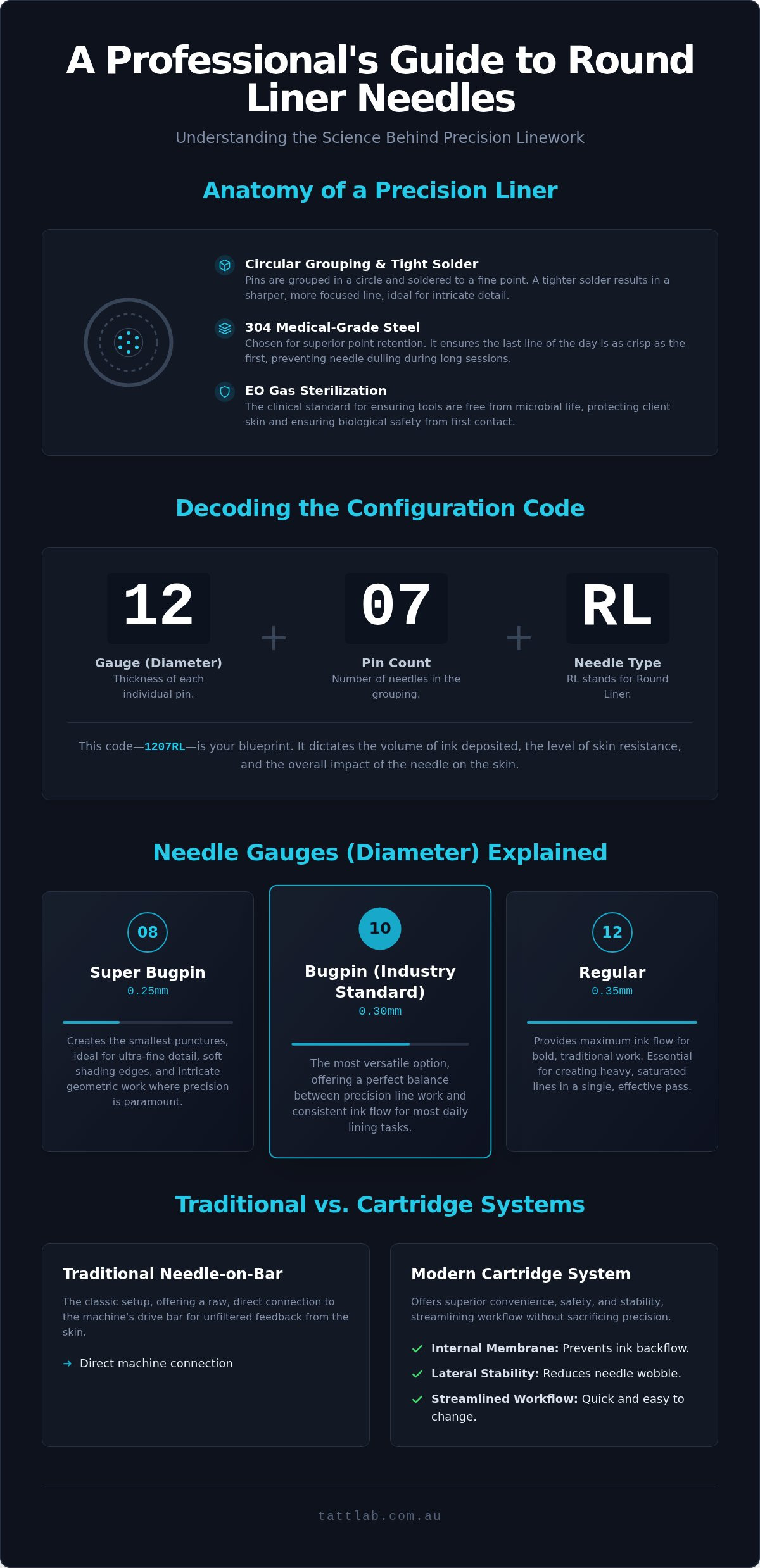
The performance of a liner is dictated by the "tightness" of its solder. A tighter grouping results in a more focused point, which is ideal for intricate fine-line work where every micron matters. High-quality variants utilize 304 medical-grade Japanese steel. This material is chosen for its superior point retention; it doesn't dull as quickly during long sessions, ensuring that the last line of the day is as crisp as the first. Safety is equally critical, which is why professional studios prioritize needles that undergo EO gas sterilization. This clinical process ensures the tools are free from microbial life, protecting the biological integrity of the client's skin from the moment of first contact.
Traditional vs. Cartridge Round Liners
The industry has seen a significant shift from traditional needle-on-bar setups to modern cartridge systems. While traditional needles offer a raw, direct connection to the machine's drive bar, cartridges provide a level of convenience and safety that is hard to ignore. Modern cartridges often feature internal membranes that prevent backflow and provide lateral stability. This membrane tension reduces needle wobble, which is a common cause of inconsistent line weights. For artists who value a streamlined workflow without sacrificing precision, selecting the right cartridge system is vital. You can explore more about these technical choices in The Professional Guide to Tattoo Supplies in Australia, which details how quality equipment supports better clinical outcomes.
The Science of Configuration: Gauge, Taper, and Grouping
The code on a box of round liner needles serves as a technical blueprint for the procedure ahead. When you look at a configuration like 1207RL, you're reading a summary of the needle's physical impact on the body. The first two digits (12) represent the gauge or diameter of each individual pin, while the next two (07) indicate the number of pins grouped together. Understanding this geometry is vital because it dictates the volume of ink deposited per puncture and the level of resistance you'll feel from the dermis. A higher pin count requires more voltage and pressure to break the skin's surface tension, whereas a tight 3-round liner enters with minimal resistance.
Choosing the right configuration is fundamentally about managing skin trauma. If the needle is too thick for the intended detail, you risk over-working the area, which can lead to scarring or "blowouts" where ink migrates into the subcutaneous fat. Maintaining high standards for Tattoo Safety involves not just sterilization, but also selecting the correct needle geometry to preserve skin integrity. When the needle matches the skin's physiological needs, the healing process is more predictable and the final result remains sharp for years.
Understanding Needle Gauges (Diameter)
The gauge refers to the thickness of the individual pins within the grouping. This diameter influences the size of the "channel" created in the skin.
- 08 (0.25mm) Super Bugpins: These are the choice for ultra-fine detail. Because each pin is thinner, they create smaller punctures, which is ideal for soft edges and intricate geometric work where precision is paramount.
- 10 (0.30mm) Bugpins: This is the industry standard for a reason. It offers a perfect balance between precision and ink flow, making it versatile for most daily lining tasks.
- 12 (0.35mm) Regulars: These provide maximum ink flow. They're essential for bold, traditional work where a single, heavy pass is required to saturate the line effectively.
The Role of Taper Length
Taper length is the distance from the very tip of the needle to the point where it reaches its full diameter. This distance determines how the needle interacts with the tissue.
- Long Taper (LT): Typically around 5.5mm, a long taper allows for a more surgical entry. It penetrates the skin gradually, which minimizes trauma and allows for greater precision in tight spaces.
- Medium Taper (MT): These have a shorter point, meaning the needle reaches its full width faster. This results in more ink being deposited more quickly, which is excellent for bold lines that need fast saturation.
- Textured Tapers: Some professional needles feature micro-grooves. This science-driven design allows the needle to carry more pigment into the skin per strike, reducing the number of passes needed and further protecting the skin.
If you're looking to refine your technical setup, you can explore professional configurations that match your specific artistic requirements and skin-safety goals.
Matching Round Liners to Tattooing Styles
Artistic intent and technical execution are inseparable. While a specific needle might excel in one context, it could prove detrimental in another. Choosing the right round liner needles is about more than just the immediate visual; it's about how the pigment settles and matures within the dermis. A line that looks perfect today might blur into a shadow in five years if the needle configuration didn't provide enough saturation or stability. This long-term perspective is what separates a technician from a specialist who values the physical integrity of their work.
Machine settings must evolve alongside your needle choice. Larger groupings possess a higher surface area, requiring increased voltage to penetrate the skin efficiently. If your voltage is too low for a large grouping, you'll experience "snagging," which increases trauma and slows healing. Conversely, fine-line work requires a delicate balance of lower voltage and steady hand speed to ensure the ink is deposited without causing blowouts. This synergy between tool and technique is further enhanced by selecting high-quality pigments, as detailed in The Professional Guide to Tattoo Ink.
American Traditional and Bold Work
For styles that demand permanence and high visibility, the 1209RL and 1211RL are indispensable. These larger groupings allow for "one-pass" bold outlines that define the design's structure. In these scenarios, regular tapers are often preferred over long tapers. The shorter point allows the needle to reach its full diameter quickly, packing maximum pigment into the skin channel. This approach fulfills the "bold will hold" mantra, ensuring the structural integrity of the tattoo remains intact as the skin ages and shifts over decades.
Fine Line, Realism, and Dotwork
When the artistic narrative requires subtlety, artists turn to 0801RL and 1003RL configurations. These tools allow for the execution of intricate details and delicate textures found in realism and micro-tattoos. Mastering the "Single Needle" (01RL) is a technical milestone; it offers zero margin for error but provides unmatched precision for hyper-detailed work. For dotwork, Tight Liners are the preferred choice. These are soldered even closer to the tip, creating consistent, sharp stippling patterns that allow for smooth gradients and complex shading without compromising the skin's long-term health.
Safety, Sterility, and Quality Control in Australia
Clinical safety in the tattoo studio is a non-negotiable standard that protects both the artist's reputation and the client's physical health. Ethylene Oxide (EO) Gas sterilization is the industry's clinical necessity because it effectively eliminates microbial life without the high-heat risks associated with autoclaving delicate needle tips. While manufacturers provide this service, the final verification falls on the practitioner. Every blister pack features a sterilization indicator; if this chemical marker hasn't transitioned to the specified color, the tool is compromised and must be discarded. Beyond microbial safety, physical defects like "needle hooks" or microscopic burrs can cause significant skin trauma. Inspecting your round liner needles under 10x magnification before use is a hallmark of professional diligence that ensures every puncture is clean and precise.
The Australian market operates under state-specific health regulations, such as the mandatory HLTINF005 certification in Queensland and licensing requirements in New South Wales. These standards ensure that every consumable used in a studio meets strict hygiene benchmarks. Maintaining these standards requires a methodical approach to supply chain management, ensuring that every tool entering your studio has been vetted for both safety and performance.
Material Integrity and Skin Safety
304 medical-grade Japanese steel is the gold standard for hypoallergenic performance. This specific alloy provides the necessary rigidity to maintain point sharpness throughout a long session, which reduces the number of passes required to achieve saturation. A high-quality safety membrane is another critical barrier. It prevents ink and biological fluids from migrating into the machine's internal housing, which is essential for preventing cross-contamination between clients. You can find more detailed protocols on maintaining a sterile environment in our Medical Supplies for Tattoo Artists: Studio Safety Guide.
Quality Control in Cartridge Manufacturing
Professional artists often perform a "Wobble Test" to ensure needle-to-tip centering. If the needle isn't perfectly centered within the housing, it'll create an erratic vibration that makes straight lines impossible to achieve. Internal housing design also influences ink splatter and reservoir capacity. Premium cartridges are engineered to hold more pigment while maintaining a controlled flow, allowing for a cleaner workspace and better visibility of the stencil. Avoiding mass-produced, generic alternatives is a simple way to ensure your round liner needles perform predictably every time you hit the foot pedal.
To maintain the highest clinical standards in your studio, you can shop artist-vetted round liner needles and cartridges that meet rigorous Australian safety benchmarks.
Selecting Your Setup: Why Pros Source via Tatt Lab
The relationship between an artist and their supplier is a partnership built on technical trust. At Tatt Lab, we don't just stock equipment; we curate it. Every tool in our inventory, from traditional bars to advanced cartridges, undergoes a rigorous vetting process at our Moorabbin facility. We understand that your reputation depends on the consistency of your round liner needles, which is why we only provide supplies that meet our internal benchmarks for clinical safety and performance. By sourcing through a specialist partner, you ensure that every box of needles delivered to your studio has the structural integrity required for high-stakes work.
Growth in this industry requires a balance of artistic talent and smart business logistics. We support both emerging artists and established studios through wholesale opportunities and a commitment to predictable supply chains. Reliable workflow depends on efficient logistics, so we prioritize express nationwide shipping across Australia. This ensures you're never caught without the essential configurations needed to complete a session. For local artists, our 'Click & Collect' service provides an immediate solution for those urgent inventory gaps, maintaining the steady, methodical rhythm your studio requires.
Building Your Professional Needle Inventory
A well-rounded inventory is the secret to versatility. Every professional studio should maintain a consistent stock of essential RL configurations, typically ranging from 03RL for fine details to 11RL for traditional power-lining. Many artists are currently navigating the transition from traditional needle-on-bar setups to a full cartridge workflow. This shift offers significant benefits in efficiency and safety, particularly with the integrated membranes found in premium brands like Elite III and EZ V-Select. These modern systems reduce machine vibration and eliminate the risk of backflow, allowing you to focus entirely on the precision of your line work.
The Path to Better Healing
The technical choices you make during a session have a direct impact on the client's recovery. High-quality round liner needles made from 304 medical-grade steel maintain their sharpness longer, which means you can achieve full saturation with fewer passes. This reduction in repetitive trauma is the first step in a successful healing narrative. When the skin's physical integrity is respected through precise needle choice, the body can focus its energy on pigment retention rather than repairing excessive tissue damage. This technical precision, combined with a dedicated recovery protocol, ensures long-term client satisfaction. For a comprehensive look at the biological recovery process, consult our Mastering Tattoo Aftercare: Professional Guide.
Advancing Your Technical Precision
Mastering the technical nuances of needle geometry is a transformative step in any artist's career. By aligning your choice of round liner needles with specific skin types and artistic styles, you ensure that every line maintains its clarity and structural integrity over time. We've explored how 304 medical-grade Japanese steel and EO gas sterilization serve as the baseline for clinical safety, providing a foundation where science meets aesthetic excellence. This methodical approach to equipment selection doesn't just improve your immediate workflow; it respects the biological reality of the skin, leading to faster healing and superior long-term results.
Your commitment to quality is what builds lasting trust with your clients. At Tatt Lab, we support that commitment by providing artist-vetted tools designed for professional precision. With our express nationwide shipping, you can maintain a consistent inventory of the industry's most reliable configurations. Shop our range of Professional Round Liner Needles to experience the difference that specialized, high-performance equipment makes in your daily practice. We're here to partner with you as you refine your craft and deliver exceptional, safe outcomes for every client.
Frequently Asked Questions
What is the difference between a 1007RL and a 1207RL?
The difference lies in the needle gauge or diameter of the individual pins. Both configurations feature seven pins, but the '10' in 1007RL signifies a 0.30mm diameter, while the '12' in 1207RL signifies a 0.35mm diameter. A 1207RL deposits more ink and creates a bolder line, whereas a 1007RL offers more precision with slightly less skin resistance, making it ideal for detailed work that requires a medium weight.
Can I use round liner needles for shading?
While you can use them, it's not clinically ideal for achieving smooth gradients. Round liner needles have pins soldered to a very tight point, which creates a highly concentrated puncture pattern. For shading, this often results in unwanted "pepper" textures or increased skin trauma if the area is over-worked. It's better to use round shaders or magnums, which have broader groupings designed to distribute pigment evenly without the aggressive focus of a liner.
Why do my lines look 'shaky' when using a 01RL single needle?
Single needles (01RL) have no surrounding pins to provide lateral stability, making them highly sensitive to hand tremors and machine vibration. Without the "cushion" of a larger grouping, every microscopic movement is amplified. To master this, ensure your machine's stroke length is appropriate and maintain a consistent hand speed. Using high-quality cartridges with internal stabilization membranes can also help reduce unwanted needle wobble and improve your overall control.
Are cartridge needles more sterile than traditional bar needles?
Both formats are equally sterile if they undergo EO (Ethylene Oxide) Gas sterilization and remain in their sealed blister packs. The primary safety advantage of cartridges isn't the needles themselves, but the internal membrane. This barrier prevents biological fluids from entering the machine's grip and motor. Regardless of the format, always verify the sterilization indicator on the packaging before opening any round liner needles for a session.
What does 'Bugpin' mean in tattoo needle terminology?
'Bugpin' refers to needles with a thinner diameter than the standard #12 gauge. While a standard needle is 0.35mm, a bugpin is typically #10 (0.30mm) or #08 (0.25mm). These thinner pins allow more needles to be grouped into a smaller physical space. This configuration is highly favored for realism and fine-line work because it creates smaller punctures, resulting in less skin trauma and significantly smoother detail in the final healed result.
How do I know if my round liner is a 'Tight' liner?
You can identify a tight liner by checking the distance of the solder from the needle tips. In a standard round liner, the pins are grouped circularly, but in a 'Tight' or 'X-Tight' liner, the pins are soldered much closer to the point. This forces the tips into a more needle-like convergence. This geometry creates a finer, more concentrated line that is perfect for high-detail scripts and intricate geometric patterns that require absolute clarity.
Does the taper length affect how deep I should tattoo?
Taper length doesn't change the target depth in the dermis, but it does change how you reach it. A long taper (5.5mm) enters the skin more gradually, which can make it feel like you're "floating" the needle. A short taper reaches its full diameter quickly, creating more resistance. Regardless of the taper, you must still maintain a consistent depth of approximately 1.5mm to 2mm to ensure proper pigment retention and avoid blowouts.
Why is my tattoo machine spitting ink when using round liners?
Ink spitting usually occurs when the needle is not centered in the tip or if there's an air gap in the reservoir. If the round liner needles are vibrating against the side of the tube, it disrupts the surface tension of the ink. Check your needle hang and ensure your cartridge has a proper internal housing design. Reducing your machine's voltage slightly can also help stabilize the ink flow and prevent splatter during your session.


Comments (0)
There are no comments for this article. Be the first one to leave a message!