

A tattoo cartridge is not just a needle in a plastic housing; it is the critical fail-safe between your artistic reputation and a total equipment breakdown. While a high-end rotary pen provides the power, your choice of tattoo cartridges determines whether that energy translates into a crisp line or a compromised session. Many artists have experienced the frustration of a needle wobbling during a fine-line detail or, worse, discovering ink backflow has reached their expensive motor. These aren't just minor inconveniences; they're risks to your equipment's physical integrity and your client's safety.
We understand that your work is a delicate balance of technical rigor and creative expression. You deserve specialised tools that offer consistent sharpness and a reliable safety membrane to prevent cross-contamination. This guide explores the engineering behind modern needle configurations, from long tapers to curved magnums. You will learn how to evaluate membrane tension and housing stability to ensure every drop of ink saturates the skin with minimal trauma. By the end, you'll have the technical knowledge to select cartridges that protect your machine and elevate your artistry.
Key Takeaways
- Understand why modern self-contained systems improve procedural hygiene and streamline your workflow compared to traditional needle-on-bar setups.
- Learn how to select the ideal tattoo cartridges by decoding configurations like Round Liners and Curved Magnums for specific line weights and saturation.
- Protect your rotary machine by identifying high-performance safety membranes that prevent pigment and biological fluids from damaging the motor.
- Master the relationship between needle tapers and skin trauma to achieve maximum ink saturation while respecting the physical integrity of the skin.
- Recognise the importance of sourcing artist-vetted, sterile consumables from specialists who prioritise clinical safety and professional performance.
The Evolution of Tattoo Cartridges: Precision Engineering for Modern Artistry
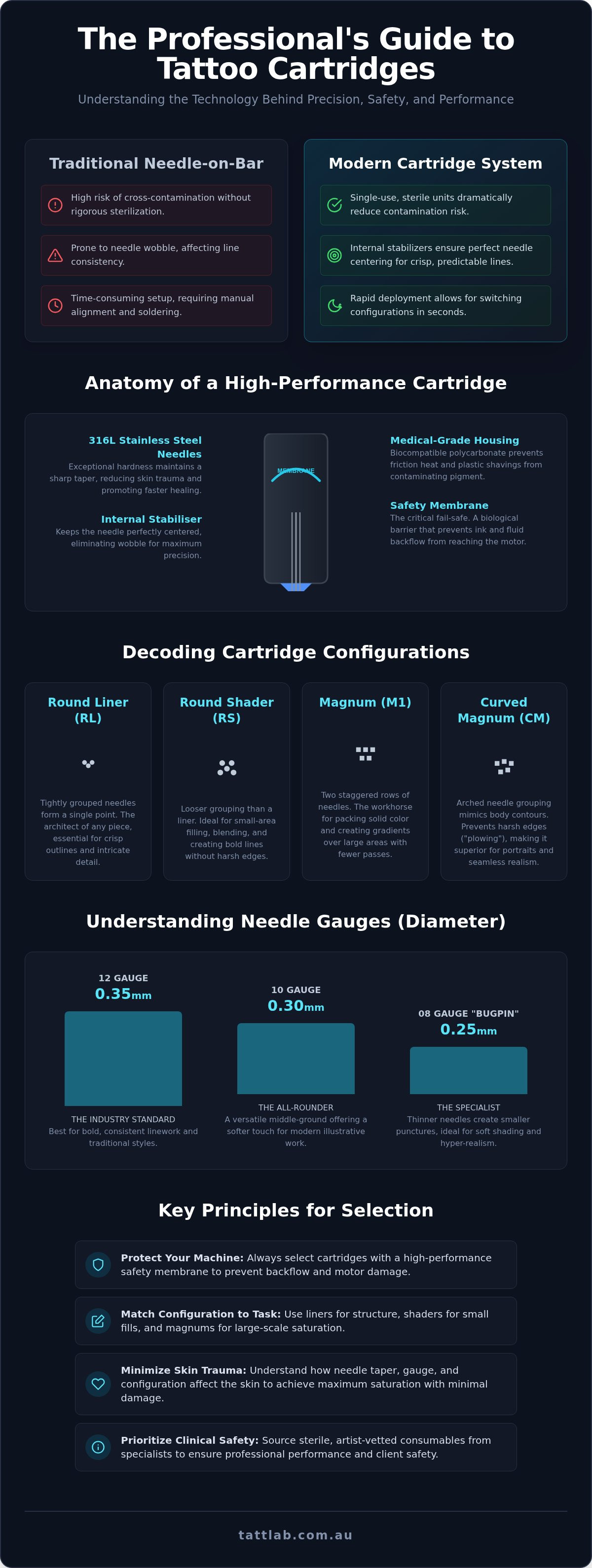
Modern tattoo cartridges represent a significant shift in the Evolution of Tattoo Machines, moving away from the cumbersome needle-on-bar setups of the past. A professional cartridge is a self-contained needle and housing system designed for rapid deployment. Unlike traditional needles that required manual alignment and soldering, these units come pre-sterilised and ready for immediate use. This engineering shift isn't just about convenience; it's about transforming the tattoo machine into a precision instrument that prioritises the physical integrity of the client's skin.
The clinical benefits of these disposable systems are profound. By using a single-use, enclosed unit, you create a controlled environment that significantly reduces the risk of cross-contamination. The primary driver of modern design has been needle stabilisation. In the past, needle wobble was a constant variable artists had to manage. Today's high-performance housing designs include internal stabilisers that keep the needle perfectly centred, ensuring every stroke is predictable and every line is crisp.
Why Professional Artists Prefer Cartridge Systems
The transition to cartridge-based workflows has redefined studio efficiency. Artists can now switch between a 3RL for fine details and a 27 Mag for large-scale saturation in seconds, rather than minutes. This agility allows for a more fluid creative process without the interruption of technical recalibration.
- Time Efficiency: There is a significant reduction in setup and breakdown time, allowing more focus on the artistic narrative of the session.
- Mechanical Consistency: Standardised fitment ensures consistency in needle depth and throw across different wireless rotary pen brands.
- Machine Longevity: Integrated backflow prevention mechanisms act as a biological barrier, protecting your expensive machine motor from pigment and fluids.
The Role of Medical-Grade Materials
Precision starts with the raw materials. Professional tattoo cartridges utilise 316L stainless steel for the needles, a material chosen for its exceptional hardness and ability to maintain a sharp taper throughout long sessions. This ensures the needle enters the skin cleanly, reducing trauma and promoting faster healing. The housing is typically constructed from medical-grade polycarbonate or similar high-impact plastics. These materials are engineered to prevent friction-induced heat and eliminate the risk of plastic shavings contaminating the pigment. The biocompatibility of these housing materials ensures that no harmful particulates are introduced into the dermal layer during the tattooing process.
Decoding Cartridge Configurations: Liners, Shaders, and Magnums
Selecting the correct tattoo cartridges involves a calculated balance between needle geometry and the biological response of the dermal layer. The configuration you choose dictates the density of the pigment deposit and the resulting skin trauma. For example, a 3RL (Round Liner) uses three needles grouped tightly to create a singular, focused point of entry, whereas a 9RL produces a significantly bolder line with higher resistance. This relationship between needle count and pigment saturation is a fundamental concept explored in our Professional Guide to Tattoo Ink, which details how different needle groupings interact with varying pigment viscosities to achieve optimal results.
Liners and Shaders: The Foundations of Structure
Round Liners are the architects of any piece, providing the tight groupings necessary for crisp outlines and intricate detail work. In contrast, Round Shaders feature a looser grouping. This design allows for small-area filling and bold colour blending without the harshness of a dedicated liner. Choosing the right gauge is equally vital for the physical integrity of the skin. While technique is paramount, adhering to FDA tattoo safety guidelines regarding sterile, high-quality consumables is the baseline for any professional studio. Artists typically choose between these common gauges:
- 12 Gauge (0.35mm): The industry standard for traditional work and bold, consistent linework.
- 10 Gauge (0.30mm): A versatile middle ground that offers a softer touch for modern illustrative styles.
- 08 Gauge (0.25mm): Known as "bugpins," these thinner needles are preferred for soft shading and hyper-realistic textures because they create smaller puncture sites.
Magnums and Curved Magnums: Mastering Large Scale Saturation
Magnums provide a mechanical advantage when you need to pack solid colour or create smooth gradients over large surface areas. Their staggered, two-row needle arrangement covers more ground with fewer passes, which is essential for reducing skin fatigue. Curved Magnums, or Soft Edge Mags, take this a step further. By slightly arching the needle grouping, they mimic the natural contours of the body. This prevents the "plowing" effect often seen at the edges of standard magnums, making them the superior choice for portraits and seamless realism.
The "taper" of the needle also plays a significant role in the healing process. Long Tapers are highly valued for black and grey work because they allow for a more gradual entry into the skin. This leads to smoother transitions and significantly less trauma during long sessions. If you're looking to refine your setup, you can explore our range of artist-vetted Round Liners and Magnums to ensure your tools match the precision of your vision.
Anatomy of a High-Performance Cartridge: Membranes and Stabilization
The internal mechanics of tattoo cartridges define the boundary between a successful session and a potential equipment failure. While the needle configuration determines the visual outcome, the architecture inside the housing governs the safety and predictability of the procedure. A professional-grade unit acts as a sophisticated barrier, protecting your machine's motor while ensuring the needle behaves exactly as intended under high-speed operation. Understanding these components allows you to move beyond brand names and evaluate tools based on their mechanical integrity.
The Science of Backflow Prevention
The safety membrane is the most critical component for maintaining a sterile studio environment. This tensioned silicone barrier serves as a physical seal that prevents pigment and biological fluids from being drawn up into the machine grip and motor. This phenomenon, known as backflow, can cause permanent damage to expensive rotary machines and create a significant cross-contamination risk. Many budget options use simple rubber bands that lack a true seal; professional cartridges, however, utilise a full-enclosure membrane that remains airtight even during rapid reciprocation.
The specific resistance of the silicone membrane directly influences the "give" of your machine, requiring a balance between motor power and needle response. High-quality membranes are engineered to maintain consistent tension throughout a six-hour session, ensuring that the machine doesn't have to work harder as the material fatigues. This technical consistency is what separates a medical-grade consumable from a generic alternative.
Stabilization Systems and Needle Track
Precision in fine-line work or smooth shading is often compromised by needle "play" or "wobble." A high-performance cartridge features an internal stabiliser that keeps the needle track perfectly centred within the housing. This alignment is vital for consistent ink flow. If a needle deviates even slightly from its track, the reservoir cannot deliver pigment evenly, leading to patchy saturation and the need for multiple passes. These stabilisers also dampen vibration, which significantly reduces hand fatigue for the artist during large-scale projects.
The tip of the cartridge is equally important. High-quality plastic tips are manufactured with friction-reducing properties to prevent the needle from wearing down the housing. Inferior plastics can produce microscopic shavings that contaminate the pigment and irritate the skin. Maintaining a sterile workspace involves more than just the needle itself; it requires a comprehensive approach to all consumables. For a deeper look at maintaining clinical standards, see our guide on Studio Safety: Medical Supplies for Tattoo Artists. By prioritising these technical details, you ensure that every session is defined by precision rather than mechanical uncertainty.
Selection Framework: Matching Cartridges to Your Technique
Choosing the right tattoo cartridges requires a nuanced understanding of how mechanical tension interacts with your specific machine settings. While previous sections detailed the anatomy and configurations of these tools, the final selection depends on your individual hand speed and the stroke length of your rotary machine. A machine with a 4.2mm stroke delivers a more aggressive hit, which may require a cartridge with higher membrane tension to ensure the needle retracts quickly enough for the next cycle. Conversely, a softer 3.5mm stroke often pairs better with a more flexible membrane to avoid overworking the motor. Finding this synergy is a process of refinement that directly impacts the consistency of your work.
Taper Length and Skin Integrity
The taper of a needle refers to the length of the point before it reaches its full diameter. This geometry is a primary factor in how the needle enters the dermal layer and how much resistance it encounters. Long Tapers (LT) are the preferred choice for artists specialising in delicate shading and smooth transitions. Because the point is more gradual, it creates a smaller entry wound, which reduces skin trauma and allows for multiple passes without excessive swelling. This is particularly beneficial for high-detail realism where gradual pigment layering is essential.
Short Tapers (ST) provide a different mechanical advantage. They reach their full diameter almost immediately upon entry, making them ideal for bold, single-pass lines and solid colour packing. While they offer more "punch," they also increase skin resistance; this requires a confident hand to prevent over-working the area. The sharpness of the needle, combined with the correct taper, ensures a clean puncture that supports a more predictable healing process. Testing various brands, such as Elite or EZ, allows you to feel these subtle differences in skin response and find a "feel" that complements your artistic pace.
Cartridge Compatibility and Machine Care
Most professional studios have transitioned to universal fitment systems, which allow cartridges to be used across a wide variety of rotary pens and specialised grips. However, compatibility goes beyond just the physical connection. You must monitor how the cartridge reservoir handles your specific pigment. A poorly designed tip can lead to "spitting" or ink pooling, where pigment collects on the skin surface and obscures your stencil. This is often caused by a lack of proper venting or a tip that doesn't align perfectly with the needle grouping.
Maintaining your equipment is a vital part of professional practice. Using high-quality consumables protects your machine's internal components from unnecessary strain. For comprehensive advice on keeping your gear in peak condition, you can refer to The Professional Guide to Tattoo Supplies in Australia. If you are ready to upgrade your current setup, we invite you to explore our artist-vetted range of professional cartridges and sterile studio essentials designed for the modern specialist.
Elevating Your Studio with Artist-Vetted Supplies
Sourcing tattoo cartridges is a decision that extends beyond a simple inventory list; it's about choosing a partner who understands the vulnerability of the skin and the mechanical precision of the machine. When you procure your tools from a specialist who actively works within the industry, you gain access to a curated selection that has already been tested against the highest clinical and aesthetic standards. This level of vetting ensures that every needle configuration you use supports a predictable, high-quality outcome for your clients. It removes the uncertainty of inconsistent needle sharpness and allows you to focus entirely on the artistic narrative of the session.
The Tatt Lab Quality Standard
Our selection process is rigorous, focusing on brands that demonstrate mechanical integrity and consistent sharpness across every box. We don't just stock products; we provide a complete sterile workflow by offering complementary medical-grade PPE and sterile consumables alongside our needles. This holistic approach ensures that your studio operates with the scientific rigor required for modern professional tattooing. You're supported by experts who use this equipment daily, providing a level of technical insight that general suppliers cannot match. We understand that your reputation is built on the physical integrity of your work, and we provide the tools to protect it.
Efficient Fulfillment for Australian Studios
Studio downtime is more than just a logistical hurdle; it's a disruption to your creative momentum and business growth. By maintaining an Australian-based inventory, we provide express nationwide shipping to ensure your station is always replenished. For high-volume professional environments, our wholesale accounts offer a streamlined way to manage your consumables without compromising on quality or safety. You can view our latest availability and specialised configurations by visiting the Tatt Lab Tattoo Cartridges Collection.
The journey of a professional tattoo doesn't end when the machine stops. To protect the meticulous work created by high-quality needles, we encourage the use of professional-grade tattoo aftercare. This final step in the process ensures that the skin is nurtured during the healing phase, preserving the saturation and detail you worked hard to achieve. Tatt Lab remains a dedicated partner for studios that prioritise safety, quality, and clinical excellence from the first line to the final result.
Advancing Your Artistry with Clinical Precision
The choice of tools defines the boundary between technical struggle and artistic liberation. We've explored how the mechanical integrity of tattoo cartridges impacts everything from ink flow to machine safety. By understanding the science of membrane tension and the nuances of needle tapers, you empower yourself to deliver results that are both visually striking and biologically sound. This commitment to technical rigour ensures that your focus remains on the creative narrative rather than equipment failure.
Professionalism in the studio requires a partnership with specialists who share your dedication to clinical excellence. Tatt Lab provides this through artist-owned expertise and medical-grade safety standards, ensuring every consumable meets the demands of high-volume professional environments. With express nationwide Australian shipping, your station remains equipped for the next transformation. It's about more than just the procedure; it's about the physical integrity of the work you leave behind.
Explore Professional Tattoo Cartridges at Tatt Lab and secure the precision your artistry deserves. Your dedication to perfection is a journey we're proud to support.
Frequently Asked Questions
Are all tattoo cartridges universal and compatible with my machine?
Most professional tattoo cartridges utilise a universal fitment design that is compatible with the majority of rotary pen-style machines and specialised cartridge grips. While this standardisation has simplified studio workflows, it's vital to verify compatibility with proprietary systems before purchase. Some high-end brands require specific locking mechanisms to ensure stability. Always check that the housing seats securely to prevent vibration or mechanical play during high-speed operation.
What is the difference between a safety membrane and a rubber band system?
A true safety membrane provides an airtight, silicone-based barrier that prevents pigment and biological fluids from entering your machine's motor. Rubber band systems only facilitate needle retraction and offer no protection against backflow. Using tattoo cartridges without a verified safety membrane risks permanent damage to your equipment and creates a significant cross-contamination hazard. Prioritising tensioned membranes ensures both mechanical longevity and the physical integrity of your clinical environment.
How do I choose between a Long Taper and a Medium Taper needle?
Long Taper needles are specifically engineered for delicate shading and realism because their gradual point reduces skin resistance and trauma. This allows for multiple passes and smoother gradients in black and grey work. Medium or Short Tapers reach their full diameter much faster, making them the superior choice for bold, single-pass linework and solid colour packing. Your choice should depend on whether you prioritise soft transitions or maximum pigment saturation.
Can I use tattoo cartridges for permanent makeup (PMU) procedures?
You can use professional cartridges for permanent makeup, provided you select configurations that respect the delicate nature of facial skin. Many PMU specialists prefer 08 gauge bugpin Round Liners for their precision and minimal trauma. It's essential to ensure the cartridge has a robust safety membrane to prevent pigment from contaminating the PMU machine. Always match the needle configuration to the specific density of the pigment being used.
Why is my tattoo cartridge spitting ink or leaking into the grip?
Spitting is typically caused by a lack of proper venting in the cartridge housing or an incorrect needle-to-tip alignment. If ink is leaking into your grip, it indicates a failed or non-existent safety membrane, which is a serious mechanical and hygiene issue. Ensure your machine is running at the correct voltage for the cartridge's membrane tension. Replacing a faulty unit immediately is the only way to protect your equipment and artistic results.
How often should I change my cartridge during a single tattoo session?
You should change your cartridge if the needle loses its sharpness, if you need a different configuration, or if you suspect the internal membrane has fatigued. Most high-quality needles maintain their edge for several hours, but aggressive colour packing on tougher skin may dull them faster. Always inspect the needle under magnification if the skin begins to resist the hit. Never reuse a cartridge between different clients or sessions.
What needle gauge is best for fine-line black and grey work?
The 08 gauge (0.25mm) bugpin or a 10 gauge (0.30mm) needle is generally best for fine-line black and grey work. These thinner gauges create smaller puncture sites, allowing for intricate detail and soft, peppered shading without excessive trauma. Using a 10 gauge provides slightly more stability for longer lines, while the 08 gauge is ideal for hyper-realistic textures. Your selection should balance line weight with the required saturation level.
Do I need to use an autoclave on disposable tattoo cartridges?
Disposable tattoo cartridges must never be placed in an autoclave. These units are manufactured from medical-grade plastics that will warp or melt under the high heat and pressure of a sterilisation cycle. Every professional cartridge is pre-sterilised using Ethylene Oxide (EO) gas and is intended for single use only. To maintain a sterile studio environment, always dispose of used cartridges in a sharps container immediately after the session concludes.


Comments (0)
There are no comments for this article. Be the first one to leave a message!