

What if the frustration of a patchy line has less to do with your technique and everything to do with the fluid dynamics of your equipment? Every artist knows the sinking feeling of a needle that vibrates mid-stroke or a cartridge that fails to deliver a consistent flow of ink. These mechanical failures don't just compromise your art; they increase trauma to the client's skin and lead to unnecessary hand fatigue during long sessions. Choosing the right round liner tattoo cartridges is a decision that impacts both the biological integrity of the procedure and the final aesthetic outcome.
We understand that your work is a delicate balance of science and self-expression. You deserve tools that perform with the same meticulous care you bring to every design. In this professional guide, you'll learn to master the technical nuances of round liner cartridges to achieve surgical precision and predictable ink flow in every session. We will break down the engineering behind internal stabilization systems, the necessity of medical-grade safety membranes, and how to select the ideal taper for crisp, single-pass outlines that heal beautifully.
Key Takeaways
- Understand how needle grouping density and soldering techniques dictate the specific weight and saturation of your linework for cleaner results.
- Master the selection of round liner tattoo cartridges by decoding how gauges like #08 and #12 influence fluid dynamics and minimize skin trauma.
- Compare the mechanical advantages of professional series like Elite EVO and EZ V-Select to find the internal stabilization system that matches your hand speed.
- Identify the optimal needle configurations for diverse styles, ranging from the surgical precision of micro-realism to the bold requirements of American Traditional.
- Recognize the clinical importance of medical-grade safety membranes and EO gas sterilization in maintaining a secure, professional tattooing environment.
Understanding Round Liner Anatomy: More Than Just a Needle
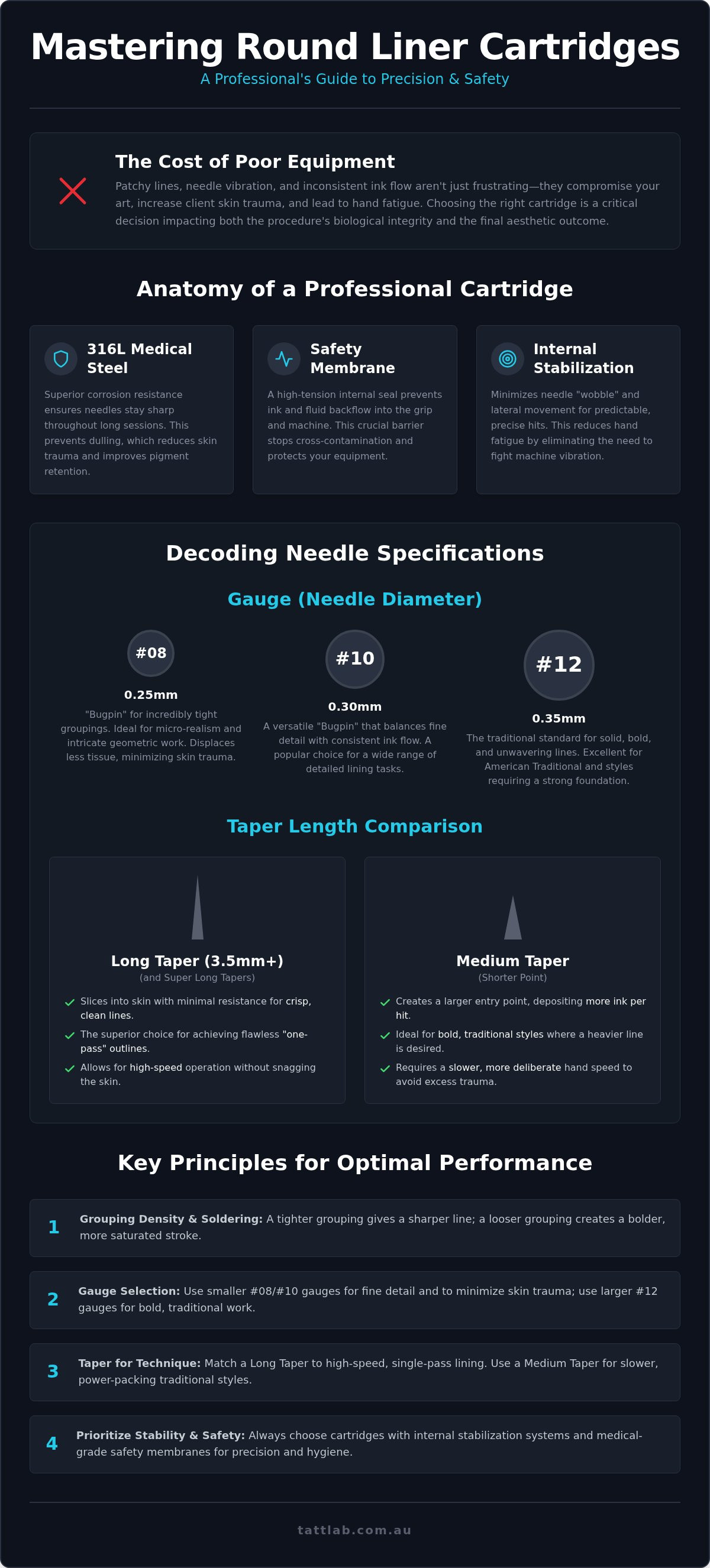
The Round Liner (RL) is the fundamental tool for defining structure in any tattoo. At its core, an RL consists of multiple needles arranged in a circular configuration and soldered together at a precise point. This convergence creates a singular, focused tip designed to deposit ink into the dermis with high specificity. The grouping density, or how tightly those needles are clustered, directly dictates the "weight" of the line. A tighter grouping provides a sharper, more concentrated delivery, whereas a slightly looser grouping allows for a more saturated, bolder stroke. This choice determines the level of skin resistance you'll encounter during the session.
In professional-grade round liner tattoo cartridges, physical integrity is paramount. High-end manufacturers utilize 316L medical-grade stainless steel for the needle pins. This specific alloy is chosen for its superior corrosion resistance and its ability to maintain a sharp point throughout a long session. Using inferior materials can lead to rapid dulling, which increases skin resistance and causes unnecessary trauma for the client. Understanding these components is essential for anyone mastering modern tattooing methods, as the interaction between the needle and the skin is the primary driver of successful healing and pigment retention.
The Role of the Safety Membrane
Modern hygiene standards require more than just a sharp needle. A high-tension safety membrane acts as a dynamic seal within the cartridge housing. Its primary function is to prevent ink, blood, and interstitial fluid from traveling back into the grip or the tattoo machine motor. This prevents cross-contamination and protects your equipment from internal damage. The safety membrane is the primary barrier against cross-contamination between the client and the tattooing hardware.
Internal Stabilization Systems
Precision is often lost due to mechanical vibration. Many standard round liner tattoo cartridges suffer from needle "wobble," where the needle bar moves laterally inside the plastic housing. Premium cartridges feature internal stabilization systems or guides that minimize this play. By reducing plastic-to-plastic friction and centering the needle, these systems ensure a predictable hit every time. For the artist, this stability translates directly into reduced hand fatigue, as you don't have to fight the machine's vibration to maintain a straight line. This mechanical calm allows for longer, more focused sessions without sacrificing the quality of the linework.
Decoding Needle Gauges and Taper Lengths
The gauge of a needle refers to its diameter, a measurement that dictates the volume of the puncture and the amount of pigment delivered to the dermis. Common industry standards include #12 (0.35mm), #10 (0.30mm), and #08 (0.25mm). A #12 gauge is the traditional choice for solid, unwavering lines. In contrast, #10 and #08 gauges, often referred to as "Bugpins," allow for incredibly tight groupings. These smaller diameters are preferred for micro-realism and intricate geometric work because they displace less tissue. This technical nuance is a cornerstone of Tattoo Safety, as selecting the appropriate diameter minimizes unnecessary inflammatory responses in the client's skin.
Taper length describes the distance from the beginning of the needle's point to its thickest part. A Long Taper (3.5mm) or Super Long Taper (5.0mm+) provides a very sharp, thin point. This geometry allows the needle to enter the skin with minimal resistance. Conversely, a Medium Taper has a more abrupt point, which creates a slightly larger entry point. This larger opening allows more ink to be deposited with each hit, making it a favorite for artists who prioritize saturation over surgical thinness. Understanding these geometric differences is vital when selecting round liner tattoo cartridges for specific skin types.
Long Taper vs. Medium Taper for Lining
For artists pursuing the elusive "one-pass" line, the Long Taper is almost always the superior choice. Its slender profile slices into the skin with ease, allowing for high-speed operation without catching or snagging. This results in a cleaner, more consistent line that requires fewer touch-ups. Medium tapers are better suited for bold, traditional styles where a "heavier" look is desired. The shorter taper creates a larger wound channel, which holds more ink but requires a slower, more deliberate hand speed to avoid excessive trauma.
The Science of Ink Saturation
Ink flow isn't just about the taper; it's also about the surface of the needle. Polished needles offer a smooth, glass-like finish that reduces friction, while textured needles have microscopic pits that "grab" more ink. These factors must be balanced with your machine's voltage. A technical tip for your next session: higher gauges typically require more voltage to penetrate effectively due to the increased surface area of the needle tip. Ensuring your power supply is calibrated to your needle's resistance is the key to predictable saturation. To find your ideal balance of power and precision, explore the professional round liner collection available at Tatt Lab.
Comparing the Professional Collection: Elite, EZ, and Revolution
Selecting the right hardware is where technical knowledge meets daily studio practice. While many brands offer similar configurations on paper, the internal engineering of round liner tattoo cartridges varies significantly between professional lines. Elite III cartridges provide a grounded balance between cost-efficiency and precision. They're an excellent choice for artists who require consistent performance for standard sessions without the premium price tag of specialized stabilization systems. This line focuses on the essentials: sharp needles and a reliable safety membrane.
When your work moves into the territory of high-detail realism or complex geometric patterns, the mechanical tolerances of your equipment become more critical. This is where the distinction between a standard cartridge and a specialized professional line becomes apparent. The internal friction, the clarity of the shell, and the responsiveness of the membrane all contribute to the final result on the skin. Choosing between these brands isn't just about brand loyalty; it's about matching the mechanical behavior of the cartridge to your specific hand speed and machine stroke.
Elite EVO: The Professional Standard
The Elite EVO series is specifically engineered for artists who demand absolute mechanical stillness. Its housing design is a result of rigorous artist feedback, featuring a unique tip structure that effectively minimizes ink splashing. This design ensures that the workspace remains clean, allowing for better visibility of your stencil. It's become a staple in professional Australian studios because it addresses the core need for stability during long, intricate sessions. Every box maintains a high standard of needle sharpness, ensuring your last liner is as crisp as your first.
Revolution and EZ V-Select: Innovation in Flow
Innovation in cartridge technology often centers on the interaction between the machine motor and the needle's resistance. The EZ V-Select utilizes a proprietary V-System membrane. This tension-balanced membrane reduces the workload on your machine's motor, promoting longevity for your expensive hardware while maintaining a steady ink flow. It's a design that prioritizes the health of your machine as much as the precision of your line.
Revolution cartridges appeal to those who prefer a minimalist, clinical aesthetic. Their clear shells provide total visibility of the needle and ink reservoir, allowing you to monitor flow and hygiene in real-time. This transparency is a functional benefit, making it easier to see if your needle is properly loaded or if there's any sign of backflow. For a deeper look at how these tools integrate into your professional workflow, consult our Ultimate Guide to Tattoo Needles & Cartridges. Selecting the right brand ensures that your equipment acts as a seamless extension of your hand rather than a mechanical obstacle.
Matching Round Liners to Your Tattooing Style
Success in tattooing depends on aligning your tool's mechanical properties with the specific aesthetic goal. While a universal approach might seem efficient, the physical interaction between the needle and the dermis varies significantly across different artistic styles. Selecting the correct round liner tattoo cartridges ensures that the skin receives the pigment without excessive trauma, facilitating a cleaner healing process and long-term clarity. Each configuration offers a different narrative of progression for the artwork, from the initial stencil to the healed result.
For micro-realism and delicate scripts, the #08 (0.25mm) 3RL has become the industry standard. This configuration displaces minimal tissue, allowing for high-detail work that remains crisp as the skin ages. The smaller diameter reduces the "dot" size of each puncture, which is essential when the margin for error is measured in fractions of a millimeter. When your work requires this level of surgical precision, the mechanical behavior of the needle must be perfectly predictable.
The Fine Line Selection Framework
Achieving a surgical line requires more than just a small gauge; it requires a tight grouping. Round Liner Tight (RLT) configurations are essential here to avoid the "fuzziness" often seen with standard groupings where the needles are slightly more flared. We recommend a Super Long Taper for these delicate tasks, as the slender point enters the skin with the least possible resistance. A common mistake in script work is using a higher needle count than necessary, which can lead to unintended "bleeding" or lines that appear too heavy for the intended scale.
American Traditional work demands the opposite approach. Using #12 (0.35mm) 7RL or 9RL configurations provides the "unbreakable" lines this style is known for. The larger surface area of the #12 needle allows for a higher volume of ink to be deposited in a single pass, ensuring the line is solid from the start. Neo-Traditional artists often expand on this by mixing gauges, using a #12 for the primary frame and a #08 for secondary details to create visual depth through varying line weights.
Bold Lining for Longevity
Solid black saturation is the primary goal for traditional outlines. While long tapers are excellent for precision, many artists prefer medium tapers for these bolder lines. The slightly blunter point of a medium taper creates a wider wound channel, allowing the ink to saturate the entry point more effectively. This creates a dense line that adheres to the "bold will hold" philosophy. Tight round liners are also surprisingly effective for whip shading and dotwork, as the focused point allows for precise stippling and smooth gradients.
To find the exact configuration for your signature style, browse our artist-vetted round liner collection.
Sourcing Quality: Why Australian Artists Choose Tatt Lab
Tatt Lab operates as a dedicated partner for the professional community, bridging the gap between high-end manufacturing and daily studio requirements. As an artist-owned supplier, our selection process is rigorous. We don't simply stock products; we vet hardware to ensure it meets the physical integrity required for elite-level work. For those sourcing round liner tattoo cartridges, this means every box has been tested for needle sharpness and mechanical stability. Our national express shipping ensures that your workflow remains uninterrupted, providing a reliable safety net for busy studios across the country.
Maintaining a professional environment requires a holistic approach to consumables. Beyond needles, we provide a curated range of tattoo inks, stencils, and aftercare. This "one-stop shop" model allows artists to streamline their procurement, ensuring that every component of the procedure, from the first line to the final healing stage, adheres to a consistent standard of quality. Our team provides expert support grounded in technical experience, helping you navigate the science of your tools without the pressure of a traditional sales environment.
Clinical Safety in Every Cartridge
Safety is the cornerstone of our operations. Every cartridge in our collection is constructed from medical-grade plastics and 316L stainless steel, sterilized with EO gas to meet international hygiene standards. These tools are designed to integrate seamlessly with our broader range of medical supplies for tattoo artists. By prioritizing high-tension membranes and sealed systems, we help studios mitigate backflow risks and maintain a sterile field, ensuring both the artist's peace of mind and the client's physical safety.
Ready to Upgrade Your Linework?
Mastering your craft is a continuous narrative of progression. The technical nuances of needle gauge, taper length, and stabilization aren't just details; they're the building blocks of surgical precision. We encourage artists to experiment with different configurations of round liner tattoo cartridges to discover the perfect synergy for their specific hand speed and style. Whether you are refining a micro-realism piece or laying down bold traditional outlines, your hardware should never be the limiting factor in your artistic evolution.
If you are ready to explore our full range of professional Round Liner cartridges, our collection is organized to help you find the exact specifications you need for your next session. We remain committed to providing the tools that support your journey toward technical mastery and uncompromising safety.
Elevating Your Technical Precision
Mastering your linework is an ongoing journey of refinement. By understanding the mechanical interplay between needle gauge, taper length, and internal stabilization, you've moved beyond trial and error toward a more predictable, scientific approach. Whether you're executing a surgical micro-realism piece with a #08 3RL or laying down bold traditional outlines, your choice of round liner tattoo cartridges remains the most critical link between your artistic vision and the client's skin. The physical integrity of your tools dictates the narrative of the healing process and the long-term clarity of the art.
Tatt Lab is a dedicated partner in your professional progression. As an artist-owned and operated supplier, we prioritize medical-grade safety standards and physical integrity in every product we vet for our collection. Our nationwide express shipping ensures your studio is always equipped with the hardware needed for consistent, high-performance outcomes. We invite you to Shop Professional Round Liner Cartridges and experience the difference that stabilized engineering brings to your daily sessions. Your dedication to the craft deserves tools that perform with the same meticulous care you bring to every design. We look forward to supporting your next professional breakthrough.
Frequently Asked Questions
What is the difference between a Round Liner and a Tight Round Liner?
A Tight Round Liner (RLT) features needles that are soldered closer together at the tip compared to a standard Round Liner (RL). This tighter grouping reduces the diameter of the needle cluster, allowing for a more focused delivery of ink. While a standard RL is excellent for general lining, the RLT configuration is the preferred choice for artists executing intricate scripts or micro-realism where every fraction of a millimeter counts toward the final clarity.
Can I use a Round Liner for shading or small fill areas?
You can use round liners for shading, specifically for techniques like whip shading or stippling in small, confined areas. Because the needle grouping is concentrated, it creates a peppered effect that adds texture and depth to the artwork. However, for larger areas of solid fill or smooth gradients, switching to a magnum or round shader is more efficient. This prevents overworking the skin and ensures a more uniform distribution of pigment across the dermis.
How do I know if my cartridge has a safety membrane?
To verify the presence of a safety membrane, inspect the internal housing of the cartridge for a flexible silicone or rubber barrier. This component sits between the needle bar and the back of the cartridge. Most professional round liner tattoo cartridges from reputable brands like Elite or EZ include this as a standard feature. If you can see directly through the cartridge to the machine's drive bar without any obstruction, it likely lacks this critical backflow protection.
What is a "Bugpin" needle and when should I use it?
A Bugpin refers to a needle with a significantly thinner gauge, typically #08 (0.25mm) or #10 (0.30mm). These smaller diameters allow for tighter groupings that displace less tissue during the procedure. You should use Bugpins when your design requires extreme detail, soft transitions, or very fine lines. They are especially useful in micro-realism sessions where minimizing skin trauma is a priority for achieving a delicate, high-definition healed result that remains crisp over time.
Why are my lines coming out patchy even with a new cartridge?
Patchy lines often result from a mismatch between your hand speed and the machine's voltage. If the machine is running too slowly for your movement, the needle won't deposit enough ink per millimeter of skin. Additionally, ensure your needle depth is consistent; if the needle isn't reaching the correct layer of the dermis, the pigment won't hold. Using high-quality round liner tattoo cartridges helps, but you must also calibrate your power supply to the specific resistance of the needle.
Are these cartridges compatible with all rotary tattoo machines?
Most modern cartridges utilize a universal twist-lock connection, making them compatible with the vast majority of rotary tattoo machines and pen-style devices. This industry standard ensures that you can switch between different brands without needing specialized grips or adapters. However, it's always prudent to check the specific connection type of your machine. If your device uses a proprietary system, you may require a specific adapter to maintain the physical integrity of your setup during the session.
How often should I change my cartridge during a long session?
You should change your cartridge if you notice any decrease in needle sharpness or an accumulation of dried ink that hinders the flow. While a single high-quality cartridge often lasts an entire session, very long procedures or working on tougher skin can cause the needle points to dull. If the skin begins to resist the needle more than usual or if you see the line quality degrading, a fresh cartridge will restore the surgical precision required for a successful outcome.
What does the "T" stand for in needle codes like 1207RLT?
The T in needle codes like 1207RLT stands for Tight, indicating that the needles are grouped more closely at the tip than a standard configuration. This designation is essential for artists who need a more concentrated hit for fine linework. For example, a 1207RLT uses #12 gauge needles in a 7-count grouping that is pulled together tightly. This engineering choice provides a sharper, more defined line, which is vital for maintaining the structural integrity of complex designs.


Comments (0)
There are no comments for this article. Be the first one to leave a message!