

A tattoo machine isn't just a tool; it's a clinical instrument that bridges the gap between your artistic vision and the biological integrity of your client's skin. You likely understand that a stuttering motor or a lapse in hygiene protocol is more than just a technical glitch. It's a direct threat to your professional reputation and the safety of those who trust you with their transformation. This tattoo equipment maintenance guide serves as your definitive manual for elevating your studio standards to a medical grade. We've designed this resource to help you manage the complexities of hardware care, ensuring your equipment performs with the same precision on its thousandth hour as it did on its first.
Whether you're balancing the internal mechanics of a high-performance rotary pen or the specific tuning requirements of traditional coil machines, the goal remains a seamless, sterile workflow. We'll explore the science of high-level disinfection, the necessity of professional-grade barriers, and the methodical steps required to pass health inspections with absolute confidence. This guide provides the scientific evidence for a maintenance routine that replaces uncertainty with controlled, predictable progress, allowing you to focus on the art of healing and self-expression.
Key Takeaways
- Understand the critical intersection between mechanical performance and clinical sanitation to protect your professional reputation and client safety.
- Follow this comprehensive tattoo equipment maintenance guide to master the specific cleaning protocols required for both modern rotary pens and traditional coil machines.
- Learn the hierarchy of clinical hygiene, from selecting effective detergents to understanding why medical-grade nitrile gloves are a non-negotiable barrier during the servicing process.
- Identify which internal components require advanced sterilization in an autoclave and how to utilize ultrasonic cleaning for deep-seated contaminants.
- Discover how integrating artist-vetted consumables and high-quality inks prevents internal clogging, significantly extending the operational lifespan of your hardware.
The Clinical Importance of Professional Equipment Maintenance
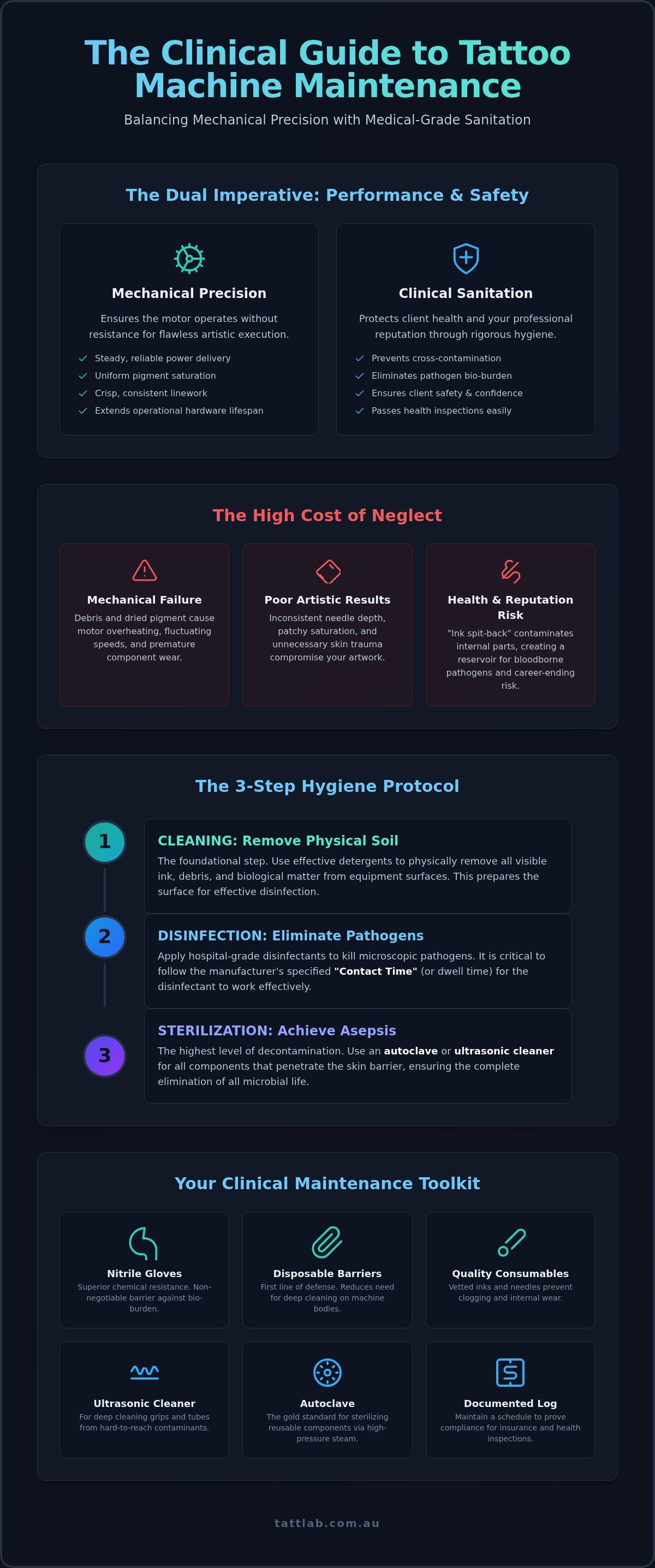
Professional equipment care represents the critical intersection where mechanical precision meets clinical sanitation. In a high-end studio environment, your machine is far more than a tool; it's a sophisticated medical instrument that facilitates the biological transformation of the skin. This tattoo equipment maintenance guide frames the care of your hardware as a non-negotiable protocol for protecting both your artistic legacy and the physical integrity of your clients. When a machine is neglected, the consequences manifest as inconsistent needle depth, poor pigment saturation, and, most dangerously, an increased risk of cross-contamination.
Relying on a simple surface wipe-down is a common but hazardous mistake. Pathogens don't just sit on the exterior; they can migrate into the internal housings, drive bars, and grip attachments through a phenomenon known as ink spit-back. This occurs when fluids travel up the needle bar during the tattooing process and hygiene lapses allow bio-burden to accumulate in areas that are difficult to reach. If these internal components aren't addressed with clinical rigor, the machine becomes a reservoir for bacteria. This eventually leads to motor failure or, in the worst-case scenario, the transmission of bloodborne pathogens that can devastate an artist's career and reputation.
Performance vs. Pathology: A Dual Approach
A well-maintained machine ensures that the motor operates without resistance, providing the steady power required for uniform saturation and crisp line work. When debris or dried pigment builds up within the assembly, the motor must work harder, leading to overheating and fluctuating needle speeds that traumatize the skin. From a clinical perspective, the goal is to eliminate the bio-burden that accumulates during every session. Bio-burden is the total population of viable microorganisms present on or within a tattoo machine housing before any sterilization or high-level disinfection process begins. By managing this biological load, you ensure that your technical performance remains as precise as your safety standards.
Australian Standards and Studio Compliance
Aligning your studio with national health and safety guidelines is essential for maintaining professional insurance and liability coverage. Most Australian jurisdictions require a documented maintenance schedule that proves your equipment is regularly serviced and sterilized according to manufacturer and health department specifications. This methodical approach to record-keeping demystifies the science of studio safety, replacing the anxiety of inspections with a sense of controlled progress. Tatt Lab supports this journey by providing a range of vetted medical supplies for tattoo artists, ensuring that every barrier and cleaning agent you use meets the rigorous demands of a modern clinical environment. Consistent maintenance isn't just a technical chore; it's a commitment to the long-term health of your equipment and the community you serve.
This commitment to professional upkeep is a standard across many industries; for instance, to ensure your vehicle receives similar high-quality care, you can learn more about Veloce Tuning for specialized log book servicing.
Essential Medical Supplies for Your Maintenance Toolkit
Maintaining a professional studio requires a toolkit that looks more like a clinical laboratory than a traditional workshop. To execute an effective tattoo equipment maintenance guide, you must first understand the hierarchy of hygiene. This protocol begins with detergents to remove physical soil, followed by hospital-grade disinfectants to eliminate pathogens, and concludes with sterilization for components that penetrate the skin barrier. Using the wrong grade of cleaner can be a costly mistake. Industrial-strength solvents often degrade the anodized finishes and delicate O-rings of modern rotary machines, leading to premature mechanical failure.
High-quality nitrile gloves are your primary defense during the teardown process. Unlike latex, nitrile offers superior resistance to the petroleum-based lubricants and harsh chemicals used during servicing. They provide a reliable barrier against the bio-burden mentioned in previous sections, ensuring that you don't inadvertently transfer contaminants from the machine to your skin or workspace. Beyond PPE, the use of disposable barriers and machine sleeves is essential. These protective layers act as a first line of defense, significantly reducing the amount of deep mechanical cleaning required by preventing ink and biological fluids from ever reaching the machine's chassis.
Sourcing your supplies from a specialist ensures that your cleaners are compatible with professional hardware. You can find clinical-grade barriers and PPE through the vetted range at Tatt Lab, which prioritizes the physical integrity of both the artist and the equipment.
The Disinfection Arsenal
Precision in disinfection relies heavily on "contact time," also known as dwell time. This is the specific duration a surface must remain visibly wet with a disinfectant to effectively neutralize pathogens. While 70% isopropyl alcohol is excellent for quick evaporation, it may not meet the required contact time for certain resistant viruses. Hospital-grade wipes are often preferred because they are saturated with a balanced chemistry designed to stay active on the surface longer. This meticulous attention to detail is a cornerstone of managing tattoo risks and precautions within a high-traffic studio environment.
Mechanical Maintenance Tools
Lubrication is a science of its own. Using the wrong oil can gum up a motor or cause it to overheat during a long session. Most modern rotaries require a specific synthetic lubricant or a light food-grade grease that won't migrate into the electrical components. For those utilizing traditional coil machines, your toolkit should include precision-ground screwdrivers, feeler gauges for gap adjustment, and replacement springs. Once serviced, store your equipment in a dedicated, non-porous container or a UV-sterilization cabinet to maintain its integrity until your next session begins. This methodical progression from cleaning to protected storage ensures your hardware remains a reliable partner, much like the precision mechanical care provided by Oztrack Performance Tuning & Engines for high-performance automotive systems.
Step-by-Step Cleaning Protocols for Rotary and Coil Machines
Every machine possesses a unique mechanical architecture that dictates its specific care requirements. While the biological risks remain constant across all procedures, the technical approach varies significantly between the sealed precision of a modern rotary pen and the exposed, adjustable components of a traditional coil machine. This tattoo equipment maintenance guide provides a methodical framework for managing both, ensuring your hardware remains a reliable extension of your hand. It's not just about cleaning; it's about preserving the delicate balance of the machine's internal soul.
The "clean-down" ritual begins the moment the needle is removed from the skin. Immediately discard all single-use barriers, sleeves, and cartridges into the appropriate biohazard waste. With your clinical PPE still in place, perform an initial wipe-down of the machine's exterior using a hospital-grade disinfectant to stabilize the bio-burden before any disassembly occurs. This immediate action prevents pigment and biological fluids from drying, which makes subsequent deep cleaning much more effective. It's a steady, predictable process that prioritizes safety above speed.
Rotary Pen Maintenance: The External Focus
Modern rotary pens are often designed as closed systems to protect the precision motor from external contaminants. You shouldn't attempt to lubricate or open a sealed rotary motor. Doing so typically voids your warranty and risks introducing debris into the drive mechanism. Instead, focus your attention on the grip and the internal plunger bar area. Use a dampened, not saturated, medical wipe to clean the connection point where the cartridge sits. Inspect the O-rings for wear and apply a microscopic amount of manufacturer-recommended lubricant only if the movement feels restricted. This minimalist approach respects the high-end engineering of the device.
Coil Machine Maintenance: The Mechanical Teardown
Traditional coil machines are mechanical workhorses that require a more invasive teardown to maintain optimal conductivity. Because their components are largely exposed, they're prone to accumulating a layer of carbon and dried ink that can impede the electrical circuit.
- Clean the contact screw and binding posts with a fine-grit abrasive or a dedicated metal cleaner to ensure a crisp electrical connection.
- Inspect the front and rear springs for signs of fatigue, rust, or hairline fractures that could cause a mid-session failure.
- Wipe down the frame and coils with a high-level disinfectant, paying close attention to the crevices where the armature bar meets the coils.
Once reassembled, perform a brief performance test. Run the machine at your standard voltage to listen for any irregular vibrations or mechanical stutter. This final step confirms the machine is session-ready, replacing uncertainty with the calm confidence of a prepared professional. It's a liberating feeling to know your equipment won't let you down during a transformative piece of work.
Advanced Sterilisation: Ultrasonic Cleaners and Autoclave Safety
Advanced sterilisation represents the highest tier of studio hygiene. While the previous sections of this tattoo equipment maintenance guide focused on immediate surface care and mechanical teardowns, certain components require a deeper level of intervention to ensure absolute safety. Surface disinfection alone cannot reach the microscopic crevices of textured grips or the internal channels of reusable hardware. For these items, you must employ mechanical and thermal processes that eliminate life at a microbial level, transforming your tools back into a pristine, sterile state.
This phase of maintenance is about more than just cleanliness; it's about the physical integrity of your equipment. Using professional-grade sterilisation hardware protects your investment by removing corrosive biological matter that can degrade stainless steel over time. By following a methodical progression from cleaning to sterilisation, you replace the uncertainty of "clean enough" with the calm confidence of medical-grade results. This rigorous approach is what separates a standard studio from a high-end clinical facility.
Ultrasonic Cleaning Best Practices
Ultrasonic cleaners utilize a scientific process called cavitation to remove debris that manual scrubbing might miss. High-frequency sound waves create millions of microscopic bubbles in an enzymatic solution. When these bubbles collapse, they release a focused burst of energy that physically dislodges dried pigment and biological matter from every surface. Executing this stage of your tattoo equipment maintenance guide correctly ensures that your hardware remains free of microscopic contaminants. It's critical to use a solution specifically formulated for tattoo pigments, as standard detergents often fail to break down the complex carriers found in professional inks.
Only stainless steel grips and non-electrical hardware should enter the ultrasonic bath. You must never submerge a rotary motor or any electronic component in an ultrasonic cleaner, as the vibration and moisture will cause immediate, irreversible damage to the internal circuitry. After the cycle, parts must be thoroughly rinsed with distilled water and dried completely to prevent flash-rusting before they move to the autoclave.
Autoclave Integration for Reusable Hardware
The autoclave is the definitive tool for achieving a sterile state through the use of saturated steam and high pressure. To maintain studio integrity, use professional sterilisation pouches with integrated chemical indicators. These indicators change colour to verify that each cycle has reached the necessary temperature and pressure. The widespread adoption of modern tattoo cartridges has significantly streamlined this process, as these single-use items eliminate the need for complex internal tube sterilisation. However, for those using traditional reusable grips, managing the "sterile chain" from the autoclave to the workstation is paramount.
Store your bagged items in a clean, dry, and dedicated environment. Only open these pouches in the presence of the client to build immediate trust and demonstrate your commitment to their safety. Regular maintenance of your sterilisation hardware is just as important as the process itself. Perform weekly spore tests and routine seal inspections to ensure your autoclave operates at the required clinical standards. For the medical-grade PPE and clinical indicators required to maintain these high-standard protocols, source your studio essentials from Tatt Lab.
Maintaining Studio Integrity with Tatt Lab Supplies
Maintaining a high-standard studio is a continuous narrative of precision and care. While this tattoo equipment maintenance guide has detailed the technical protocols for hardware longevity, the final pillar of studio integrity rests on the quality of the consumables you choose. Professional artists trust Tatt Lab because we provide a curated selection of medical-grade supplies that mirror the rigor of a clinical facility, ensuring that every barrier, cleaner, and pigment supports your machine's performance rather than hindering it. This partnership allows you to focus on the liberating art of transformation while we manage the science of your toolkit.
One often overlooked aspect of machine care is the chemistry of the pigments used. Using artist-vetted tattoo ink is essential for preventing internal clogging and motor strain. Low-quality pigments with inconsistent particle sizes or unstable carriers can accumulate within the cartridge housing or the internal drive bar of rotary machines. This accumulation creates unnecessary friction, forcing the motor to work harder and leading to overheating or premature failure. By choosing pigments that are tested for flow and stability, you protect the mechanical heart of your equipment and ensure consistent, predictable results for your clients.
A well-stocked studio is a resilient studio. By maintaining a consistent inventory of maintenance essentials, you reduce the risk of downtime and the need for emergency repairs. This proactive approach allows for a steady, educational workflow where safety is never compromised for speed. Tatt Lab's commitment to quality and national Australian support means you have a dedicated partner from the initial supply order to the final, healed result, replacing the anxiety of equipment failure with a sense of controlled progress.
Sourcing Your Maintenance Essentials
Compliance with Australian health standards requires a methodical approach to inventory management. Your maintenance checklist should include medical-grade nitrile gloves, barrier film, machine sleeves, and high-level enzymatic cleaners. Sourcing these through a wholesale supply model ensures that busy Australian studios remain fully equipped without the stress of frequent reordering. Using premium medical-grade products isn't just about passing inspections; it's about providing a reassuring environment where science meets health, prioritizing the physical integrity of every client who enters your space.
The Tatt Lab Difference: Expert Knowledge
We understand the vulnerability inherent in the tattooing process, which is why Tatt Lab functions as a trusted specialist rather than a high-pressure sales environment. Our team provides professional support for equipment queries, helping you bridge the gap between clinical safety and artistic excellence. This collaborative approach ensures that your studio standards evolve alongside the latest biological and mechanical advancements. To ensure your hardware performs with clinical precision, we invite you to explore our full range of professional tattoo supplies.
Elevating Your Studio Standards to Clinical Excellence
Adopting a rigorous maintenance routine is a transformative step that moves your practice from a technical task to a narrative of professional assurance. By integrating the protocols outlined in this tattoo equipment maintenance guide, you ensure that every session is supported by a foundation of mechanical precision and medical-grade safety. You've learned that the intersection of high-level disinfection and meticulous mechanical care is what protects your reputation and the physical integrity of your clients. This steady, methodical approach replaces the uncertainty of hardware failure with a sense of controlled, predictable progress.
As an artist-owned and operated specialist, Tatt Lab understands the specific demands of a modern studio environment. We bridge the gap between clinical rigor and artistic excellence with a comprehensive range of medical-grade PPE and disinfectants designed for the specialized needs of the industry. With express nationwide shipping across Australia, we ensure your facility remains a high-end laboratory where science meets health. Secure your studio's safety with professional medical supplies from Tatt Lab and continue your journey toward mastery with the confidence that your equipment is as resilient as your vision.
Frequently Asked Questions
How often should I deep clean my tattoo machine?
You should perform a surface disinfection after every session and a thorough mechanical clean down at the end of each working day. While barriers prevent most contamination, microscopic particles can still migrate during the tattooing process. Following a consistent schedule ensures your hardware remains a reliable partner in your creative process and prevents the accumulation of bio-burden within the machine housing.
Can I use WD-40 to lubricate my tattoo machine?
No, you should never use WD-40 on a tattoo machine because it is primarily a solvent rather than a long-term lubricant. It can break down internal seals and attract dust, which leads to motor friction and overheating. Instead, use a microscopic amount of manufacturer-recommended synthetic oil or food-grade grease to maintain smooth mechanical movement without compromising the motor's integrity.
What is the difference between sanitising and sterilising tattoo equipment?
Sanitising involves using chemical agents to reduce the number of pathogens on a surface to a safe level, whereas sterilising is a total process that eliminates all microbial life, including resistant spores. In this tattoo equipment maintenance guide, we emphasize that while frames can often be disinfected, any component that breaks the skin barrier must be processed in an autoclave to meet clinical standards.
Do rotary tattoo pens need to be oiled?
Most modern rotary pens feature a sealed motor design that does not require internal oiling. Attempting to lubricate these closed systems can actually damage the electronics and void your warranty. You should only apply a tiny amount of lubricant to the external plunger bar or O-rings if the manufacturer’s instructions specifically recommend it for maintaining smooth cartridge movement and preventing friction wear.
Is it safe to put my tattoo machine motor in an ultrasonic cleaner?
You must never submerge a tattoo machine motor in an ultrasonic cleaner. The high-frequency vibrations and moisture will cause immediate, irreversible damage to the electrical components and internal bearings. Ultrasonic cleaning is strictly reserved for non-electrical hardware like stainless steel grips and tubes after they have been disassembled from the motor housing to remove deep-seated debris.
How do I know if my autoclave is working correctly?
You can verify your autoclave's performance by using biological indicators, commonly known as spore tests, on a weekly basis. These tests provide the scientific evidence that the machine is successfully eliminating resistant microorganisms. Additionally, always check the chemical indicator tape on your pouches to ensure each cycle has reached the required temperature and pressure for total, predictable sterilisation.
What should I do if ink gets inside my rotary machine motor?
If ink migrates into your rotary motor, you should stop using the machine immediately to prevent the pigment from drying and seizing the internal drive. Don't attempt to spray liquid cleaners directly into the motor housing, as this can short-circuit the electronics. Your best course of action is to contact the manufacturer for a professional service to ensure the motor is safely cleaned without compromising its physical integrity.
Can I use rubbing alcohol to clean my tattoo machine frame?
You can use 70% isopropyl alcohol for quick surface disinfection, but it may not provide the necessary contact time to kill all bloodborne pathogens. It's also important to note that high concentrations of alcohol can eventually degrade certain anodized finishes or plastic components. For a more comprehensive result, use hospital-grade disinfectant wipes that are specifically formulated to remain active on surfaces long enough to ensure clinical safety.


Comments (0)
There are no comments for this article. Be the first one to leave a message!