

Your new tattoo isn't just a piece of art; it's a deliberate, controlled dermal wound that demands the same biological respect as a surgical site. Understanding the tattoo healing process is vital because the way your skin reconstructs itself determines the lifelong clarity and vibrancy of your ink. It's normal to feel a surge of anxiety when you notice initial weeping or the first signs of scabbing. You want to protect your investment, yet conflicting aftercare advice often makes it difficult to distinguish between a healthy recovery and a potential complication.
We believe that transparency and scientific rigor are the best tools for a successful recovery. This professional guide provides you with a clear roadmap of what your body is doing at a cellular level during each stage of repair. You'll gain the confidence to identify normal skin reactions versus red flags, ensuring your journey from the studio to a fully settled piece is seamless. We'll examine the progression from the acute inflammatory phase to the final maturation of the dermis, giving you the expert guidance required for vibrant, healthy results.
Key Takeaways
- Identify why the initial discharge of plasma and ink is a healthy biological response rather than a cause for alarm.
- Navigate the secondary "ugly phase" with confidence by understanding how scabbing and peeling signal successful cellular regeneration.
- Master the tattoo healing process by learning to differentiate between normal inflammatory stages and genuine signs of infection.
- Discover why long-term skin integrity depends on a six-month maturation window where the dermis fully stabilizes the ink.
- Understand the clinical advantage of using professional-grade aftercare balms to support the skin's barrier more effectively than generic alternatives.
The Biological Blueprint: Understanding the Stages of Tattoo Healing
A tattoo isn't merely a cosmetic addition; it's a medical-grade dermal wound that triggers a complex cascade of biological responses. While many view the biological process of tattooing as a simple surface treatment, it actually involves a deep structural impact across the epidermis and the dermis. Your body doesn't recognize "art" in the traditional sense. Instead, it identifies a breach in its primary defense barrier and immediately initiates a sophisticated reconstruction effort to restore skin integrity.
We approach recovery through a "Skin Integrity" framework. This philosophy prioritizes the proactive preservation of the skin's natural barrier rather than reacting to complications after they occur. It's much more effective to protect a healthy healing environment through precise aftercare than it is to attempt to "fix" a patchy, faded, or compromised result later. Understanding the tattoo healing process requires looking beneath the surface at how your cells cooperate to lock in pigment.
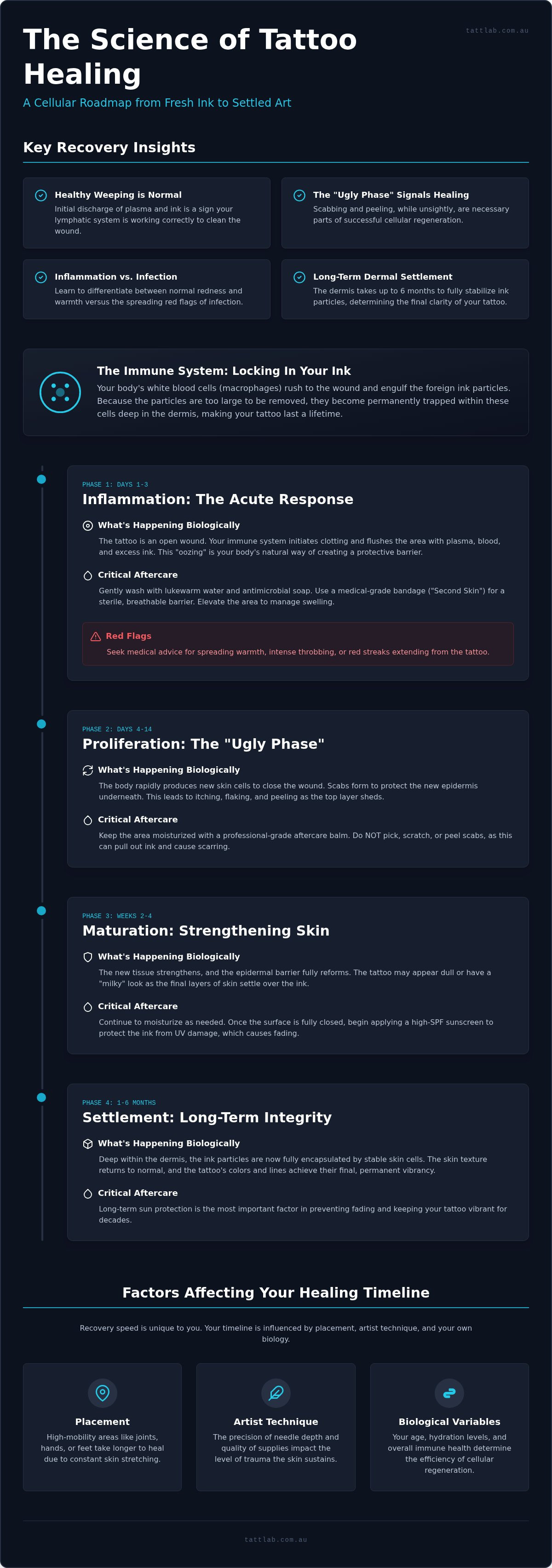
The journey from a fresh wound to a settled piece of art follows four primary phases:
- Inflammation: The immediate immune response to trauma, characterized by redness and swelling.
- Proliferation: The rapid production of new skin cells to close the wound.
- Maturation: The strengthening of the new tissue and the reforming of the epidermal barrier.
- Settlement: The long-term stabilization of ink particles within the dermal layer.
The Role of the Immune System in Ink Retention
As soon as the needle enters the dermis, your immune system activates. Specialized white blood cells called macrophages rush to the site. They attempt to "clean up" the foreign ink particles by engulfing them. Because many ink particles are too large for the macrophages to digest, they remain trapped within the cell. While some ink is carried away through the lymphatic system and some is lost during epidermal shedding, the majority remains. Dermal settlement is the process where ink particles are permanently encapsulated by skin cells, ensuring the tattoo remains visible long after the initial wound has closed.
Factors Affecting Your Unique Healing Timeline
No two bodies recover at the same rate. Your unique timeline is influenced by several clinical variables that dictate how quickly your skin can repair itself. Placement is a primary factor; tattoos on high-mobility areas like joints or hands often take longer to heal because the skin is constantly stretching and pulling. Artist technique also plays a role, as the precision of needle depth and the choice of professional tattoo supplies impact the level of trauma the skin sustains. Finally, biological variables such as your age, hydration levels, and overall immune health will determine the efficiency of your cellular regeneration.
The Inflammatory Phase: Managing the Critical First 72 Hours
The first 72 hours of the tattoo healing process are a period of high-alert biological activity. During Day 1, your tattoo is technically an open wound. It's common to see a mixture of plasma, blood, and excess ink pooling on the surface. This "oozing" isn't a failure of the skin; it's a sign that your lymphatic system is working to flush out debris and initiate clotting. Your body is essentially creating its own internal bandage to protect the newly deposited pigment in the dermis.
You'll likely notice a distinct warmth emanating from the tattooed area. This is a natural byproduct of increased blood flow as white blood cells rush to the site of trauma. However, it's vital to distinguish this from the early signs of infection. Normal inflammatory heat is localized and typically subsides by Day 3. If the warmth spreads, intensifies, or is accompanied by persistent throbbing and red streaks, it's time to seek professional medical advice. By the end of the third day, the skin begins its first structural seal, transitioning from a weeping wound to a stabilizing, albeit sensitive, surface.
Immediate Aftercare Protocols
The first wash is a delicate operation. You need to remove dried lymph and excess ointment without being abrasive. Use lukewarm water and a fragrance-free, antimicrobial soap to gently break down the biofilm. Many collectors now prefer "Second Skin" medical-grade bandages, which provide a sterile, breathable barrier that mimics the skin's natural function. Following professional tattoo aftercare instructions during this phase ensures you don't disrupt the delicate clotting process. To manage swelling, especially on the lower extremities, keep the area elevated and use cool compresses on the surrounding, non-tattooed skin.
Avoiding Early-Stage Contamination
Maintaining a sterile environment extends beyond the studio chair. While your artist relies on high-quality medical supplies for tattoo artists to ensure a clean procedure, the responsibility shifts to you once you leave. Friction is a major enemy. Tight clothing can pull at the healing tissue or trap bacteria against the wound. Avoid environmental hazards like gym floors, public pools, and pet dander, which are common vectors for contamination. Choosing a dedicated professional tattoo aftercare routine helps maintain the pH balance of the skin while providing a reliable barrier against these external threats.
The Proliferative Phase: Navigating Peeling, Itching, and Scabbing
Days 4 through 14 often represent the most challenging stretch of the tattoo healing process. This period, known as the proliferative phase, is when your body focuses on cellular regeneration to close the epidermal breach. You'll likely encounter what many collectors call the "ugly phase," where the crisp lines of your new art are obscured by peeling skin and a dull, cloudy appearance. This cloudiness, or "silver skin," is a layer of newly formed, immature skin cells that haven't yet reached full transparency. It's a hallmark of successful epithelialization and a sign that your body is successfully shielding the ink in the dermis.
During this stage, your sensory nerves often become hypersensitive as the skin tightens and contracts. This leads to an intense itching sensation that can be more frustrating than the initial procedure. It's vital to distinguish between healthy shedding and trauma-induced scabbing. Healthy peeling resembles the fine, flaky texture of a mild sunburn. Conversely, thick, heavy scabs usually indicate localized trauma, excess fluid buildup, or improper moisture levels. While fine peeling is a standard part of recovery, deep scabbing requires extra vigilance to ensure the underlying pigment isn't displaced.
Moisture Management and TEWL
As the new epidermis forms, it's highly susceptible to Transepidermal Water Loss (TEWL). This is the process where water evaporates through the skin's surface, leading to the "tight" or "cracked" feeling common in the second week. To combat this, we recommend a "thin layer" rule. Over-moisturizing can be just as detrimental as dehydration; it traps bacteria and can cause "bubbling," where the scab softens and lifts prematurely. Utilizing specialized tattoo aftercare products provides a controlled breathable barrier that generic, petroleum-heavy lotions cannot replicate.
The Golden Rule: Non-Intervention
The biological cost of picking at your tattoo is high. When you forcibly remove a scab or a flake of skin, you risk pulling out ink particles that haven't yet been fully encapsulated by macrophages. This leads to "holidays" or gaps in the finished piece and increases the risk of permanent scarring. Following dermatologist-approved tattoo aftercare means practicing strict non-intervention. If the itch becomes unbearable, try gently tapping the area or applying a clean, cold compress to soothe the nerves. If you notice "pitting" or scabs that appear yellow or greenish, consult your artist immediately, as these are clinical indicators of a compromised healing environment.
The Maturation Phase: Long-Term Skin Integrity and Color Settlement
While many sources suggest the tattoo healing process concludes within three weeks, biological maturation actually extends far beyond the visible surface repair. Between weeks three and six, your epidermis fully reforms its protective barrier, but the deeper dermal layers remain in a state of flux. It takes approximately six months for the dermis to fully stabilize and encapsulate the pigment. During this extended window, the ink is still "settling" into its permanent position. This is why a tattoo may look slightly different at six months than it did at six weeks; the edges soften slightly as the body completes its long-term integration of the foreign particles.
UV radiation is the primary catalyst for long-term ink degradation. High-energy UV rays penetrate the skin and can physically fragment tattoo ink particles, allowing the immune system to carry them away more easily. This results in premature fading and loss of detail. Consistent sun protection isn't just about preventing burns; it's a lifelong commitment to preserving the integrity of your art. Longevity also depends on hydration from within. Your skin's elasticity is driven by internal nutrient intake, and a diet rich in antioxidants helps prevent the dullness that often affects older tattoos.
To further enhance your skin's resilience and appearance as it matures, check out Organic Skin & Body Med Spa to explore how professional aesthetic services can maintain your "living canvas" at its best.
Maintaining the Barrier Function
Once the "silver skin" phase has fully transitioned back to a normal texture, you should move from intensive healing balms to high-quality daily maintenance moisturizers. It's usually safe to resume normal skin care routines, including gentle exfoliation, after the six-week mark. Avoid aggressive chemical peels or abrasive scrubs on the area until the six-month maturation window has closed. If you're experiencing significant muscle growth or weight changes, matured ink typically adapts well to gradual shifts, though rapid fluctuations can occasionally cause slight distortion in fine-line work.
Identifying Long-Term Complications
It's important to distinguish between a "blowout" and normal settling. A blowout occurs when ink spreads into the subcutaneous fatty layer during the procedure, usually appearing as a blueish halo. Normal settling, however, is a subtle softening of lines that occurs months later as the dermis stabilizes. Occasionally, delayed hypersensitivity reactions to specific pigments can occur years after the initial session. If you notice localized itching or raised skin on specific colors long after the heal, it's often an immune response rather than an infection. Professional touch-ups can address minor settling issues, but they should only be performed once the skin has reached full biological maturity.
For long-term preservation and skin health, you can browse our artist-vetted tattoo aftercare collection to find the right maintenance products for your routine.
Professional Aftercare: Curating Your Recovery with Tatt Lab
The final success of your tattoo healing process isn't determined solely in the studio chair; it's defined by the environment you curate for your skin in the following weeks. While your body provides the biological machinery for repair, the quality of the topicals you apply dictates the efficiency of that reconstruction. We prioritize artist-vetted tattoo supplies because the professional studio environment shouldn't end when you walk out the door. High-grade recovery tools ensure that the transition from an open wound to settled art is managed with clinical precision.
Many generic supermarket alternatives rely heavily on petrolatum-based formulas. While these are inexpensive, they are often occlusive, meaning they create a suffocating seal over the skin. This can trap heat and bacteria, leading to the "bubbling" of scabs and a higher risk of infection. Professional-grade balms are engineered to be breathable, supporting the skin's natural gas exchange while providing essential lipids to the reforming epidermal barrier. By choosing specialized products, you're investing in a results-oriented approach that values long-term skin integrity over a quick, superficial fix.
The Tatt Lab Selection Criteria
Our selection process is governed by a commitment to safety and performance. We only stock products that respect the delicate pH balance of healing tissue. This includes industry staples like Dr Pickles Original Formula, which has become a professional favorite for its ability to soothe inflammation without clogging pores. Beyond balms, we emphasize the use of sterile, medical-grade disposables during the critical first wash. Using clean, professional-grade paper towels and antimicrobial soaps prevents the cross-contamination that often occurs with household linens.
Next Steps for Your Ink Journey
As you move through the maturation phase, remember that your tattoo artist is your primary consultant. If you notice any deviations from the recovery roadmap we've discussed, seek their professional advice early. Preparation is the best defense against complications. You can secure your aftercare essentials through our online store, where we offer free express shipping across Australia on all orders over $100. This ensures you have the clinical-grade tools you need exactly when your skin needs them most. We invite you to join our community for ongoing education on skin health, ensuring your collection remains as vibrant and defined as the day it was settled.
The relationship between an artist, a collector, and their supplies is a partnership. By respecting the biological requirements of your skin and utilizing professional-grade tattoo aftercare, you ensure that your personal narrative of transformation is preserved with the clarity it deserves. Your skin is a living canvas; treat it with the scientific rigor it requires.
Mastering the Art of Dermal Recovery
The journey from a fresh procedure to a fully matured piece of art is a sophisticated biological narrative. You've learned that the tattoo healing process extends far beyond the initial peeling phase, requiring consistent support for up to six months as the dermis stabilizes. By prioritizing skin integrity through the inflammatory and proliferative stages, you ensure your ink remains a vibrant testament to your personal transformation. Patience and precision are your most valuable tools during this recovery window.
Success depends on the synergy between your body's natural repair mechanisms and the quality of the topicals you choose. At Tatt Lab, we bridge the gap between clinical rigor and aesthetic excellence. As an artist-owned and operated specialist, we provide access to the same professional-grade medical and tattoo supplies used in Australia's leading studios. We don't just sell products; we offer the scientific foundation for a successful heal.
Secure your professional aftercare essentials at Tatt Lab Australia and benefit from our express nationwide shipping. Your commitment to expert care today secures the clarity and longevity of your art for years to come. Trust the science of recovery and enjoy the confidence of a perfectly settled, vibrant tattoo.
Frequently Asked Questions
How long does the tattoo healing process actually take?
The initial surface phase of the tattoo healing process typically takes two to three weeks, but full biological recovery requires significantly more time. While the epidermis closes relatively quickly, the underlying dermis takes up to six months to fully stabilize and encapsulate the ink particles. You should treat the area with specialized care until the skin texture has completely returned to its natural, resilient state.
Is it normal for my tattoo to leak ink and fluid on the first day?
Yes, it's completely normal to see plasma, blood, and excess ink weeping from the site during the first 24 hours. This fluid is a sign that your lymphatic system is actively flushing the wound and initiating the clotting process. Simply wash the area gently with antimicrobial soap as instructed by your artist to prevent a thick biofilm from forming on the surface.
What are the signs of a tattoo infection vs. normal healing?
Normal healing involves localized redness, minor swelling, and warmth that subsides within 72 hours. In contrast, a clinical infection often presents as intensifying pain, spreading red streaks, or the presence of thick, foul-smelling yellow or green discharge. If you experience a fever or persistent throbbing that extends beyond the first few days, seek an immediate medical evaluation to protect your health and your art.
Can I exercise or go to the gym while my tattoo is healing?
You should avoid strenuous exercise for at least the first 48 to 72 hours to prevent excessive swelling and mechanical friction. Once the initial inflammatory phase passes, you can resume light activity, but avoid gym floors and shared equipment that harbor bacteria. Sweat itself isn't the primary concern; rather, it's the physical pulling of the skin and the risk of environmental contamination during the tattoo healing process.
Why does my tattoo look cloudy or dull in the second week?
This cloudy appearance is known as "silver skin" and is a healthy sign of immature skin cells forming over the wound. During the second week, these new cells are not yet fully transparent, which temporarily obscures the vibrancy of the ink beneath. As the skin matures over the coming weeks and the layers thicken, the clarity and sharpness of your tattoo will gradually return to its intended state.
When can I stop using specialized aftercare balm and switch to regular lotion?
You can typically transition to a high-quality, fragrance-free daily moisturizer once the peeling stage is complete, which usually occurs around the 14-day mark. Specialized aftercare balms are formulated for the acute phase when the skin barrier is actively compromised. Once the new epidermis has fully closed, your focus shifts from wound healing to maintaining long-term hydration and barrier function.
What should I do if my tattoo starts scabbing heavily?
If heavy scabbing occurs, the most important rule is to never pick or pull at the tissue. Picking can lead to "pitting" and permanent ink loss by removing pigment that hasn't yet settled. Maintain a clean environment and apply a very thin layer of professional balm to keep the scab pliable. If the scabs appear exceptionally deep or show signs of yellowing, consult your artist for a clinical assessment.
How soon can I go swimming or submerge my new tattoo in water?
You must avoid swimming in pools, oceans, or hot tubs for at least two to four weeks until the skin is fully sealed. Submerging a healing tattoo introduces opportunistic bacteria to an open wound and can lead to serious infection or ink leaching. Wait until the peeling phase has entirely finished and your skin has formed a complete, resilient barrier before exposing it to any body of water.


Comments (0)
There are no comments for this article. Be the first one to leave a message!