

Relying on a single multipurpose ointment to protect your fresh ink from day one to day thirty is one of the easiest ways to compromise your results. Effective tattoo skin healing isn't a static, one-step routine. Your recovering epidermal barrier undergoes distinct biological shifts, each requiring targeted support rather than a heavy layer of whatever happens to be sitting in your medicine cabinet.
If you feel overwhelmed by contradictory advice across forums and studio counters while dreading dry scabbing or faded linework, you aren't alone. Watching your skin peel, tighten, and itch without knowing whether to reach for a dense balm or a light lotion can make anyone anxious about protecting their investment.
This guide demystifies the recovery process so you can select the right formulations for every stage of healing, ensuring rich ink retention and resilient barrier repair. You'll learn the clinical criteria behind ingredient selection, how to match aftercare to your specific skin type, and the exact roadmap needed for a clean, predictable heal.
Key Takeaways
- Understand the cellular biology of tattoo skin healing to see why your ink relies on structured epidermal repair rather than passive waiting.
- Compare ointments, balms, and lotions by their lipid ratios so you never suffocate fresh tissue or starve peeling skin.
- Identify restorative active ingredients like provitamin B5 while avoiding the fragrances and drying alcohols that trigger contact dermatitis.
- Match your aftercare formulations directly to wound weeping, peeling stages, and placement friction to stop heavy scabbing before it starts.
- Discover artist-vetted aftercare products designed to protect your investment and maintain long-term pigment saturation across Australia.
The Biology of Tattoo Skin Healing: Understanding Epidermal Recovery
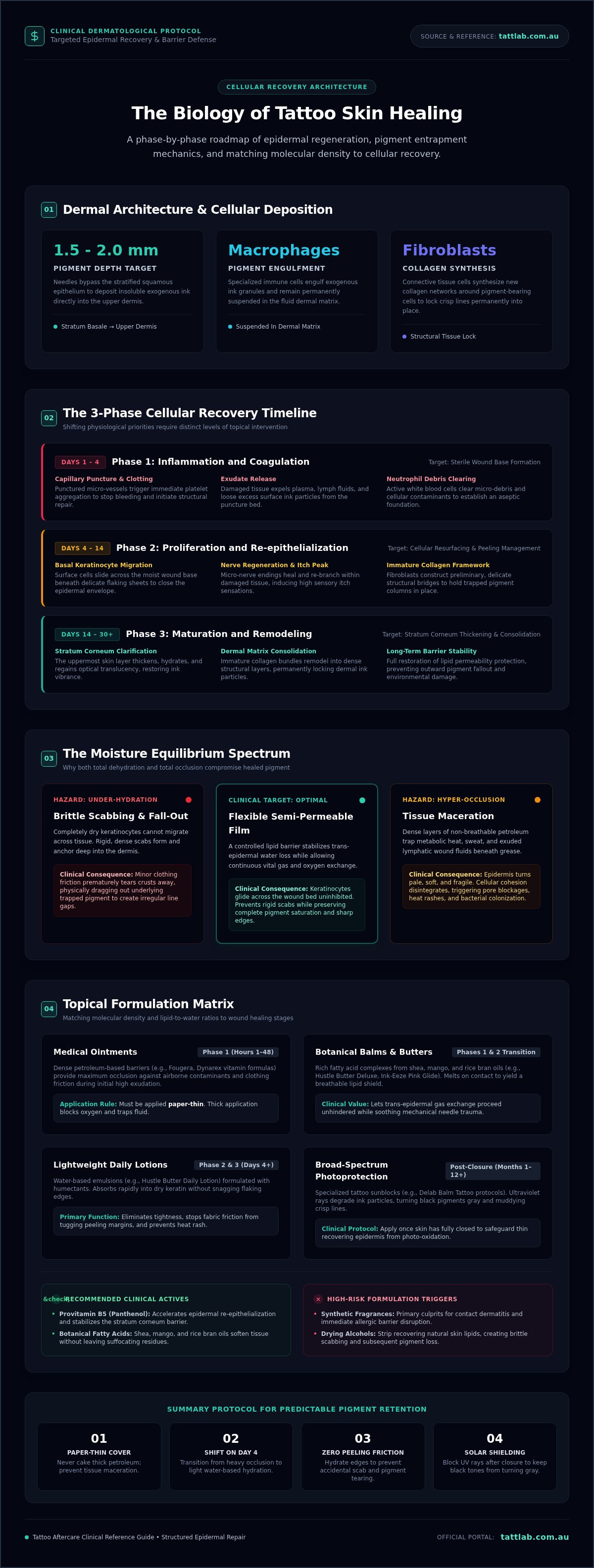
A fresh tattoo is an intentional puncture wound penetrating both the stratified squamous epithelium and the upper dermis. During application, needles deposit insoluble pigment roughly 1.5 to 2 millimetres beneath the surface. To lock in crisp linework, your immune system initiates a complex cascade. As detailed in clinical overviews of the biology of tattoo healing, specialized white blood cells called macrophages engulf the exogenous ink particles. These cells remain suspended within the dermal matrix while fibroblasts synthesize new collagen to secure them. Successful tattoo skin healing relies entirely on how efficiently the overlying epidermis can resurface itself without pulling that underlying pigment outward.
Phase 1 to Phase 3: The Cellular Recovery Timeline
Biological recovery moves through three continuous stages that demand shifting levels of topical support:
- Phase 1: Inflammation and Coagulation (Days 1-4). Punctured capillaries trigger platelet aggregation, while damaged tissue releases plasma, excess ink, and lymph fluid. Neutrophils clear cellular debris to establish a sterile wound base.
- Phase 2: Proliferation and Re-epithelialization (Days 4-14). Basal keratinocytes migrate across the wound bed beneath light peeling skin. As nerve endings regenerate, itchiness peaks while fibroblasts weave an immature collagen framework.
- Phase 3: Maturation and Remodeling (Days 14-30+). The stratum corneum thickens and clarifies. Beneath the surface, the dermal architecture consolidates, locking the suspended pigment into place for long-term stability.
Why Proper Hydration Protects Against Ink Fall-Out
Keratinocytes require a moist wound environment to slide across the tissue bed. If your healing skin dries out completely, it forms thick, brittle crusts. These rigid scabs anchor deep into the dermis. Any minor movement or clothing friction tears the scab off prematurely, tearing out trapped pigment and leaving irregular gaps in your linework.
Suffocating the area creates the opposite hazard. Applying thick layers of non-breathable grease traps heat and exuded fluids, leading to tissue maceration. Macerated skin turns pale, soft, and fragile, which breaks down cellular cohesion and invites bacterial colonization. Balanced tattoo skin healing maintains a flexible, semi-permeable lipid film. This controlled environment stabilizes trans-epidermal water balance, prevents heavy crusting, and keeps your healed lines sharp and fully saturated.
Tattoo Aftercare Product Formulations: Balms, Ointments, and Lotions Compared
Every recovery phase requires a deliberate lipid-to-water ratio. Selecting aftercare isn't about finding a single universal cure; it's about matching molecular density to your skin's current cellular state. Medical ointments shield freshly punctured tissue, plant-derived balms nourish active epithelial cells, and daily lotions rehydrate the surface without suffocating tissue. Managing your tattoo skin healing requires balancing this barrier without blocking trans-epidermal oxygen exchange.
Medical Ointments vs. Natural Plant Balms
Medical-grade ointments, such as Fougera or Dynarex vitamin formulas, create an immediate, semi-occlusive barrier. They shield vulnerable raw dermis from ambient airborne contaminants and clothing friction during the initial hours of high exudation. However, they must be spread paper-thin. Overapplying dense petroleum bases can trap metabolic heat and fluid.
Conversely, botanical butters rely on rich fatty acid profiles from shea, mango, or rice bran oils. Formulations like Hustle Butter Deluxe melt cleanly on skin contact, creating a breathable lipid film that softens tissue while letting cellular gas exchange proceed unhindered. Botanical glide formulas like Ink-Eeze Pink Glide combine this breathability with targeted calming agents, soothing mechanical needle irritation without leaving a greasy, suffocating residue.
Lightweight Daily Lotions vs. Heavy Emollients
Once active peeling starts around day four, your tissue needs hydration rather than heavy occlusion. Water-based lotions absorb fast, distributing humectants into dry epidermal sheets without catching on flaking edges:
- Fluid hydration: Lightweight formulas like Hustle Butter Daily Lotion deliver moisture deep into dry keratin layers, eliminating uncomfortable tightness.
- Reduced friction: Non-greasy emulsions stop clothing from tugging delicate peeling margins, preventing accidental pigment loss.
- Heat regulation: Heavy emollients applied to hot, flaking skin trap metabolic warmth, often causing uncomfortable heat rashes or clogged pores.
UV Barrier Defenses: High-Protection Tattoo Sunblocks
Sun protection represents the final, vital phase of tattoo longevity. Cellular repair doesn't stop once the flaking clears; your newly stratified epidermis remains exceptionally thin and sensitive to solar radiation for months. Ultraviolet light breaks down stable pigment particles, causing lines to blur and deep black tones to fade gray.
Clinical protocols for dermatologist-approved aftercare emphasise broad-spectrum photoprotection once the skin has completely closed. Specialized formulas like Delab Balm Tattoo Sunblock 75+ block aggressive UVA and UVB rays while maintaining the dermal hydration established during earlier stages. To support every stage of tissue recovery from day one through long-term preservation, explore the options in our curated skin healing collection.
Evaluating Key Ingredients: What Promotes Skin Healing vs. Causes Irritation
Every ingredient applied to broken tissue directly impacts cellular regeneration. Clinical wound management shows that certain bioavailable actives accelerate closure, while common additives disrupt the fragile skin barrier. Up to 18% of individuals encounter adverse cutaneous reactions after getting tattooed, often sparked by topical irritants rather than the pigment itself. Navigating your tattoo skin healing successfully requires auditing every bottle and tin for proven reparative agents while eliminating reactive triggers.
The Power of Dexpanthenol, Vitamin A, and Vitamin D
Dexpanthenol (pro-vitamin B5) acts as an enzymatic precursor to coenzyme A, a biochemical engine that drives stratum corneum lipid synthesis and cellular proliferation. When applied during active tissue repair, it speeds re-epithelialization while soothing acute inflammation. Established medical ointments like Dynarex and Fougera integrate vitamin A (retinyl palmitate) and vitamin D to condition wounded margins, helping fragile tissue withstand everyday mechanical tension. For a comprehensive look at maintaining tissue stability, review our mastering tattoo aftercare guide.
Botanical Actives: Shea Butter, Mango Seed, and Essential Fatty Acids
Plant lipids deliver a concentrated spectrum of oleic, stearic, and linoleic acids. These natural triglycerides integrate directly into your intercellular lipid matrix, repairing micro-tears without forming an occlusive, pore-suffocating seal:
- Unrefined shea butter: Delivers high concentrations of cinnamic acid esters that visibly calm erythematous, needle-stressed tissue.
- Mango seed butter: Provides a rich lipid profile that melts at body temperature, softening tightening skin margins during middle-stage flaking.
- Specialized botanical balms: Formulations like Mad Rabbit and Nikko Hurtado Vegan Blue combine essential fatty acids to quell the intense itching common to proliferative repair.
Ingredients to Avoid During Active Epithelialization
Fresh puncture wounds lack an intact stratum corneum to block chemical absorption. Synthetic fragrances and unrefined essential oils rank as the most frequent causes of acute allergic contact dermatitis, triggering redness, raised bumps, and ink displacement. Medical timelines outlining the Tattoo Healing Stages highlight why stripping agents like denatured alcohol or isopropyl alcohol delay cellular migration. Traditional triple-antibiotic ointments should also be avoided due to high contact allergy rates from neomycin. Additionally, individuals prone to wool wax sensitivities should select lanolin-free or 100% vegan alternatives to safeguard their tattoo skin healing from unnecessary inflammation.
How to Choose the Right Product for Your Tattoo Healing Stage
Every piece of body art presents unique biological demands. A dense blackwork sleeve on an elbow requires vastly different aftercare than delicate fine-line script along the collarbone. Heavily worked areas generate greater dermal trauma and prolonged lymphatic weeping, while friction-heavy placements demand elevated physical shielding. Selecting your regimen means evaluating needle density, anatomical placement, and your baseline skin oiliness. Reading your body's physical signals enables smooth progression throughout tattoo skin healing without stalling cellular turnover.
Step 1: Days 1 to 4 - Soothing Fresh Punctures and Managing Weeping
The initial seventy-two hours demand absolute cleanliness and measured barrier support. After cleansing with a gentle, fragrance-free studio wash and patting the skin dry with clean paper towels, apply a sheer layer of a dedicated barrier ointment:
- Barrier ointments: Formulations like Aquaphor or Bepanthen Tattoo 50ml form a protective shield against airborne microbes without suffocating open punctures.
- Application rule: Use a micro-dose, warming it between clean fingers before pressing it gently onto the tissue until the surface holds a subtle sheen rather than a greasy glaze.
- Avoiding maceration: Excessively thick coats trap oozing plasma, softening underlying tissue and heightening infection risks.
Step 2: Days 5 to 14 - Supporting Peeling, Itching, and Skin Renewal
When weeping stops and the epidermis begins to dry, tighten, and flake, shift away from dense petrolatum bases. This proliferative stage requires hydration that absorbs quickly without pulling at separating skin edges. Plant-rich alternatives like Mad Rabbit Tattoo Balm provide smooth glide over sensitive contours, while light formulas like Hustle Butter Daily Lotion alleviate the intense itch of expanding keratin sheets. Resist any urge to pick, scratch, or peel flaking skin; premature detachment extracts unsettled pigment granules, creating permanent voids across crisp lines.
Step 3: Day 15 Onward - Preserving Pigment Sharpness and UV Defense
Once shedding ceases, your tattoo enters long-term remodeling. Although the surface feels smooth, the deeper dermal matrix continues encapsulating pigment particles for several weeks. Daily hydration keeps this newly stratified layer transparent and supple. Convenient stick applicators like the Hustle Butter Revitalising Stick deliver targeted moisture on the move, preventing dullness across healed linework.
Solar radiation remains the primary environmental threat to tattoo longevity. Even brief sun exposure across newly settled pigment prompts cellular fading. Guard your body art daily with broad-spectrum photoprotection to maintain peak visual contrast. To equip your studio or home setup with professional-grade supplies across every recovery window, explore our complete tattoo healing selection.
Top Aftercare Products for Tattoo Skin Healing: Professional Recommendations
Investing in exceptional tattoo work requires an equally uncompromising aftercare protocol. Over fifty percent of recent aftercare innovations center on plant-based or biocompatible compounds, yet established clinical barrier creams remain indispensable within professional studios. Rather than relying on generic drugstore alternatives, matching your routine to artist-vetted formulations ensures predictable tattoo skin healing and lifelong pigment clarity.
Premium Vegan & Natural Healing Balms
For collectors seeking petroleum-free care that allows cellular respiration, modern plant lipid balms deliver exceptional performance:
- Hustle Butter Deluxe: This 100% vegan formulation combines shea, mango, and aloe butters with rice bran oil. It melts instantly upon contact, conditioning irritated skin without lifting fresh pigment.
- Mad Rabbit Tattoo Balm: Formulated with clean fatty acids, this lightweight balm enhances contrast across both healing and settled ink while soothing mid-stage itchiness.
- Nikko Hurtado Vegan Blue: Engineered by an elite tattooer, this smooth cream delivers an ultra-low-friction glide that calms needle-stressed skin without greasy buildup.
Clinical Ointments and Single-Dose Solutions
During the critical first seventy-two hours of wound sealing, clinical-grade barrier agents provide trusted physical defense. Bepanthen Tattoo 50ml incorporates dermatologically tested dexpanthenol to reinforce the recovering lipid barrier and accelerate re-epithelialization. For sterile, travel-friendly application, Dynarex and Fougera A&D single-use sachets prevent cross-contamination by eliminating the need to repeatedly open a shared jar. Meanwhile, Aquaphor Healing Ointment remains an industry staple for its ability to shield raw, weeping skin when applied in a measured, tissue-thin layer.
Convenient Daily Care and On-The-Go Maintenance
Sustaining saturation across decades requires transition care once flaking subsides. The Hustle Butter Daily Lotion delivers rapid-absorbing hydration that keeps the upper epidermis supple and free of surface dullness. For active lifestyles, the Hustle Butter Revitalising Stick provides mess-free, targeted rehydration to exposed sleeves and fine-line work throughout the day.
Under the intense Australian sun, dedicated photoprotection is mandatory to stop pigment molecules from breaking down. Delab Balm Tattoo Sunblock 75+ and Delab Vegan 70+ offer studio-grade physical and chemical filters specifically designed to defend recovering skin barriers without dulling ink clarity. To build a customized recovery kit backed by fast nationwide delivery across Australia, explore our curated tattoo skin healing collection.
Elevate Your Aftercare to Protect Your Art
A tattoo is a permanent artistic statement, but its final clarity depends on intentional, science-backed aftercare. Understanding cellular recovery allows you to move beyond generic advice. Shielding fresh punctures with breathable barriers, transitioning to hydrating lotions during the peeling phase, and maintaining strict sun defense ensure optimal tattoo skin healing without compromised pigment or heavy scabbing.
Taking control of your recovery eliminates the guesswork. When you give your skin the exact lipid-to-water balance it needs at each biological milestone, you actively defend against premature ink loss and chronic dryness. Your skin deserves formulations that work alongside its natural regenerative pathways rather than fighting against them.
Every piece of body art represents time, trust, and craftsmanship. We partner with professional artists and medical specialists to supply 100% authentic, industry-standard formulas that safeguard your skin from the first studio bandage to long-term daily maintenance. With fast nationwide delivery across Australia, the right aftercare is always within reach. Explore the complete collection of professional tattoo skin healing products today to give your ink the clinical care it deserves.
Frequently Asked Questions
How long does the complete tattoo skin healing process typically take?
Surface epithelialization usually wraps up within two to three weeks, but complete dermal recovery takes four to six weeks or longer. While visible peeling and weeping subside early, deeper dermal tissue continues encapsulating pigment granules and remodeling collagen beneath the surface. Supporting this entire cycle with stage-matched tattoo skin healing products ensures your ink settles with maximum clarity and structural longevity.
Can I use standard petroleum jelly like Vaseline on a fresh tattoo?
Standard 100% petroleum jelly isn't recommended for fresh punctures because it forms an impermeable, non-breathable seal. Trapping plasma, heat, and sweat against raw tissue creates a moist environment prone to bacterial overgrowth and tissue maceration. Instead, choose breathable medical barrier ointments or plant-based balms formulated specifically to allow essential trans-epidermal gas exchange while protecting the wound bed.
What is the difference between tattoo balm and regular body lotion?
Tattoo balms are rich, water-free lipid salves engineered to form a flexible protective shield during early tissue regeneration. Regular body lotions contain higher water ratios designed for daily hydration, but generic versions often include artificial fragrances, drying alcohols, and parabens that trigger contact dermatitis. Dedicated tattoo formulations prioritize biocompatible plant butters, pro-vitamins, and hypoallergenic emollients that respect wounded skin.
When should I switch from a healing ointment to a daily moisturiser?
Make the switch as soon as active weeping stops and your skin begins tightening into light, dry flakes, usually between days four and six. Applying dense ointments to flaking tissue traps excess heat and softens peeling margins prematurely. A lightweight, fragrance-free lotion hydrates the expanding epidermal sheets smoothly, reducing itchiness without clogging pores or dragging delicate edges.
Why is my healing tattoo peeling, and should I moisturise it more often?
Peeling is a normal phase of cellular proliferation where damaged superficial keratinocytes shed as new skin forms underneath. Moisturising two to three times daily keeps flakes pliable, but slathering lotion every hour can overhydrate and soften the skin barrier. Never pick, rub, or force flakes off; let them detach naturally during gentle washing to prevent pulling settled pigment.
How do I know if my tattoo is healing normally or developing an infection?
Normal tattoo skin healing involves mild redness, localized warmth, and clear fluid exudation that subsides within seventy-two hours. An infection typically presents with spreading erythema, persistent throbbing heat, excessive swelling beyond day four, foul-smelling green or yellow pus, or systemic fever. If you observe these symptoms, stop topical applications and consult a medical practitioner immediately.
Can I apply high-SPF sunblock directly onto a fresh tattoo?
No, you should never apply chemical or mineral sunblock onto raw, unhealed punctures. Sunscreens contain active UV filters and stabilizing chemicals intended solely for intact stratum corneum; introducing them to broken skin invites acute chemical dermatitis and inflammation. Keep fresh ink covered with loose, dark clothing until peeling finishes completely, then introduce high-SPF photoprotection daily.


Comments (0)
There are no comments for this article. Be the first one to leave a message!