

Elbow and knee ink can last, but these high-movement areas may need a touch-up within a few months. Tattooing elbows and knees usually takes 1 to 2 hours, depending on the design’s complexity. Healing also needs extra care: friction, scratching and too much joint bending can disrupt the process.
If you’re considering a tattoo on a joint, it’s natural to wonder whether the pain will be manageable and whether the design will keep its detail. With tattooing elbows and knees, placement matters: skin moves and folds differently over an elbow than over a kneecap, so the sensation and healing needs vary.
This guide explains why these joints can be uncomfortable to tattoo, how elbow pain compares with knee pain, and what aftercare involves as the skin heals. You’ll also learn why bold designs can work well in these areas, what affects how the ink looks over time, and when a touch-up may be needed.
Key Takeaways
- Ink on joints can soften or fade unevenly, so design placement and realistic touch-up expectations matter.
- Elbows and kneecaps can feel different to tattoo because their contours, movement and skin coverage differ.
- Joint tattoos can work within sleeve or leg compositions when the design follows the body’s shape and movement.
- Bold designs are generally better suited to these areas than ultra-fine detail, which may be harder to maintain clearly.
- Consistent aftercare supports healing; Tatt Lab offers tattoo aftercare for people preparing for the recovery phase.
Fading and touch-up expectations
Elbow and knee tattoos can soften unevenly as the skin moves and folds. Planning for that change helps you choose details that remain easy to read.
Ink fading
Fading is a gradual loss of definition or intensity in tattooed skin. On elbows and knees, frequent bending and contact can affect how a design looks over time. A line crossing the kneecap bends whenever the leg moves. Ink across the elbow crease also sits on skin that repeatedly folds and stretches.
That movement makes placement as important as the image itself. A compact motif centred on the kneecap may read differently from fine lines crossing its edges. On an elbow, a design can follow the joint’s contour instead of relying on tiny details in the crease. These choices won’t prevent fading, but they can help the image stay legible as it settles and ages.
Expect the result to vary across the tattoo. Raised or frequently rubbed areas can look different from nearby skin, so a design may lose crispness in specific spots rather than fade evenly. Consider how the artwork looks with your arm bent or knee flexed, not just when the joint is straight. These positions reveal where lines and shapes may distort.
Touch-up expectations
A touch-up is a later session to refresh areas where ink has softened or settled unevenly. Some tattooed areas on the knees and elbows may need one within a few months. Treat this as a planning consideration, not a fixed deadline for every joint tattoo. The design, movement in the area, and how the tattoo settles all affect what needs attention.
Once the tattoo has healed, assess the whole design in everyday positions. Look for a line that’s become hard to follow, a small patch that appears lighter, or a detail that no longer reads clearly. For example, a softened outline around the kneecap may matter more than slight variation in a broad shaded area. Specific changes can help distinguish a practical refresh from normal skin texture.
Keep the original design in mind when considering adjustments. A touch-up can reinforce selected lines or shading, but it doesn’t need to add detail to every softened patch. On a joint, simpler shapes often remain easier to read as the skin moves. Reviewing the healed tattoo’s actual appearance gives the artist a clear basis for deciding what to refresh.
Be patient between the initial session and any assessment. Healing changes the tattoo’s surface, so judging it before the skin has settled can lead to premature conclusions. Follow the aftercare guidance for the fresh tattoo, then review the result once it has healed. This measured approach keeps the focus on lasting clarity rather than every small variation in the skin.
Healing and aftercare for joints
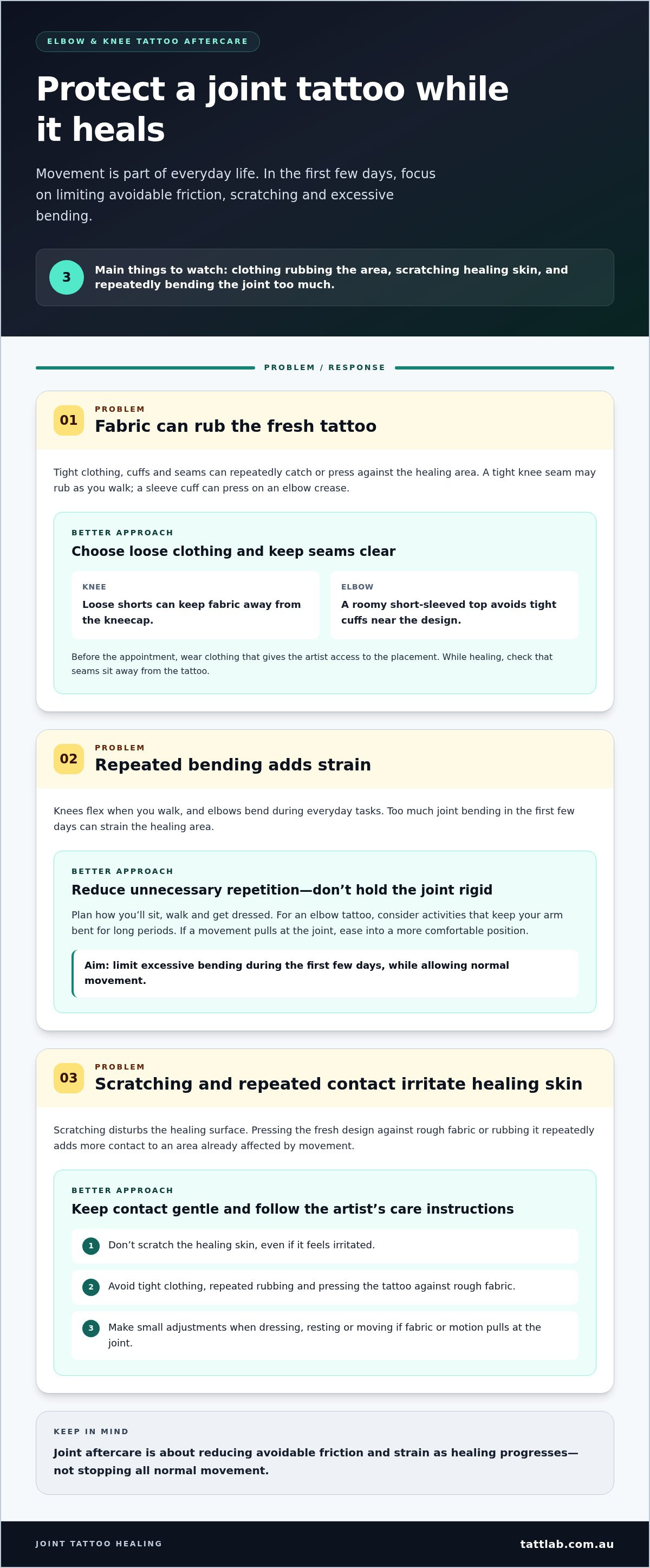
Wear loose clothing that leaves the joint accessible during tattooing. Friction, scratching, and excessive bending in the first few days can affect the healing area.
Joint tattoo healing
Joint tattoo healing is the skin’s recovery while the elbow or knee continues to move. That makes aftercare especially relevant: bending can stretch the area, while sleeves or trouser fabric can rub it. A tight knee seam, for example, may catch the tattoo repeatedly as you walk. Reducing avoidable friction helps protect the healing skin.
Joint tattoo risks
Joint tattoo risks include irritation from repeated contact and movement while the skin heals. Scratching can disturb the healing surface, and too much elbow or knee bending in the first few days can add strain. A sleeve cuff pressing on an elbow crease is one avoidable source of friction. Being aware of these triggers helps you adjust everyday movements and clothing.
Before your appointment, choose clothing that gives the artist access to the placement. For a knee tattoo, loose shorts can keep fabric away from the kneecap. For an elbow, a roomy short-sleeved top avoids tight cuffs near the design. If you need to update your wardrobe with relaxed, non-restrictive pieces for healing, fashion retailers like MO. DA FASHION offer comfortable tops, t-shirts, and loose pants. This also makes it easier to keep restrictive clothing away from the area afterward.
Plan your routine around the joint being tattooed. If the tattoo is on your knee, consider how you’ll sit, walk, and get dressed without repeatedly pressing fabric against it. For an elbow tattoo, think about activities that keep your arm bent for long periods. You don’t need to immobilise the joint, but limit excessive bending during the first few days.
After the session, follow the artist’s care instructions. Avoid tight clothing and friction while the skin heals. A loose sleeve or trouser leg can rub less than snug fabric. Don’t scratch the healing skin, even if it feels irritated. Scratching adds direct contact to an area already affected by movement.
Use everyday tasks as reminders. When dressing, check that seams sit away from the tattoo. When resting, avoid pressing the fresh design against rough fabric. If a movement pulls at your elbow or knee, ease into a more comfortable position. These small adjustments reduce unnecessary contact without stopping all normal movement.
Keep the first few days simple. Avoid excessive joint bending, scratching, tight clothing, and repeated rubbing. Your knee flexes when you walk, and your elbow bends during meals or desk work, so notice those motions and reduce unnecessary repetition. Aftercare isn’t about holding the joint rigid. It’s about limiting avoidable friction and strain as healing progresses.
Knee and elbow tattoos: among the most painful placements?
Yes, both knees and elbows can feel intense to tattoo. Sensation varies across each joint, so the kneecap and the skin around it may feel different during the same session.
Getting tattooed there often means holding a position while the artist works around a curved surface. A knee or elbow also moves naturally, so staying still takes attention. Knee and elbow sessions usually last 1 to 2 hours, depending on design complexity. That gives a sense of session length, not a measure of pain.
Both knees can be tattooed in one session, though the experience can be intense. This may suit a balanced pair of designs, but it also means managing discomfort across both legs. A single-knee piece leaves the other leg free. The right choice depends on the composition and session plan.
For sleeves, a joint tattoo can serve as a visual anchor. An elbow motif can connect upper-arm and forearm imagery, while a kneecap design can link elements on the thigh and lower leg. A central shape can sit over the joint, for example, with surrounding lines flowing into the larger sleeve. This gives the artwork continuity instead of leaving the joint isolated.
A leg composition needs similar planning. A design around the kneecap should work with images above and below it. Consider how the leg looks both straight and bent. An outline that appears balanced while standing may shift when seated. Mapping the composition in both positions helps the joint fit the overall design.
Australian tattoo pricing is based on the design’s size, detail, placement, and time required. A small, bold elbow motif takes a different approach from a detailed kneecap that connects to a larger leg composition. Session length also shapes the work involved, with joint sessions usually lasting 1 to 2 hours.
Before booking, decide whether the joint design will stand alone or join a sleeve. Bring reference images showing the elbow or knee in different positions, and identify the surrounding areas the artwork should connect to. These choices help define the design scope and inform the artist’s time estimate and pricing.
During the session, expect the sensation to change as the needle moves across different parts of the joint. The centre of the kneecap may feel different from the area beside it. An elbow design also crosses changing contours. Communicate clearly if you need a pause, and keep your body position steady while the artist works.
Pain doesn’t determine whether a joint belongs in a sleeve. Thoughtful placement, a clear composition, and a session plan can make the experience more manageable. A bold central element can make the joint part of the artwork, while surrounding shapes carry the design into the limb.
Pain differences between the elbow and kneecap
The elbow and kneecap can feel distinct during tattooing. Their shape, skin movement, and position all matter. The olecranon, the pointed bone at the elbow, lies close beneath the skin. The patella also forms a prominent surface at the front of the knee. Nearby areas can feel different from the centre of each joint.
Tattooing elbows and knees can involve changing sensations across a small area. On the elbow, the point may feel sharp and concentrated. The inner crease folds as the arm moves, changing skin tension. A design crossing both areas can feel different from edge to edge. An outline around the elbow tip, for example, may feel unlike shading beside the crease.
The kneecap has its own contrasts. Skin over the patella moves when you bend your leg, while the surrounding area follows a broader curve. A central motif and its outline can therefore feel different. Shading over the kneecap may feel more resonant, while work beside it may feel more like surface contact.
Position affects the experience, too. An elbow tattoo may require your arm to rest at an angle, while a kneecap design may require an extended leg. These positions give the artist access to the surface, but they can also tense nearby muscles. If your elbow tightens, relax your hand and shoulder. If your thigh stiffens, let your leg settle.
Technique also changes the sensation. A firm outline has a different rhythm from gradual shading. For an elbow, curved lines may require the artist to reposition your arm. Around the patella, they may adjust your leg to follow its contour. Each change in angle can alter what you feel, even within a small tattoo.
Your experience of tattooing elbows and knees also depends on how you communicate. Describe the sensation and where you feel it. “The outer edge feels sharper than the centre” gives useful detail; a general “it hurts” offers less direction. Stay still while the artist works, and request a pause if needed. Clear communication helps manage the session without sudden movement.
Neither joint has a universal pain ranking. The elbow tip, inner crease, kneecap centre, and surrounding skin each have different conditions. Compare exact placements rather than “elbow” with “knee.” A small design on the elbow point differs from a larger piece spanning the patella. Knowing the intended placement helps you prepare for its particular sensation.
Why do knees and elbows hurt so much to tattoo?
The elbow point and kneecap sit close beneath the skin. Less cushioning can make needle vibration feel more pronounced. Each joint also bends, changing skin tension across the tattoo area. Together, these factors help explain why these placements can feel intense.
Bone is only part of the sensation. The elbow crease folds as the arm moves, while the kneecap shifts beneath stretched skin. A line crossing either area can feel different from one placed beside it. Shading over the kneecap, for example, may feel more resonant than work on the surrounding skin.
Joint tattoos also require the artist to work across curved surfaces. They may adjust your arm or leg to position the skin, and small shifts can change the angle of contact. Holding one position as the design develops can add physical strain, especially if the muscles around the joint tense.
Design affects the experience, too. Bold shapes and clear outlines often suit these areas better than ultra-fine detail. A simple flower centred on a kneecap can remain easy to read; those looking for botanical tattoo inspiration can study real bloom structures through florists like Flowers Alley to see which petals and shapes hold clean outlines. Tiny petals or dense micro-lines may be harder to place cleanly across moving contours. A strong silhouette gives the artist a clearer structure to follow.
Consider the elbow’s shape before settling on a motif. A circular emblem can frame the point, while a curved shape can follow the arm’s natural bend. On a knee, a bold centre with open space around it can work with the patella’s curve. These approaches help the tattoo feel integrated rather than compressed into a crease.
Fine detail isn’t automatically unsuitable, but it needs careful placement. A small cluster of lines may work better on flatter skin beside the joint. For instance, delicate leaves could sit above the kneecap, with a broader leaf shape across it. This contrast helps preserve the design’s visual hierarchy.
Before the session, compare the design with your joint straight and bent. Check whether a circle becomes oval or a line disappears into a fold. Ask the artist to consider both positions when mapping the stencil. A design that reads clearly in motion may feel more coherent than one planned only for a still pose.
During the appointment, steady breathing can help you avoid tensing nearby muscles. Tell the artist if the sensation changes sharply at a specific edge. A precise note such as “the crease feels more intense” identifies the location. Then let the artist reposition your limb before continuing.
Tatt Lab: Tattoo Aftercare
Tatt Lab offers Tattoo Aftercare for the recovery stage after an elbow or knee tattoo. Joint placement can make friction and movement harder to manage, so having aftercare products on hand helps you follow your artist’s care instructions. Tattoo Inks, Traditional Needles, and Tattoo Catridges also support artists preparing for joint work, where considered design and application matter. Choose aftercare that fits the instructions provided for your fresh tattoo, and keep your routine focused on protecting the healing skin. For tattoo equipment and aftercare, visit Tatt Lab online.
Make your next step part of the design
A joint tattoo is a collaboration between the design, the artist’s technique, and your body’s movement. Before your appointment, decide what you want the elbow or knee piece to express and how it should connect with your wider style. That direction can make discussions about placement and detail more focused.
For artists preparing for tattooing elbows and knees, Tatt Lab offers Tattoo Aftercare, Traditional Needles, and Tattoo Cartridges. These supplies support different parts of the process, from equipment preparation to care after the session. Keep your questions specific, such as which aftercare product suits your routine, to make the next step practical.
Whether you’re planning a design or sourcing professional supplies, move forward at a pace that respects the placement and the healing process. Contact Tatt Lab about your tattoo and take the next step with clarity and confidence.
Frequently Asked Questions
Does the ink last?
Yes, elbow and knee tattoos can last, though some areas may soften sooner. Joint movement and repeated contact can affect how clearly details show. Some tattooed areas may need a touch-up within a few months. Once the skin has healed, compare the design in different positions, such as with a bent elbow and a straight arm. This can reveal whether a particular line needs refreshing.
Is it unbearable?
No, “unbearable” isn’t a reliable way to predict the experience. Sensation changes as the artist moves between the joint’s centre, edges, and folds. A sharp feeling in one spot may become more manageable elsewhere. Tell the artist what you feel and where, then pause if needed. Staying relaxed and avoiding sudden movement can help the artist work steadily across the curved surface.
What about aesthetics?
Joint tattoos can look cohesive when their shapes follow the body’s contours. A bold central motif can anchor a larger arm sleeve, for example, while surrounding forms connect it to the upper arm and forearm. Consider how the artwork looks with the joint bent and straight. This helps reveal whether a line, circle, or focal detail changes shape during everyday movement.
What about elbows?
Elbows can be tattooed as standalone features or incorporated into a sleeve. The pointed surface and inner crease create different spaces for artwork. A curved design can frame the elbow point, while smaller elements may sit beside the crease. Think about the whole arm, not just the elbow’s front view. The relationship between the design and nearby forearm or upper-arm imagery affects the finished composition.
How painful are elbow and knee tattoos compared with other areas?
There’s no universal pain ranking for every person or design. Elbow points and kneecaps have different contours from broader, flatter areas, so the sensation can feel more concentrated in some spots. A small motif on the elbow tip also differs from a design spanning the kneecap. Compare the exact placement and work involved instead of relying on a general ranking of body areas.
How do elbow and knee tattoos heal, and how long does healing take?
Healing involves the tattooed skin settling as the joint continues its normal movement. Bending, clothing contact, and everyday pressure can affect how comfortable the area feels. There’s no single healing duration for every elbow or knee tattoo. Follow the artist’s care guidance and assess the design only after the surface has healed, rather than judging its final appearance during recovery.
What aftercare is needed for elbow and knee tattoos?
Follow the artist’s aftercare instructions and protect the area from avoidable rubbing. Choose loose sleeves or trouser legs, don’t scratch healing skin, and limit excessive bending during the first few days. For example, avoid a tight cuff pressing on an elbow crease. Adjust how you sit or dress if fabric repeatedly catches the tattoo, and keep your routine gentle while the skin heals.
Why do elbow and knee tattoos fade or need touch-ups?
Repeated movement and contact can make ink look less even across joint surfaces. A fine line crossing an elbow crease, for example, may become less distinct than a broader nearby shape. Some tattooed areas may need a touch-up within a few months. Once healing is complete, look for specific softened lines or lighter patches. This focused assessment helps distinguish areas needing attention from ordinary variation in the skin.


Comments (0)
There are no comments for this article. Be the first one to leave a message!