

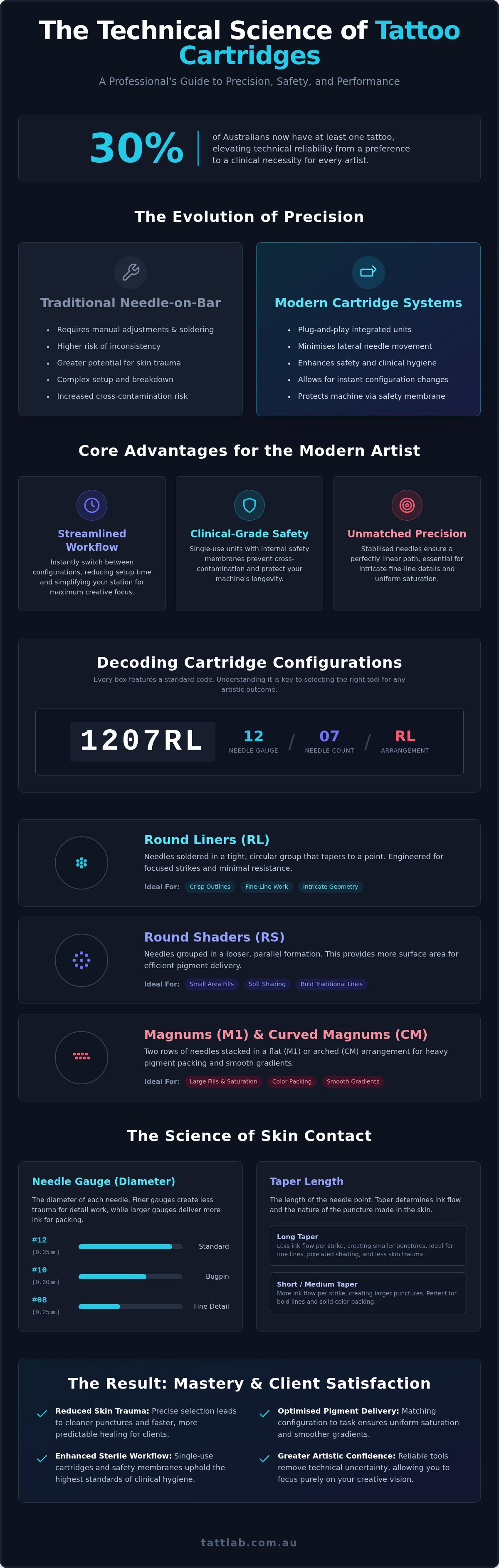
A single millimetre of needle depth or a microscopic flaw in a membrane can be the difference between a seamless gradient and permanent skin trauma. In an industry where 30% of Australians now carry at least one piece of permanent art, the technical reliability of your tattoo cartridges is no longer just a preference. It's a clinical necessity. You likely understand the quiet frustration of a needle that drags or the underlying anxiety of potential ink backflow during a long session. These technical inconsistencies don't just disrupt your creative flow; they impact the biological healing process of the person in your chair.
We're here to replace that uncertainty with professional precision. This guide masters the technical science behind cartridge architecture to help you elevate your artistry while ensuring maximum safety for every client. We will deconstruct the mechanics of taper lengths and gauges, explain the physics of membrane tension, and provide a clear roadmap for maintaining a 100% sterile workflow. By the end, you'll have the knowledge to select the perfect configuration for every skin type, ensuring cleaner lines and significantly reduced healing times.
Key Takeaways
- Learn how to decode professional packaging to select the ideal arrangement of Round Liners, Shaders, or Magnums for specific artistic outcomes.
- Understand the critical role of internal safety membranes in preventing cross-contamination and protecting your machine’s motor longevity.
- Master the relationship between needle gauges and taper lengths to optimise pigment delivery and skin penetration with your tattoo cartridges.
- Discover how precise technical selection reduces skin trauma to achieve smoother gradients and faster healing times for your clients.
- Gain insights into sourcing artist-vetted, professional-grade consumables that meet the clinical rigor required for modern Australian studios.
The Evolution of Tattoo Cartridges: Modern Precision in Artistry
Modern tattooing is a discipline of microscopic precision. At the heart of this technical shift are tattoo cartridges, which represent a significant departure from the traditional needle-on-bar setups that defined previous decades. These integrated systems house the needle within a medical-grade plastic shell, designed specifically for the high-torque, low-vibration environment of contemporary rotary and pen machines. While the early Tattoo machine relied on manual adjustments and soldering, today's cartridges provide a plug-and-play solution that prioritises both artistic control and clinical safety.
This evolution has directly supported the rise of highly specialised techniques. The growth of fine-line and micro-realism in the Australian market requires a level of stability that traditional needles often struggle to maintain. By encasing the needle and providing an internal guide, cartridges minimise lateral movement. This allows you to execute intricate details with a level of confidence that was previously difficult to achieve consistently across long sessions.
Why Professional Artists are Switching to Cartridge Systems
The transition to cartridge-based workflows is driven by a need for both efficiency and enhanced hygiene. In a professional studio, time spent on technical setup is time taken away from the creative process. Cartridges allow for near-instant configuration changes. You can move from a Round Liner to a Curved Magnum in seconds, without needing to recalibrate multiple machines or adjust tube heights. This streamlined workflow reduces the physical footprint of your station and simplifies the breakdown process.
Safety is the other primary driver. Because these are disposable, single-use units, the risk of cross-contamination is significantly lower than with reusable tubes. High-quality cartridges also include internal tension systems, such as membranes or specialised rubber, which provide a consistent "give." This ensures the needle returns to its housing with every stroke, maintaining a predictable rhythm that protects the integrity of the client's skin.
Compatibility with Professional Rotary and Pen Machines
The versatility of modern tattoo cartridges stems from a nearly universal drive system. Most professional brands use a standardised notch and plunger interface, allowing you to use your preferred cartridge brand across various high-end rotary machines. This cross-brand compatibility gives you the freedom to curate your toolkit based on the specific needs of the piece rather than the limitations of your hardware.
The mechanical synergy between a high-quality machine and a stabilised cartridge ensures that the needle's path remains perfectly linear, even during high-frequency oscillation. The plunger bar within the machine acts as the primary driver, engaging with the cartridge's internal mechanism to execute precise needle depth. This controlled movement is essential for achieving the uniform saturation required for modern blackwork and neo-traditional styles.
Understanding Cartridge Configurations: Liners, Shaders, and Magnums
Selecting the right needle configuration is a clinical decision that directly influences pigment saturation and epidermal integrity. Every box of professional tattoo cartridges features a standardised code, such as 1207RL. Decoding this is simple: the first two digits represent the needle gauge (diameter), the next two indicate the needle count, and the letters define the physical arrangement. Choosing the correct configuration is a foundational skill discussed in our broader resource, The Professional Guide to Tattoo Supplies in Australia, which helps artists align their technical choices with their artistic intent.
Round Liners (RL) and Round Shaders (RS)
Round Liners are engineered for precision. The needles are soldered in a tight, circular grouping that tapers toward a central point. This creates a focused strike, making them ideal for crisp outlines, intricate geometry, and detailed script. Because the needles are grouped so closely, they penetrate the skin with minimal resistance, which is why they're the standard for fine-line work. While hardware quality is vital, biological safety remains a priority for every practitioner. Adhering to standards similar to the FDA safety regulations for tattoo inks and equipment ensures that your technical precision is matched by clinical rigor.
Round Shaders differ in their soldering geometry. Unlike liners, the needles in an RS configuration run parallel or are soldered further back from the tip. This allows the grouping to remain "loose," providing more surface area for pigment delivery. They're excellent for small-area filling, soft shading, and bold traditional lines. The increased flexibility of the needles in a shader configuration reduces the risk of over-working the skin, promoting a more predictable healing narrative for your client.
Magnums (MG) and Curved Magnums (CM)
When your work requires heavy pigment packing or large-scale colour saturation, Magnums are the essential tool. Standard Magnums feature two rows of needles stacked in a flat, staggered arrangement. This allows you to cover more surface area with fewer passes, significantly reducing client discomfort and healing time. However, the flat edge of a standard magnum can sometimes "bite" into the skin at the corners if the angle isn't perfectly perpendicular.
Curved Magnums, often called Soft Edge Magnums, solve this through a slightly arched needle profile. This arch mimics the natural contours of the body, allowing for a more gradual transition of pigment. In realism and portraiture, this configuration is indispensable for achieving smooth gradients and eliminating the "edge marking" that can occur with flat configurations. Using curved arrangements ensures a more empathetic approach to the skin's anatomy, especially on delicate areas like the inner arm or ribs. To ensure your studio is equipped for these specialised techniques, you can browse our artist-vetted collection of professional cartridges designed for modern performance.
The Anatomy of a High-Performance Cartridge: Safety and Stability
The internal architecture of tattoo cartridges is what separates a medical-grade consumable from a generic needle. While the external housing provides the grip, the internal components dictate the biological safety of the procedure. The most critical component is the safety membrane. This silicone barrier serves a dual purpose: it creates the necessary tension for needle retraction and acts as a fluid-tight seal. Without this seal, ink and biological fluids can travel up the needle bar and into your machine's grip. This creates a significant risk of cross-contamination that cannot be rectified by external cleaning alone.
The tension of this membrane also directly impacts the longevity of your equipment. If a membrane is too stiff, your rotary motor must work harder to overcome the resistance with every stroke. This leads to premature motor failure and inconsistent needle depth. Conversely, a membrane that's too soft won't provide enough "give," resulting in a sluggish needle return that can snag the skin. High-performance cartridges find a calibrated balance, ensuring the machine operates at peak efficiency while maintaining a predictable strike.
Safety Membranes vs. Rubber Bands
In the early days of cartridge development, some manufacturers used simple rubber bands to provide needle tension. These systems are technically inferior because they don't provide a true seal against backflow. Rubber is also prone to degradation, which can release microscopic particles into the cartridge's housing. A true safety membrane is a non-negotiable standard for professional Australian studios. Using cartridges without a verified membrane risks the health of your client and the integrity of your hardware. As detailed in the FDA Tattoo Safety Fact Sheet, unsterile equipment and backflow are primary vectors for infection, making the choice of cartridge a vital part of your clinical protocol.
Needle Stabilisation and Precision
Stability is the second pillar of cartridge anatomy. A high-quality cartridge features an internal stabiliser that holds the needle grouping perfectly centred within the tip. This prevents the needle from "wobbling" or vibrating laterally at high speeds. When a needle is stabilised, it enters and exits the skin in a perfectly linear path. This reduces unnecessary skin trauma and allows for more efficient pigment deposition. Precision housing made from medical-grade plastic further ensures that friction between the needle and the shell doesn't create micro-debris. Maintaining these high standards of hygiene and technical precision is essential for any modern studio. For a comprehensive look at maintaining your workspace, refer to our guide on Medical Supplies for Tattoo Artists.
Tapers and Gauges: The Science of Skin Penetration
The biological response of the skin is dictated by the geometry of the needle's point and the diameter of its shaft. While the configuration defines the grouping's shape, the taper and gauge determine the "hit" and the resulting epidermal trauma. Understanding this science allows you to calibrate your approach based on the client's skin type and the specific requirements of the piece. High-quality tattoo cartridges offer a variety of these specifications to ensure that every strike is both efficient and empathetic to the body's healing process.
Taper refers to the length of the needle's point before it reaches its full diameter. This length affects how much resistance the skin provides during penetration. A longer taper enters the skin more gradually, which reduces the force required and results in a smaller puncture hole. Conversely, gauge identifies the diameter of the individual needle shafts. Thicker needles deliver more pigment per stroke but require more pressure, while thinner needles allow for higher density groupings with less overall trauma. Some specialised tattoo cartridges also feature textured needles. These needles lack the polished finish of standard versions, allowing the microscopic grooves on the shaft to hold more ink for maximum saturation in fewer passes.
Choosing Your Taper: Short, Long, and Extra Long
The length of the taper is the primary factor in determining the "softness" of the needle's impact. Short Tapers have a blunt, aggressive profile. Because the point reaches the full shaft width quickly, they create a larger puncture hole. This is excellent for fast colour packing, though it carries a higher risk of trauma if the artist is not precise. Long Tapers (LT) are the industry standard for a reason. They offer a balance of precision and ink flow, allowing for smooth shading without the aggressive bite of a shorter point. This gradual entry is essential for maintaining skin integrity during long sessions.
Extra Long Tapers (XLT) provide the least amount of skin resistance. These are the specialist choice for ultra-delicate grey wash gradients where the goal is a soft, airbrushed finish. Because the entry point is so small, the skin heals significantly faster, making them ideal for realism. To achieve these professional results, you can explore our curated selection of long taper tattoo cartridges designed for maximum precision.
Understanding Needle Gauges (#08, #10, #12)
Gauges are standardised by number, with each representing a specific millimetre diameter. A #12 gauge (0.35mm) is the heavy hitter of the industry. It provides the highest volume of pigment delivery, making it the preferred choice for bold traditional work where solid saturation is the primary objective. It's a matter of physics; a larger diameter simply carries more ink into the dermis.
A #10 gauge (0.30mm) is frequently used in "Bugpin" configurations. These allow for more needles to be grouped in a smaller space, resulting in smoother shading and more controlled saturation. For micro-realism and intricate detail, a #08 gauge (0.25mm) is essential. These needles create the smallest possible entry point, allowing for high-density detail with minimal epidermal response. By matching the gauge to the specific anatomical location and skin thickness, you ensure a predictable healing narrative for every client.
Sourcing Professional Tattoo Cartridges in Australia
The reliability of your supply chain is as vital as the precision of your hand. When sourcing tattoo cartridges, professional artists require more than just a vendor; they need a partner that prioritises clinical rigor and artistic performance. Tatt Lab serves this role for studios across the country, curating a selection of professional brands that are recognised for their engineering excellence. By focusing on high-performance options like Elite III, Elite EVO, and EZ Revolution, we ensure that every box delivered to your studio meets the exacting standards required for modern tattooing. This methodical approach mirrors the precision of the work itself, providing a transparent, results-oriented solution that builds immediate trust.
Choosing the right supplier involves looking beyond the price point to the underlying expertise. An artist-owned supplier understands the quiet anxiety of a failing membrane or the frustration of inconsistent needle quality. This shared experience informs every product we stock. We view the procurement of tattoo cartridges not as a simple transaction, but as a critical step in a liberating narrative of personal transformation and self-assurance for your clients. By providing tools that perform predictably, we help you maintain the calm, meticulous environment that characterises a high-end, boutique studio.
The Tatt Lab Quality Assurance
Every brand in our inventory undergoes a rigorous artist-vetting process. This ensures that the stability and membrane integrity we've discussed throughout this guide are consistent across every unit. We don't just provide artistic tools; we provide medical-grade consumables that respect the physical integrity of your clients. This commitment to quality is what defines our approach to Professional Tattoo Supplies in Australia, helping you maintain a studio environment that is both safe and sophisticated. Our selection process focuses on the mechanical synergy between the needle and the machine, ensuring that your technical execution remains flawless from the first stroke to the final detail.
National Express Shipping and Support
We understand that studio workflows are demanding and often time-sensitive. To support your practice, we provide express nationwide shipping across Australia, ensuring that your essential consumables arrive when you need them. This steady, predictable progress is designed to lower your operational anxiety, replacing uncertainty with a sense of controlled logistics. Our support team is composed of individuals who speak the language of the studio, offering professional guidance that respects your expertise and the vulnerability of the clients you serve.
Our communication rhythm is designed to be educational and low-pressure, reflecting the patience required for successful artistic outcomes. We don't believe in high-pressure sales; instead, we position ourselves as a dedicated partner in your professional journey. This clinical yet contemporary vibe ensures that you have access to the best technical and biological information available. We invite you to explore our full range of professional tattoo cartridges and experience the difference that specialist curation makes to your daily artistry and client safety.
Elevating Your Artistry Through Clinical Precision
Mastering the technical science of tattoo cartridges is a commitment to both your artistic growth and the physical integrity of every client. By aligning your configuration choices with biological principles, you move beyond simple pigment application into a space of true clinical precision. We've explored how internal safety membranes safeguard your expensive equipment from backflow and how specific taper lengths can dramatically reduce client healing times. These technical nuances aren't just details; they're the foundation of a professional studio workflow that prioritises long-term health and aesthetic excellence.
As an artist-owned and operated specialist, Tatt Lab understands the meticulousness required for world-class results. We maintain strict medical-grade safety standards to ensure every tool in our inventory is vetted for stability and performance. We invite you to Shop Professional Tattoo Cartridges with Express National Shipping across Australia. By choosing supplies that match your expertise, you ensure that your creative vision is never compromised by technical limitations. We're here to support your progression toward a safer, more efficient, and more inspired career.
Frequently Asked Questions
What is the difference between a safety membrane and a rubber band in a cartridge?
A silicone safety membrane is a fluid-tight barrier that prevents ink and biological fluids from entering your machine's grip. In contrast, a rubber band only provides needle tension and offers zero protection against backflow or cross-contamination. Professional tattoo cartridges must include a membrane to meet clinical safety standards. This component also protects your rotary motor by providing calibrated resistance, whereas rubber bands can degrade and release microscopic debris into the housing.
Can I use any brand of cartridge with my tattoo pen machine?
Most professional rotary and pen machines utilise a universal drive system, making them compatible with the majority of high-quality cartridge brands. This standardised notch and plunger interface allows you to select configurations based on your artistic needs rather than machine limitations. It's always prudent to verify that your specific machine doesn't require a proprietary locking mechanism, though these are increasingly rare in the modern Australian studio environment.
What configuration should I use for fine-line tattooing?
For fine-line work, Round Liners (RL) in a #08 (0.25mm) or #10 (0.30mm) gauge are the preferred choice. These tight groupings, especially when paired with a Long Taper, allow for microscopic precision and crisp, consistent lines. The smaller needle diameter creates a focused strike that minimises epidermal trauma, which is essential for the delicate, high-detail aesthetic currently trending across the national tattoo landscape.
How do I know if a tattoo cartridge is sterile and safe?
Professional tattoo cartridges are individually sealed in blister packs that feature an EO (Ethylene Oxide) gas sterilisation indicator. You should verify that the indicator has changed colour according to the manufacturer's key and that the expiry date is still valid. We recommend sourcing only from artist-vetted suppliers who prioritise medical-grade safety standards. This ensures that every unit has undergone rigorous quality control for both needle sharpness and membrane integrity.
What are bugpin needles and when should I use them?
Bugpin needles are characterised by their smaller diameter shafts, typically #10 (0.30mm) or #08 (0.25mm). Because they're thinner than standard #12 needles, they allow for tighter groupings that deliver pigment more delicately. Use bugpins for micro-realism, smooth grey wash shading, and intricate details. They're an excellent tool for achieving high-density saturation while reducing the overall puncture size, leading to a more predictable healing narrative for the client.
Why does the taper length matter for shading?
Taper length determines the geometry of the needle's point and how it displaces skin tissue. Long tapers provide a more gradual entry into the dermis, which results in a softer hit compared to short, blunt tapers. This softness is critical for shading because it allows you to layer pigment gradually without overworking the skin. It enables the creation of airbrushed gradients and subtle transitions that are the hallmark of high-end realism.
Do tattoo cartridges expire?
Yes, the sterilisation of the packaging is only guaranteed until the date printed on the blister pack. Over time, the seal of the medical-grade paper can degrade, potentially compromising the sterile environment within. Using expired equipment is a violation of professional infection control standards and risks the health of your client. Always rotate your stock and perform a visual check of the sterilisation indicator before opening any new unit.
How should I dispose of used tattoo cartridges in Australia?
Used cartridges are classified as clinical sharps waste and must be handled with extreme care. They should be deposited into a puncture-resistant, yellow sharps container immediately after use to prevent accidental needle-stick injuries. In Australia, these containers must comply with AS 4031 or AS/NZS 4261 standards. Once full, the container must be collected and processed by a licensed medical waste disposal service to ensure total biological safety in the studio.


Comments (0)
There are no comments for this article. Be the first one to leave a message!