

The difference between a flawless gradient and irreversible skin trauma often comes down to the microscopic geometry of your needle. It's a common frustration to experience inconsistent ink flow or observe excessive redness, even when your technique feels precise. Understanding the specific types of tattoo cartridges available is about more than just filling your kit; it's about mastering the biological interface between steel and skin. This methodical approach ensures that every puncture serves a purpose without compromising the body's natural integrity.
By refining your knowledge of configurations and technical specs, you'll enhance your precision and significantly improve healing results for your clients. This professional guide provides a clear framework for selecting cartridges based on specific styles, from delicate fine line work to heavy saturation. We'll demystify the science of needle tapers and gauges, providing the technical clarity you need to transform your work from a simple procedure into a predictable, high-end outcome. You'll gain a specialist's perspective on how configuration dictates pigment implantation, replacing uncertainty with a sense of controlled, professional progress.
Key Takeaways
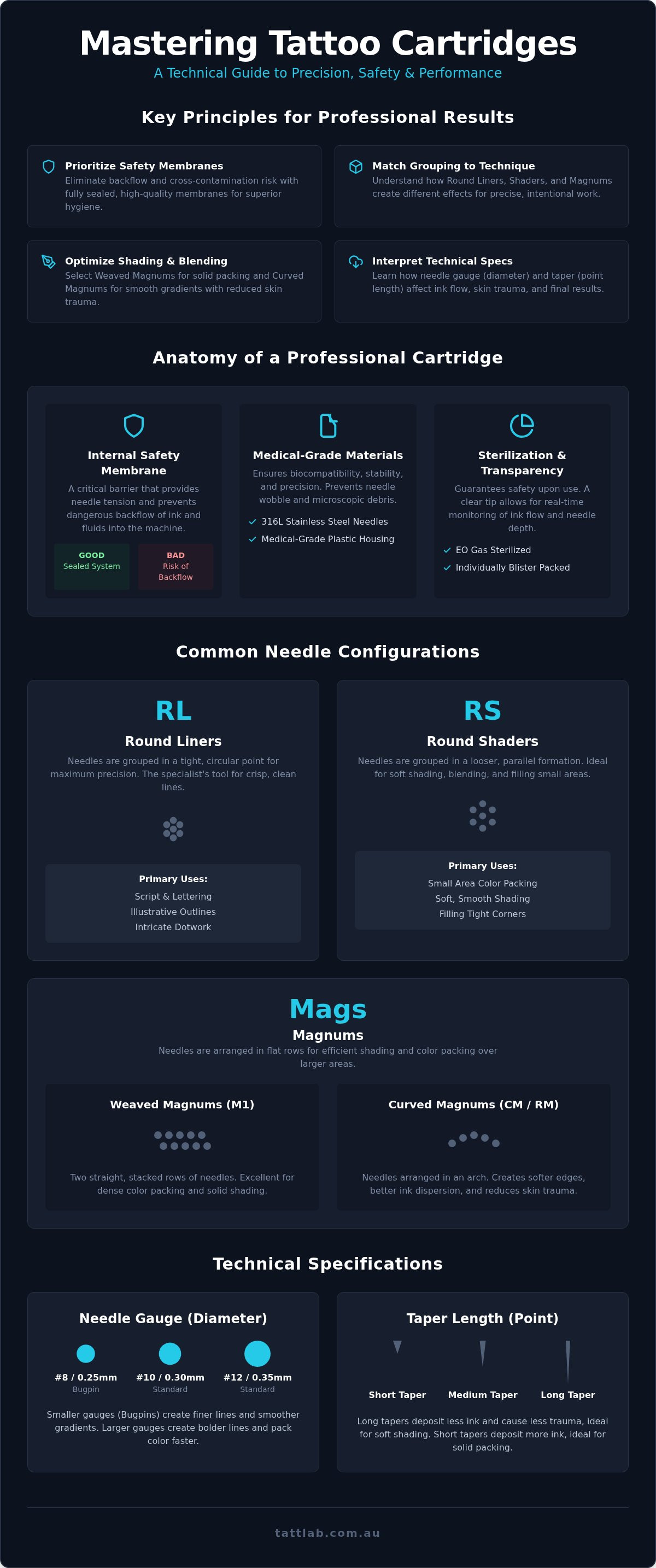
- Identify the clinical necessity of integrated safety membranes to eliminate the risk of backflow and maintain the highest standards of studio hygiene.
- Navigate the diverse types of tattoo cartridges by understanding how specific needle groupings like Round Liners and Shaders dictate the density and precision of your work.
- Optimise your shading and blending techniques by selecting between Weaved and Curved Magnums to achieve smoother transitions with reduced skin trauma.
- Learn to interpret technical needle gauges and taper lengths to ensure consistent ink flow and superior healing results for every client.
- Gain a specialist’s perspective on sourcing reliable, medical-grade supplies that prevent the frustration of inconsistent cartridge performance during complex procedures.
Understanding Tattoo Cartridge Anatomy and Safety
A tattoo cartridge is a self-contained needle system engineered specifically for modern rotary and pen-style machines. Unlike traditional needle bars that require manual alignment and open tube setups, these modules house the needle and reservoir within a single, sterile unit. The industry's shift toward these systems isn't merely about convenience; it's a commitment to clinical precision. Professional studios now favour various types of tattoo cartridges because they allow for rapid configuration changes without the need to re-sterilise a full grip or adjust a needle bar's hang. This efficiency allows artists to focus entirely on the skin's response rather than the mechanics of the machine.
The Internal Membrane System
Selecting the right types of tattoo cartridges involves more than checking the needle count; it requires an audit of the internal safety features. The most vital component is the internal safety membrane. This flexible barrier serves two primary functions: providing needle tension and ensuring biological isolation. A membrane's tension directly influences your machine's motor performance. If it's too stiff, the motor works harder, leading to heat buildup and inconsistent hits. A balanced membrane ensures the needle returns to its housing smoothly, maintaining a steady rhythm that protects the skin's integrity.
From a clinical perspective, a 100% sealed system is essential for fluid hygiene. In non-membrane or poorly constructed cartridges, backflow refers to the dangerous upward travel of fluids like blood and Tattoo Ink Composition into the machine body, creating an invisible reservoir for cross-contamination. High-quality cartridges eliminate this risk, acting as a one-way valve that protects both the equipment and the client.
Medical-Grade Materials and Sterilisation
Precision begins with the raw materials. Professional-grade needles are crafted from 316L stainless steel, a material chosen for its exceptional biocompatibility and resistance to corrosion. These needles are housed in medical-grade plastic that remains stable under the high-frequency vibration of a rotary motor. Cheaper alternatives often use lower-quality plastics that can shed microscopic debris or cause needle "wobble," which increases skin trauma and compromises the final aesthetic. Using a stable, high-quality housing ensures that the needle stays centred, providing the predictable results required for complex work.
Safety is verified through EO (Ethylene Oxide) gas sterilisation. Every reputable cartridge arrives in an individual blister pack with a visible indicator to confirm the process is complete. Transparency in the housing design is also essential. It allows you to monitor ink flow and needle depth in real-time, ensuring the biological interface remains controlled throughout the session. This visual feedback is critical for adjusting your technique to the specific needs of the client's skin.
Round Liners and Round Shaders: The Foundations of Detail
Round Liners (RL) and Round Shaders (RS) represent the fundamental tools for precision and saturation. While they look similar to the naked eye, their needle geometry creates vastly different biological interactions. Round Liners feature needles soldered in a tight, circular point, concentrating the force into a single focal area. This configuration is essential for crisp, defined edges. In contrast, Round Shaders use a parallel needle grouping, allowing for more space between the tips. This subtle shift in architecture reduces the puncture density, making RS ideal for soft shading or small-area colour packing without the aggressive impact of a liner.
Needle wobble is a significant technical hurdle in lower-quality cartridges. When a needle isn't perfectly centred, it creates erratic lines and unnecessary skin trauma. High-end cartridges incorporate internal stabilisers that lock the needle bar in place. This rigidity ensures that every hit is predictable, allowing you to focus on the artistic narrative rather than fighting your equipment. Adhering to professional standards, such as those outlined in the FDA Tattoo Safety Guidelines, reinforces the importance of using precision-engineered tools to maintain client safety and skin health.
Precision Linework with Round Liners
Round Liners are the specialist's choice for script, illustrative outlines, and intricate dotwork. The specific types of tattoo cartridges you select will dictate the line weight and the resistance you feel against the skin. For example, a 3RL offers minimal resistance and allows for hyper-delicate details, whereas a 9RL provides a much bolder presence suitable for traditional American styles. Many artists find that "Tight" or "Extra Tight" configurations, where the needles are tapered even more closely together, are the key to achieving that elusive, single-pass fine line. For a deeper look at sourcing these precision tools, consult The Professional Guide to Tattoo Supplies in Australia.
Transitioning to Round Shaders
Round Shaders provide a bridge between fine detail and broad coverage. They are superior for filling small gaps or tight corners where even a small Magnum would be too cumbersome. Because the needles in an RS are parallel rather than pinched, they distribute ink across a wider surface area with each strike. This biological benefit reduces skin trauma during colour packing, leading to faster healing and better pigment retention. RS configurations are particularly effective for "bold-will-hold" traditional styles, where solid saturation in smaller ornaments is required. If you're looking to refine your kit, exploring professional-grade Round Shaders can elevate your technical consistency.
Magnums and Curved Magnums: Mastering Large Surface Areas
When your work transitions from fine detail to broad saturation, the configuration of your needles must shift to accommodate larger biological surface areas. Magnums are the essential workhorses for this purpose, designed to distribute ink efficiently across the dermis. Among the various types of tattoo cartridges, the Weaved Magnum (M1) remains the industry standard for smooth shading and seamless blending. Its needles are soldered with specific spacing between them, allowing for a softer dispersion of pigment that is ideal for black and grey gradients. In contrast, the Stacked Magnum (M2) groups needles more tightly in two rows. This dense architecture is specifically engineered for high-density colour packing, allowing you to saturate large areas with fewer passes.
The width of a Magnum, dictated by its needle count, significantly alters the "hit" of your machine. A smaller 7-needle Magnum focuses the machine's force into a narrow area, requiring less voltage to penetrate. As you move to larger configurations, such as a 27-needle Magnum, the force is spread across a wider plane. This requires a precise adjustment in voltage and hand speed to maintain consistent depth. Adhering to FDA guidelines on tattoo safety is critical here; using high-quality, stabilised Magnums ensures that these larger groupings don't cause unnecessary trauma during long sessions.
The Evolution of the Curved Magnum
The Curved Magnum (CM), often referred to as a "Soft Edge" Magnum, represents a significant ergonomic advancement in needle design. The needles are arranged in a subtle arc, which mimics the natural rolling motion of an artist's wrist and the contoured surfaces of the human body. This profile prevents the "side-cutting" effect often associated with traditional flat Magnums, where the edges can dig too deeply into the skin during a gradient stroke. These types of tattoo cartridges are the preferred choice for realism and soft grey-wash work, where seamless transitions are the primary goal.
Colour Packing with Weaved Magnums
Successful colour packing relies on the relationship between needle spacing and skin resistance. The M1 configuration provides enough room between needles to carry a significant amount of ink while still allowing the skin to "breathe" between punctures. To avoid "chewing" or overworking the tissue, you must select a Magnum size that matches the muscle group and skin tension of the specific anatomical site. Larger muscle groups like the thigh can handle wider Magnums, whereas more delicate areas require a smaller, more controlled footprint. The larger the Magnum configuration, the more critical your manual skin tension becomes to ensure uniform needle penetration.
Technical Specifications: Gauges, Tapers, and Textures
The technical performance of different types of tattoo cartridges is governed by three primary variables: gauge, taper, and texture. These specifications aren't just industry jargon; they dictate the physics of how a needle enters and exits the skin. By adjusting these parameters, you can fine-tune the "skin hit" to match the client's unique physiology and your desired aesthetic outcome. Selecting between these types of tattoo cartridges requires a methodical understanding of how needle geometry impacts the healing process. For instance, textured needles feature a micro-etched surface that holds more pigment, facilitating a higher pigment load per strike. While niche, this option is invaluable for artists who prioritse deep saturation in dense tissue.
Selecting the Correct Needle Gauge
Needle gauge refers to the diameter of each individual needle in the grouping. A #08 gauge (0.25mm) is ultra-fine, whereas a #10 (0.30mm), often called a Bugpin, is the professional choice for smooth realism and hyper-fine details. The smaller diameter creates a smaller entry point, allowing for softer gradients and reduced trauma. In contrast, #12 (0.35mm) needles are the traditional standard. Their larger diameter provides the structural rigidity needed for bold linework and heavy colour saturation. Understanding how these diameters interact with different pigments is essential, as detailed in The Professional Guide to Tattoo Ink.
The Science of Taper Length
Taper length describes the distance from the very tip of the needle to its widest point. Long Tapers (LT) or Super Long Tapers (SLT) create a sharp, elongated point. This sharpness allows for incredible precision, but because the needle is so thin at the tip, it carries less ink and may require more passes to achieve full saturation. Short Tapers (ST), on the other hand, reach their full diameter quickly. This creates a larger "hole" in the dermis, making them the preferred choice for bold, single-pass colour packing where maximum ink delivery is the priority. Medium Tapers (MT) offer a versatile middle ground, balancing skin trauma with efficient pigment delivery.
Choosing the right combination of these technical specs is what separates a technician from a specialist. If you're ready to upgrade your setup with precision-engineered tools, explore our range of professional tattoo cartridges designed for superior skin integrity and predictable results.
Professional Cartridge Selection for Australian Studios
In the Australian landscape, where specific national manufacturing standards for tattoo hardware remain less defined than European REACH regulations, the responsibility for quality control falls on the studio owner. Selecting the right types of tattoo cartridges is a decision that balances artistic precision with operational reliability. Elite brands like EZ V-Select and Elite have become staples in high-end studios because they prioritise consistent manufacturing. A single "dud" cartridge in a box of 20 isn't just a minor inconvenience; it's a disruption to the technical rhythm of a session and a potential risk to the client's skin integrity. We encourage a methodical approach to kit building, testing specific configurations in small batches before committing to bulk orders to ensure they align with your machine's stroke and your personal hand speed.
Building Your Cartridge Inventory
A professional studio inventory should be built around a "Core Four" foundation: Round Liners for structural definition, Round Shaders for small-area saturation, and both Weaved and Curved Magnums for large-scale gradients. This versatile setup allows you to handle almost any style with predictable outcomes. While budget options are available in the market, professional environments must balance cost-efficiency with clinical safety. Ensuring your needles are housed in medical-grade plastic with secure, high-tension membranes is a non-negotiable standard for maintaining a sterile field and protecting your equipment from backflow. For a comprehensive look at studio safety protocols, refer to our guide on Medical Supplies for Tattoo Artists.
The Tatt Lab Advantage
Tatt Lab operates from an artist-owned perspective, which means we vet every configuration based on real-world performance and biological outcomes. We understand the nuances of how different types of tattoo cartridges interact with various skin types, from delicate fine-line work to heavy blackwork saturation. Our vetting process is informed by direct feedback from the Australian artist community, ensuring only high-performance gear makes the cut. We recognise that studio life is fast-paced and unpredictable, which is why we offer nationwide express shipping across Australia for urgent restocks. Our team provides dedicated support for artists at all stages, whether you're a veteran or a practitioner transitioning from traditional needle bars to modern cartridge systems, helping you maintain a sense of controlled, professional progress in your craft.
Elevating Your Technical Precision and Skin Integrity
Mastering the technical nuances of your equipment is a transformative step in your professional journey. By aligning your choice of specific types of tattoo cartridges with the biological needs of the skin, you replace technical uncertainty with a sense of methodical progress. We've explored how needle geometry, from taper length to gauge diameter, dictates the precision of your linework and the smoothness of your gradients. Prioritising medical-grade safety membranes ensures that your commitment to hygiene matches the high standards of your artistic vision.
As an artist-owned specialist, Tatt Lab is dedicated to providing the tools that support this narrative of excellence. Our selection is built on artist-vetted configurations that meet rigorous medical-grade safety standards, ensuring every procedure is as safe as it is beautiful. With express nationwide shipping across Australia, we ensure your studio remains stocked with the high-performance gear required for consistent, predictable results. This reliability allows you to focus on the specialized services you provide, knowing your equipment won't let you down.
Explore the Professional Cartridge Range at Tatt Lab and continue your progression toward technical mastery with the confidence that your tools are as precise as your craft.
Frequently Asked Questions
What is the difference between a Bugpin and a Standard tattoo cartridge?
Standard #12 needles feature a 0.35mm diameter, while Bugpin #10 needles are narrower at 0.30mm. This difference in diameter dictates the size of the puncture in the dermis. Bugpins are the professional choice for smooth realism because they allow for softer gradients. Standard needles provide the structural rigidity required for bold linework and heavy colour packing. Choosing between these types of tattoo cartridges depends on the level of detail your specific style requires.
Can I use any brand of cartridge with my tattoo pen machine?
Most rotary pen machines utilise a universal twist-lock connection, allowing you to use various brands of cartridges. However, you must consider the internal membrane tension. Machines with lower torque motors may struggle with high-tension membranes, leading to inconsistent hits or motor overheating. It's best to test how different types of tattoo cartridges interact with your specific machine's stroke length to ensure a predictable, controlled performance during long sessions.
Why does the needle gauge matter for my tattooing style?
Needle gauge directly affects the physical trauma caused to the skin and the amount of pigment deposited per strike. A smaller gauge, like #08 or #10, creates microscopic punctures that are ideal for hyper-delicate fine-line work. A larger #12 gauge is the traditional standard for bold saturation and crisp outlines. Selecting the correct gauge ensures that you achieve the desired aesthetic result while respecting the biological integrity of the client's tissue.
What are Curved Magnums used for in professional tattooing?
Curved Magnums are engineered for seamless shading and blending, particularly on the body's natural contours. The subtle arc of the needle grouping ensures that the edges don't dig too deeply into the dermis, preventing the "side-cutting" effect common with flat magnums. This configuration is a staple for realism and soft grey-wash work. It allows for a more ergonomic movement that mimics the rolling motion of an artist's hand during a gradient stroke.
How do I know if a tattoo cartridge has a safety membrane?
You can verify the presence of a safety membrane by inspecting the clear housing for a flexible silicone or rubber barrier. This membrane acts as a seal between the needle bar and the machine motor. High-performance cartridges explicitly label this feature on their blister packaging. Avoid budget options that use simple rubber bands, as these don't provide a 100% sealed system and significantly increase the risk of cross-contamination through ink backflow.
What taper length should I use for fine-line tattooing?
Long Tapers (LT) or Super Long Tapers (SLT) are the preferred choice for fine-line tattooing. The elongated needle point creates a smaller entry hole, allowing for surgical precision with minimal skin resistance. While these tapers carry less ink than short versions, they provide the control needed for intricate script and technical dotwork. This surgical approach reduces initial trauma, which is essential for the delicate healing process required for fine-line aesthetics.
Are tattoo cartridges more expensive than traditional needles in the long run?
While the individual unit price of a cartridge is higher than a traditional needle and tube, they are often more cost-effective for modern studios. Cartridges eliminate the need for an autoclave and reduce the time spent on setup and teardown. The ability to switch configurations in seconds allows for a more efficient workflow, reducing overall chair time. This efficiency, combined with better machine protection, supports a more sustainable and professional business model.
How should I dispose of used tattoo cartridges in Australia?
In Australia, all used tattoo cartridges are classified as clinical sharps waste and must be handled with strict adherence to hygiene regulations. You must dispose of them in a puncture-proof sharps container that complies with AS 23907:2023 standards. Once full, these containers should be collected and processed by a licensed medical waste disposal service. This methodical approach to waste management is essential for maintaining studio safety and fulfilling your professional duty of care.


Comments (0)
There are no comments for this article. Be the first one to leave a message!