

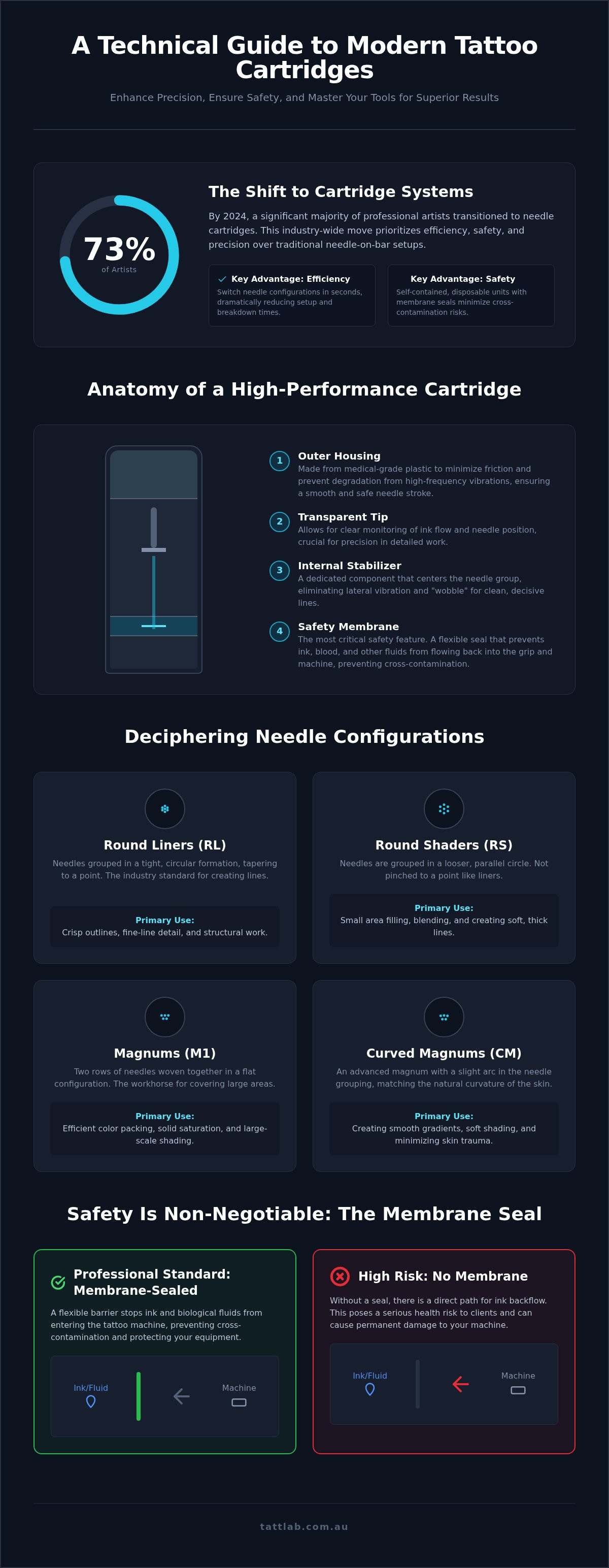
By 2024, approximately 73% of professional tattoo artists had already transitioned to needle cartridges over traditional needles, a trend that has only intensified as we enter 2026. This industry shift reflects a collective move toward efficiency and safety, yet it has also created a market saturated with options that vary wildly in quality. You know that the difference between a masterpiece and a difficult healing process often comes down to the tools you choose. Inconsistent needle quality can lead to unnecessary skin trauma, while inferior tattoo cartridges without proper membrane systems pose a genuine risk of ink backflow and cross-contamination.
We understand that your reputation relies on the delicate balance of artistic vision and clinical rigor. This guide is designed to help you master the technical nuances of cartridge selection, allowing you to enhance your precision and maintain the highest safety standards in your studio. You will learn how to navigate taper lengths and gauges with confidence, ensuring every line is crisp and every gradient is smooth. We will break down the essential mechanics of modern cartridge systems and explore how to maintain a reliable, professional grade supply chain right here in Australia.
Key Takeaways
- Evaluate the technical anatomy of self-contained needle systems to improve machine efficiency and skin integrity during complex procedures.
- Decode the physics of taper lengths and needle gauges to ensure predictable ink flow while minimizing trauma for your clients.
- Master the use of specialized configurations, including Round Liners and Magnums, to achieve consistent and high-definition results across various artistic styles.
- Prioritize clinical safety by distinguishing between professional membrane-sealed tattoo cartridges and lower-tier alternatives that risk ink backflow.
- Optimise your studio inventory with a strategic approach to testing and sourcing premium, artist-vetted supplies within the Australian market.
Understanding the Anatomy of Modern Tattoo Cartridges
Modern tattooing has moved beyond the labor-intensive assembly of the past. A tattoo cartridge is a sophisticated, self-contained needle system designed specifically for rotary and pen-style machines. Unlike the traditional needle-on-bar setups that defined the early history of the tattoo machine, these modular units integrate the needle, tip, and reservoir into a single disposable housing. This integration provides a level of precision that was previously difficult to achieve consistently across long sessions.
The efficiency gains are undeniable. Traditional methods involved manual needle soldering and complex tube sterilization, but cartridges allow you to switch configurations in seconds. The outer housing plays a clinical role here; it's engineered to guide the needle stroke with microscopic accuracy while managing fluid dynamics. Professional-grade tattoo cartridges utilize medical-grade plastics for this housing. This choice of material is critical because it minimizes friction between the moving needle and the casing. Lower-quality plastics can degrade under the high-frequency vibration of a rotary motor, potentially introducing heat or synthetic particulates into the skin, which complicates the healing narrative for your client.
The Evolution from Traditional Needles
The transition to cartridge systems has fundamentally changed studio workflows across Australia. By standardizing the click-and-lock mechanism, these systems have revolutionized setup times and tightened cross-contamination protocols. You don't need to break down an entire machine to change from a liner to a shader anymore. This agility is especially vital for the modern shift toward wireless pen-style machines. These devices rely entirely on the cartridge's internal tension and alignment to deliver consistent power, making the quality of the tattoo cartridges you select as important as the machine itself.
Key Components: Housing, Needle, and Seal
A high-performance cartridge is a sum of its specialized parts. Most professional models feature a transparent or semi-transparent tip, which is essential for monitoring ink levels and needle position during high-detail work. Inside, an internal plunger acts as the bridge between the machine’s drive bar and the needle group, ensuring that your depth settings remain constant throughout the procedure. The internal stabilizer is a dedicated component designed to center the needle group, effectively eliminating lateral vibration and wobble during high-speed operation. This stability allows for the clean, decisive movements required for modern aesthetic outcomes, ensuring the process remains a controlled and predictable progression toward the final result.
Deciphering Configurations: Liners, Shaders, and Magnums
Selecting the correct configuration within your tattoo cartridges is a clinical decision that dictates the biological response of the skin. Round Liners (RL) are the standard for structural integrity. These needles are soldered in a tight, circular grouping that tapers toward a single point. This design focuses the machine’s force into a concentrated area, allowing for the crisp, decisive outlines required in both bold American Traditional and delicate fine-line work.
Linear Precision with Round Liners
The resistance you feel during a session changes based on needle count. A 3RL penetrates with minimal force, while a 9RL encounters significantly more epidermal resistance. You should also consider the grouping density; "Extra Tight" liners pull the needles even closer together for microscopic detail, while standard liners allow for slightly better ink flow. Aligning these choices with FDA tattoo safety guidelines ensures that you are using tools designed for minimal trauma and maximum precision.
Round Shaders (RS) differ from liners because their needles are grouped in a parallel fashion rather than being pinched together. This makes them ideal for filling small areas or creating thicker, softer lines that don't require the sharp definition of a liner. They offer a versatile middle ground for artists who need to blend saturation with structural weight.
Saturation and Shading with Magnums
For larger coverage, Magnums (M1) are the industry workhorses. They consist of two rows of needles woven together, providing a wide surface area for efficient saturation. Curved Magnums (CM) represent a significant advancement in minimizing skin trauma. The slight arc of the needle grouping matches the natural curvature of the skin, which prevents the edges of the magnum from digging in or snagging during movement. This leads to a smoother gradient and more predictable skin integrity and healing.
If you specialize in soft-edge realism, the Bugpin variant is essential. These tattoo cartridges use thinner needle gauges, typically 0.20mm or 0.25mm, to create ultra-fine dots for seamless transitions. Finding the right balance for your workflow is easier when you source from an artist-owned Australian specialist that understands these technical demands and provides vetted configurations for every style.
The Science of Precision: Tapers, Gauges, and Needle Counts
Precision in tattooing isn't just an aesthetic choice; it's a clinical necessity. When you select specific tattoo cartridges, you're choosing exactly how the needle interacts with the dermis. This interaction determines the body's inflammatory response and the ultimate speed of recovery. Understanding the technical specifications of your tools allows you to mitigate tattoo health risks by reducing unnecessary trauma to the client's skin.
Choosing the Right Gauge for Your Style
The gauge refers to the diameter of each individual needle within the grouping. While a few microns might seem negligible, they fundamentally change the skin's resistance and the volume of ink deposited. In the Australian market, three primary gauges dominate professional studios:
- #12 (0.35mm): This is the traditional standard. It's robust and delivers a larger volume of pigment, making it the preferred choice for bold Traditional work or heavy color packing.
- #10 (0.30mm): Often considered the industry "sweet spot," these needles provide a balance of stability and finesse. They're versatile enough for daily use across most styles, from illustrative to neo-traditional.
- #08 (0.25mm): These are finer "Bugpin" needles. They're exceptional for ultra-soft shading or "pepper" shading techniques where you want to minimize the visibility of individual dots.
Taper Length and Skin Entry
The taper is the geometry of the needle point itself. This shape dictates the size of the puncture and how the needle carries ink into the dermis. Physics dictates that a longer taper creates a smaller, cleaner entry point. Because the puncture is more refined, you can perform more passes with less trauma, which is why Long Tapers are the professional standard for smooth black-and-grey gradients. In contrast, short tapers have a blunter, more aggressive profile. These are designed for "packing" pigment efficiently because they create a larger opening in the skin, allowing a higher volume of ink to deposit quickly.
A longer taper generally results in a slower, more controlled ink flow, whereas a shorter taper allows for a rapid discharge of pigment into the dermis. Matching your needle count to the surface area of the design is the final step in this technical progression. A 3-count grouping provides the focus needed for tight corners, while a 27-count magnum is required to cover large muscle groups efficiently without overworking the tissue. Using the wrong count for the area increases session time and skin fatigue, which ultimately compromises the healing process and the longevity of the art.
Safety Standards and the Importance of Membrane Systems
Safety in a professional studio isn't merely a checklist; it's a commitment to the physical integrity of every client who enters your space. When you select tattoo cartridges, the internal seal is the most critical component for protecting both your equipment and the human canvas. A true safety membrane acts as a physical barrier that prevents ink, blood, and interstitial fluid from traveling up the needle bar and into the machine's motor. Without this barrier, your rotary machine becomes a reservoir for cross-contamination, regardless of how meticulously you clean the exterior.
There is a significant difference between entry-level supplies and professional standards. Lower-tier cartridges often use simple rubber bands to provide needle tension. These are prone to fatigue and offer zero protection against backflow. In contrast, professional membrane systems use high-grade silicone or specialized elastomers. These materials provide a consistent bounce-back that maintains machine longevity while ensuring a hermetic seal. This technical rigor is essential for maintaining a sterile environment and ensuring the tattooing process remains a safe, predictable narrative of transformation.
Preventing Cross-Contamination
The science of fluid dynamics explains why a membrane is non-negotiable. Capillary action can pull liquids upward into the internal housing of a rotary pen. A high-tension membrane mitigates this risk by providing a pressurized seal that blocks the path of contaminants. This level of precision is the cornerstone of modern practice, and integrating these cartridges with medical-grade studio safety protocols is the only way to guarantee a clinical standard of care. It protects the artist's investment in their machinery while prioritizing the client's long-term health.
Identifying Quality Manufacturing
Quality begins with the raw materials used in construction. Every professional needle should be manufactured from 316L medical-grade stainless steel, an alloy chosen for its superior corrosion resistance and biocompatibility. At Tatt Lab, we vet every brand for consistent soldering and housing alignment to prevent the common failures that plague unverified supplies. A failed cartridge isn't just a technical nuisance; it's a risk to the final aesthetic outcome. You can identify a compromised unit by several clinical signs:
- Audible rattling during the machine stroke, indicating a loose needle bar.
- Uneven needle groupings that cause irregular skin trauma.
- Ink leaking from the rear of the housing despite proper dipping technique.
Always verify that your supplies have undergone Ethylene Oxide (E.O.) Gas processing. Each unit must arrive in individual blister packaging with a visible sterilization indicator and a valid expiration date. Using expired or compromised tools resets the trust you've built with your audience. To ensure your studio meets these rigorous standards, you can source artist-vetted tattoo cartridges and medical PPE that have been tested for performance and safety in professional Australian environments.
Integrating Premium Cartridges into Your Professional Workflow
Adopting new tattoo cartridges into a high-stakes studio environment requires a methodical transition that protects both your reputation and your client's physical integrity. When you're testing a new manufacturer, start by evaluating the needle's performance on synthetic skin to gauge the internal membrane tension and ink flow dynamics. This controlled assessment allows you to understand how the needle responds to your specific machine's motor torque before you apply it to a human canvas. Once vetted, managing your inventory becomes a balance of maintaining staple configurations while holding specialized needles for unique aesthetic demands.
Style-Specific Recommendations
Your tool kit should reflect the specific narrative of your work. For artists focusing on realism, a specialized "Realism Kit" typically comprises Bugpin Round Liners for microscopic detail and Curved Magnums for seamless, soft-edge shading. Conversely, a "Bold Will Hold" setup for traditional styles relies on the structural weight of 0.35mm Round Liners and standard Magnums for high-saturation color packing. We often recommend the Elite EVO range for those seeking clinical-grade consistency, as these cartridges are engineered to maintain their structural integrity throughout long, demanding sessions. Finalizing your technical setup also involves pairing these precision tools with professional tattoo ink to ensure the biological response of the skin remains predictable and healthy.
The Tatt Lab Advantage
Sourcing your supplies from a dedicated Australian specialist eliminates the uncertainty of fragmented international supply chains. Tatt Lab provides national express shipping across Australia, ensuring your studio remains fully stocked with artist-vetted gear. Because our team is artist-owned, we understand the technical nuances of the equipment we stock. We don't just sell products; we partner with established Australian studios to provide wholesale opportunities and expert support that respects the specific subculture of our industry.
This professional partnership ensures that every time you reach for a cartridge, you're using a tool that has been rigorously tested for precision, safety, and performance. This commitment to quality allows you to focus on the artistic progression of your work, knowing that the technical foundation of your practice is secure. By choosing reliable, high-performance tattoo cartridges, you're investing in a controlled and predictable outcome for every client, reinforcing the trust that is essential to the tattooing process.
Elevating Your Craft with Clinical Precision
Mastering the technical nuances of your equipment is a fundamental step in the progression of your artistic career. We've explored how the anatomy of modern tattoo cartridges dictates fluid dynamics and how specific configurations like Curved Magnums and Long Tapers directly influence the biological response of the skin. By prioritizing professional membrane systems and medical-grade 316L stainless steel, you're not just choosing a tool; you're upholding a clinical standard that protects both your reputation and your client's physical integrity.
As an artist-owned specialist, Tatt Lab is dedicated to providing gear that meets the rigorous demands of the 2026 industry. We've vetted every product in our collection for technical excellence, ensuring you can work with absolute confidence. With national express shipping across Australia and our status as an official stockist for Elite and EZ brands, your studio is always supported by a reliable, expert-led supply chain. We invite you to Shop Australia's Premium Selection of Professional Tattoo Cartridges and continue your journey toward total technical mastery. Your commitment to excellence is what transforms a procedure into a narrative of personal assurance.
Frequently Asked Questions
What is the difference between a tattoo needle and a tattoo cartridge?
A traditional tattoo needle is a long stainless steel bar that requires manual assembly into a tube and grip, whereas a cartridge is a modular, self-contained system. Cartridges integrate the needle and the tip into a single disposable housing, allowing you to switch between configurations in seconds. This design is specifically engineered for rotary and pen-style machines, offering superior efficiency and a higher clinical standard of hygiene compared to traditional setups.
Do all tattoo cartridges fit every tattoo machine?
Most professional tattoo cartridges utilize a universal twist-and-lock connection that is compatible with the vast majority of rotary pen machines. However, a few specific brands operate on proprietary systems that only accept their own brand of needles. It's essential to verify the drive bar connection of your machine before purchasing to ensure a secure fit and consistent needle depth during your procedures.
What are the best tattoo cartridges for fine line work in 2026?
For fine line work in 2026, professional artists prioritize Round Liners with a long taper and a tight grouping density. Specifically, 0.25mm or 0.30mm gauges are ideal for achieving the microscopic detail required in modern aesthetic styles. We recommend artist-vetted ranges like the Elite EVO or EZ V-Select, which are engineered for maximum stability and minimal lateral vibration during high-stakes precision work.
Why is a safety membrane important in a tattoo cartridge?
A safety membrane is a critical internal seal that prevents ink, blood, and interstitial fluids from flowing back into the machine's motor. This barrier is the primary defense against cross-contamination between clients. Without a high-tension membrane, your machine essentially becomes a biohazard reservoir. Using professional-grade tattoo cartridges ensures that capillary action cannot pull contaminants into the mechanical drive, protecting both your equipment and your clients.
What does 'Bugpin' mean in tattoo needle sizes?
The term Bugpin refers to needle groupings made from thinner individual needles, typically 0.20mm (#06) or 0.25mm (#08) in diameter. These finer gauges allow for a more concentrated grouping, which is essential for ultra-soft shading gradients and pepper shading techniques. Because the punctures are smaller, they create a more subtle texture on the skin, facilitating the smooth transitions required for high-definition realism and delicate illustrative work.
How do I know if a tattoo cartridge is sterile?
You can verify the sterility of a cartridge by checking the individual blister packaging for an Ethylene Oxide (E.O.) Gas sterilization indicator. This indicator usually changes color once the process is complete. Every professional unit must arrive in a sealed, undamaged package with a clearly printed lot number and expiration date. At Tatt Lab, we vet our entire inventory to ensure every box meets these rigorous clinical safety standards before it reaches your studio.
Can I reuse a tattoo cartridge if I clean it in an autoclave?
No, you must never reuse a tattoo cartridge, even if you have access to an autoclave. These units are strictly designed for single-use and are manufactured from medical-grade plastics that cannot withstand the high heat and pressure of a sterilization cycle without melting or warping. Reusing a cartridge compromises the safety membrane and the needle's structural integrity, posing an unacceptable risk of infection and cross-contamination for your clients.
What gauge needle should I use for shading?
The ideal gauge for shading depends on the desired texture, but #10 (0.30mm) is the industry standard for versatile, daily use. If you are aiming for exceptionally soft blends and seamless gradients, a #08 (0.25mm) Bugpin gauge is often more effective. These thinner needles create smaller entry points in the skin, allowing you to build saturation gradually with less trauma, which is crucial for maintaining long-term skin health.


Comments (0)
There are no comments for this article. Be the first one to leave a message!