

In a professional studio, your choice of tattoo cartridges is the most critical variable between clinical excellence and a compromised result. It's a reality every experienced artist understands; the tools you select are an extension of your biological precision. You've likely felt the frustration of inconsistent needle tension or the anxiety of potential ink backflow from inferior housings. These aren't just technical inconveniences. They're direct risks to the physical integrity of your client's skin and your professional reputation.
This guide serves as a technical roadmap to mastering the nuances of modern needle configurations. You'll learn how to decode the complex landscape of taper lengths, gauges, and membrane safety to achieve the crisp lines and smooth shading gradients your artistry demands. We'll demystify the science behind fluid dynamics and medical-grade polycarbonate housings, ensuring your studio meets the highest safety standards of 2026. From identifying reliable Australian supply chains to selecting the perfect long taper for fine-line work, we're providing the data-driven insights needed for predictable, high-end outcomes.
Key Takeaways
- Understand the mechanical advantages of modern tattoo cartridges over traditional needle-on-bar setups to enhance stability and session efficiency.
- Identify the specific clinical applications for Round Liners, Round Shaders, and Magnums to achieve precise saturation and smooth gradients.
- Learn how to select optimal needle gauges and taper lengths to minimize skin trauma while ensuring consistent ink delivery across various skin types.
- Prioritize biological safety by distinguishing between professional membrane systems and high-risk rubber band mechanisms to prevent backflow.
- Develop a methodical workflow for testing new configurations and managing inventory to maintain a reliable supply of vetted, high-performance tools.
Understanding the Anatomy of Modern Tattoo Cartridges
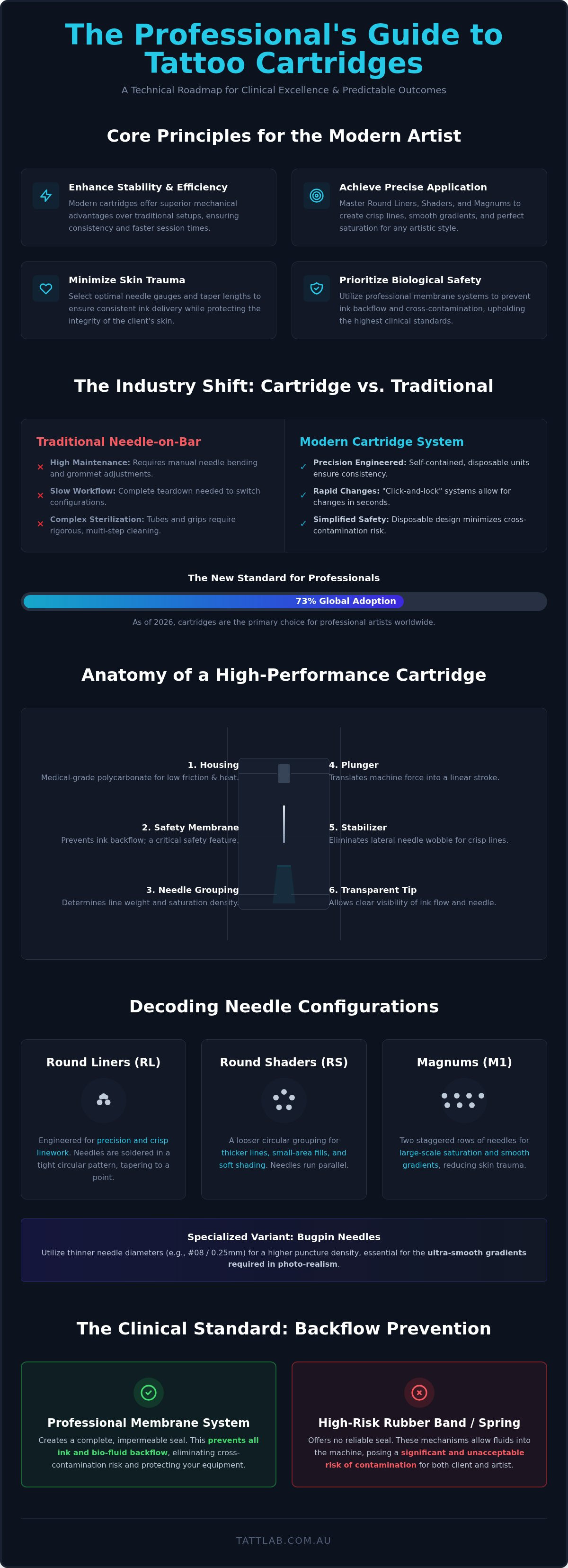
In a professional clinical environment, we view the tattoo cartridge not merely as a consumable, but as a precision-engineered instrument. A modern cartridge is a self-contained needle system specifically designed for use with rotary and pen-style machines. Unlike traditional setups, these units house the needle, tension mechanism, and ink reservoir within a single medical-grade shell. This integrated design ensures the needle remains retracted when the machine isn't active, which significantly reduces the risk of accidental needle sticks and enhances the overall safety of your workspace.
The efficiency of tattoo cartridges far exceeds the older "needle-on-bar" setups that once dominated the industry. Traditional methods required manual needle bending, grommet adjustments, and complex sterilization routines for tubes. Cartridges eliminate these mechanical variables, allowing you to focus entirely on the artistic application. The outer housing is crafted from medical-grade plastics, such as high-density polycarbonate, which is essential for preventing friction and heat. Because the needle moves at high frequencies, any friction against the housing can create micro-particles or heat that irritates the skin. By using low-friction materials, you protect the biological integrity of the client's skin while ensuring the machine's motor operates without unnecessary resistance.
The Evolution from Traditional Needles
The transition to cartridge systems has revolutionized setup times and cross-contamination protocols in the modern studio. In the past, switching between a liner and a shader required multiple machines or a complete teardown of your setup. Now, the "click-and-lock" mechanism allows for mid-session changes in seconds, keeping your creative momentum intact. This speed doesn't come at the expense of safety. Since the entire needle assembly is disposed of as a single unit, your cross-contamination protocols become simpler and more reliable. As pen-style machines have become the standard in 2026, the industry's reliance on the precision of these disposable systems has solidified, making them the primary choice for 73% of professionals globally.
Key Components: Housing, Needle, and Seal
The structural integrity of a professional cartridge depends on several internal elements working in harmony to deliver a predictable result. Most high-end options, such as those stocked at Tatt Lab, feature a transparent or semi-transparent tip. This visibility is vital for monitoring ink flow and needle placement during intricate, high-detail work. Inside the housing, an internal plunger translates the rotational force of your machine into a linear stroke, ensuring consistent depth even when working on challenging areas of the body. To ensure the highest level of accuracy, a dedicated stabilizer component acts as a guide within the housing to eliminate lateral needle wobble, ensuring that every puncture is clean and intentional. This combination of visibility and stability is what allows for the crisp lines and smooth gradients that define modern professional work.
Deciphering Configurations: Liners, Shaders, and Magnums
Selecting the correct configuration is a clinical decision that dictates how pigment interacts with the dermis. While the outer housing provides the framework, the needle grouping determines the saturation density and the level of trauma inflicted on the tissue. Professional tattoo cartridges are categorized by their arrangement, with Round Liners (RL), Round Shaders (RS), and Magnums (M1/CM) forming the essential toolkit for any modern specialist. Each grouping is engineered to solve a specific technical challenge, from the surgical precision of a fine line to the broad saturation required for large-scale coverage.
Round Liners feature needles soldered in a circular pattern that tapers to a specific point. This configuration is designed for precision, creating a single, focused entry point for the ink. Round Shaders, conversely, utilize a looser circular grouping where the needles run parallel. This design allows for thicker line weights and small-scale filling, providing a softer impact than a dedicated liner. For large-scale saturation, Magnums are indispensable. They consist of two staggered rows of needles that cover more surface area in a single pass, which significantly reduces the total time the skin is under tension.
The "Bugpin" variant is a specialized configuration within tattoo cartridges that uses thinner needle diameters, typically 0.25mm (#08). These provide a higher density of punctures within the same grouping size, allowing for the soft-edge gradients required in high-end realism. Choosing the right balance of these tools is a hallmark of a Trusted Specialist who values both the aesthetic outcome and the physical well-being of the client.
Linear Precision with Round Liners
Round Liners are defined by their grouping tension. "Tight" and "Extra Tight" configurations pull the needle tips closer together, reducing the footprint of each strike for surgical detail. The needle count, such as a 3RL versus a 9RL, fundamentally changes how the skin resists the needle. A lower count penetrates with less force, while a higher count requires more machine power to overcome skin tension. This technical choice is what separates the bold, heavy lines of American Traditional from the ethereal, microscopic details of contemporary fineline work.
Saturation and Shading with Magnums
Curved Magnums represent a significant advancement in ergonomic needle design. By slightly arching the needle row, these cartridges prevent the outer needles from digging too deep during a stroke, which reduces snagging and minimizes potential scarring. This mechanical advantage is vital for optimizing pigment saturation without compromising skin integrity and healing. When you reduce epidermal trauma through smart tool selection, you ensure the client's journey toward transformation is as comfortable as it is aesthetically successful. For those refining their professional inventory, exploring a vetted range of Curved Magnums is a logical step toward more consistent, predictable results.
The Science of Precision: Tapers, Gauges, and Needle Counts
Mastering the technical specifications of your tools is what distinguishes a technician from a specialist. While the configuration determines the layout, the needle's gauge and taper length dictate the biological interaction between the pigment and the dermis. High-quality tattoo cartridges offer a level of standardization that allows you to predict exactly how the skin will respond to every strike. Understanding these microscopic variables is essential for minimizing micro-trauma and ensuring the longevity of the artwork.
Needle gauge refers to the diameter of each individual needle within the grouping. The industry standardizes these into three primary sizes: 0.25mm (#08), 0.30mm (#10), and 0.35mm (#12). A thinner gauge creates a smaller entry point, while a thicker gauge displaces more tissue to deposit a larger volume of ink. Choosing between these is a clinical decision based on the client's skin type and the desired saturation level. When you match the needle count to the surface area of your design, you optimize efficiency and reduce the time the skin remains open to the environment.
Choosing the Right Gauge for Your Style
The #10 (0.30mm) gauge has become the industry "sweet spot" for its remarkable versatility. It provides enough stability for clean linework while remaining fine enough for smooth shading. For artists specializing in ultra-soft realism or "pepper" shading, the #08 (0.25mm) gauge is the superior choice. These thinner needles allow for a higher density of punctures with minimal epidermal resistance, creating ethereal gradients that appear seamless to the eye. Conversely, #12 (0.35mm) needles are the foundation of bold, high-saturation work. Their larger diameter is ideal for the heavy, solid packing required in American Traditional or Japanese styles, where pigment density is the primary objective.
Taper Length and Skin Entry
Taper refers to the length of the point at the end of the needle. The physics of the taper determines the shape of the puncture and the volume of ink delivered. Long Tapers are the professional standard for black-and-grey work; because the point is more gradual, it creates a smaller puncture that allows you to make multiple passes with significantly less trauma. Short tapers have a more blunt profile, making them highly efficient for "packing" pigment into the dermis in fewer passes. A longer taper length results in a more controlled, slower ink flow speed, which provides the artist with greater precision during delicate transitions. By selecting tattoo cartridges with the appropriate taper, you manage the healing narrative from the very first stroke.
Safety Standards and the Importance of Membrane Systems
In a professional studio environment, the safety of the client is as vital as the quality of the art. When selecting tattoo cartridges, the most critical internal component is the safety membrane. This thin silicone or rubber barrier serves a dual purpose: it provides the necessary tension for the needle stroke and, more importantly, creates a physical seal that prevents biological fluids and ink from migrating back into the machine's motor. Without this barrier, the risk of cross-contamination between clients increases exponentially, as rotary machines are notoriously difficult to fully sterilize internally.
Beyond the membrane, the material composition of the needles themselves determines the level of irritation during the procedure. Professional-grade needles are manufactured from 316L stainless steel, a medical-grade alloy known for its corrosion resistance and biocompatibility. To ensure absolute sterility, every cartridge must undergo Ethylene Oxide (E.O.) Gas processing and be housed in individual, tamper-evident blister packaging. This rigorous protocol ensures that the instrument is free from pathogens from the moment it leaves the facility until it meets the client's skin.
Preventing Cross-Contamination
The science of fluid dynamics explains why a membrane is superior to older, budget-friendly designs. Capillary action can pull liquid upwards through the needle housing, a phenomenon that often occurs with "rubber band" style cartridges. These cheaper alternatives lack a true seal, allowing ink to bypass the tensioner and enter the drive bar area. A high-tension membrane doesn't just block fluids; it also offers a consistent "bounce-back" that preserves the longevity of your machine's motor by reducing strain. Integrating these high-performance tools is a fundamental part of maintaining medical-grade studio safety and upholding professional clinical standards.
Identifying Quality Manufacturing
Recognizing the signs of a failed cartridge is a skill every artist must develop to protect their work. A rattling sound or visible needle wobble during operation indicates a lack of internal stabilization, which often results in uneven saturation and unnecessary skin trauma. If you notice ink leaking from the back of the housing, the membrane has failed, and the session should be stopped immediately to protect the machine. At Tatt Lab, we vet every brand for consistent soldering and housing alignment to ensure your focus remains on the client. Always check the expiration dates on your sterile packaging; over time, the seal on a blister pack can degrade, compromising the sterile environment. To maintain a workspace that prioritizes both health and performance, you can shop our vetted range of professional supplies today.
Integrating Premium Cartridges into Your Professional Workflow
Adopting new tools into a high-stakes clinical environment requires a methodical approach to maintain predictability. While the technical specifications of tattoo cartridges provide the foundation, the integration into your daily practice determines the ultimate success of the healing narrative. We recommend testing new configurations on synthetic media or during small, controlled sessions before committing to large-scale projects. This allows you to calibrate your machine's voltage and hand speed to the specific tension of the cartridge membrane without compromising client work.
Effective inventory management is another hallmark of a professional studio. A balanced stock should consist of "staple" configurations that handle 80% of your daily tasks, supplemented by specialized needles for specific artistic challenges. By maintaining a consistent supply of vetted tools, you eliminate the anxiety of equipment failure mid-session. To achieve the best results, ensure your setup is finalized with professional tattoo ink that matches the flow rate and viscosity requirements of your chosen needle gauge.
Style-Specific Recommendations
Every artistic style demands a unique mechanical approach to the skin. For specialists focused on the "Realism Kit," we suggest a combination of Bugpin Round Liners for microscopic detail and Curved Magnums for soft, seamless gradients. This setup minimizes epidermal trauma while allowing for the layered saturation required in photographic realism. Conversely, the "Bold Will Hold" setup relies on the stability of 0.35mm (#12) Round Liners paired with standard Magnums to deliver the heavy pigment packing essential for Traditional and Neo-Traditional work. For artists seeking clinical-grade consistency across all styles, Tatt Lab recommends the Elite EVO range, known for its rigorous quality control and superior internal stabilization.
The Tatt Lab Advantage
Sourcing your tattoo cartridges from a dedicated Australian specialist ensures your studio remains operational even during high-demand periods. We understand that a reliable supply chain is the backbone of your business. Our artist-owned team provides more than just supplies; we offer expert support grounded in a deep understanding of how this gear performs in a professional setting. By choosing a local specialist, you benefit from several key advantages:
- National express shipping across Australia for rapid studio replenishment.
- A vetted selection of leading brands like Elite and EZ, ensuring every box meets our safety standards.
- Transparent technical support from professionals who use these tools daily.
- Wholesale opportunities designed to support the growth of established Australian studios.
This methodical approach to equipment selection reflects a commitment to both artistic excellence and physical integrity. When you treat your tools as medical-grade instruments, you elevate the entire experience for your clients, turning a technical procedure into a predictable journey of transformation.
Mastering Technical Excellence in Every Session
Selecting the right tattoo cartridges is a commitment to the physical integrity of your client's skin and the clinical precision of your craft. By prioritizing high-tension membrane systems and medical-grade 316L stainless steel, you eliminate the mechanical variables that lead to inconsistent results or cross-contamination risks. Whether you're refining a realism kit with bugpins or packing solid color with #12 magnums, your tools must match the sophistication of your technique to ensure predictable, high-end outcomes.
At Tatt Lab, we act as your dedicated partner in this professional progression. Our selection is artist-vetted to meet rigorous 2026 standards, ensuring every configuration delivers the stability you require. As an official stockist of the Elite and EZ ranges, we provide the reliable infrastructure your studio needs to thrive. With express national shipping across Australia, you can maintain your inventory without the anxiety of supply delays or quality fluctuations.
Shop Australia's Premium Selection of Professional Tattoo Cartridges and secure the tools your artistry deserves. We're here to support your journey toward becoming a trusted specialist in our vibrant community.
Frequently Asked Questions
What is the difference between a tattoo needle and a tattoo cartridge?
A traditional needle is a long metal bar that requires a separate tube and grip, whereas a tattoo cartridge is a self-contained, disposable system. Cartridges house the needle and tension mechanism within a plastic shell, allowing for rapid swaps during a session. This evolution has improved workflow efficiency and safety by reducing the risk of accidental needle sticks in the studio.
Do all tattoo cartridges fit every tattoo machine?
Most modern tattoo cartridges use a universal twist-and-lock connection designed for rotary pen-style machines. However, some proprietary brands require specific machine interfaces. It's essential to verify compatibility with your machine's drive bar before purchase. Standardized systems like those from Elite and EZ are engineered to fit the majority of professional rotary pens available in 2026.
What are the best tattoo cartridges for fine line work in 2026?
For fine line work, specialists prioritize cartridges with internal stabilizers and tight groupings, such as the Elite EVO or EZ V-Select Round Liners. Specifically, a 0.25mm (#08) or 0.30mm (#10) gauge with a long taper provides the surgical precision required for microscopic detail. These configurations minimize needle wobble, ensuring that delicate pigment application remains crisp and consistent throughout the procedure.
Why is a safety membrane important in a tattoo cartridge?
The safety membrane acts as a biological seal that prevents ink and bodily fluids from migrating into your machine's motor. This component is the primary defense against cross-contamination in a clinical studio setting. High-quality membranes also provide consistent tension for the needle stroke, which preserves the longevity of your rotary machine by reducing internal friction and motor strain during long sessions.
What does 'Bugpin' mean in tattoo needle sizes?
'Bugpin' refers to needles with a thinner diameter than the standard #12 (0.35mm) gauge, typically measuring 0.25mm (#08) or 0.30mm (#10). These thinner needles are grouped more tightly together, allowing for a higher density of punctures within a smaller surface area. This configuration is essential for creating the soft-edge gradients and smooth transitions found in high-end realism and delicate shading styles.
How do I know if a tattoo cartridge is sterile?
A sterile tattoo cartridge must be individually sealed in a tamper-evident blister pack that features a color-changing Ethylene Oxide (E.O.) Gas indicator. Always check the expiration date printed on the packaging to ensure the sterile seal hasn't degraded over time. Professional suppliers like Tatt Lab only stock vetted brands that adhere to international medical sterilization standards for every batch produced.
Can I reuse a tattoo cartridge if I clean it in an autoclave?
No, tattoo cartridges are strictly single-use medical devices and must never be reused or placed in an autoclave. The plastic housing and internal silicone membranes are not designed to withstand high heat and pressure, which can cause structural failure or melting. Reusing a cartridge poses an extreme biological risk to your clients and violates professional health and safety regulations in Australia.
What gauge needle should I use for shading?
For smooth, versatile shading, the #10 (0.30mm) gauge is considered the industry standard for daily professional use. If your style requires ultra-soft "pepper" shading or ethereal realism, a #08 (0.25mm) bugpin provides a finer footprint for more delicate transitions. For heavy, solid color packing in traditional styles, a #12 (0.35mm) gauge is often preferred to deposit a larger volume of pigment efficiently.


Comments (0)
There are no comments for this article. Be the first one to leave a message!