

A tattoo cartridge is not just a consumable; it is a precision-engineered medical instrument that dictates the biological outcome of your client's skin. In a discipline where a fraction of a millimetre separates a crisp line from permanent dermal trauma, your choice of tattoo pen cartridges acts as the primary interface between your creative vision and the body's natural canvas. You likely understand the daily frustration of a needle that drags or the quiet anxiety of questioning whether your equipment truly prevents fluid backflow.
We agree that navigating Australia's current regulatory landscape places an immense responsibility on you to source supplies that meet clinical-grade expectations. This guide will help you master the technical nuances of membrane systems and needle tapers to elevate your artistry. We'll examine how to select professional configurations that ensure reduced skin trauma and align with global safety benchmarks, providing a clear path toward technical mastery and absolute physical integrity in your studio.
Key Takeaways
- Understand how 316L Surgical Stainless Steel and medical-grade housing provide the structural stability required for superior skin integrity and predictable healing outcomes.
- Learn why professional tattoo pen cartridges must utilize integrated safety membranes rather than rubber band systems to eliminate the risk of fluid backflow and cross-contamination.
- Master the technical selection process for matching specific needle configurations, from micro-realism liners to curved magnums, to your unique artistic style.
- Discover the shift toward clinical-grade standards in the Australian industry and how adopting medical-grade procurement protects both your clients and your professional reputation.
- Identify how to source artist-vetted equipment with national express shipping to ensure your studio maintains a consistent supply of high-performance tools.
Understanding the Evolution of Tattoo Pen Cartridges
The modern tattoo studio functions more like a specialized medical facility than the rebellious workshops of the past. Central to this transformation are tattoo pen cartridges, which have effectively replaced the traditional needle bar and tube setup. These self-contained units represent a sophisticated leap in engineering, housing the needle, tension mechanism, and ink reservoir within a single, sterile module. This shift allows for a more controlled, predictable application of pigment that respects the physical integrity of the skin.
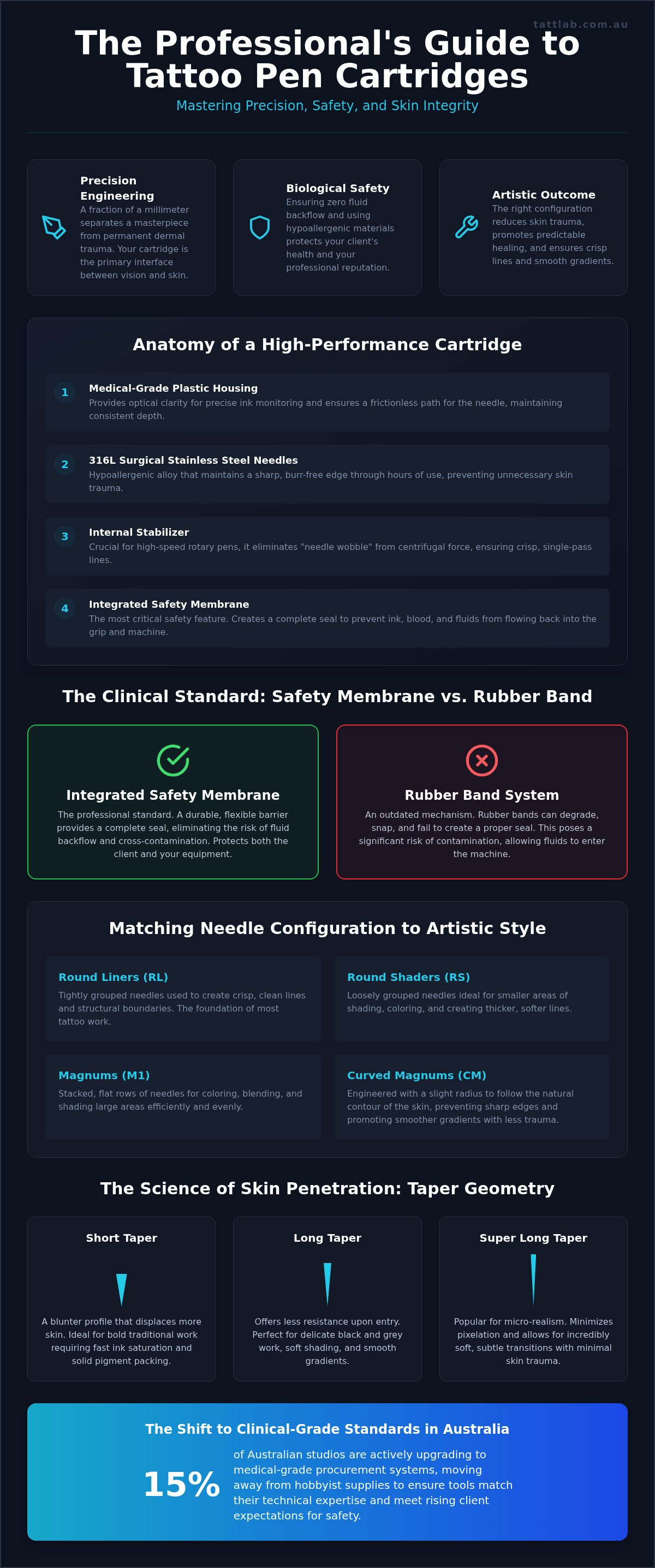
The evolution of tattoo machines reflects a relentless pursuit of control and safety. In Australia, professional artists are increasingly moving away from the mechanical variability of coil machines toward the streamlined performance of rotary pens. This isn't merely a trend; it's a commitment to clinical rigor. Current data suggests that 15% of Australian studios are actively upgrading to medical-grade procurement systems to ensure their tools match their technical expertise and meet rising client expectations for safety.
The Advantages of Modular Systems
Modular systems provide an unprecedented level of flexibility during a session. You can switch from a fine-line round liner to a curved magnum for soft shading in a matter of seconds, rather than managing multiple machine setups. This efficiency doesn't just save time; it improves the ergonomics of your workspace. Because cartridges are stabilized within precision-moulded housing, they produce significantly less vibration than traditional bars. This stability is essential for maintaining accuracy during long-form pieces, protecting your hands from the cumulative strain of vibrating equipment.
Rotary Pens and Cartridge Compatibility
The industry has largely converged on a universal twist-lock standard, allowing high-performance tattoo pen cartridges to integrate seamlessly with most rotary pen machines. The internal drive bar of your machine must communicate effectively with the cartridge’s internal plunger. When this interaction is calibrated correctly, it ensures a consistent needle depth and hit strength. Using professional-vetted supplies from a trusted Australian specialist ensures that your equipment operates as a cohesive system, demystifying the science of ink saturation and allowing you to focus entirely on the artistic progression of the piece.
Anatomy of a Professional Tattoo Cartridge: Precision Engineering
The performance of tattoo pen cartridges depends on the synergy of their internal components. High-end housing is typically crafted from medical-grade plastic, which provides the optical clarity needed for precise ink monitoring while ensuring a frictionless path for needle travel. This smooth movement is essential for maintaining consistent depth. The needles themselves are manufactured from 316L Surgical Stainless Steel. This specific alloy is chosen for its hypoallergenic properties and its ability to maintain a sharp edge through hours of repetitive skin penetration. Using inferior metals can lead to microscopic burrs that cause unnecessary trauma. While Australian standards are evolving, looking at FDA safety regulations for tattoo inks and equipment highlights the global emphasis on material purity to prevent adverse reactions.
A critical but often overlooked component is the internal stabilizer. In high-speed rotary pens, centrifugal force can cause "needle wobble." A precision stabilizer keeps the needle centered, which is the difference between a crisp single-pass line and a blurred edge. This mechanical stability allows the artist to maintain a calm, controlled rhythm, even during complex sessions. To ensure you are working with these exact specifications, it's vital to source from a specialist supplier that understands the technical demands of professional artistry.
Needle Configurations and Their Purpose
Structure starts with Round Liners (RL) and Round Shaders (RS). RLs are tightly grouped to create structural boundaries, while RSs allow for more ink flow in tighter spaces. For larger areas, Magnums (M1) and Curved Magnums (CM) are the gold standard. Curved magnums are engineered with a slight radius to follow the natural contour of the skin, preventing the side-cutting often associated with flat needles. This geometry facilitates smooth, gradient shading without overworking the tissue, promoting a more efficient healing process.
Taper Length and Skin Resistance
Taper geometry dictates how the needle enters the dermis. Long tapers, such as #10 (0.30mm) or #12 (0.35mm) configurations, offer less resistance, making them ideal for delicate grey-wash gradients. Short tapers have a blunter profile that displaces more skin, allowing for faster saturation and solid pigment packing in traditional work. Super long tapers are increasingly popular for micro-realism, as they minimize pixelation and allow for incredibly soft transitions. Choosing the right taper is a matter of matching the tool to the biological response you want to elicit from the skin.
Safety and Hygiene: The Clinical Standard for Cartridge Systems
Maintaining a sterile environment is the foundation of professional tattooing. In a modern studio, tattoo pen cartridges serve as the critical line of defense against cross-contamination. This protection is primarily achieved through a safety membrane, a technical safeguard that distinguishes professional equipment from entry-level supplies. While older systems relied on rubber bands for needle tension, these left the machine's internal drive bar exposed to fluids. A membrane creates a hermetic seal, ensuring that pigment, blood, and interstitial fluid cannot travel back into the grip or the motor. This level of backflow prevention is essential, especially considering FDA guidance on tattoo ink safety which highlights the persistent risks of bacterial contamination in the tattooing process.
Sterilization protocols must be absolute. Every professional cartridge is treated with Ethylene Oxide (EO) Gas and sealed in individual blister packaging. This process ensures the needle remains sterile until the exact moment of use. When fluids bypass a plunger in a non-membrane system, they settle in the internal drive mechanism. This creates a breeding ground for bio-matter that is impossible to fully sterilize, posing a significant risk to every subsequent client. Protecting your rotary machine isn't just about equipment longevity; it's about honoring the biological trust your clients place in your hands.
The Science of the Safety Membrane
The silicone membrane is engineered for a specific "snap-back" tension. This elasticity must be perfectly balanced. If the tension is too high, it forces the machine's motor to work harder, leading to overheating and premature failure. If it's too low, the needle will drag, causing inconsistent saturation and skin trauma. High-quality membranes are also designed to resist tearing under the high-frequency vibration of modern pens. You should be wary of imitation cartridges that use thin plastic sleeves instead of genuine silicone. These "fakes" often fail to provide a true fluid seal, leaving your machine vulnerable to internal contamination.
Australian Health Standards and Disposables
Australian infection control guidelines demand a zero-tolerance approach to bio-matter exposure. Using single-use tattoo pen cartridges simplifies compliance by eliminating the need for complex autoclave cycles for tubes and bars. Once a session is complete, the entire module is disposed of in a puncture-proof sharps container. This efficiency reduces the risk of accidental needle sticks during teardown and ensures your studio maintains a hospital-grade hygiene protocol. For a deeper look at maintaining a compliant environment, consult our Medical Supplies for Tattoo Artists: The Professional Studio Safety Guide (2026).
Selection Guide: Matching Cartridge Configurations to Tattooing Styles
Artistic progression requires a deep understanding of how different tattoo pen cartridges interact with the dermis. Your configuration choice isn't just about the visual result; it's about managing skin resistance and ensuring efficient pigment delivery. For fine line and micro-realism, the precision of a Round Liner is paramount. These styles demand a needle that maintains its grouping under pressure, allowing for the single-pass accuracy that defines high-level detail work.
Diameter and Gauge Breakdown
- #08 (0.25mm) Gauges: Often referred to as "bugpins," these are the specialist choice for ultra-soft shading and micro-detail. The thinner diameter creates smaller puncture sites, resulting in smoother gradients and faster healing for delicate skin areas.
- #10 (0.30mm) Gauges: The versatile industry standard. These provide a balance between steady ink flow and reduced trauma, making them suitable for most shading and lining tasks.
- #12 (0.35mm) Gauges: These larger needles deposit a higher volume of ink per hit. They're essential for bold lines and solid colour packing where maximum saturation is the goal.
Traditional and neo-traditional styles rely on the structural integrity of bold, consistent linework. Here, #12 gauge round liners provide the necessary displacement to create those iconic boundaries. Conversely, black and grey realism necessitates the use of Curved Magnums. The slight radius of the needle grouping allows you to blend tones without the harsh "side-cut" marks often left by standard flat magnums. This geometry is what enables the seamless, photographic transitions that clients expect from modern realism.
For artists specialising in whip shading or dotwork, the texture of the needle becomes a creative tool. By leveraging the specific "hit" of a long taper needle, you can create the pixelated effects that define these contemporary styles. It's about choosing a tool that complements your hand speed and machine voltage to achieve a predictable, repeatable result. This methodical approach to equipment selection lowers the reader's anxiety, replacing uncertainty with a sense of controlled progress.
The Specialist Choice: Elite III vs. Elite EVO
Selecting the right brand is as important as the configuration. The Elite III series is a reliable workhorse for standard applications, offering consistent quality for daily studio use. However, for high-detail realism, the Elite EVO provides precision-moulded housing that virtually eliminates needle play. When your work involves complex layers and biological accuracy, professional-grade options like EZ V-Select offer the structural stability required for long sessions. To ensure your studio is equipped for any artistic challenge, explore our curated range of professional tattoo pen cartridges today.
Sourcing Quality: Why Australian Studios Trust Tatt Lab for Professional Supplies
Sourcing professional equipment in Australia requires a discerning eye, particularly given the current regulatory landscape where artists must often set their own benchmarks for safety. At Tatt Lab, we bridge this gap by acting as a dedicated partner in your professional progression. As an artist-owned and operated specialist, we don't just stock products; we vet them through the lens of clinical rigor and practical studio experience. Our commitment ensures that every tool we provide, from intricate tattoo pen cartridges to medical-grade PPE, meets the high standards required for superior aesthetic outcomes and client safety. We understand the vulnerability involved in specialized services, and our goal is to provide the technical edge that builds immediate trust between you and your clients.
A Curated Selection of Industry Leaders
We prioritize performance and reliability by curating a selection from globally recognized manufacturers. Our inventory includes Elite III, Elite EVO, EZ V-Select, and Revolution series. These brands are chosen because they consistently meet our internal quality control benchmarks, ensuring that every batch delivers the precision and sterile integrity you expect. This methodical approach to procurement demystifies the science of equipment selection, allowing you to focus on the transformative nature of your work. Every item is verified for its structural stability and material purity before it reaches your station. For a broader perspective on maintaining these standards within your facility, read The Professional Guide to Tattoo Supplies in Australia: Quality, Safety, and Performance.
Partnering with Tatt Lab for Your Studio
Efficiency in procurement is essential for maintaining a modern, boutique-studio persona that values physical integrity. We've streamlined our ordering process to provide national express shipping across Australia, ensuring that your studio never faces a supply deficit. Whether you are a solo artist or manage a high-volume facility, our wholesale opportunities allow for predictable, cost-effective scaling. Our team provides expert technical support, drawing on years of industry experience to help you navigate needle configurations and machine compatibility. By centralizing your procurement of tattoo pen cartridges and medical-grade disinfectants, you reduce the administrative burden and maintain a consistent, hospital-grade environment. We invite you to explore our full range of professional tattoo cartridges and experience a partnership grounded in technical edge and empathetic support.
Elevating Studio Standards and Technical Mastery
Mastering the technicalities of tattoo pen cartridges is a fundamental commitment to both your artistic growth and your client's long-term wellbeing. By adopting modular systems with integrated safety membranes, you ensure a sterile environment that aligns with medical-grade safety standards. We've examined how 316L Surgical Stainless Steel and precise taper geometry act as the essential bridge between your creative vision and predictable, high-quality results. This methodical approach to equipment selection replaces uncertainty with a sense of controlled, professional progress.
As an artist-owned and operated specialist, Tatt Lab is dedicated to supporting your progression with vetted tools and expert technical support. We prioritize clinical rigor so you can focus on the narrative of personal transformation your work provides. With national express shipping across Australia, maintaining a sophisticated, modern studio is both efficient and reliable. Shop Professional Tattoo Cartridges at Tatt Lab and continue your journey toward technical mastery. Your dedication to precision defines your professional legacy; we're proud to be your partner in every successful outcome.
Frequently Asked Questions
Do tattoo cartridges fit all tattoo pen machines?
Most professional tattoo pen cartridges utilize a universal twist-lock connection that is compatible with the vast majority of rotary pen machines. While the industry has largely standardized this fitment, some proprietary brands still require specific modules. It is essential to verify that your machine’s drive bar aligns correctly with the internal plunger of the cartridge to ensure a consistent hit and prevent mechanical wear over time.
What is the difference between a membrane and a rubber band cartridge?
The primary difference lies in safety and fluid dynamics. A membrane cartridge uses a silicone barrier to create a hermetic seal, preventing blood and pigment from entering the machine. In contrast, rubber band systems only provide needle tension and lack a physical barrier, which significantly increases the risk of cross-contamination. Professional Australian studios exclusively demand membrane systems to maintain clinical hygiene standards and protect their equipment.
How do I know if a tattoo cartridge is sterile?
You can verify sterility by inspecting the individual blister packaging for an Ethylene Oxide (EO) Gas indicator, which typically changes color once the process is complete. Every professional-grade module must arrive in an undamaged, heat-sealed pack with a clear lot number and expiration date. If the seal is compromised or the indicator is missing, the cartridge must be discarded immediately to prevent the risk of introducing pathogens.
What needle gauge should I use for fine line tattooing?
Fine line tattooing typically requires #08 (0.25mm) or #10 (0.30mm) needle gauges. These thinner diameters, often called bugpins, create smaller puncture sites that allow for the high-detail precision needed in micro-realism. Using a #08 gauge reduces skin resistance and minimizes pixelation, ensuring that delicate gradients and crisp structural lines heal with the intended clarity while respecting the biological integrity of the client’s skin.
Can I reuse a tattoo cartridge if I clean it in an autoclave?
No, you must never attempt to reuse or autoclave a tattoo cartridge. These units are strictly engineered for single-use application and are constructed from medical-grade plastics that cannot withstand the high temperatures of an autoclave without warping. Attempting to clean them also fails to remove bio-matter trapped behind the internal membrane. Proper disposal in a sharps container after a single session is the only way to ensure absolute safety.
Why is backflow prevention so important in rotary machines?
Backflow prevention is critical because it stops contaminated fluids from migrating into the non-autoclavable parts of your rotary machine. Since the internal motor and drive mechanism cannot be sterilized, any ink or biological matter that enters the machine creates a permanent risk of cross-contamination for future clients. Utilizing high-quality tattoo pen cartridges with integrated membranes preserves the physical integrity of your equipment and maintains a hospital-grade hygiene protocol.
What are the benefits of using curved magnums over standard magnums?
Curved magnums feature a tapered grouping that follows the natural radius of the skin, providing a softer hit at the edges of the needle cluster. This design prevents the harsh side-cutting marks that standard flat magnums can leave, making them the superior choice for smooth black and grey shading. By distributing pressure more evenly, curved magnums reduce dermal trauma and facilitate more efficient pigment saturation during large-scale work.
How do I choose between a long taper and a short taper needle?
Your choice depends on the desired ink deposit and skin response. Long tapers offer less resistance and create smaller holes, making them ideal for soft shading and delicate linework where you want to minimize trauma. Short tapers have a blunter profile that displaces more tissue, which allows for faster pigment saturation and solid colour packing. Matching the taper to your specific artistic style ensures a more predictable healing process for the body.


Comments (0)
There are no comments for this article. Be the first one to leave a message!