

A bold line doesn’t come from a label alone. If you’ve wondered what are power liner needles, the term often refers to a round liner setup with a thicker needle, commonly #12 gauge (0.35 mm), for bold, saturated linework. However, suppliers and artists may use the name differently, so check the actual specifications instead of relying on the label.
Needle grouping, gauge and taper are easy to mix up, but they describe different parts of a setup. Each can affect how a line is formed, alongside the design, machine settings and your technique, including hand speed.
This guide explains what artists usually mean by “power liner,” how the term relates to round liner groupings, and which details to compare before choosing a setup. You’ll learn how to read key needle specifications and consider how they work together, so you can match professional supplies to your intended linework. Tatt Lab is an Australian artist-owned supplier with traditional needles, cartridges and Round Liners among its supply categories.
Key Takeaways
- Understand what are power liner needles without assuming the phrase identifies a universal product or standard.
- Compare grouping, gauge and taper as separate specifications.
- Match a liner setup to the intended linework, machine compatibility and your technique, not the label alone.
- Before professional use, check the packaging, sterility information and manufacturer instructions. Compare Round Liners against your requirements.
What Are Power Liner Needles in Tattooing?
“Power liner” is a term some suppliers or artists use for a tattoo liner setup intended to make stronger, more prominent lines. It is not a universally standard needle configuration. If you’re asking what are power liner needles, treat the name as a description to verify, not a specification that tells you exactly what’s in the pack.
The phrase may describe a particular liner grouping, but it doesn’t give you the full setup or predict the finished line. Grouping refers to how the needles are arranged and how many are included. Linework style describes the intended result. Machine settings, hand speed and applied pressure are separate factors that also influence needle movement and ink deposition. Tattooing involves more than selecting a needle, as this overview of the Process of tattooing helps illustrate.
That distinction matters when comparing products. Two packages labelled “power liner” may list different configurations, while the same grouping can produce different results in different setups. A label alone can’t guarantee line width, saturation or healed appearance. Those outcomes depend on the complete setup and the artist’s trained technique.
Is power liner a standard tattoo needle configuration?
Don’t assume it is. Manufacturers, suppliers and professional communities may use the term differently, or use other wording for a similar linework aim. Check the product description and manufacturer specifications for the actual configuration. Don’t infer a needle count or grouping from “power liner” alone. Confirm the details on the packaging or product information.
What does a liner needle do?
Round Liner groupings are selected for tattoo linework. The appropriate choice depends on the design and the artist’s approach. A grouping name identifies a needle arrangement, not a guaranteed line width or healed result. When comparing products, check gauge and taper separately, then consider how the needle works with your machine and technique. Tattoo needle terminology can also overlap with permanent makeup (PMU) listings. A PMU liner may be intended for a different application, so confirm the product’s stated use rather than assuming the categories are interchangeable.
In short, “power liner” can communicate an intended effect, but it isn’t enough information to choose a setup. Read the specifications, check the intended application and assess the full combination using professional judgement.
How Power Liner Needle Grouping, Taper, and Gauge Affect the Setup
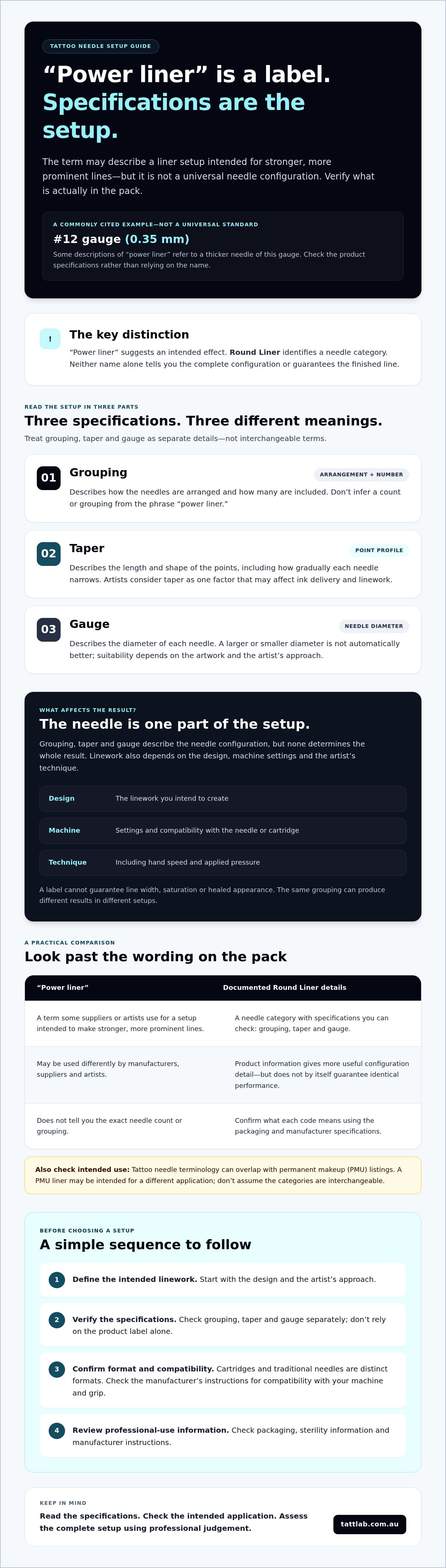
To compare liner setups, separate three specifications: grouping is the arrangement and number of needles, taper describes the length and shape of their points, and gauge is the diameter of each needle.
These features describe the needle configuration, but none determines the whole result. Consider them alongside the design, machine, hand speed and technique. If you’re still asking what are power liner needles, the practical answer is to look beyond the label and examine the specifications that describe the setup.
How is a liner grouping different from taper and gauge?
Think of the three details as separate coordinates, not interchangeable terms:
- Grouping: The number of needles and how they’re arranged in the configuration.
- Taper: The point profile, including how gradually each needle narrows. Artists consider taper as one factor that may affect ink delivery and linework.
- Gauge: The needle’s diameter. A larger or smaller diameter isn’t automatically better. Suitability depends on the artwork and the artist’s approach.
Check product packaging and manufacturer specifications to confirm what each code means. Even when two products list the same grouping, taper or gauge, that alone doesn’t establish identical performance. Needle design and the rest of the setup matter. For wider selection context, see The Professional Guide to Tattoo Supplies in Australia.
How do cartridges and traditional needles change the decision?
Cartridges and traditional needles are distinct supply formats, with different components and handling. Don’t assume a needle or cartridge will suit every machine and grip. Confirm compatibility against the manufacturer’s instructions before use, and check packaging and sterility information as part of your professional process. For broader health context, Mayo Clinic outlines tattoo risks and precautions, including sterile equipment.
Make the choice in sequence: identify the linework you intend to create, verify grouping, taper and gauge, then confirm the format works with your equipment. Tatt Lab supplies traditional needles and cartridges, as well as Round Liners, so artists can compare categories against their setup requirements. Browse the professional Round Liners and assess them against those criteria.
Power Liner Needles Compared With Other Round Liner Setups
“Power liner” suggests an intended linework effect, while Round Liner identifies a needle category. The terms aren’t interchangeable: a Round Liner’s documented grouping, taper and gauge provide more useful information than a “power” label alone. A tattoo machine deposits ink through repeated needle movement, as explained in How Tattoos Work, but the needle is only one part of the working setup.
Use this comparison as a checklist, not a promise of line width. Confirm each product’s actual specifications with its manufacturer, and check that the format is compatible with your machine and grip.
| Intended linework | Needle specification to verify | Machine compatibility | Artist preference |
|---|---|---|---|
| Stronger or more prominent lines, sometimes described as “power liner” work | Confirm the grouping, taper and gauge in product documentation. The label alone doesn’t establish them. | Check manufacturer guidance for the specific needle format, machine and grip. | Consider whether the setup fits the design and your established technique. |
| Other linework using a Round Liner | Compare the stated grouping, taper and gauge. Don’t assume all Round Liners share the same specifications. | Verify compatibility for that exact product and equipment combination. | Choose according to the line character and scale you’re aiming for. |
Neither a larger grouping nor a “power” name automatically makes a line better. The visible and healed result can vary with skin, ink, technique and the rest of the setup. A configuration that suits one design or artist’s workflow may not translate directly to another.
When might an artist consider a different liner setup?
Start with the design’s line character and scale, then consider what has worked reliably in your own professional workflow. Fine detail and more prominent outlines may call for different choices, but these are illustrative goals, not fixed needle prescriptions. Assess a setup using professional judgement and appropriate testing. Don’t copy another artist’s configuration without understanding its context.
What should artists compare before choosing Round Liners?
Compare grouping, taper, gauge, format, equipment compatibility and manufacturer documentation. Consistent information makes product differences easier to assess and prevents a label from standing in for an actual specification. For the separate question of liner versus shader use, see Round Liners vs. Shaders: Which Needle to Use?
How to Select and Check a Power Liner Needle Setup
Choose by evidence, not by label. Base needle selection on verified specifications, machine compatibility and the artist’s technique. Use this sequence to assess whether a setup fits the intended work before professional use:
- Define the linework. Consider the design’s scale and the line character you’re aiming for. Treat “power liner” as a description to investigate, not a complete specification.
- Confirm the needle details. Check the stated grouping, gauge, taper and format against the product information. Don’t infer missing specifications from the product name or marketing language.
- Check compatibility. Confirm that the needle format works with your machine and grip by following the relevant manufacturer instructions.
- Assess the setup. Apply professional judgement within your established workflow and studio procedures. Review the result over time, including healed work, rather than relying only on its fresh appearance.
Before use, inspect the packaging and supplied sterility information, and follow the manufacturer’s instructions. Also follow applicable local requirements and your studio’s infection-control procedures. If information is missing, unclear or inconsistent, verify it with the supplier or manufacturer rather than making assumptions.
What should you verify on the needle packaging?
Look for the stated grouping, gauge, taper and format, along with product identification or traceability details where supplied. Confirm the needle is intended for your equipment and professional application. A term such as “power” doesn’t establish sterility, safety certification or machine compatibility. Check the relevant documentation for each claim. If the package or instructions don’t provide enough information to make a confident assessment, pause and seek clarification before use.
How can artists assess a setup without overpromising results?
Assess a setup through controlled practice consistent with studio procedures and your professional training. Keep the design, machine and technique in view when reviewing results, and compare healed work as well as the immediate appearance. This helps you decide whether the setup fits your workflow without assuming that a label or a single result guarantees the same outcome elsewhere. A needle name can’t replace training, sound judgement or safe practice.
Once you’ve clarified your requirements, compare them with the documented specifications for professional Round Liners from Tatt Lab. Consider the category alongside your format and compatibility checks, without treating “power liner” as a product specification.
Choosing Professional Round Liners From Tatt Lab
Once you understand that “power liner” is terminology to verify, make a measured comparison. Start with the linework you intend to create, then assess the documented specifications and format of each option. A useful checklist includes grouping, gauge and taper, compatibility with your machine and grip, and any professional requirements that apply to your studio.
Tatt Lab is an Australian, artist-owned and operated supplier with professional Round Liners among its supply categories. This gives artists a category to consider against their own criteria, not a claim that any one liner suits every design or technique. Knowing what are power liner needles doesn’t determine the best choice for your work. Let the specific product details and your established workflow guide that decision.
How do you match a liner category to your professional needs?
Begin with your workflow and the product specifications, not an assumed universal best choice. If you’re comparing traditional needles with cartridges, first confirm which format the product listing describes. Then check that the format and stated configuration suit your equipment, and review the manufacturer’s instructions before use.
For a wider view of professional supply selection and safety considerations, consult The Professional Guide to Tattoo Supplies in Australia. Apply the same standard across options: verify the details, check compatibility and consider how the product fits your studio’s requirements.
What is a practical next step for artists?
Before ordering, review the product information and confirm machine and grip compatibility using the relevant manufacturer guidance. If you’re buying for a studio and need clarification about professional supply options, you can contact Tatt Lab through its available contact channels. Confirm the details that matter to your setup instead of relying on a category label alone.
For artists ready to compare the confirmed supply categories with their requirements, explore Tatt Lab’s professional tattoo supplies. Take time to review the specifications and choose according to the design, equipment and technique you can work with confidently.
Choose Your Next Liner Setup With Confidence
Understanding what are power liner needles starts with recognising that the label isn’t a complete specification. A considered choice comes from checking the actual grouping, taper and gauge, then confirming the format suits your machine and grip. The intended linework matters, along with your technique and professional judgement.
Use that checklist to compare options instead of searching for one universally “best” liner. Tatt Lab is an Australian, artist-owned and operated supplier, with traditional needles, cartridges and Round Liners among its supply categories. Review the product details against your requirements before making a selection.
Explore Tatt Lab’s professional tattoo supplies to compare options for your workflow. Check the specifications and choose a setup that fits your design, equipment and technique.
Frequently Asked Questions
Are power liner needles a standard needle grouping?
No universal grouping should be assumed from the term “power liner.” Product naming can vary among manufacturers, suppliers and tattooing communities. Some references associate the phrase with a particular gauge, but that doesn’t establish what’s inside every product sold under that name. Before selecting a setup, confirm the grouping and other specifications on its packaging or manufacturer documentation rather than inferring them from the label.
Are power liner needles the same as Round Liners?
Not exactly. Round Liner describes a needle category used for tattoo linework, while “power liner” may describe an intended linework effect or a supplier’s terminology for a setup. The terms can overlap, but one doesn’t automatically define the other. Check whether a product is identified as a Round Liner and review its stated specifications, intended application and format before treating it as suitable for your work.
How do grouping, taper, and gauge affect tattoo liner needles?
Grouping is the arrangement and number of needles, taper describes how the needle points narrow, and gauge refers to needle diameter. These are separate specifications, not interchangeable names for line thickness. Artists consider them together because each contributes to the needle setup, but none guarantees a particular fresh or healed line. Compare the manufacturer’s details and assess them in the context of the design and technique.
Can any tattoo machine use power liner needles?
No. Compatibility depends on the specific needle format and the machine and grip being used. Traditional needles and cartridges are distinct formats, so don’t assume a product will fit every setup just because it is called a liner or power liner. Check the product documentation and the machine or grip manufacturer’s instructions before use. If compatibility isn’t clear, seek confirmation from the relevant supplier or manufacturer.
How do I choose a liner needle for a specific tattoo design?
Start with the design’s scale and intended line character, then compare the needle’s documented grouping, taper, gauge and format. Consider how those details fit your established technique and equipment rather than copying another artist’s setup without context. There isn’t one universally correct liner for every design. Professional judgement and experience should guide selection, with healed results considered when reviewing how a setup performs over time.
What should I check before using a tattoo needle or cartridge?
Inspect the packaging and check the product identification, stated specifications, sterility information and manufacturer instructions. Confirm that the needle or cartridge is intended for your equipment and professional use. Don’t infer sterility, certification or compatibility from promotional wording alone. Follow the product instructions, applicable local requirements and your studio’s infection-control procedures. If packaging is damaged or key details are unclear, pause and resolve the uncertainty before use.


Comments (0)
There are no comments for this article. Be the first one to leave a message!