
A tattoo kit can be only one part of a studio’s supply plan. For wholesale tattoo supplies in Australia, compare products by category and role in your workflow, from needles and cartridges to aftercare and stencil materials, rather than treating every purchase as a single bundle.
Keeping a studio supplied takes more than choosing equipment. You also need to plan for the consumables and artist supplies used at each stage of an appointment. Comparing product categories helps you decide what suits your setup and whether a kit covers your needs.
This guide compares wholesale aftercare, traditional needles and cartridges, stencil paper, studio supplies, tattoo kits and artist supplies for Australian studios. It also explains what to consider when choosing products and how specialist supplies can support your day-to-day work.
Key Takeaways
- Match traditional needles or cartridges to your preferred workflow and the configurations your studio uses.
- Consider stencil paper and other studio consumables as part of a consistent setup, not an afterthought.
- Assess whether a tattoo kit suits your needs, then identify the separate artist supplies your practice requires.
- Compare Australian suppliers by the product categories they carry and how well those categories fit your studio’s purchasing needs.
Tattoo needles and cartridges
Choose needles for the work, not the packaging. Round liners suit line-focused work, while round shaders and magnums support different shading and colour-packing techniques. Curved magnums and long tapers offer further configurations for artists whose techniques call for them. When ordering wholesale tattoo supplies in Australia, sorting stock by needle grouping makes it easier to organise and replenish.
Traditional bar needles and cartridges suit different setups. Bar needles attach to a needle bar, while cartridges combine the needle grouping and housing in a replaceable unit. Before ordering cartridges, match their format to the machine or grip used at your studio. Wireless and corded machines may have different requirements, so the word “wireless” alone doesn’t establish compatibility.
- Round liners: consider these for line-focused work.
- Round shaders: include them in stock for shading techniques.
- Magnums and curved magnums: compare these groupings for broader shading or colour work.
- Long tapers: consider them where the artist’s preferred technique calls for that configuration.
Follow a simple purchasing sequence: identify the machine and grip, choose a compatible needle format, then select the grouping for the planned work. For example, an artist using traditional bars can store round liners separately from magnums. An artist using cartridges can sort them by grouping and machine compatibility. Keeping formats distinct helps avoid confusion when restocking.
Needles and inks are separate choices, but both shape a session’s setup. Select a needle grouping for the technique, then choose tattoo ink for the intended colour work. Record ink names and needle configurations clearly so repeat orders match the studio’s established setup. A battery-powered machine still needs compatible needles or cartridges; its power source doesn’t determine the grouping. Tatt Lab supplies traditional needles, cartridges and tattoo inks across these distinct categories.
Studio supplies and stencil paper
A well-organised studio supply plan covers more than needles and ink. Stencil paper supports design transfer, while gloves and disposable barriers help structure preparation and cleanup. Group items by task to make restocking clearer: keep transfer materials together, store gloves near the work area and separate used disposables from clean stock. When ordering stencil paper, consider how artists create, transfer and store designs. Consistent handling helps keep the reference legible as the design moves from preparation to skin.
Build a simple inventory around your workstations. An artist might keep stencil paper and transfer materials near the design-preparation area, with gloves and other single-use items stored separately from reusable furniture. Let your studio’s own standards guide how supplies are organised and replenished. A stock list can record each item, its storage location and when staff should add it to the next order.
- Stencil paper: organise it with transfer materials for easy access during design preparation.
- Gloves and disposables: store clean stock apart from used items and other supplies.
- Furniture: plan the workstation layout around the artist’s movement and the client’s position.
- Colour work: keep the items used for a session grouped by task, not mixed across stations.
Furniture affects how a studio functions throughout an appointment. A chair or treatment bed, artist seating and a work surface each serve a different purpose. Consider reach, adjustability and cleanable surfaces when planning a station. Even a preferred layout should leave supplies accessible without crowding the artist’s working area. Keep frequently used items in nearby drawers or trays and reserve stock separate.
Gloves and studio disposables belong in the same inventory plan, but not necessarily the same storage area. Separate clean, unused supplies from items awaiting disposal, and make replenishment part of routine station preparation. Tattoo and piercing supplies may also need distinct stock categories, since each practice has its own workflow. For tattoo work, tattoo stencil supplies can sit alongside the studio’s transfer materials and design tools.
Tattoo kits and artist supplies
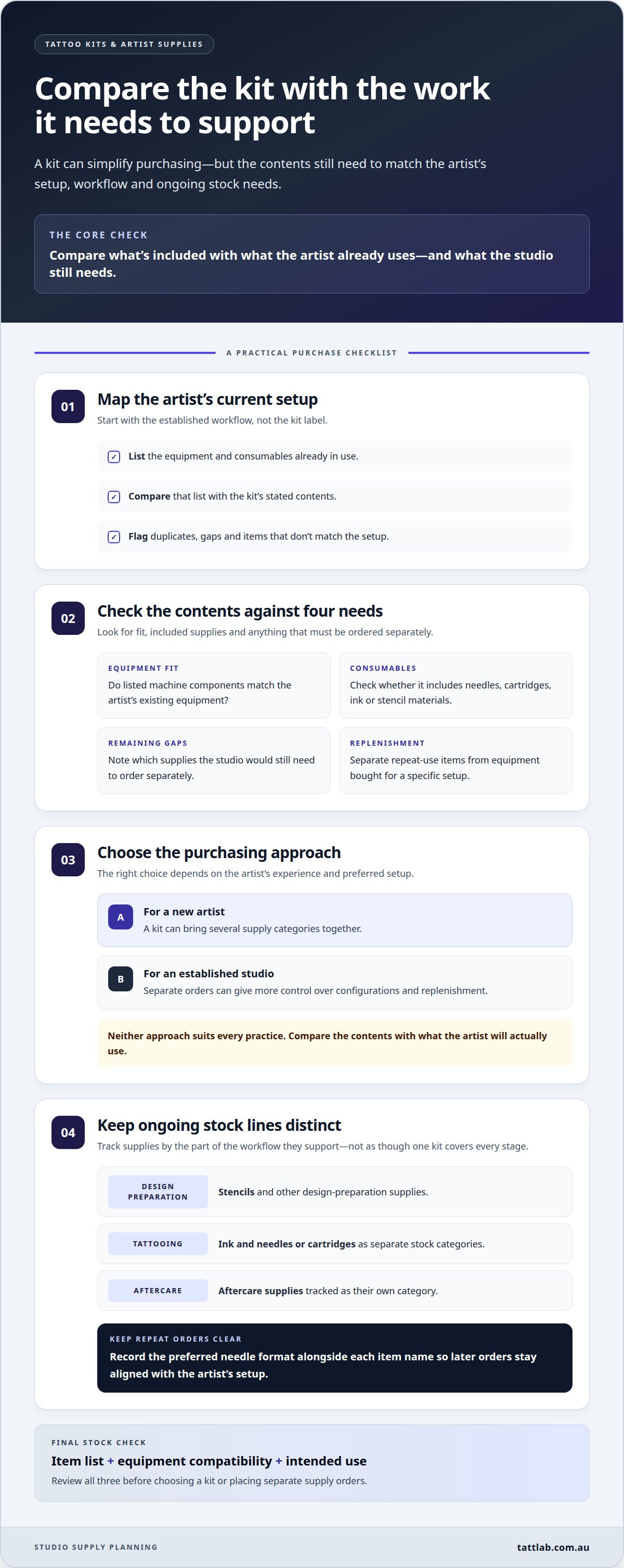
A tattoo kit can simplify purchasing, but its label alone doesn’t tell you whether the contents suit your studio. Start with the artist’s established workflow. List the equipment and consumables already in use, then compare them with each kit’s stated contents. This helps identify duplicates, gaps and items that don’t match the setup.
For a new artist, a kit can bring several categories together. An established studio may prefer separate orders for more control over configurations and replenishment. Neither approach suits every practice. Compare the kit’s contents with what the artist will actually use.
- Match the setup: compare any listed machine components with the artist’s existing equipment.
- Review consumables: identify whether the kit includes needles, cartridges, ink or stencil materials.
- Spot gaps: note supplies the studio would still need to order separately.
- Plan replenishment: separate repeat-use items from equipment purchased for a specific setup.
Distinguish a starter purchase from an ongoing stock plan. A kit may organise an initial selection, while repeat orders should reflect actual studio use. For example, an artist who prefers traditional needles may need different items replenished from one who works with cartridges. Recording the preferred format alongside each item name helps keep later orders straight.
Artist supplies extend beyond a kit’s contents. Tattoo inks, stencils and aftercare are separate categories to consider across the workflow. Track them as distinct stock lines rather than assuming one kit covers every stage. This makes it easier to see what supports design preparation, tattooing and aftercare, then adjust orders as the studio’s needs become clearer.
Before choosing, compare the item list, equipment compatibility and intended use. A studio with an established setup may benefit more from ordering specific supplies than replacing familiar equipment with a broad kit. A newer artist can use the same review to see what the kit covers and what remains separate. Buy according to workflow and stated contents, not the word “kit” alone.
What are the best wholesale tattoo supply stores in Australia?
For an Australian studio, a suitable supplier should match its regular stock needs, equipment and ordering workflow. A studio focused on linework may prioritise round liners, while another may need a wider mix of needles, inks, stencil materials and aftercare. List the categories you reorder, then compare suppliers against that list rather than relying on a “best” label.
Product range matters because managing scattered orders can be harder. Check whether a supplier carries the categories your studio uses, such as traditional needles and cartridges or tattoo inks and stencil supplies. Then review product descriptions for the details you need to match items to your setup. Clear category labels help staff identify the right stock when preparing repeat orders.
For an Australian studio, the ordering process is another practical comparison point. Review the supplier’s delivery options, local collection arrangements and order information. These details affect replenishment planning, especially when a frequently used item is running low. Record each order’s product name, format and intended workstation to reduce mix-ups between similar supplies.
- Range: compare the product categories against your studio’s regular purchasing list.
- Compatibility: match needle or cartridge formats to the equipment already in use.
- Product information: look for descriptions that distinguish items clearly.
- Ordering workflow: consider how delivery or collection fits your replenishment routine.
“Wholesale” doesn’t mean the same purchasing terms at every supplier. Compare how each store supports your actual ordering pattern, from recurring consumables to occasional equipment needs. A studio placing one consolidated order may value range, while an artist replenishing a specific needle grouping may prioritise a clearly organised category. Compare your needs directly rather than assuming one supplier suits every practice.
Use your stock list to narrow the choice and create a repeatable purchasing process. Explore Australian tattoo supply options for the categories your studio needs.
Tatt Lab
Tatt Lab supplies Australian studios with tattoo products across several core categories, including tattoo aftercare, traditional needles, cartridges and tattoo inks. These supplies support different stages of a studio’s workflow. Once you’ve identified the products your team uses, you can organise your supply needs through a specialist retailer.
For example, consider your preferred needle format alongside the inks and aftercare you use regularly. Reviewing these categories together can make purchasing decisions more coherent without assuming every artist needs the same setup. Tatt Lab also offers round liners, round shaders and tattoo stencils for studios building a supply list around specific work.
Ready to plan supplies for your studio? Contact Tatt Lab to discuss your needs.
Make your next supply order with intention
Turn your studio’s purchasing priorities into a clear order plan. Decide which categories need replenishing, which products must fit your established workflow and what can wait until a later order. This connects each purchasing decision to the work your studio actually does.
For Australian studios sourcing wholesale tattoo supplies, Tatt Lab offers tattoo aftercare, traditional needles and cartridges. Build a supply list around your practice rather than buying by habit or adding items without a clear purpose. A focused plan can help maintain continuity as your studio’s needs evolve.
Contact Tatt Lab about wholesale supplies to take the next step for your studio. With a considered approach, you can build a supply routine that supports your work with greater clarity.
Frequently Asked Questions
What are the wholesale prices for tattoo machines, needles, inks and accessories in Australia?
There isn’t one wholesale price for machines, needles, inks and accessories. The total depends on the products and purchasing arrangement. When comparing wholesale tattoo supplies in Australia, group items by category and format so you’re comparing like with like. Assess equipment separately from recurring consumables, as they serve different purchasing needs. Use Australian-dollar totals and include delivery when planning a studio budget.
Which tattoo supply brands and products are available from Australian wholesalers?
Brand availability varies by supplier. Tatt Lab carries tattoo inks from Dynamic Color, Perma Blend, Intenze, World Famous and Tommy’s Starbrite, alongside traditional needles, cartridges, aftercare and tattoo stencils. Its needle range includes round liners, round shaders, magnums, curved magnums and long tapers. When purchasing, identify both the brand and product format to find supplies that fit your studio’s requirements.
What are the minimum order quantities and trade account requirements for Australian tattoo suppliers?
Wholesale purchasing at Tatt Lab is available to registered professional studios and medical clinics. Tatt Lab says studios can sign up for a wholesale account to receive 10% off its catalogue, plus additional benefits. This account suits businesses placing professional supply orders. The stated eligibility centres on registered studio or clinic status, rather than an individual consumer purchase.
Do Australian tattoo supply wholesalers offer bulk discounts, shipping and returns?
Shipping options depend on the supplier and destination. Returns are a separate consideration: eligibility may depend on the seller’s terms and the item’s condition. Include return handling when comparing purchases, especially for consolidated studio orders, and don’t assume a bulk order changes the return conditions.
How do Australian wholesale prices compare with importing tattoo supplies from overseas?
Compare an overseas order by its total payable amount, not just the listed item price. Account for currency conversion and international freight, then consider delivery timing and the practicalities of returning or replacing an incorrect item. Australian wholesale pricing can be assessed directly in A$, while overseas purchases may involve more variables in the final cost. Compare products and formats as well as totals before ordering.


Comments (0)
There are no comments for this article. Be the first one to leave a message!